Celebrity Rings
Taylor Swift's Engagement Ring: The Elongated Cushion Explained
Travis Kelce's choice of an antique elongated cushion for Taylor Swift put a rare, romantic diamond shape at the center of engagement ring culture — here is everything you need to know about it.
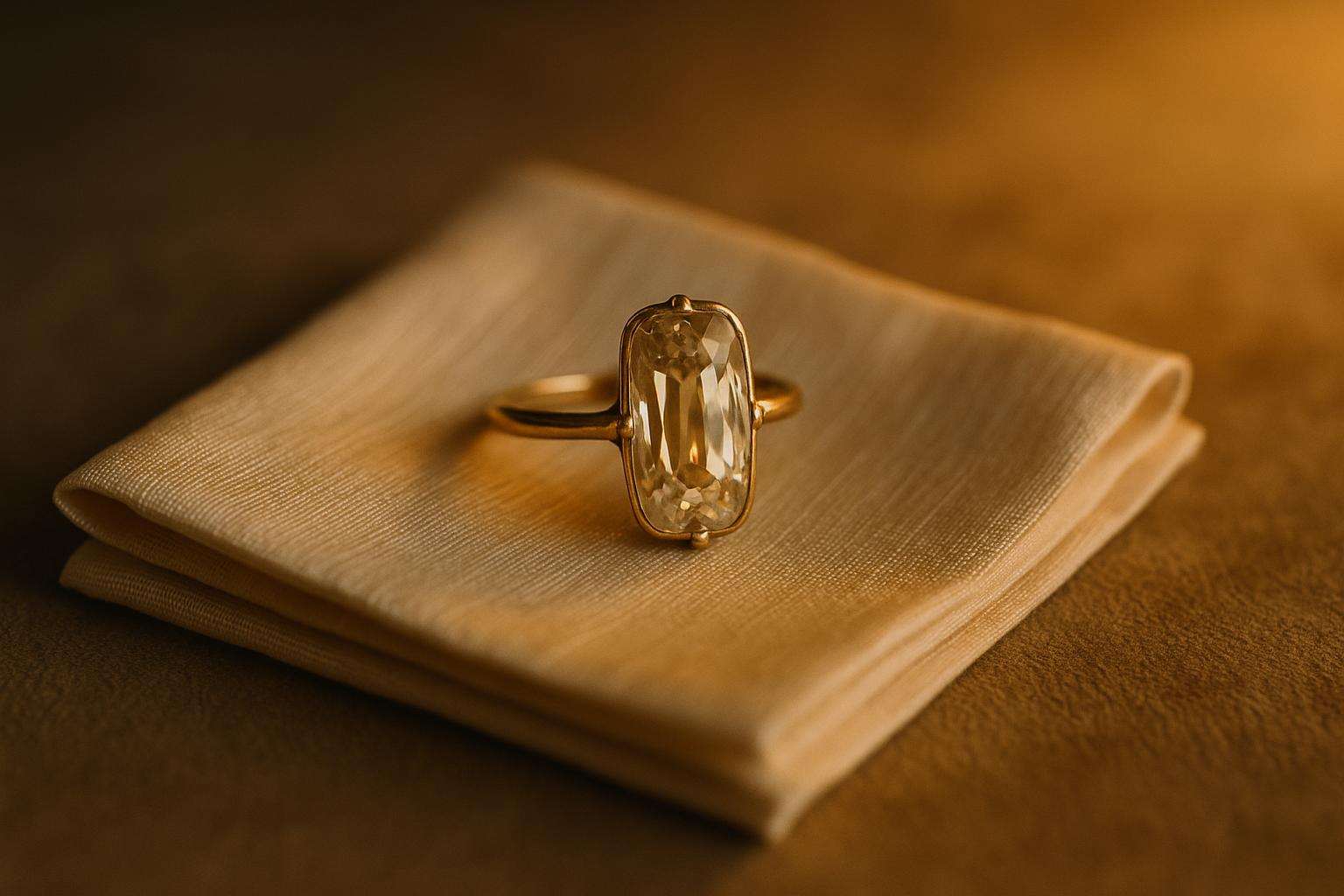
Taylor Swift's engagement ring from Travis Kelce is an antique elongated cushion-cut diamond — officially an old mine brilliant — estimated at 8 to 10 carats and set in 18-karat yellow gold by New York designer Kindred Lubeck of Artifex Fine Jewelry. The couple announced their engagement on August 26, 2025. The ring reignited consumer interest in the elongated cushion shape, which combines vintage romance with a flattering, finger-lengthening silhouette — and costs 25–30% less per carat than a round brilliant of equivalent grade.
What exactly is Taylor Swift's engagement ring?
When Travis Kelce proposed in a rose-filled garden at his Missouri property on August 26, 2025, the ring on Taylor Swift's finger sent gemologists and journalists to their magnifying loupes in near-simultaneous fascination. The reason: the center stone is not a modern oval, not a round brilliant, and not a contemporary cushion. It is an old mine cut diamond — a hand-fashioned antique shape that predates electric lighting, machined cutting tools, and the GIA grading system itself.
Kindred Lubeck, the New York goldsmith behind Artifex Fine Jewelry, designed the piece. Her studio is known for sculptural, hand-engraved work with an antique sensibility — exactly the aesthetic Swift pointed Kelce toward when she shared a video of Lubeck's portfolio roughly eighteen months before the proposal. According to Swift's own account, she had no idea at the time that Kelce would later commission Lubeck to create her ring. The coincidence became, as Swift put it, a kind of proof that he truly knew her.
The setting is 18-karat yellow gold with needlepoint prongs, ornate engraving, and accent diamonds that frame the center stone without overpowering it. The result is a ring that reads as a considered heirloom rather than a flex — which is part of why its cultural resonance has proven so durable in the months since the announcement.
How many carats is the ring, and what does it actually look like?
Because no GIA certificate for the stone has been made public, carat estimates rely on expert analysis of photographs and video — a method that is informative but inexact, especially for an old mine cut. The shape's characteristically high crown and deep pavilion can cause a stone to look smaller or larger than its carat weight suggests depending on viewing angle and lighting.
With that caveat stated, the independent assessments cluster meaningfully. Stephanie Gottlieb, founder and creative director of Stephanie Gottlieb Fine Jewelry in New York, estimated the stone at approximately 8 to 10 carats. Benjamin Khordipour of Estate Diamond Jewelry named it closer to 8 carats. The Clear Cut, a New York studio that specializes in engagement ring sourcing, placed the visible spread between 4 and 7 carats — a lower number that the firm attributed to the stone being “spready,” meaning its weight is distributed in a wide, shallow face rather than concentrated in depth. Daniela Tarantino of James Allen and Blue Nile estimated the total ring at 10 to 15 carats when accounting for accent stones alongside the center.
In terms of visual character, the stone displays the broad, slow flashes distinctive of antique cuts: less rapid-fire scintillation than a modern brilliant, more of a luminous, shifting glow. Experts who reviewed high-resolution images estimated the color at approximately F and the clarity at VS1 — grades that place it well into the exceptional category for a natural diamond of this vintage. The elongated outline — an L:W ratio that multiple sources estimate above 1.20 — gives the ring its distinctly modern-feeling finger coverage while the facet pattern keeps it anchored in another century entirely.
| Expert / firm | Carat estimate | Estimated value |
|---|---|---|
| Stephanie Gottlieb Fine Jewelry | 8–10 ct | Not stated |
| Estate Diamond Jewelry (Khordipour) | ~8 ct | Not stated |
| The Clear Cut | 4–7 ct (spread-adjusted) | Not stated |
| James Allen / Blue Nile (Tarantino) | 10–15 ct total ring | $750,000–$1,000,000 |
| Natural Diamond Council (Mobley) | Not stated | ~$750,000 |
| Fortune / general expert consensus | ~8 ct | ~$550,000 |
What is the elongated cushion cut, and why has it become the shape of the moment?
The elongated cushion is not a single standardized cut the way a round brilliant is. It is a family of cushion-shaped diamonds — defined by their softly rounded corners and pillow-like silhouette — where the stone's length-to-width ratio exceeds approximately 1.10, stretching the outline from square toward rectangular. The industry-standard range for what most jewelers consider a “true” elongated cushion runs from 1.15 to 1.35; ratios above 1.40 exist but are considerably rarer and carry higher bow-tie risk.
Within that family there are two meaningfully different optical personalities. A cushion brilliant — sometimes called a chunky-facet cushion — uses larger facets to produce broad, defined flashes of white light. A cushion modified brilliant, often called a crushed-ice cushion, adds extra facets beneath the girdle that scatter light into a glittering, water-like shimmer with no single dominant flash. Swift's old mine cut sits outside both modern categories (it predates them), but its large handcut facets and soft reflections put it closer in character to the chunky brilliant end of the spectrum.
The shape's current cultural moment predates Swift's engagement ring by several years but has been dramatically accelerated by it. Natural Diamond Council trend data and trade-level reports from Stuller both identified the elongated cushion as one of the three shapes with the most significant year-over-year growth heading into 2026 — alongside marquise and emerald cut. The reason buyers are drawn to it is the same reason Kelce may have been drawn to it for Swift: it occupies a persuasive middle ground between the oval's mainstream sleekness and the traditional cushion's vintage warmth, while delivering more finger coverage than a square cushion at the same carat weight.
From a value standpoint, the elongated cushion is also one of the more efficient shapes on the market. Because cushion cutting retains more rough diamond than round brilliant cutting, cushion cuts typically run 25–30% below equivalent rounds per carat, compared with 20–25% for ovals. A well-specified 1.5-carat elongated cushion in H color, VS2 clarity can be found at major retailers including Brilliant Earth and Blue Nile for substantially less than a round brilliant of the same grade. Our full diamond shapes guide compares size-per-carat and price across all ten major cuts.
Old mine cut vs. modern elongated cushion: what is the difference?
Most elongated cushion engagement rings on the market today are cut with modern tools to precise specifications. Taylor Swift's stone is something different: a surviving old mine cut, fashioned by hand between roughly the early 1700s and the late 1800s, in a period when diamond cutting was constrained by human skill, candlelight, and a strong incentive to preserve as much rough weight as possible.
GIA describes the old mine cut as having 58 facets, a characteristically small table (often under 53% of the stone's diameter), a high crown, a deep pavilion, and a large culet — the bottom facet, which in antique cuts is large enough to appear as a circle when you look down through the table. These proportions were not engineered for maximum light return. They were engineered for maximum weight retention from irregular rough crystals, which is why old mine cuts have more visual variety than any modern shape: no two are quite alike in outline, proportion, or the way they handle light.
The practical consequence for buyers is that old mine cuts cannot be evaluated against standard cushion proportion benchmarks the way modern stones can. There is no GIA cut grade. There is no industry-consensus depth percentage range. The evaluation is necessarily visual: you look at the stone in natural light, in artificial light, and in motion. The broad, slow, romantic flashes that characterize a well-preserved old mine cut — described by many gemologists as a “candlelit sparkle” — are either the aesthetic you want or they are not. There is no intermediate position.
For buyers drawn to this character who cannot source or afford an authentic antique stone, several contemporary cutters produce antique cushion reproductions — modern stones cut to old mine proportions with updated precision. Goodstone and Estate Diamond Jewelry are two sources that specialize in this category and offer certified examples.
Get the look: how to find an elongated cushion ring at your budget
A ring identical to Swift's is, by definition, unrepeatable — it is an antique stone of extraordinary size, paired with a one-of-a-kind hand-engraved setting. But the aesthetic of the ring is entirely accessible: an elongated cushion center stone in yellow gold, with soft vintage-inflected detailing. Here is how to approach it at different spend levels.
Choosing the right length-to-width ratio
For a ring that reads as elongated without looking stretched, target an L:W ratio between 1.15 and 1.30. Below 1.10, the stone looks closer to square and loses the finger-lengthening effect. Above 1.35, bow-tie risk increases — though elongated cushions are generally less bow-tie-prone than ovals or marquise cuts because their wider body distributes the shadow zone across a broader area. GIA does not assign a cut grade to cushion cuts of any shape, so proportion review and 360-degree video from retailers like Blue Nile, James Allen, or Brilliant Earth are your primary evaluation tools.
Color and clarity for cushion cuts
Cushion cuts — especially those with larger, chunkier facets — tend to retain body color more visibly than ovals. In yellow gold (the setting choice that best complements Swift's ring aesthetically), H or G color works well because the warm metal absorbs any faint yellow tint. In white gold or platinum, consider stepping up to G or F to keep the stone face-up white. For clarity, VS2 or better is generally recommended for cushion cuts above 1.5 carats to ensure an eye-clean appearance; VS1 or VS2 gives you meaningful assurance without the premium of FL or IF grades.
Natural vs. lab-grown
A natural elongated cushion in 1.5 to 2 carats, H color, VS2, in yellow gold, will typically run between $8,000 and $20,000 at an online retailer depending on exact proportions and certification. The equivalent lab-grown stone costs 60–80% less — often $2,500 to $5,000 for the same specification — making a 2-carat elongated cushion achievable on a moderate budget. Our budget guide walks through exactly what different spend levels buy, including shape-specific recommendations.
For antique or old mine cut stones specifically, Estate Diamond Jewelry and Goodstone maintain curated inventories with GIA color and clarity grading. Authentically antique stones above 3 carats require patience and a higher budget — expect to spend north of $30,000 for a well-preserved natural old mine cut in that size range.
The elongated cushion's appeal is finally being recognized at the scale it deserves: a shape with genuine historical depth, flattering proportions, and meaningful cost advantages over the round brilliant. Whether you are drawn to it because of Taylor Swift or because you have always loved the romantic character of antique diamonds, the buying framework is the same — proportion, facet style, color, clarity, and a setting that lets the stone speak rather than competing with it.
Frequently asked
What kind of ring did Travis Kelce give Taylor Swift?
Travis Kelce proposed to Taylor Swift on August 26, 2025, with an antique elongated cushion-cut diamond — specifically described by experts as a brilliant-cut old mine diamond — set in an 18-karat yellow gold band. The ring was custom-designed by Kindred Lubeck of Artifex Fine Jewelry, a New York City studio known for its handcrafted, vintage-inspired work. The setting features needlepoint prongs, accent diamonds, and hand-engraved details that give the piece a distinctly artisanal, heirloom quality. Swift has said she had shown Kelce a video of Lubeck's work a year and a half before the proposal without realizing he would commission the designer for her ring.
How many carats is Taylor Swift's engagement ring?
Multiple independent gemologists estimate the center stone at 8 to 10 carats, though some assessments range from 4 to 15 carats depending on methodology. Stephanie Gottlieb, founder of Stephanie Gottlieb Fine Jewelry, placed the weight at approximately 8 to 10 carats. Benjamin Khordipour of Estate Diamond Jewelry estimated closer to 8 carats. Because the stone is an old mine cut — a hand-fashioned antique shape with a high crown and large culet that distributes weight differently than modern cuts — its face-up spread can appear larger than the carat number alone would suggest. Daniela Tarantino of James Allen and Blue Nile estimated the total ring at 10 to 15 carats, accounting for accent stones. No official GIA report has been published for the stone.
How much is Taylor Swift's engagement ring worth?
Jewelers who reviewed photographs and video of the ring estimate its value at $400,000 to $1.2 million, with the most-cited figure landing around $550,000. Fortune reported this estimate from a jewelry specialist on the day of the engagement announcement. Grant Mobley of the Natural Diamond Council placed the value higher, at approximately $750,000, citing the stone's exceptional clarity and the rarity of a large, well-preserved old mine cut of this size. The wide range reflects the genuine difficulty of pricing an antique stone without a lab report: old mine cuts are not valued by the same per-carat tables as modern brilliant cuts, and the handcrafted setting by Kindred Lubeck adds further premium for artisanal workmanship.
What is an elongated cushion cut diamond, and how does it differ from an oval?
An elongated cushion cut is a cushion-shaped diamond with a rectangular outline and softly rounded corners, typically defined by a length-to-width ratio above 1.10 — the industry standard range is 1.15 to 1.35. It shares the cushion's signature pillow-like softness and romantic character, while adding finger coverage closer to an oval. The key differences from an oval: cushion corners are rounded rather than pointed, the sparkle pattern depends on facet style (brilliant chunks or crushed-ice), and GIA does not issue a cut grade for either shape. On price, elongated cushions typically run 25–30% below equivalent round brilliants, comparable to ovals which run 20–25% below rounds. For buyers who find ovals too mainstream, the elongated cushion is the closest alternative in terms of finger coverage and visual size.
What is an old mine cut diamond, and why is it special?
An old mine cut is an antique diamond cutting style dominant from roughly the early 1700s through the late 1800s, predating electric lighting and mechanized cutting. Each stone was shaped entirely by hand, which is why surviving examples vary in symmetry and proportion. GIA describes the old mine cut as having a squarish outline, small table, high crown, deep pavilion, and a large culet — the flat or pointed bottom facet visible from above. These proportions create broad, slow flashes of light often described as a “candlelit glow” rather than the rapid-fire scintillation of a modern brilliant. Because old mine cuts must be sourced from antique jewelry rather than new rough, large examples above 5 carats are genuinely rare. GIA grades old mine cuts for color, clarity, and carat weight but does not assign a cut grade.
Can I get an elongated cushion engagement ring on a normal budget?
Yes — the elongated cushion is one of the most budget-friendly elongated shapes available. Natural elongated cushions typically cost 25–30% less per carat than round brilliants of the same color and clarity grade, and a lab-grown elongated cushion carries a further discount of roughly 60–80% versus natural. At a $5,000 budget, a well-graded 1.5-carat lab-grown elongated cushion in H color, VS2 clarity is achievable at major online retailers. At $10,000 to $15,000, a 2-carat natural elongated cushion in the same quality range is realistic. Our budget guide breaks down exactly what different spend levels buy across shapes and stone types, including cushion-specific recommendations by tier.