Diamonds & Stones
Opal, Moss Agate & Alternative Stones for Engagement Rings
The most-searched trend stones ranked by beauty, durability, and daily-wear reality — including the ones gemologists warn you about.
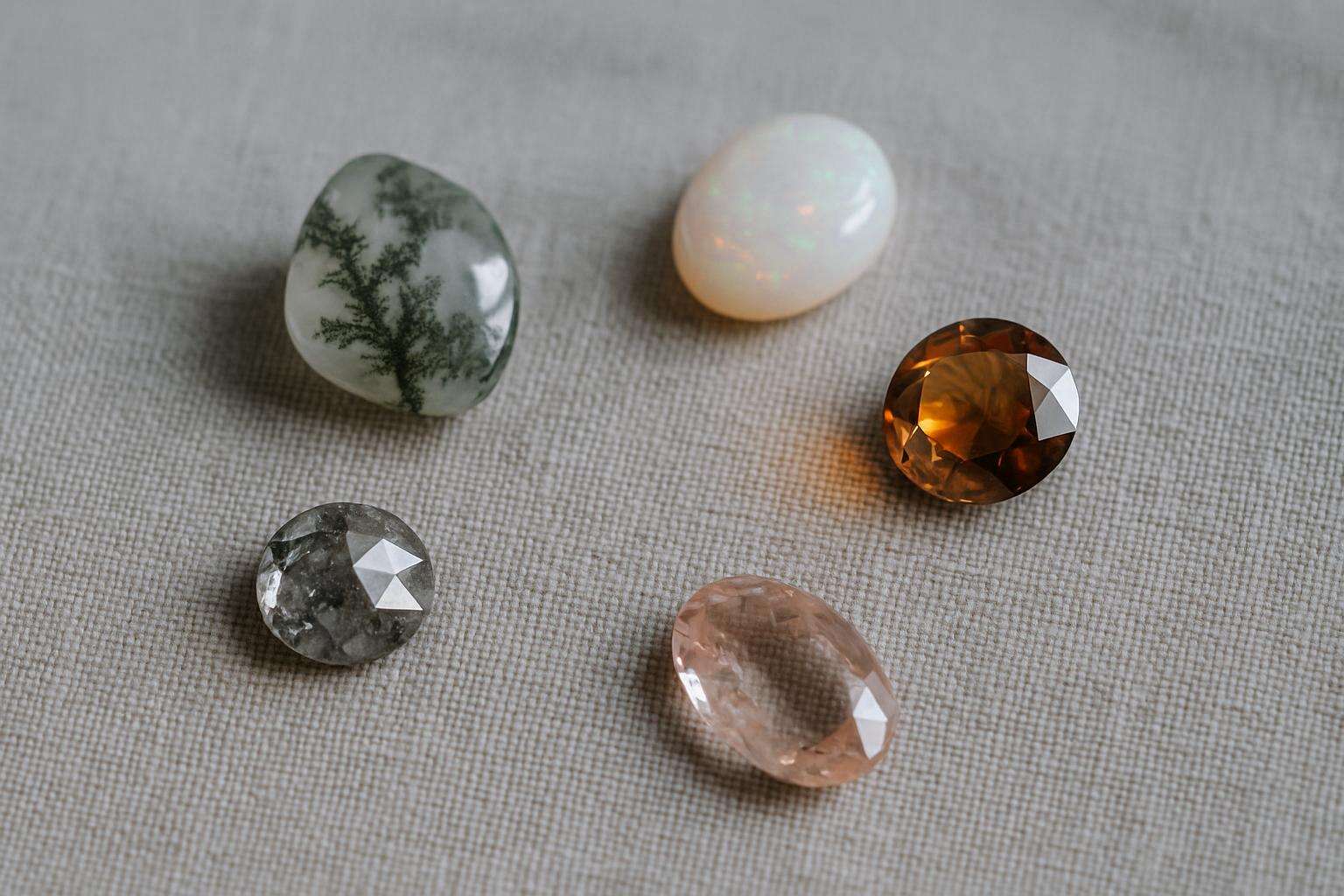
Moss agate (19K monthly searches) and opal (10K monthly searches) are two of the most-searched alternative engagement ring stones in 2026 — but search volume tells you what people want, not how a stone holds up after a decade on a working hand. This guide ranks moss agate, opal, alexandrite, salt-and-pepper diamond, and morganite by the three real durability dimensions — Mohs hardness, toughness, and stability — and gives you the honest picture on each stone before you commit.
Every few years, a stone breaks out of the collector and custom-jeweler world and lands in the mainstream search universe. In 2026, that stone is moss agate. Its 19,000 monthly searches place it alongside far more established categories, and its appeal is immediately legible: each stone looks like a small painting — branching green mineral inclusions frozen inside a semi-translucent silica matrix, every specimen genuinely unique. Opal has been pulling comparable volume for longer, powered by its play-of-color that no other stone replicates. Alexandrite, salt-and-pepper diamond, and morganite round out the category that jewelers now call alternative center stones.
The problem is that aesthetic beauty and search volume are not proxies for durability. A stone that photographs magnificently on a model's hand in a studio can fail in the hands of someone who works with their hands, commutes, exercises, and never once thinks about removing their ring. Before choosing any alternative stone, you need to understand the three independent dimensions of gemstone durability: hardness (resistance to scratching, measured by the Mohs scale), toughness (resistance to chipping or fracturing from impact), and stability (resistance to chemical and thermal stress). Mohs hardness is the most cited number, but it tells only part of the story. A stone with a high Mohs rating and poor toughness — like topaz at Mohs 8 with a pronounced cleavage plane — can split from a single well-angled blow that a softer but cleavage-free stone would survive. Conversely, a stone at Mohs 6.5 with no cleavage planes may outperform a Mohs 8 stone in certain real-world wear scenarios.
What follows is a stone-by-stone assessment, grounded in gemological properties and current market realities, written for someone buying a ring they intend to wear every day for the rest of their life.
Is Moss Agate Actually Durable Enough for Daily Wear?
Moss agate is a variety of chalcedony — a microcrystalline form of quartz — not a true agate in the strict mineralogical sense, though the trade name is universal. The branching green formations inside the stone are mineral inclusions (chlorite, manganese, or iron oxides) that grew along fracture planes over geological time, creating patterns that look unmistakably organic. Every stone is one of a kind.
On the Mohs scale, moss agate sits at 6.5–7. Gemologists conventionally use Mohs 7 as the minimum threshold for daily-wear stones, because household dust and grit contain quartz particles rated at approximately Mohs 7. A stone softer than quartz will accumulate surface scratches from normal environmental contact over years. Moss agate rides right at that boundary. Gem Breakfast's durability guide and the International Gem Society both rate moss agate as "Good" for daily wearability — workable, not ideal.
Here is where moss agate's chalcedony structure becomes a meaningful argument in its favor: it has no cleavage planes. Gemstone cleavage refers to the crystallographic directions along which a stone can split under impact — emerald has it, topaz has it severely, diamond has four directions of perfect cleavage despite its Mohs 10 rating. Chalcedony is composed of millions of interlocked microcrystals with no preferred split direction, meaning an impact that would cleave an emerald or topaz crystal will not cleave moss agate. For a stone worn on a hand that regularly contacts door handles, steering wheels, and countertops, the absence of cleavage is a practical advantage that the raw Mohs number does not capture.
The honest daily-wear guidance for moss agate: wear it without concern for office work, light cooking, and casual daily activities. Remove it before the gym, gardening, construction work, or any activity with hard impact risk. Store it separately from diamonds and moissanite (Mohs 9–10), which can scratch it. Avoid ultrasonic cleaners, which can stress the dendritic inclusions. Clean at home with mild dish soap, lukewarm water, and a soft brush. A bezel setting — which encircles the stone's girdle with a metal wall — provides the most protection against both impact and abrasion for stones in this hardness range.
On price: in 2026, complete moss agate engagement rings in solid 14k gold run roughly $900–$2,000, with 18k gold pushing to $1,400–$2,800 and platinum starting around $1,800. The stone itself typically costs $5–$300 per carat; the metal accounts for most of the total price. That positions moss agate 65–75% below The Knot's reported 2024 average engagement ring spend of $5,200 — a structural price difference, not a promotional discount.
What Does the GIA Actually Say About Opal Engagement Rings?
Opal is one of the most visually arresting stones in existence. The play-of-color — the shifting spectral flashes that move as the stone rotates in light — results from the diffraction of light through a microstructure of stacked silica spheres. No two opals display the same pattern. Fine Australian white opals, black opals from Lightning Ridge, and boulder opals each have distinct characters. The aesthetic case for opal is strong.
The durability case is not. Opal ranges from 5.5 to 6.5 on the Mohs scale — clearly below the quartz threshold — and contains between 3% and 20% water by weight. That water is responsible for the play-of-color, but it also creates vulnerabilities that no other stone in this guide shares. Rapid temperature changes, prolonged dry environments, and repeated exposure to direct sunlight can cause moisture to migrate out of the stone, leading to crazing — a network of fine surface fractures that permanently damages the play-of-color and the stone's structural integrity. This process is irreversible.
Nathan Renfro, senior manager of colored stone identification at the GIA, addressed opal engagement rings directly when speaking to The Knot: opal requires special care and is generally appropriate for careful everyday wear, not rough daily use. Taylor & Hart, a respected custom-ring house, lists opal explicitly among stones they caution clients about for center-stone use, citing scratching, crazing, and impact damage as the primary concerns. Several fine jewelers recommend opal as an accent stone — surrounding a more durable center — rather than the center stone itself, precisely because the accent position reduces direct impact exposure.
If you are committed to an opal center stone, the guidance is specific: choose a solid Australian opal — not a doublet (opal layer bonded to a backing material) or triplet (opal layer sandwiched between backing and glass cap), both of which are more vulnerable to delamination and moisture penetration. Use a bezel setting, which encircles the stone and provides maximum impact and abrasion protection. Remove the ring before exercise, cleaning, swimming, and any task involving hot water or harsh chemicals. Do not use ultrasonic or steam cleaners. Store it away from heat and dry conditions.
The opal engagement ring is not a wrong choice. It is a choice that requires genuine behavioral commitment from the wearer. Buyers who remove their rings routinely and approach wear with care can own a beautiful opal ring for decades. Buyers who wear their ring straight through every activity without thought are likely to be disappointed within a few years.
| Stone | Mohs Hardness | Cleavage / Toughness | Special Stability Concerns | Daily-Wear Rating | Approx. Ring Cost (14k Gold) |
|---|---|---|---|---|---|
| Salt-and-pepper diamond | 10 | 4 cleavage directions; excellent overall | Dense inclusions can increase chip risk at edges under sharp impact | Excellent | $1,500–$6,000+ |
| Alexandrite (lab-grown) | 8.5 | Good; no major cleavage weakness | None under normal conditions | Excellent | $800–$2,500 |
| Morganite | 7.5–8 | Directional cleavage (beryl); bezel recommended | Avoid ultrasonics, chlorine, strong chemicals | Good with care | $600–$2,000 |
| Moss agate | 6.5–7 | No cleavage; good toughness | Avoid ultrasonics; remove before hard impact activities | Good with care | $900–$2,000 |
| Opal | 5.5–6.5 | No cleavage; but brittle and shock-sensitive | Moisture-sensitive; crazing risk from heat/dry environments | Careful wear only | $700–$3,000+ |
What Makes Alexandrite So Expensive — and Is Lab-Grown the Answer?
Alexandrite is a color-change variety of chrysoberyl — a rare mineral species distinct from both corundum (sapphires and rubies) and beryl (emeralds, morganite, aquamarine). Its defining characteristic is a genuine shift in body color depending on the light source: typically green to teal in daylight, shifting toward raspberry to purplish red under incandescent light. The effect is caused by trace chromium in the crystal structure, which absorbs wavelengths at the boundary between red and green, producing different dominant color perceptions under different light spectra. For gemological classification, a stone must show at least 30% color change to qualify as true alexandrite; lesser color change classifies the stone as color-change chrysoberyl.
At Mohs 8.5, alexandrite is one of the most durable alternative stones available. It has good toughness with no prominent cleavage weakness, making it genuinely suitable for continuous daily wear. The only caveat is that a sharp blow at an unlucky angle can chip any stone, and a protective prong configuration or bezel setting remains advisable for active wearers.
Natural fine alexandrite is extraordinarily rare. The original Russian deposits from the Ural Mountains — the source of the most coveted material, which displayed a vivid green-to-red shift — are largely exhausted. Brazil's Hematita mines supply most current commercial material, though yields are inconsistent. Fine natural stones over one carat with strong color change trade at $5,000–$30,000 per carat at retail, according to current Gemval pricing data. Russian-origin material commands premiums at the high end of that range and beyond.
Lab-grown alexandrite is the rational answer for most engagement-ring buyers. It is chemically, physically, and optically identical to natural chrysoberyl — grown by pulling a crystal from a melt using the Czochralski or flux method, not coating or staining another material. The color-change phenomenon is produced by the same chromium chemistry as in natural stones; it is structural and permanent, not a coating that fades. Lab-grown alexandrite retails at approximately $300–$600 per carat, making a complete engagement ring achievable for $800–$2,500 in 14k gold. Brilliant Earth offers lab-grown alexandrite in multiple cuts; Capucinne and Esdomera are among the specialist retailers with strong selections. Always confirm you are purchasing genuine lab-created chrysoberyl — not a simulant like color-change garnet or synthetic spinel marketed under the alexandrite name. For natural stones, insist on a GIA or AGL certificate confirming species, origin, and treatment status.
Salt-and-Pepper Diamonds: All the Drama, All the Durability
Salt-and-pepper diamonds resolve the durability concern entirely while delivering the nontraditional aesthetic that drives most searches for alternative stones. They are genuine earth-mined diamonds — Mohs 10, the hardest known material — with heavy visible inclusions that the conventional grading system would penalize severely but that define their entire visual character. The white or light inclusions (clouds, pinpoints, feathers) are the "salt"; the black carbon inclusions are the "pepper." The full spectrum runs from nearly opaque milky white through soft gray stones with black scatter patterns to crisp "galaxy" stones with a transparent background and high-contrast dark inclusions.
Because the GIA's standard 4Cs framework does not translate meaningfully to material where inclusions are the point rather than a defect, Gem Breakfast and other authorities note that salt-and-pepper diamonds do not receive standard GIA grading reports. Buyers should request detailed multi-angle photographs and, where possible, provenance documentation. Canadian and Indonesian (Kalimantan) material is generally considered more traceable; material from Russia has faced buyer caution since 2022 sanctions.
Two named jewelers have become the recognized anchors of the category in the United States. Catbird, the Brooklyn-based fine jeweler, works with conflict-free material, uses over 95% recycled metals and diamonds, and prices salt-and-pepper rings from approximately $2,085 (a rose-cut solitaire in 14k yellow gold) to $3,670 for a pavé-accented halo design. Alexis Russell, based in Buffalo and founded in 2005, hand-crafts every piece in their studio in recycled gold with ethically sourced, untreated stones; their custom program starts around $2,000. Both brands work in rose-cut, kite, shield, and elongated pear formats — cuts that maximize the visual character of each stone's unique inclusion pattern.
On price: mid-range salt-and-pepper material with attractive inclusion patterns retails at $400–$1,500 per carat — a fraction of colorless diamond pricing, while delivering the same physical durability that makes a diamond center stone the conventional default. A 4-carat salt-and-pepper stone in a completed ring might cost approximately $10,000; a 4-carat colorless diamond ring of comparable quality would exceed $40,000.
Morganite: The Beryl Family's Most Practical Alternative
Morganite is pink-to-peach-orange beryl, colored by manganese, sharing its mineral family with aquamarine and emerald. At Mohs 7.5–8, it sits above the quartz threshold and is genuinely suitable for daily wear in a thoughtful setting. Unlike its beryl cousin emerald — which is typically heavily included and fracture-filled, demanding significant maintenance discipline — morganite is frequently eye-clean, widely available in larger sizes at accessible prices, and requires only straightforward care: mild soap and warm water at home, avoidance of ultrasonic and steam cleaners (vibration risks for stones with any directional cleavage), and removal before handling strong household chemicals or swimming in chlorinated pools.
Morganite rose to mainstream engagement-ring prominence through the 2010s, driven substantially by its visual harmony with rose gold settings — the warm peachy-pink of the stone and the warm tint of rose gold are mutually flattering in a way that white metal can occasionally undercut. In 2026, yellow gold has reasserted itself as the dominant alternative-metal trend, and morganite's affinity for warm metals gives it a second aesthetic moment. It typically retails at $50–$300 per carat, making it possible to set a visually large oval or cushion-cut center stone within a modest total budget — one of the most accessible price-to-size propositions in the alternative-stone market.
The durability note to communicate clearly: beryl has directional cleavage. It is less pronounced than diamond's four cleavage directions, but it means the stone is best served by a bezel or six-prong setting rather than a minimal two-prong or tension setting. Our colored gemstone guide covers morganite, aquamarine, sapphire, and ruby in greater depth, including care protocols and price-per-carat data for each species. The diamond 4Cs guide provides the grading framework against which all these stone decisions are ultimately made, since the 4Cs vocabulary is the baseline literacy for understanding any center stone comparison.
How to Choose Between These Stones
The honest framework: start with your lifestyle, not your aesthetic preference. If you never remove your jewelry, you need a stone at Mohs 8 or above — alexandrite (natural or lab-grown) or salt-and-pepper diamond are your alternatives. If you are a disciplined ring-remover who treats jewelry with care, moss agate and morganite open up. If you understand that opal requires the most maintenance commitment of any stone in this guide and accept that willingly, an opal ring can be beautiful and lasting with the right setting and habits.
The second variable is provenance and ethics. Salt-and-pepper diamonds from Catbird and Alexis Russell are conflict-free and set in recycled gold. Lab-grown alexandrite has essentially no mining footprint. Moss agate is abundantly available with a low extraction impact. Opal from Australian mines is generally well-regulated. These are meaningful distinctions if sustainable sourcing matters to your decision. For deeper treatment of that topic, see our guide to conflict-free and ethical stones.
The final variable is budget. Every stone in this guide — including salt-and-pepper diamond — is available at a fraction of colorless natural diamond prices. Moss agate in 14k gold is achievable under $1,500. Lab-grown alexandrite in 14k gold under $2,000. Salt-and-pepper diamond under $3,000 for a genuinely striking stone. Morganite in 14k gold under $1,500. These are not compromise choices. They are different choices, each with a distinct visual identity, origin story, and set of trade-offs that you now have the information to weigh honestly.
Frequently asked
Is moss agate durable enough for an engagement ring?
Moss agate scores 6.5–7 on the Mohs hardness scale — below the Mohs 7 quartz threshold that gemologists use as the daily-wear minimum. That means airborne silica dust can technically scratch the surface over years of constant contact. However, moss agate's chalcedony structure gives it one key advantage over many harder stones: it has no cleavage planes, so it cannot split from a well-angled impact the way emerald or topaz can. The practical assessment from the International Gem Society is "Good" wearability — suitable for daily office and social wear, but worth removing before gym sessions, gardening, or anything involving hard impacts. A bezel or sturdy four-prong setting significantly extends the stone's service life. If you love the look, moss agate is a reasonable choice with realistic expectations; if you want a low-maintenance ring that needs zero thought, choose a stone at Mohs 8 or above.
Can you wear an opal engagement ring every day?
With meaningful caveats. Opal sits at 5.5–6.5 on the Mohs scale — below the quartz threshold, which means it will accumulate surface scratches from everyday dust and contact over time. More critically, opal contains up to 20% water by weight, and rapid temperature changes or prolonged dry conditions can cause the stone to lose moisture and develop crazing (a network of tiny surface fractures). Nathan Renfro, senior manager of colored stone identification at the GIA, told The Knot that opal requires special care and is generally appropriate for careful everyday wear, not rough daily use. Many bench jewelers recommend opal as an accent stone rather than a center stone for this reason. If you choose an opal center stone, select a solid Australian opal (not a doublet or triplet), use a bezel or halo setting for protection, and remove the ring before exercise, cleaning, swimming, or exposure to extreme heat or dry air.
What is moss agate, exactly — is it really a stone?
Moss agate is a variety of chalcedony, which is a microcrystalline form of quartz. It is not technically a true agate in the strict mineralogical sense, but the name is used consistently in the trade. The green fern-like or branching patterns inside the stone are not plant matter — they are mineral inclusions, typically chlorite, manganese oxides, or iron oxides, that formed branching patterns over geological time inside a semi-translucent silica matrix. Every stone has a unique internal landscape, which is a primary part of the appeal: no two moss agate engagement rings will ever look identical. The stone is mined commercially in India, the United States (Montana is a notable source), and Brazil. Premium Montana moss agate with vivid green patterning can command higher prices than standard commercial material.
How rare is alexandrite, and is lab-grown worth considering?
Natural gem-quality alexandrite with strong, balanced color change — green in daylight, red-to-raspberry under incandescent light — is genuinely rare, ranking among the most coveted collector gemstones in the world. The original Russian deposits from the Ural Mountains are largely exhausted; today most natural material comes from Brazil's Hematita mines, though supply is inconsistent and most stones are small. Fine natural alexandrite over one carat with good color change trades at $5,000–$30,000+ per carat. Lab-grown alexandrite is chemically and optically identical to natural chrysoberyl, shares the same Mohs 8.5 hardness, and produces the same color-change effect — at $300–$600 per carat. For an engagement ring where daily-wear beauty is the goal, lab-grown alexandrite is an exceptionally strong value. Always request independent certification (GIA or AGL for natural stones) to avoid simulants like color-change corundum or garnet sold under the alexandrite name.
What is a salt-and-pepper diamond — is it a real diamond?
Yes. Salt-and-pepper diamonds are genuine, earth-mined diamonds with heavy visible inclusions — white or light inclusions ("salt") and black carbon inclusions ("pepper"). They retain diamond's Mohs 10 hardness and are every bit as durable as a colorless diamond. What sets them apart is aesthetic: the inclusions, which would suppress the value of a conventional stone, are the entire point. Every salt-and-pepper diamond is unique. The GIA does not issue standard grading reports for these stones because the 4Cs framework does not translate meaningfully to material where inclusions define the look rather than detract from it. Reputable jewelers such as Catbird and Alexis Russell work exclusively in conflict-free, traceable material. Pricing is substantially below colorless diamonds: well-chosen material runs $400–$1,500 per carat at retail, compared to $4,500–$7,000 per carat for a comparable natural colorless stone.
Which alternative stones are safest for long-term daily wear?
Ranked by overall durability (combining hardness, toughness, and stability): alexandrite (Mohs 8.5, very good toughness, no special care) is the strongest daily-wear alternative stone in this group. Salt-and-pepper diamond (Mohs 10) is as durable as any colorless diamond. Morganite (Mohs 7.5–8, beryl family) is acceptable with care — avoid ultrasonics and strong chemicals, use a bezel or six-prong setting. Moss agate (Mohs 6.5–7) is workable for light daily wear with protective settings, though it sits below the quartz threshold and will show wear over years. Opal (Mohs 5.5–6.5) is the most challenging: softer, water-sensitive, and prone to crazing under thermal stress — best for careful wearers in a protective setting, or used as an accent rather than a center stone.
How much does a moss agate engagement ring cost compared to a diamond ring?
A complete moss agate engagement ring in solid 14k gold typically runs $900–$2,000 in 2026; 18k gold pushes that to $1,400–$2,800, and platinum starts around $1,800. The loose stone itself — the moss agate — typically costs $5–$300 per carat, meaning the metal accounts for most of the price. By contrast, The Knot's 2024 Real Weddings Study reported an average engagement ring spend of $5,200, almost entirely for the center diamond. A moss agate ring runs 65–75% below that average, while offering a one-of-a-kind natural landscape in the stone that a colorless diamond center cannot match. The savings are structural, not promotional: moss agate is genuinely abundant and inexpensive to mine compared to gem-quality diamond rough.