Diamonds & Stones
Best Diamond Shapes That Look Bigger Per Carat (2026)
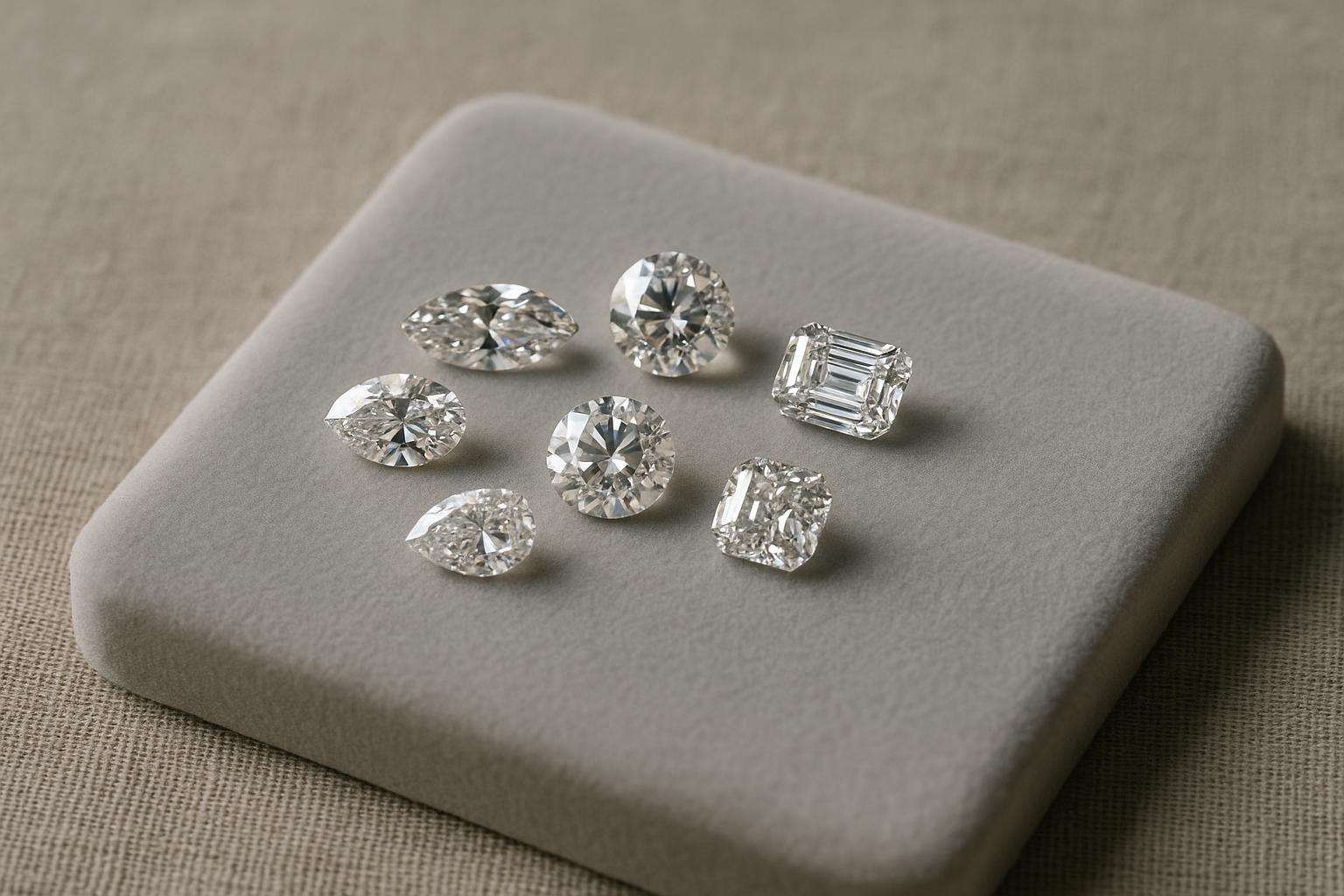
Carat weight measures mass, not surface area — the right shape can make your diamond appear 15% larger without spending a cent more.
face-up size per caratbiggest looking diamond shapediamond shape price comparisonelongated diamond shapesbow-tie effect guide2026 shape trends
The quick verdict
Marquise delivers the most face-up surface area per carat of any shape — about 15% more than a round brilliant — and costs 26% less. Oval and pear rank second, each adding roughly 8% face-up spread at 28–33% below round pricing. All three require per-stone video inspection to manage the bow-tie shadow effect.
- Best overall
- Marquise — Largest face-up area per carat of any commercially available shape — approximately 15% more surface spread than a round brilliant — at 26% lower per-carat cost. The elongated silhouette also visually lengthens the finger. Manageable bow-tie risk with the correct 1.75–2.25 L:W ratio and Excellent symmetry grade.
- Best value
- Pear — Approximately 8% more face-up area than a round brilliant of identical weight, at 33% below round per-carat pricing — the strongest combination of face-up advantage and price discount among the top three elongated shapes.
- Best for Maximum size with minimal bow-tie risk
- Elongated Radiant — Hybrid brilliant-step faceting distributes light across a broader zone, suppressing defined bow-tie bands in most well-cut examples. Faces up larger than a square cushion or princess, at 34% below round pricing, with lower optical risk than oval or marquise.
How we evaluated
Shapes are ranked by their documented face-up surface area advantage relative to a round brilliant of equal carat weight, cross-referenced with per-carat pricing data from major online retailers verified in June 2026. Face-up size data draws from the VRAI Diamond Size Chart, International Gem Society shape guides, and the Fascinating Diamonds marquise size comparison. Pricing benchmarks use a 1-carat J/SI1 natural diamond at Blue Nile as the baseline, consistent with the diamonds.pro shape pricing survey. Bow-tie risk assessments reference GIA Gems & Gemology Fall 2024 research on oval, pear, and marquise proportions, and the Goodstone and Labrilliante bow-tie effect guides. Market share figures are from the Natural Diamond Council / Tenoris 2025 Report (4M+ transactions) and The Knot 2026 Real Weddings Study. No affiliate relationships influence rankings; this is a data-driven editorial comparison.
- Face-Up Surface Area Advantage. Documented percentage difference in face-up surface area versus a round brilliant of identical carat weight, based on average proportions for each shape.
- Price-Per-Carat Discount vs. Round. Average price discount relative to a round brilliant of equivalent grade (J/SI1 natural), using verified Blue Nile retail data as the market reference benchmark.
- Optical Quality and Bow-Tie Risk. Susceptibility to the bow-tie shadow effect, manageability of that risk through proportion selection, and any clarity premium required by the shape's facet architecture.
- Setting Versatility and Finger Coverage. Whether the shape's geometry allows standard solitaire, halo, and pavé settings, and the degree to which the shape's footprint flatters a range of finger types.
- Market Adoption and Resale Liquidity. Current market share and trend trajectory from verified industry data, as a proxy for the availability of the shape in secondary market resale scenarios.
Rating scale: Ratings are on a 1.0–5.0 scale reflecting face-up size advantage, value, and optical quality combined.
Last verified .
At a glance
| # | Name | Rating | Best for | Pricing |
|---|---|---|---|---|
| 1 | Marquise | 4.5 | Buyers prioritizing maximum face-up size on the hand, finger-elongating aesthetics, and below-round pricing who are willing to inspect individual stones carefully for bow-tie severity and select Excellent symmetry grades | Approximately 26% below round per carat. 1-carat natural marquise J/SI1 benchmark: ~$2,480 at major online retailers. Lab-grown equivalent: approximately 67% below natural pricing. |
| 2 | Oval | 4.5 | Buyers who want near-round brilliance with a demonstrable face-up size advantage and strong resale liquidity, and who will inspect individual stones for proportion compliance and bow-tie severity | Approximately 28% below round per carat. 1-carat natural oval J/SI1 benchmark: ~$2,440. Lab-grown equivalent: approximately 67% below natural pricing. |
| 3 | Pear (Teardrop) | 4.0 | Buyers who want an elongated shape with the strongest available price discount versus rounds, are open to an asymmetric silhouette, and will verify proportions and bow-tie severity via per-stone video | Approximately 33% below round per carat. 1-carat natural pear J/SI1 benchmark: ~$2,270. Lab-grown equivalent: approximately 67% below natural pricing. |
| 4 | Elongated Radiant | 4.0 | Buyers who want an elongated shape's face-up size benefit with the lowest bow-tie risk in the category, and prefer a cropped-corner silhouette to pointed ends | Approximately 34% below round per carat. 1-carat natural elongated radiant J/SI1 benchmark: ~$2,250. Lab-grown equivalent: approximately 67% below natural pricing. |
| 5 | Elongated Cushion | 3.5 | Buyers who want an on-trend elongated silhouette with maximum per-carat savings and minimal optical risk, particularly those buying lab-grown where the 40% shape discount stacks on top of the lab-grown price advantage | Approximately 40% below round per carat. 1-carat natural elongated cushion J/SI1 benchmark: ~$2,050. Lab-grown equivalent: approximately 67% below natural pricing. |
Marquise
Maximum face-up area per carat — the elongated brilliant that has the most finger presence of any shape
Editor's pick
The marquise cut produces the largest face-up surface area of any commercially available diamond shape — approximately 15% more visible spread than a round brilliant of identical carat weight. Where a 1-carat round brilliant measures roughly 6.5 mm in diameter, a 1-carat marquise in its optimal proportion range measures approximately 10 mm × 5 mm. That elongated footprint covers substantially more of the wearer's finger and creates a visual slimming effect on the hand that no other shape replicates as forcefully.
The marquise cut is a pointed ellipse with 56–58 brilliant facets, optimized for light return in a similar manner to the round brilliant but lacking a standardized GIA cut grade (no fancy shape receives one). The recommended length-to-width ratio is 1.75–2.25; ratios near 2.00 represent the sweet spot between dramatic elongation and structural proportion. Excellent symmetry is functionally non-negotiable: any asymmetry in the pointed tips causes the stone to appear tilted in its setting, and an uneven bow-tie shadow — one side darker than the other — is the inevitable result of poor symmetry grades.
The bow-tie effect is more pronounced in marquise than in any other elongated shape because the narrow, pointed silhouette concentrates light leakage into a tight central band. A severe bow-tie in a marquise is harder to visually ignore than in an oval precisely because the shape is narrower and the shadow spans a larger proportion of the face-up view. A well-cut marquise with excellent symmetry will still display a mild bow-tie, but scintillation — the rapid flash pattern as the stone moves — keeps it from being static and distracting. Per-stone 360-degree video inspection is the only reliable method to evaluate bow-tie severity before purchase.
Per-carat pricing runs approximately 26% below round brilliants of equivalent grade: about $2,480 versus $3,390 at the 1-carat J/SI1 natural diamond benchmark. The shape saw approximately 12% year-over-year growth in 2025 across diamond jewelry categories per the Natural Diamond Council, driven by younger buyers pairing it with bezel settings, east-west orientations, and minimal thin-band designs rather than traditional prong-and-cathedral mounts. Selena Gomez's marquise engagement ring was credited by trade press with contributing to renewed mainstream interest in the shape.
Strengths
- Largest face-up surface area per carat of any diamond shape — approximately 15% more than round
- 26% lower per-carat cost than round brilliants of equivalent grade
- Visually elongates and slims the finger more than any other shape
- Strong 2025–2026 trend trajectory — approximately 12% year-over-year growth in the U.S. market
- Lab-grown marquise availability makes 2-carat sizes attainable on moderate budgets
Weaknesses
- Highest bow-tie shadow risk of any elongated shape — per-stone video inspection is essential
- Excellent symmetry is non-negotiable; asymmetric tip alignment is immediately visible
- Pointed tips are structurally vulnerable in prong settings; V-prong or bezel protection is recommended
- No GIA cut grade available — proportion evaluation requires manual review of certificate dimensions
- Best for
- Buyers prioritizing maximum face-up size on the hand, finger-elongating aesthetics, and below-round pricing who are willing to inspect individual stones carefully for bow-tie severity and select Excellent symmetry grades
- Pricing
- Approximately 26% below round per carat. 1-carat natural marquise J/SI1 benchmark: ~$2,480 at major online retailers. Lab-grown equivalent: approximately 67% below natural pricing.
Source: Fascinating Diamonds — Do Marquise Diamonds Look Bigger? Size Comparison & Buying Guide · Visit Marquise
Oval
The round brilliant's closest rival in brilliance — with 8% more face-up spread and 28% lower price
Editor's pick
The oval cut is the most commercially significant of the elongated brilliant shapes — holding approximately 14–25% of U.S. engagement ring market share depending on the dataset surveyed — and for many buyers it represents the optimal balance of face-up size advantage, visual appeal, and manageable optical trade-offs. At 1 carat, an oval measures approximately 7.7 mm × 5.7 mm, producing roughly 8% more face-up surface area than the 6.5 mm round brilliant at equal weight. Visually, a 1-carat oval reads comparably to a 1.1–1.2-carat round on the hand — a perceptible difference at no extra cost.
The oval cut's 57–58 brilliant facets mirror the round brilliant's light-performance architecture closely, producing near-identical scintillation patterns that make the oval one of the most optically expressive fancy shapes available. It does not carry a GIA cut grade — none of the fancy shapes do — but proportion guidance is well-established: the optimal length-to-width ratio sits between 1.35 and 1.50. Ratios below 1.35 produce a fat, nearly round appearance that sacrifices the elongation benefit; ratios above 1.50 elevate bow-tie risk substantially, and stones above 1.55 frequently display severe shadowing that meaningfully reduces brilliance.
Depth percentage for ovals should fall between 57% and 66%, with table percentages of 53–64%. Outside those ranges, light performance deteriorates in ways that are visible without magnification. The IGI began incorporating bow-tie considerations into its fancy-shape cut grades in September 2022, providing some additional grading context for IGI-certified stones, though no lab assigns a separate bow-tie severity score. The practical guidance remains the same: 360-degree video inspection of the individual stone under varied lighting before purchase.
Per-carat pricing sits approximately 28% below round brilliants of equivalent grade — roughly $2,440 versus $3,390 at the 1-carat J/SI1 natural benchmark. The oval's mainstream popularity relative to other elongated shapes means its secondary market liquidity is substantially better than the marquise or pear, which may matter for buyers considering long-term resale value. The Natural Diamond Council's 2025 data shows the oval at approximately 14% of natural diamond engagement ring sales; The Knot's 2026 data shows ovals approaching parity with rounds among recently married couples at 25% versus 26%.
Strengths
- Approximately 8% more face-up surface area than a round brilliant — a 1-carat oval reads like a 1.1–1.2-carat round on the hand
- 28% lower per-carat cost than rounds at equivalent grade specifications
- Near-round brilliant light performance and scintillation pattern — the most optically similar of all fancy shapes to a round
- Strongest secondary market liquidity of any elongated shape; approaching round in market share
- Manageable bow-tie risk when proportions are within the 1.35–1.50 L:W guideline
Weaknesses
- Bow-tie effect is present in all ovals; severe in stones with L:W above 1.50
- No GIA cut grade — proportions must be manually reviewed against depth/table/L:W guidelines
- Mainstream popularity means less distinctiveness for buyers seeking a less common aesthetic
- Best for
- Buyers who want near-round brilliance with a demonstrable face-up size advantage and strong resale liquidity, and who will inspect individual stones for proportion compliance and bow-tie severity
- Pricing
- Approximately 28% below round per carat. 1-carat natural oval J/SI1 benchmark: ~$2,440. Lab-grown equivalent: approximately 67% below natural pricing.
Source: GIA 4Cs — Oval Cut Diamond Buying Guide · Visit Oval
Pear (Teardrop)
The strongest price-discount among top elongated shapes — 33% below round, 8% more face-up spread
The pear cut — a teardrop silhouette that combines a rounded bottom with a pointed top — delivers approximately 8% more face-up surface area than a round brilliant of equal carat weight, matching the oval in size-per-carat performance while typically carrying a steeper price discount: roughly 33% below rounds of equivalent grade versus 28% for ovals. At the 1-carat J/SI1 natural benchmark, a pear runs approximately $2,270. For buyers whose primary metric is face-up size at minimum per-carat cost, the pear offers the most favorable arithmetic of the top three elongated shapes.
The pear's asymmetric outline — one pointed end, one rounded — creates distinct wearing conventions: the point traditionally faces the fingertip rather than the hand, which maximizes the visual elongation effect on the finger. Most buyers prefer a pear length-to-width ratio between 1.45 and 1.70; a ratio near 1.45 produces a fuller, more compact teardrop, while ratios above 1.70 create a more dramatic, elongated silhouette with higher bow-tie exposure. The bow-tie shadow in pears concentrates at the widest section near the rounded end, and asymmetric symmetry grades can cause the shadow to appear uneven — one side darker than the other — in a way that draws the eye even when the shadow itself is mild.
Gemologists consistently recommend restricting pear purchases to Excellent or Very Good GIA polish and symmetry grades to ensure balanced light distribution across the asymmetric outline. Depth percentage in the 58–64% range offers the best trade-off between bow-tie suppression and face-up size. The pear's pointed tip shares the same structural vulnerability as the marquise: V-prong or bezel protection at the tip is advisable to prevent chipping, particularly in active-wear scenarios.
Market share data places the pear at approximately 8% of U.S. engagement ring sales in The Knot's 2026 dataset, making it a distinctly less common choice than oval — which may be a selling point for buyers seeking a less ubiquitous silhouette. Pear-shaped diamonds are frequently featured in toi et moi settings, where their asymmetric outline pairs visually with an oval, round, or contrasting gemstone.
Strengths
- Strongest price discount of the top three elongated shapes — approximately 33% below round per carat
- Approximately 8% more face-up surface area than a round brilliant of equal weight
- Distinctive asymmetric silhouette offers a less common aesthetic than the mainstream oval
- Finger-elongating visual effect comparable to marquise and oval
- Excellent fit for toi et moi settings and east-west orientations
Weaknesses
- Bow-tie effect present in all pears; asymmetric shadow distribution requires careful per-stone inspection
- Pointed tip requires V-prong or bezel protection to prevent chipping
- No GIA cut grade; proportion and symmetry evaluation required
- Asymmetric shape has narrower setting compatibility than round or oval
- Best for
- Buyers who want an elongated shape with the strongest available price discount versus rounds, are open to an asymmetric silhouette, and will verify proportions and bow-tie severity via per-stone video
- Pricing
- Approximately 33% below round per carat. 1-carat natural pear J/SI1 benchmark: ~$2,270. Lab-grown equivalent: approximately 67% below natural pricing.
Source: International Gem Society — Different Diamond Shapes: Ultimate Guide with Size & Price Chart · Visit Pear (Teardrop)
Elongated Radiant
Best bow-tie resistance of any elongated shape — a safer entry to the face-up-size category
The elongated radiant cut occupies a distinctive position in the size-per-carat category: it offers meaningful face-up spread over compact shapes — roughly 5% more surface area than a round of equal weight — at the lowest bow-tie risk of any elongated brilliant. The radiant's hybrid facet structure, which combines brilliant-cut triangular and kite-shaped facets with a cropped-corner rectangular or oval-ish silhouette, scatters light more broadly than the oval or marquise, diffusing potential shadow zones across a wider area before a defined bow-tie band can form. This makes the elongated radiant the natural recommendation for buyers who want the face-up coverage of an elongated shape but find the bow-tie risk in marquise or oval stones unacceptable after inspection.
The recommended L:W range for elongated radiants is 1.20–1.35 for a genuinely elongated appearance; stones below 1.20 are effectively square radiants, which face up smaller than rounds. Per-carat pricing sits approximately 34% below round brilliants, making the elongated radiant one of the more affordable fancy shapes — slightly below the oval and on par with the pear at the price level. Depth percentage in the 61–67% range optimizes the trade-off between face-up spread and light performance.
The elongated radiant does not carry a GIA cut grade, consistent with all other fancy shapes. Its cropped corners make it more structurally robust than the pointed marquise or pear tip — prong protection is standard rather than critical — and its compatibility with a wide range of setting styles is broad. Buyers who have considered an oval but are cautious about bow-tie risk after reading about it are frequently directed toward the elongated radiant as a lower-stakes alternative; the face-up spread advantage is smaller (5% versus 8% for oval), but the optical management is demonstrably easier.
Strengths
- Lowest bow-tie risk of any elongated brilliant shape — hybrid faceting distributes light more broadly
- Approximately 34% below round per carat, among the most affordable elongated options
- Structurally robust cropped corners — less vulnerable than pointed marquise or pear tips
- Broad setting compatibility across solitaire, halo, and three-stone configurations
- Approximately 5% more face-up surface area than a round of equal weight
Weaknesses
- Smaller face-up advantage than oval (5% versus 8%) — less dramatic elongation on the hand
- No GIA cut grade; proportions require manual review
- "Crushed ice" modified brilliants can produce a scattered, less defined scintillation pattern that divides buyer preference
- Best for
- Buyers who want an elongated shape's face-up size benefit with the lowest bow-tie risk in the category, and prefer a cropped-corner silhouette to pointed ends
- Pricing
- Approximately 34% below round per carat. 1-carat natural elongated radiant J/SI1 benchmark: ~$2,250. Lab-grown equivalent: approximately 67% below natural pricing.
Source: International Gem Society — Different Diamond Shapes: Ultimate Guide with Size & Price Chart · Visit Elongated Radiant
Elongated Cushion
The 2026 breakout shape — softer silhouette than oval, meaningful size advantage over square cuts, 40% below round
The elongated cushion cut is the most discussed breakout shape of 2025–2026 in U.S. engagement ring trade data. Its surge is directly traceable to cultural momentum: Stuller's bridal trade data identifies elongated cushion as one of three shapes with the most significant year-over-year unit growth, and Travis Kelce's selection of an elongated cushion for Taylor Swift's engagement ring generated measurable consumer follow-through that trade sources confirm converted at scale into actual purchases.
The elongated cushion delivers approximately 2% more face-up surface area than a round brilliant of equal weight — a modest advantage by the standards of marquise or oval, but a meaningful improvement over the square cushion, which faces up approximately 8% smaller than a round. Per-carat pricing sits approximately 40% below round brilliants, the largest discount of any shape in this ranking and substantially below the oval (28%) or marquise (26%). The arithmetic makes the elongated cushion appealing for buyers who want both an elongated silhouette and the maximum per-carat savings: a larger carat weight in an elongated cushion can approximate the face-up spread of a smaller oval at comparable total spend.
The elongated cushion comes in two distinct optical varieties: traditional cushion brilliant (chunky, large facets, romantic sparkle pattern) and modified cushion brilliant — the "crushed ice" variant, which produces a scattered, ice-like scintillation pattern across many smaller facets. These two varieties are visually distinct and buyers should identify which they prefer before selecting a stone. The traditional variety is more common in higher-clarity, higher-color stones; the crushed-ice variant dominates the lab-grown market at the affordable price points. Both varieties carry low to no bow-tie risk — the rounded corners and broadly distributed facets resist the directional light leakage that produces defined shadows in marquise and oval cuts.
Strengths
- Approximately 40% below round per carat — the largest price discount of any shape in this comparison
- Strong 2025–2026 market momentum driven by trade data and celebrity-ring visibility
- Low to no bow-tie risk — the safest elongated shape in terms of optical quality management
- Softer rounded corners suit buyers who prefer the cushion silhouette over the pointed ends of marquise or pear
- Widely available in lab-grown, enabling large center stones on moderate budgets
Weaknesses
- Face-up size advantage over round is modest (approximately 2%) — less dramatic than oval or marquise
- Two visually distinct varieties (traditional vs. crushed-ice) require deliberate selection; certificate does not distinguish them clearly
- Setting compatibility is narrower than oval — elongated cushion proportions can look awkward in standard oval-optimized settings
- Best for
- Buyers who want an on-trend elongated silhouette with maximum per-carat savings and minimal optical risk, particularly those buying lab-grown where the 40% shape discount stacks on top of the lab-grown price advantage
- Pricing
- Approximately 40% below round per carat. 1-carat natural elongated cushion J/SI1 benchmark: ~$2,050. Lab-grown equivalent: approximately 67% below natural pricing.
Source: National Jeweler — Engagement Ring Trends 2026: What's In, and Why · Visit Elongated Cushion
Which should you choose?
Budget-focused buyer, $3,000–$6,000, wants the largest-looking stone for the money ·
Goal:Maximize face-up size on the finger relative to total spend
Oval — The oval delivers approximately 8% more face-up spread than a round at 28% lower per-carat cost. At $3,000–$6,000, this typically allows a 10–15% larger carat weight than an equivalent round spend — and the additional size is fully visible on the hand. Bow-tie risk is manageable within the 1.35–1.50 L:W guideline and eliminable through per-stone video inspection.
Style-forward buyer, any budget, wants the most distinctive elongated look ·
Goal:Finger-elongating drama and maximum face-up presence with a less mainstream aesthetic
Marquise — The marquise produces the largest face-up spread of any shape and the most pronounced finger-slimming visual effect. It is the least common of the mainstream elongated shapes, giving it genuine distinctiveness. The bow-tie risk is the highest in the category and requires Excellent symmetry and per-stone inspection — but for a buyer willing to do that work, the payoff in size and visual impact is unmatched.
Cautious first-time buyer, $4,000–$8,000, wants elongated shape but is worried about the bow-tie ·
Goal:Face-up size advantage of an elongated shape with the lowest optical risk
Elongated Radiant — The elongated radiant's hybrid facet structure suppresses defined bow-tie bands more effectively than oval, pear, or marquise. It faces up approximately 5% larger than a round at 34% below round pricing — a smaller size advantage than the oval but with materially lower optical risk. For buyers who want to step into the elongated shape category without the anxiety of bow-tie inspection, this is the lowest-friction entry point.
Trend-aware buyer, lab-grown committed, wants a 2-carat center stone on a $4,000–$6,000 budget ·
Goal:On-trend silhouette with maximum size achievable on budget
Elongated Cushion — Stacking the elongated cushion's 40% below-round price discount on top of lab-grown's approximately 67% below-natural pricing makes a 2-carat-range elongated cushion accessible at $4,000–$6,000 total. The shape is the fastest-growing in U.S. trade data for 2025–2026, carries no meaningful bow-tie risk, and currently carries strong cultural resonance from the Taylor Swift effect documented in Stuller's purchase data.
Frequently asked
Which diamond shape looks the biggest per carat?
Marquise is the shape that produces the largest face-up surface area per carat of any commercially available diamond shape — approximately 15% more visible spread than a round brilliant of identical weight. A 1-carat marquise measures roughly 10 mm × 5 mm, compared to the 6.5 mm diameter of a round brilliant. Oval and pear shapes rank second, each delivering approximately 8% more face-up area than a round of equal weight while also elongating the appearance of the wearer's finger. The practical ranking from most to least face-up spread per carat is: marquise > oval ≈ pear > round brilliant > elongated radiant > elongated cushion > princess ≈ asscher ≈ square cushion.
What is the bow-tie effect, and which shapes are affected?
The bow-tie effect is a dark, horizontal shadow that appears across the center of certain elongated diamond shapes when viewed face-up — named for its resemblance to a formal bow tie. It forms because the elongated facet arrangement creates a zone where light entering the stone exits through the pavilion rather than returning to the viewer's eye. Five shapes are susceptible: marquise (highest risk), oval, pear, heart, and radiant. Round brilliant, princess, emerald, and asscher cuts are not affected. GIA certificates do not report bow-tie presence or severity, so per-stone 360-degree video inspection is the only reliable detection method. A mild bow-tie adds depth and contrast; only a wide, dark, dominant band constitutes a meaningful quality defect.
Are elongated diamond shapes cheaper than round brilliants?
Yes — every fancy shape costs less per carat than a round brilliant of equivalent grade specifications. The discount exists because round brilliant cutting wastes roughly 50–60% of the original rough diamond to achieve its precise 57–58 facet geometry, while fancy shapes retain more rough. Using 1-carat J/SI1 natural diamond prices at Blue Nile as a real-world benchmark: rounds cost approximately $3,390; marquise runs about 26% less; oval 28% less; pear 33% less; elongated cushion 40% less. The elongated shapes that face up largest also carry the steepest discounts relative to round — making the combination of face-up size advantage and below-round pricing doubly favorable for buyers on a fixed budget.
Does the bow-tie effect ruin a diamond?
No — a mild bow-tie is a natural optical characteristic of elongated brilliant shapes, not a defect. Every marquise, oval, and pear will display some degree of bow-tie shadow; the question is severity. A faint, narrow shadow that is only visible in certain lighting conditions and disappears when the stone moves is visually inconsequential — some buyers find it adds depth and dimension to the stone. Only a wide, dark, static band that dominates the face-up view meaningfully reduces brilliance and is worth rejecting. The GIA does not grade or report bow-tie severity on any certificate, so the evaluation must be done visually on each individual stone — via 360-degree HD video at online retailers. Prioritize stones with Excellent symmetry and proportions within the recommended L:W range, then inspect the video under varied lighting before committing.
Which diamond shape is trending most in 2026?
Trade-level purchase data from Stuller identifies marquise, emerald cut, and elongated cushion as the three shapes with the strongest year-over-year unit growth in 2025–2026. The Natural Diamond Council's 2025 report, based on 4 million-plus transactions at 2,500 U.S. specialty jewelers, shows rounds still leading at 62% with ovals a clear second at approximately 14%. The Knot's 2026 Real Weddings Study shows a sharper picture: rounds and ovals approaching parity at 26% and 25% respectively. The marquise revival is well-documented at approximately 12% year-over-year growth. The elongated cushion is the breakout story: Travis Kelce's selection of that shape for Taylor Swift's ring generated consumer follow-through confirmed in Stuller's trade data at scale.
Should I choose a bigger shape or more carats?
For buyers whose primary goal is face-up visual impact on the hand, choosing an elongated shape at the same carat weight as you would have spent on a round is generally the better strategy. An oval or marquise at 1.00 carat reads like a 1.1–1.2-carat round on the hand — a visible difference that costs nothing extra versus an equivalent-grade oval at the same weight. Adding carat weight to a compact shape (princess, square cushion) increases mass but distributes it mostly into depth, producing a smaller face-up gain per dollar than switching to an elongated shape. The exception is step cuts: emerald and asscher cuts face up smaller than rounds, but their architectural hall-of-mirrors optical effect is a fundamentally different aesthetic that buyers choose for style rather than size.
Do lab-grown diamonds come in all shapes?
Yes — lab-grown diamonds are available in every commercially significant shape including marquise, oval, pear, elongated radiant, elongated cushion, round brilliant, princess, emerald, asscher, and heart. They are physically, optically, and chemically identical to mined diamonds and are certified on the same 4Cs scale by GIA and IGI. As of mid-2026, lab-grown diamonds cost approximately 67% less than natural counterparts of equivalent grade — a price differential that makes the size-per-carat conversation especially relevant: the 40% below-round discount on an elongated cushion stacked on top of the 67% below-natural lab-grown discount makes a 2-carat elongated cushion attainable at price points where a 1-carat natural round would sit.