Diamonds & Stones
Diamond Clarity & the Eye-Clean Threshold
The GIA clarity scale has eleven grades. Only one question actually matters when you're buying an engagement ring: can you see the inclusions? Here's the shape-by-shape answer.
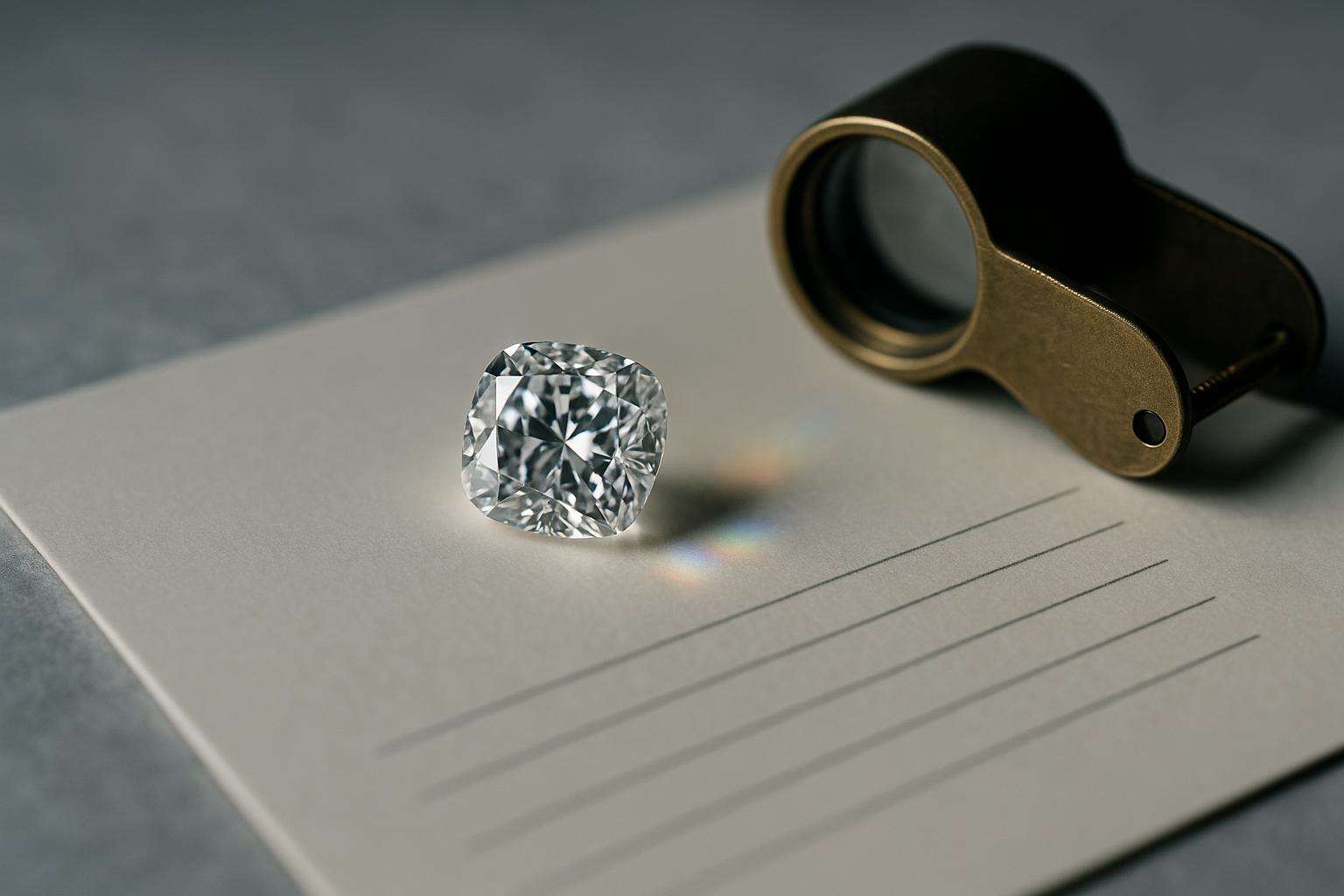
The GIA clarity scale runs from Flawless (FL) to Included (I3), but the only grade that changes how your ring looks in real life is whether inclusions are visible without magnification — the eye-clean threshold. For round brilliant cuts, VS2 is the reliable benchmark at 1.00 carat; SI1 is viable on individual stone inspection. For step cuts (emerald, Asscher), VS1 is the minimum because their open facet geometry offers far less inclusion masking. Flawless costs 2–3× more than VS2 and looks identical to the naked eye. The money saved by choosing the right grade over FL or VVS can fund a meaningfully better cut, carat, or setting.
The clarity chart on a diamond grading report is eleven grades long. The practical buying guide is considerably shorter: you need to know where inclusions stop being visible to the naked eye, and you need to know that threshold shifts depending on which shape of diamond you are buying. Everything else on the chart — the difference between VVS1 and VVS2, the precise number of pinpoints in a cluster — exists for gemologists, appraisers, and collectors, not for someone choosing a center stone for an engagement ring.
This guide decodes every grade on the GIA clarity scale, maps real price differences at each level, explains exactly which grade delivers eye-cleanliness for each major diamond shape, and identifies the inclusion types that matter most when you are inspecting a specific stone. If you are still building your foundation on the 4Cs as a whole, our diamond 4Cs guide covers all four grades together with priority order for trade-offs.
What Is the GIA Clarity Scale and How Is It Structured?
The GIA clarity scale was developed in the 1950s as part of the same grading revolution that produced the D-to-Z color scale and the modern 4Cs framework. It grades the appearance of internal characteristics (inclusions) and external characteristics (blemishes) as seen under 10x magnification by a trained grader. Eleven grades span the scale:
| Grade | Full Name | What Graders See at 10x | Visible to Naked Eye? | Approx. Price Range |
|---|---|---|---|---|
| FL | Flawless | No internal or external characteristics | No | $8,000–$15,000 |
| IF | Internally Flawless | No internal characteristics; minor surface blemishes only | No | $7,000–$13,000 |
| VVS1 | Very Very Slightly Included 1 | Microscopic inclusions extremely difficult to locate | No | $6,500–$11,000 |
| VVS2 | Very Very Slightly Included 2 | Microscopic inclusions very difficult to locate | No | $6,000–$10,000 |
| VS1 | Very Slightly Included 1 | Minor inclusions difficult to locate | No | $5,000–$8,500 |
| VS2 | Very Slightly Included 2 | Inclusions noticeable under magnification | Rarely (under 2 ct, brilliant cuts) | $4,500–$7,500 |
| SI1 | Slightly Included 1 | Inclusions easy to see under magnification | Often not (requires inspection) | $3,500–$6,000 |
| SI2 | Slightly Included 2 | Inclusions very easy to see under magnification | Sometimes | $2,800–$5,000 |
| I1 | Included 1 | Obvious inclusions; may affect transparency and brilliance | Yes | $1,500–$3,000 |
| I2 | Included 2 | Obvious inclusions; likely affect transparency and brilliance | Yes | $800–$1,800 |
| I3 | Included 3 | Prominent inclusions; affect transparency, brilliance, durability | Yes (clearly) | $400–$900 |
Price data reflects 2026 retail benchmarks at major online retailers for a 1.00-carat natural round brilliant in G color with Excellent cut, sourced from The Diamond Price. Ranges are wide because cut quality within a grade, fluorescence, and retailer markup all affect final price. The key observation: moving from FL to VS2 — a jump across five grade steps — saves $3,500–$7,500 on a single 1.00-carat stone, with zero visible difference in a mounted ring.
Where Is the Eye-Clean Threshold for Round and Brilliant-Cut Diamonds?
Round brilliant cuts are the most forgiving diamond shape for clarity. Their 57 or 58 precisely angled facets — triangular and kite-shaped, arranged to bounce light in multiple overlapping directions — create a kinetic pattern of brightness, fire, and sparkle that effectively camouflages inclusions within the visual noise. This is not a metaphor: the scattering of light paths inside a well-cut brilliant genuinely breaks up and redirects contrast that would otherwise allow an inclusion to stand out against a bright background.
The practical result, documented by gemologists at the International Gem Society, is that more than 85% of SI1 round brilliants at 1.00 carat are eye-clean — meaning their inclusions are invisible to the unaided eye at a normal viewing distance in a finished, mounted ring. VS2 is the grade at which round brilliants reliably achieve eye-cleanliness without requiring individual stone inspection; you can select any VS2 on a trusted retailer's platform with reasonable confidence.
SI1, however, cannot be purchased on grade alone. The critical variables are inclusion type and position:
- Favorable inclusions: pinpoints and clouds near the girdle edge, feathers positioned under a prong, needles with low contrast, minor surface blemishes. These are invisible in finished rings.
- Unfavorable inclusions: dark crystals (black or dark brown minerals with high contrast against the brilliant white interior), chips on the culet or girdle, and central-table feathers. These are the inclusions most likely to be visible — and they appear at SI1.
The solution: inspect the actual stone. Both James Allen and Blue Nile offer 360-degree high-definition video at 20–40x magnification, which allows you to evaluate inclusion position before purchasing. A dark crystal at SI1 that sits near the girdle and will be covered by a prong in a six-prong solitaire is a completely different purchase than a dark crystal positioned at the center of the table. The grade certificate tells you nothing about which one you are looking at; the video does.
For oval, cushion, pear, and radiant cuts — all brilliant-cut shapes — the eye-clean threshold is similar to round: VS2 for grade-based confidence, SI1 viable on individual inspection under 1.50 carats. One additional caveat for elongated brilliant cuts (oval, pear, marquise): the bow-tie shadow — a dark, butterfly-shaped optical pattern that runs across the center of most elongated brilliants — can visually amplify inclusions positioned within that shadow zone. When inspecting SI1 ovals or pears, check specifically whether inclusions fall within the bow-tie area. See our diamond shapes guide for a full comparison of how each brilliant cut handles light.
Why Step-Cut Diamonds (Emerald and Asscher) Demand Higher Clarity
Step cuts are among the oldest diamond cutting traditions — the emerald cut's beveled corners and rectangular parallel facets were developed in the 1920s; the square Asscher cut was patented by the Asscher Brothers of Amsterdam in 1902. Their visual character is entirely different from brilliant cuts: rather than maximizing sparkle through light scatter, step cuts create a series of large, flat reflections that produce what jewelers call the hall of mirrors — deep, layered rectangular reflections visible from the table down into the pavilion.
The gemological trade-off is direct: those same large, flat, parallel facets that create the hall-of-mirrors effect offer essentially no inclusion masking. They function as windows into the stone's interior, allowing the eye to look past the surface and into the body of the diamond. An inclusion that would be completely invisible in a round brilliant of identical clarity grade can be clearly apparent in an emerald cut — not because the inclusion is larger, but because the optical geometry provides no scatter to hide it.
Industry gemologists and independent experts including Your Diamond Teacher consistently recommend VS1 as the minimum practical clarity grade for emerald and Asscher cuts. For stones above 1.50 carats, where the table is large enough that even minor characteristics fall in an unobstructed visual path, VVS2 provides a higher margin of confidence. SI1 — acceptable in round brilliants with inspection — is generally not recommended for step cuts because the probability of visible inclusions increases substantially under step-cut geometry.
This shape-clarity interaction has a meaningful financial implication: if you are drawn to an emerald or Asscher cut, budget for a one-to-two grade clarity premium relative to the round brilliant equivalent. The step-cut premium on clarity is not negotiable without incurring visible quality risk. It is one reason step cuts are often paired with near-colorless or colorless color grades — both the step-cut buyer and the high-color buyer are paying for perfection that the stone's geometry makes visible.
How Carat Size Shifts the Eye-Clean Target
Carat weight and clarity interact in a predictable way that most buyers underestimate. An inclusion that is genuinely invisible in a 0.90-carat diamond may become detectable in the same clarity grade at 2.00 carats. The physics are straightforward: a larger diamond has a larger table (the flat top facet that serves as the primary visual entry point), which means any inclusion near the center of the table is further from masking facet edges and more prominently positioned in the field of view.
A practical rule: for every 0.50-carat increase above 1.50 carats, consider upgrading your target clarity by one grade to maintain the same eye-clean probability. Applied concretely:
- Under 1.50 ct, round brilliant: VS2 for grade-based eye-cleanliness; SI1 viable on inspection.
- 1.50–2.00 ct, round brilliant: VS1 for reliable eye-cleanliness; VS2 viable on inspection.
- 2.00–3.00 ct, round brilliant: VS1 minimum; VVS2 for highest confidence.
- Emerald / Asscher, any size: VS1 minimum under 1.50 ct; VVS2 minimum at 1.50 ct and above.
The financial stakes of this interaction grow sharply at larger sizes. The price difference between VS2 and VS1 on a 1.00-carat stone is approximately $1,000–$1,500. At 3.00 carats, the same grade step represents $15,000–$25,000. Clarity decisions at larger carat weights are among the most financially significant choices in the entire diamond purchase — and getting them right requires understanding both the grade and the geometry, not just the certificate number.
The Real Cost of Over-Buying Clarity: FL Through VVS2
The inclusions in FL, IF, VVS1, and VVS2 diamonds are, categorically, not visible to the human eye without magnification. No unaided observer at normal viewing distance can distinguish a Flawless diamond from a VS2 in a finished ring. The GIA itself does not claim otherwise — the grading scale is a classification of what trained graders see under 10x magnification, not a scale of visible beauty.
What FL and IF grades represent is rarity — fewer than 1% of diamonds graded by GIA achieve Flawless or Internally Flawless status. That rarity has real collector and investment value for a narrow segment of buyers. For engagement-ring buyers prioritizing how the ring looks and how far their budget reaches, the FL premium is a cost without a corresponding visual benefit.
The saving from VS2 over FL on a 1.00-carat G-color Excellent-cut round brilliant is roughly $3,500–$7,500 at 2026 retail prices. At 2.00 carats, the spread between FL and VS1 (the minimum recommended for larger brilliants) easily exceeds $20,000. Directed differently, that budget can fund: a step up from 1.00 to 1.30 carats while maintaining identical quality; a switch from white gold to platinum with a custom hand-engraved setting; a lab-grown upgrade from 1.00 carat to 2.00 carats at equivalent cut and color grades. None of these outcomes are visible in a Flawless certificate. All of them are visible in the finished ring.
If you are weighing whether to stretch budget toward a lab-grown stone to access higher clarity at a larger carat weight, our lab-grown versus natural diamonds guide covers every relevant variable — price, resale, FTC disclosure, and physical identity — in full.
Frequently asked
What does 'eye-clean' mean for a diamond?
Eye-clean is not an official GIA grade — it is a practical standard used by gemologists and experienced retailers to describe a diamond whose inclusions are invisible to the unaided eye at a normal viewing distance (roughly 25–30 cm / 10–12 inches) in a finished, mounted ring under typical lighting. A diamond can be graded SI1 on a laboratory report and still be completely eye-clean; conversely, a VS2-graded stone with an unusually positioned dark crystal can technically be eye-clean on paper but visible in practice. The grade tells you about magnified appearance; eye-clean tells you about real-world appearance. For round brilliant cuts at 1.00 carat, VS2 is the reliable eye-clean benchmark, with SI1 achievable on individual stone inspection. For step-cut shapes like emerald and Asscher, the minimum rises to VS1 because their open, parallel facets offer far less inclusion-masking than brilliant-cut geometry.
What is the difference between VS1 and VS2 diamonds?
Both grades contain inclusions that are noticeable under 10x magnification but typically invisible to the unaided eye in a finished ring. VS1 inclusions are minor under magnification — they require effort to locate and are small in size, low in relief, and/or positioned toward the girdle or pavilion. VS2 inclusions are noticeable under magnification but still invisible to the naked eye in most stones up to roughly 2 carats. The practical difference for a buyer: VS1 offers a higher degree of confidence that the stone will be eye-clean across all shapes and sizes, while VS2 offers nearly the same visual result in round and brilliant-cut shapes under 2 carats at a savings of approximately $1,000–$1,500 per carat. At 2.00 carats and above, VS1 becomes the more defensible minimum because the larger table area exposes any inclusions that might sit near the center of the stone. For step-cut shapes at any size, VS1 is the recommended floor.
Is SI1 a good clarity grade for an engagement ring?
For round brilliant cut diamonds, SI1 can be an excellent choice — but only with individual stone inspection. More than 85% of SI1 round brilliants at 1.00 carat are eye-clean, with inclusions typically positioned near the girdle, hidden under prongs, or consisting of transparent pinpoints that scatter light rather than absorbing it. The key variables are inclusion type and position: a feather or cloud near the girdle will be invisible in a finished ring; a dark crystal positioned under the table (the large flat top facet) will be clearly visible. Always request high-resolution video — both James Allen and Blue Nile offer 360-degree HD stone viewers — before purchasing SI1. For oval, cushion, and radiant cuts, SI1 is viable with the same inspection caveat. For emerald and Asscher cuts, SI1 is not recommended; their step-cut facets act as windows, and inclusions that would be masked in a round brilliant become visible.
Why does diamond shape change the clarity grade you need?
Diamond facet geometry determines how much light scatters inside the stone — and light scatter is what masks inclusions. Brilliant cuts (round, oval, cushion, pear, radiant, marquise) use many small, angled triangular and kite-shaped facets arranged to bounce light in multiple directions simultaneously. This creates a kinetic pattern of brightness and sparkle that effectively camouflages inclusions within the visual noise. Step cuts (emerald, Asscher) use large, flat rectangular facets arranged in parallel rows that produce the characteristic hall-of-mirrors reflection pattern — beautiful and distinctive, but optically transparent. The large flat facets act as windows that allow the eye to look directly into the stone's interior, making inclusions far more visible than the same inclusion would be in a brilliant cut of identical clarity grade. This is not a myth or marketing; it is a direct consequence of facet geometry and light behavior. The practical result: an SI1 that is invisible in a round brilliant can be clearly apparent in an emerald cut of the same grade.
Are Flawless diamonds worth the premium for an engagement ring?
For most engagement-ring buyers, no. Flawless (FL) and Internally Flawless (IF) diamonds are genuine rarities — fewer than 1% of diamonds submitted to GIA receive either grade — and they command prices far above their visual value to any unaided observer. A 1.00-carat FL stone costs approximately $8,000–$15,000; a VS2 stone of identical cut, color, and carat weight costs roughly $4,500–$7,500 and is visually indistinguishable from the FL in a mounted ring or in any real-world viewing condition. The FL premium is a rarity and collector premium, not a beauty premium. Exceptions exist: buyers who place intrinsic value on document-certified perfection, collectors building long-term pieces, or individuals purchasing FL as a deliberate investment in rarity. For everyone else, the $3,000–$7,500 difference is better directed toward cut quality, carat weight, or setting craftsmanship — all of which produce visible improvements in the finished ring.
How does carat size affect the clarity grade I should choose?
Carat size and clarity interact in a straightforward way: inclusions that are invisible in a smaller diamond can become detectable in the same clarity grade at a larger size, because the larger table area places inclusions further from masking facet edges and makes the stone's interior more visually prominent. As a practical rule of thumb, for every 0.50-carat increase above 1.50 carats, consider upgrading your target clarity grade by one step to maintain the same probability of eye-cleanliness. Specifically: VS2 is reliable eye-clean at 1.00 carat in round brilliants; at 2.00 carats, VS1 is the more defensible minimum; at 3.00 carats and above, VVS2 provides the highest confidence of eye-cleanliness. The price difference between VS2 and VS1 on a 1.00-carat stone is roughly $1,000–$1,500; at 3.00 carats the same grade step can represent $15,000–$25,000, making clarity decisions at larger sizes among the most financially significant choices in the entire purchase.
What inclusion types are hardest to see in a finished ring?
Not all inclusions are created equal. The GIA classifies diamond inclusions into several types, and their visibility in a finished ring varies enormously by type, position, and contrast against the stone's background. The hardest inclusions to see are: pinpoints (tiny white crystals that scatter light rather than absorbing it — often multiple pinpoints cluster as a cloud, which can reduce transparency if dense); feathers positioned at the girdle edge or under a prong (fractures that are masked by the setting); and needles (thin elongated crystals with low contrast against the diamond's interior). The most visible inclusions are: dark crystals under the table (high contrast against the white brilliance); chips on the culet or girdle; and bearding (a fringe of feathers around the girdle). When inspecting SI1 stones, specifically look for dark included crystals positioned in the center of the table — these are the inclusions most likely to be visible in a finished ring.