Diamonds & Stones
Pear-Shaped Engagement Rings: The Complete Buying Guide
The teardrop cut delivers round-brilliant sparkle in an elongating silhouette — and costs up to 33% less per carat than a round. Here is everything you need to buy one with confidence.
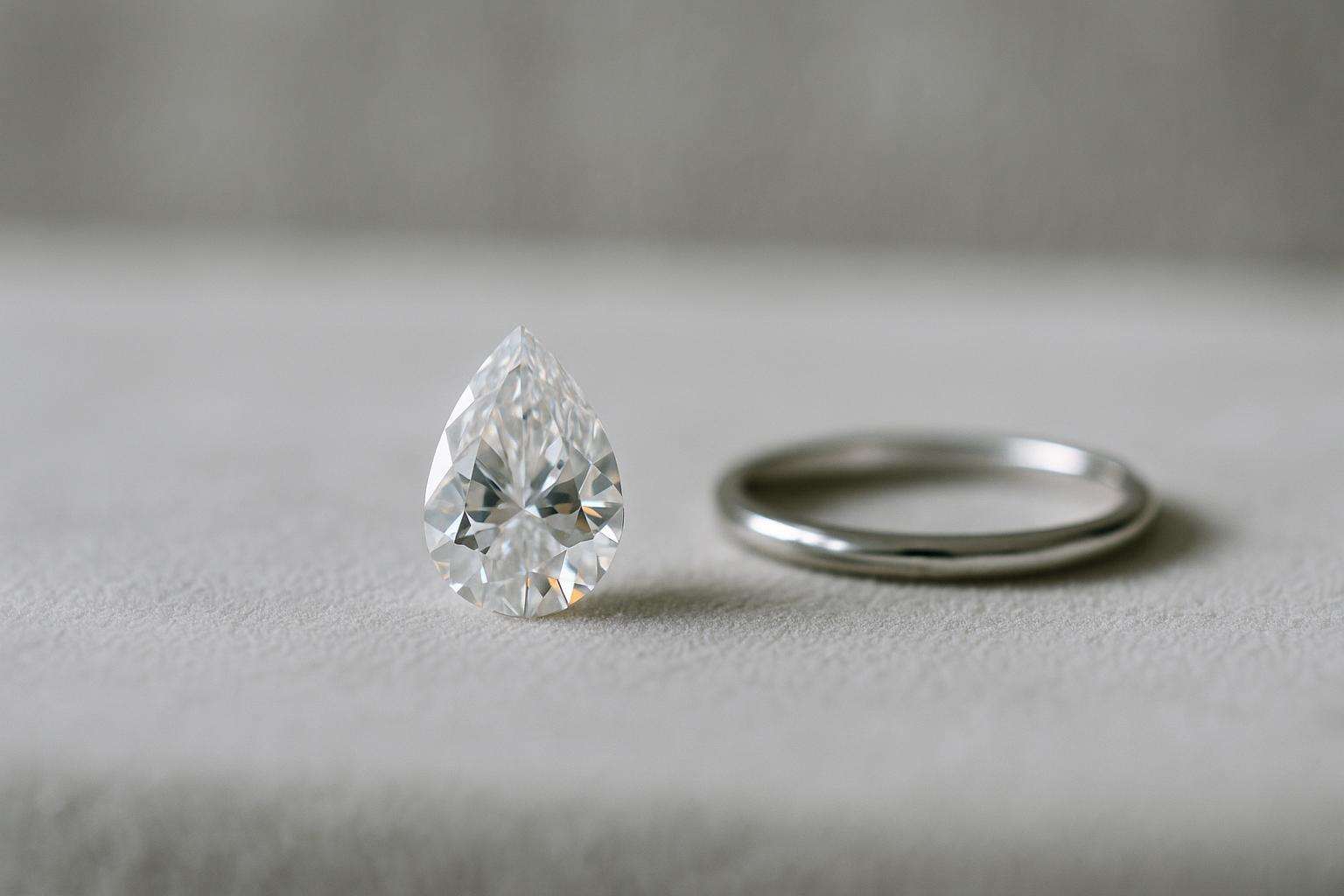
Pear-shaped diamonds deliver round-brilliant sparkle in an elongating teardrop silhouette, typically cost 25–33% less per carat than equivalent rounds, and face up larger than their stated carat weight — but none of these advantages are automatic. The shape demands careful evaluation of length-to-width ratio, bow-tie shadow, symmetry grade, tip protection, and color concentration at the point. Because GIA does not issue a cut grade for fancy shapes, the buying process is more hands-on than buying a round brilliant. This guide walks through every decision.
The pear-shaped diamond — also called the teardrop cut — is one of the oldest fancy shapes in commercial jewelry, tracing its geometry to Flemish polisher Lodewyk van Berquem around 1458. It is structurally a hybrid: a round brilliant crown fused to a marquise-like pointed tip, producing 58 facets and a scintillation pattern virtually indistinguishable from a round when the cut is well executed. That combination of heritage and optical performance has driven a meaningful resurgence. According to Austen & Blake's 2026 trend data, pear moved up two places to third among engagement ring shapes — still behind round and oval, but ahead of every other fancy cut. The Knot's 2026 Real Weddings Study, which surveyed more than 10,000 U.S. couples married in 2025, places pear alongside emerald, marquise, and princess each at approximately 8% of its sample. The Natural Diamond Council's parallel dataset, compiled from more than four million transactions across 2,500 U.S. specialty jewelers, shows pear as one of the shapes with measurable year-over-year growth fueled in part by lab-grown adoption, which makes a 1.5-carat pear stone accessible at a price point that previously bought a 0.7-carat round.
Celebrity visibility has been consistent for this shape for decades. Victoria Beckham wears a documented 17-carat pear diamond — one of the most frequently photographed pear stones in contemporary jewelry — repurposed as a pendant since 2022. Cardi B's engagement ring centers an 8-carat pear. Scarlett Johansson has worn an 11-carat light yellow pear. The shape is not a fleeting trend; it is a durable archetype whose revival is accelerating because elongated fancy cuts in general are taking share from rounds at every price tier.
What Does the Length-to-Width Ratio Actually Do to the Look of the Stone?
The length-to-width (L:W) ratio is the single most important proportion decision you make when buying a pear diamond — more consequential than carat weight at the same budget, because it determines both the visual footprint of the stone and the severity of the bow-tie shadow. GIA does not report or grade L:W ratio, so you must calculate it yourself from the measurements line on the certificate: divide the longer dimension by the shorter.
The consensus buying range is 1.45 to 1.75, with the 1.50–1.65 band the most widely recommended as a classic equilibrium. Here is what shifts as you move across that range:
| L:W Ratio | Visual Character | Finger Effect | Bow-Tie Risk |
|---|---|---|---|
| 1.40–1.49 | Full, rounded; approaches an elongated oval in feel | Moderate elongation; suits wider fingers | Lower; shorter silhouette suppresses shadow band |
| 1.50–1.65 | Classic teardrop; balanced proportion | Good elongation; flatters most hand proportions | Moderate; well-cut stones with Excellent symmetry manage it |
| 1.66–1.75 | Elongated; more dramatic silhouette | Pronounced elongation; especially slimming effect | Elevated; prioritize Excellent symmetry and 360° video review |
| Above 1.75 | Very elongated; narrow teardrop | Maximum elongation; not universally flattering | High; severe bow-ties more common above this threshold |
A ratio near 1.50 produces a rounder, more substantial-looking stone that wears confidently on all hand sizes. A ratio approaching 1.70 creates the finger-lengthening illusion that drives many buyers toward pear over oval in the first place — but requires more careful vetting. Pears above 1.75 are specialist territory: some buyers specifically seek them for their dramatic fashion statement, but the bow-tie exposure and tip vulnerability climb together as the silhouette narrows.
How Do You Evaluate a Bow-Tie — When It Does Not Appear on the Certificate?
The bow-tie effect is a dark, horizontal shadow that forms across the widest section of elongated brilliant cuts — pear, oval, marquise, and heart — when viewed face-up in normal ambient light. It is caused by light leaking through the pavilion in the central zone rather than reflecting back to the viewer's eye. Every elongated brilliant cut displays some degree of bow-tie; the question is severity. A faint shadow adds contrast and three-dimensional depth to the stone. A dark, wide band that dominates the face-up view constitutes a genuine quality defect that no amount of sparkle in the shoulder facets compensates for.
The GIA certificate reports neither the presence nor the severity of a bow-tie for any shape. The GIA's own guidance on pear-shaped diamonds confirms that symmetry and polish grades are the only cut-related assessments on GIA fancy-shape reports; bow-tie evaluation falls entirely to the buyer. The IGI began incorporating bow-tie considerations into its fancy-shape cut assessments in September 2022 but does not assign a standalone severity score. The only reliable evaluation method is a high-resolution 360-degree video of the specific stone viewed under varied lighting — a feature now standard at Blue Nile (which has absorbed James Allen's 20× zoom video technology as part of Signet Jewelers' mid-2026 brand consolidation) and at Brilliant Earth. Do not purchase a pear diamond without watching its video. A gemologist at Lily Dia Jewellery notes that the bow-tie shadow in poorly cut pears can appear uneven — one side darker than the other — when symmetry is poor, which compounds the visual distraction well beyond a centered shadow.
Symmetry grade is your proxy indicator on the certificate. Excellent or Very Good symmetry is the non-negotiable floor for a pear purchase. Symmetry governs the alignment of the two curved shoulders and the centering of the tip; any asymmetry in these elements tilts the facet pattern in a way that makes bow-tie shadows lopsided and visually prominent. The depth percentage should fall in the 58–64% range and table percentage in the 52–63% range to balance bow-tie suppression against face-up size. Outside these proportions, light return degrades regardless of how well the symmetry grades read.
From a practical workflow standpoint: filter your search for Excellent or Very Good polish and symmetry, apply depth and table percentage filters, then watch the video of every candidate before adding it to a shortlist. Never make a pear purchase based solely on grade specifications.
Which Setting Best Complements — and Protects — a Pear-Shaped Diamond?
Setting choice for a pear diamond involves two distinct considerations that pull in slightly different directions: maximizing light return and visual drama on one side, and protecting the tip on the other. The pointed apex is the shape's most structurally vulnerable feature; a sharp impact against a hard surface can chip or fracture the tip even on a well-cut stone with excellent symmetry. Every setting decision for a pear should incorporate a specific tip-protection strategy.
Solitaire with V-prong tip: The traditional and most popular approach. A six-prong solitaire — four prongs flanking the shoulders, one at the rounded base, and one V-shaped prong cradling the tip — maximizes light entry around the stone while distributing any tip impact across the metal's broader surface area. The V-prong is industry-standard and non-negotiable for prong settings; a standard round prong at the tip contacts less metal and transfers more stress directly to the diamond. For stones under 1.5 carats, three prongs plus a V-tip is commonly used. Above 1.5 carats, five prongs provide more security for the larger stone mass.
Halo: A frame of smaller diamonds following the pear's outline amplifies perceived size by 25–50% visually, adds a secondary ring of metal that buffers the tip, and has been one of the dominant pear settings in the 2020s. The halo must be custom-fit to the precise L:W ratio of the center stone; a mismatched or generic halo frame leaves uneven gaps along the shoulders that make the setting look mass-produced. A hidden halo — set beneath the girdle rather than surrounding it — adds brilliance visible from the side without altering the top-down silhouette, a detail increasingly requested by buyers who want sparkle without a traditional halo profile.
Bezel: A thin metal rim encircles the entire perimeter, including the tip. This is the most protective option available and the practical first choice for buyers with active jobs or lifestyles involving contact sports, gardening, or regular manual work. The trade-off is a modest reduction in light entry around the girdle edge compared to a prong setting. Full bezel and partial (semi-bezel) designs are both available; partial bezels open the stone's sides to additional light while still protecting the tip.
Three-stone: Three-stone pear settings — center pear flanked by two trapezoids, tapered baguettes, or half-moon side stones — are among the strongest pear-specific trends for 2026, driven by symbolism (past, present, future), visual balance, and the architectural appeal of angled side stones that echo the teardrop silhouette. Three-stone pear settings should include a V-prong at the center stone's tip regardless of side-stone configuration.
One frequently overlooked setting detail: orientation at the setting stage is permanent. The traditional point-up orientation (tip toward the fingernail) maximizes the elongating effect by following the natural taper of the finger. The bold point-down orientation is a contemporary alternative that changes the silhouette dynamic entirely — the stone appears wider and the rounded base reads as the focal point. East-west (horizontal) is a third option, currently trending as part of the broader sideways-set movement, that makes an unusually striking visual statement. Decide your preferred orientation before commissioning a custom setting or confirming an online order; the prong layout, including the V-tip location, differs between orientations.
Color and Clarity: Where the Pear Shape Changes the Calculation
Pear-shaped diamonds concentrate body color slightly more in the pointed tip than round brilliants do at the center table, because the narrower geometry at the tip holds color differently than the broader, symmetric crown of a round. The practical consequence: a pear at a given color grade can appear slightly warmer than a round at the same grade, particularly in the tip viewed from above in a finished ring. The gemological recommendation is to stay at G color or above for white metal settings — platinum or white gold — where the metal provides no warming camouflage. H works well as a budget step-down with individual stone inspection. For yellow gold or rose gold settings, I or J is often excellent value because the warm metal absorbs the color differential at the tip and makes it invisible.
Clarity for pear diamonds follows the same logic as other brilliant cuts with one specific caution: any inclusion positioned at or near the pointed tip carries compounded risk. A tip-area inclusion is more visible in the finished ring than the same inclusion positioned at the rounded shoulder, and it also represents a structural vulnerability — a tiny natural fracture at the narrow terminus can propagate under an impact that a shoulder-area inclusion would survive. Review the GIA certificate's inclusion plot carefully. VS2 is the practical threshold for most pear diamonds under 1.5 carats; SI1 is achievable on individual inspection for round brilliants but requires more caution in pears, particularly if the bow-tie shadow zone sits near a center inclusion that the shadow will then highlight. For stones above 1.5 carats, VS1 is the defensible minimum.
For a deeper grounding in how the 4Cs interact across all diamond shapes, the diamond 4Cs guide provides the foundational framework these recommendations build on. For buyers comparing pear against other elongated brilliant options, our diamond shapes guide covers all ten shapes side by side with face-up size and price data.
What Does a Pear Diamond Cost in 2026, and Where Should You Buy?
Pear-shaped diamonds price approximately 25–33% below rounds of identical grade, making them one of the best-value elongated brilliant options alongside oval and marquise. Using the Diamonds.pro benchmark dataset for 1-carat J/SI1 natural diamonds, a pear runs approximately $2,270 versus $3,390 for a round — a difference of $1,120 at the entry tier. At more typical buying specifications of G/VS2, a 1-carat natural pear at a major online retailer in mid-2026 falls in the $3,400–$4,200 range, depending on symmetry grades and specific proportions. Complete ring costs add $600–$1,500 for a solitaire setting in platinum or 14k white gold.
Lab-grown pear diamonds carry the same ~67% discount against natural stones of equivalent grade that applies across all shapes. A lab-grown 1.5-carat G/VS2 pear can currently be sourced for approximately $1,200–$1,800 — a budget that buys roughly a 0.70-carat natural stone of comparable grade. For buyers who prioritize visual size on the hand over natural provenance, the lab-grown pear is one of the most compelling value propositions in the engagement ring market. The Natural Diamond Council's 2025 Trends Report, drawn from more than four million transactions, confirms that lab-grown adoption is measurably accelerating interest in elongated fancy shapes — pear among them — as buyers use the price differential to buy up in carat weight. Our lab-grown vs. natural diamonds comparison covers the full resale, detection, and FTC disclosure picture.
Apply the buy-shy strategy to pear diamonds exactly as you would to rounds: target 0.90–0.95 carats rather than 1.00 carat, or 1.40–1.45 rather than 1.50, to capture a 10–15% per-carat saving with no perceptible size difference in the finished ring.
For the buying platform itself: as of mid-2026, James Allen's standalone website has been absorbed into Blue Nile as a proprietary collection under Signet Jewelers, with the transition completing around the end of Q2 2026. Blue Nile now carries the James Allen diamond inventory and honors all existing James Allen policies. The 360-degree high-resolution video tools that made James Allen the preferred platform for evaluating fancy shapes — including pear — are available through Blue Nile's updated interface. For pear diamonds specifically, where no GIA cut grade exists and bow-tie evaluation is mandatory, the video inspection capability is the most important platform feature. Brilliant Earth is a strong alternative, particularly for buyers prioritizing ethical sourcing documentation alongside cut evaluation.
The pear is, by any objective measure, a smart shape for buyers who want maximum visual impact per dollar spent — provided they do the visual work that its lack of a formal cut grade demands. Get the L:W ratio right for your hand, watch the video carefully for bow-tie severity, confirm Excellent or Very Good symmetry, put a V-prong on the tip, and you will have a stone that consistently draws the comment it deserves: that it looks considerably larger than any number on a certificate could explain.
Frequently asked
What is the ideal length-to-width ratio for a pear-shaped diamond?
Most buyers find a length-to-width (L:W) ratio between 1.45 and 1.75 pleasing, with the 1.50–1.65 range widely regarded as the classic sweet spot. A ratio near 1.50 produces a fuller, softer teardrop; anything above 1.70 delivers a dramatically elongated silhouette with more finger coverage but also more exposure at the pointed tip and higher bow-tie risk. The right ratio is partly personal — taller hands tend to carry longer ratios (1.65–1.75) more naturally, while shorter fingers often look best balanced by a fuller 1.45–1.55 proportion. The GIA does not grade L:W ratio on its reports, so calculate it yourself: length ÷ width, both figures found in the certificate's measurements field.
What is the bow-tie effect and how do I avoid it in a pear diamond?
The bow-tie effect is a dark, horizontal shadow that runs across the widest section of certain elongated brilliant cuts — including pear, oval, and marquise — when viewed face-up. It forms because the stone's facet geometry creates a zone where light leaks through the pavilion rather than reflecting back to the eye. A faint bow-tie adds contrast and depth and is generally unremarkable; a severe, dark bow-tie meaningfully reduces brilliance and is a meaningful quality defect. The bow-tie severity does not appear on a GIA certificate. The only reliable way to evaluate it is to watch a high-resolution 360-degree video of the specific stone under varied lighting. Excellent or Very Good symmetry grades (which do appear on GIA reports) reduce — though do not eliminate — bow-tie risk by ensuring balanced facet alignment. Depth percentage in the 58–64% range and a table percentage between 52–63% also correlate with better bow-tie suppression.
How should a pear-shaped ring be oriented on the finger — point up or point down?
The traditional orientation is point toward the fingertip (point-up). Because the finger naturally tapers from a wider base to a narrower tip, the pear's silhouette follows that taper, creating a visually elongating and slimming effect. This is the most common orientation seen in both fine jewelry and everyday wear. Point-down (point toward the palm) is a bold, contemporary alternative preferred by some modern buyers — it creates the appearance of a slightly wider stone and feels intentionally unexpected. East-west (horizontal) is a third option that has grown in popularity as part of the broader sideways-set trend in 2026. There is no functional right or wrong choice; the decision is purely aesthetic. Regardless of orientation, a V-prong at the tip is non-negotiable to protect the stone's most vulnerable point from chipping.
What color grade should I choose for a pear-shaped diamond?
Pear-shaped diamonds, like all elongated brilliant cuts, concentrate color slightly more visibly toward the pointed tip than a round brilliant does at its table. Gemologists generally recommend staying at G or higher for pear diamonds set in white gold or platinum, where any residual warmth will contrast against the cool metal. H is a workable and cost-effective choice if you inspect the specific stone. For yellow gold or rose gold settings, I–J color is often a practical option because the warm metal absorbs and masks any color concentration in the tip, and the savings can be substantial. Avoid fluorescence in D–F color pears, which can introduce a milky haziness; for H and below, medium blue fluorescence can actually make the tip read slightly whiter in natural light. Always view the specific stone face-up on the actual metal color before committing to a color grade below G in white metal.
What clarity grade do I need for a pear-shaped diamond?
Pear diamonds are brilliant cuts, which means their 58 facets scatter light in multiple directions, doing meaningful work to obscure inclusions — more work than step cuts like emerald or Asscher, but slightly less than round brilliants because the elongated shape creates a zone near the bow-tie area where a center-table inclusion is more exposed. For most pear diamonds under 1.5 carats, VS2 or SI1 will achieve eye-clean results, but SI1 requires visual inspection of the specific stone rather than grade-based confidence — always review a high-resolution video and check inclusion position on the GIA certificate before buying SI1. At 1.5 carats and above, move to VS1 to maintain the same probability of eye-clean appearance as the larger table makes inclusions proportionally more visible. Inclusions positioned near the tip are particularly problematic: not only are they visible, but any inclusion at the pointed end increases the structural vulnerability of the stone's most delicate feature.
How much does a pear-shaped diamond engagement ring cost in 2026?
Pear-shaped diamonds typically price 25–33% below rounds of equivalent grade. Using 1-carat J/SI1 natural diamonds at Blue Nile as a benchmark, pear shapes run approximately $2,270 compared to $3,390 for a round brilliant — a saving of roughly $1,120. For a more practical buying scenario: a 1-carat G/VS2 natural pear at a major online retailer in mid-2026 costs approximately $3,400–$4,200 depending on specific proportions and polish/symmetry grades. A complete ring (stone plus a simple platinum or 14k white gold solitaire setting) typically adds $600–$1,500. Lab-grown pear diamonds carry approximately 67% off natural prices, meaning a lab-grown 1.5-carat G/VS2 pear can be sourced in the $1,200–$1,800 range — a budget that would buy a 0.70-carat natural stone of equivalent grade. Apply the buy-shy strategy and target 0.90–0.95 carats rather than 1.00 carat to capture a 10–15% per-carat saving with no perceptible size difference.
Which setting best protects the tip of a pear-shaped diamond?
The pointed tip of a pear-shaped diamond is the stone's single most structurally vulnerable feature. The facets converge to a narrow terminus that, if struck sharply against a hard surface, can chip or fracture even on a GIA Excellent-symmetry stone. Three setting approaches address this risk effectively. The V-prong is the industry standard: a single V-shaped metal prong cradles the tip, distributing impact across a wide area of the metal rather than concentrating stress on the diamond itself. The bezel setting encircles the entire perimeter of the stone in a thin rim of metal, offering the maximum physical protection — an ideal choice for active lifestyles — at a slight trade-off in light return. A halo setting adds a ring of smaller diamonds around the perimeter and provides a secondary buffer of metal and stone at the tip. For buyers choosing a prong setting, gemologists recommend a minimum of five prongs for stones above 1.5 carats; under 1.5 carats, three prongs with a V at the tip is standard practice.