Ethical & Sustainable
Are Lab-Grown Diamonds Actually Eco-Friendly?
The honest answer depends almost entirely on where the electricity comes from — and the FTC is now cracking down on brands that skip that caveat.
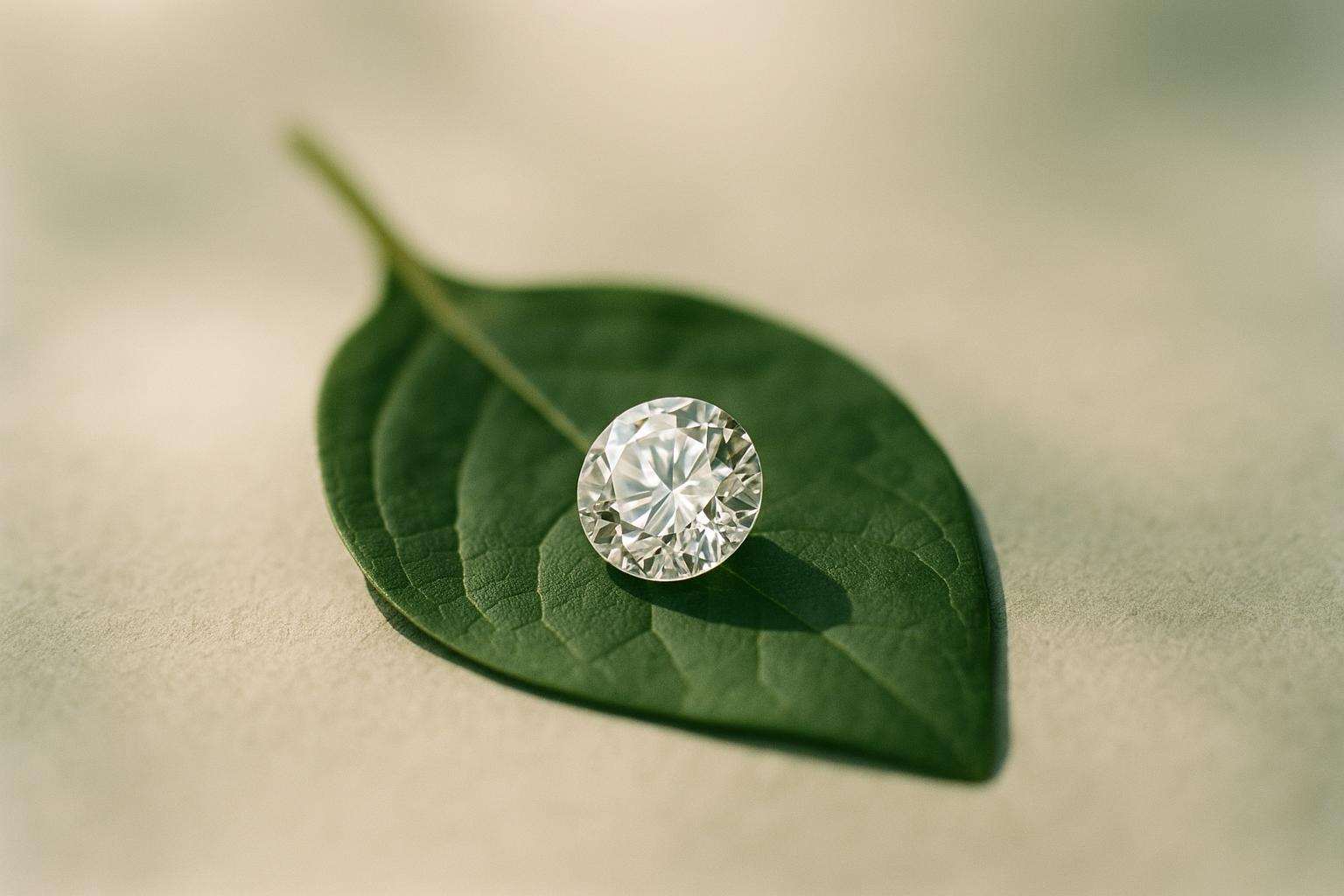
Lab-grown diamonds can be dramatically cleaner than mined stones — but only when the production facility runs on renewable electricity. More than 70% of global lab-grown output comes from coal-heavy grids in China and India, where per-carat carbon emissions can exceed those of some mining operations. The FTC has already warned eight companies for making unqualified "eco-friendly" claims. The honest verdict: ask about the energy source, not just the origin story.
Why the Energy Source Is the Whole Story
When couples ask whether lab-grown diamonds are eco-friendly, they are really asking one question dressed up as a simpler one. The actual question is: what powered the reactor that grew this diamond? The answer to that — not the production method itself — is what determines the environmental math.
Both of the methods used to grow diamonds in a laboratory — chemical vapor deposition (CVD) and high-pressure, high-temperature (HPHT) — are electricity-intensive. Producing one rough carat requires approximately 250 kilowatt-hours (kWh), equivalent to roughly nine days of average U.S. household electricity use. The reactor does not care whether that power comes from a coal plant in Henan Province or a hydroelectric dam on the Columbia River. The diamond that emerges is physically identical. The emissions are not.
A 2024 peer-reviewed study published in Humanities and Social Sciences Communications (Nature Publishing Group) — the most rigorous independent analysis to date — found that a lab-grown diamond produced with clean renewable energy generates approximately 0.028 grams of greenhouse gas per carat. The average mined diamond produces roughly 160 kg of CO₂ per polished carat according to industry data. That is a difference of roughly six million to one in favor of the lab-grown stone — but only under the best-case renewable scenario.
Shift to a coal-fired grid and the calculus reverses. A 2020 Trucost study commissioned by the Natural Diamond Council — the trade body for mined diamond producers — found that lab-grown diamonds on average produce approximately 511 kg of CO₂ per polished carat, more than three times the mined-diamond figure, when weighted toward actual real-world production conditions. That finding has been criticized for the weighting assumptions used, but it reflects a genuine empirical reality: the majority of lab-grown production occurs in regions where coal is the primary grid fuel.
Where Lab Diamonds Are Actually Made — and Why It Matters
The geographic concentration of lab-grown diamond production is the single fact most often omitted from brand marketing. China accounts for approximately 46% of global lab-grown diamond output as of late 2024, and roughly 62% of that Chinese production relies on coal power, generating an estimated 523 kg of CO₂ equivalent per carat. India — the world's other major production hub — has a coal dependence of approximately 74% and the highest carbon intensity of any major producing country, at an estimated 612 kg CO₂e per polished carat.
Combined, China and India account for more than 70% of global lab-grown diamond production, according to multiple industry analyses including reporting by JCK and the Association of Intelligent Diamond International. A consumer in the United States purchasing a lab-grown diamond from a typical retailer — without asking specifically about the production facility — is overwhelmingly likely to be buying a stone grown on a fossil-fuel grid.
This is not a theoretical concern or a talking point from the mined-diamond lobby. It is a statistical reality grounded in production geography. Lab-grown diamond production has scaled faster than the renewable energy infrastructure needed to power it cleanly: global output expanded from approximately 2.5 million carats in 2015 to approximately 16 million carats in 2024, a 6.4-fold increase, while standardized third-party verification of facility-level energy sources has not kept pace.
| Production scenario | CO₂e per polished carat (est.) | Primary source |
|---|---|---|
| Lab-grown — 100% renewable energy | ~0.028 g (near-zero) | Nature / HSSC, 2024 |
| Lab-grown — China coal grid (avg.) | ~523 kg | AIDI, 2024 |
| Lab-grown — India coal grid (avg.) | ~612 kg | AIDI, 2024 |
| Lab-grown — global weighted average | ~511 kg | Trucost / Natural Diamond Council, 2020 |
| Mined diamond — global average | ~160 kg | Natural Diamond Council / Diamond Producers Assoc. |
Note: per-carat emission estimates vary significantly by methodology, scope boundary, and energy-mix assumptions. The figures above represent the cited source's stated numbers and are presented for comparative context, not as definitive settled science. The directional conclusion — that energy source is the dominant variable — is consistent across methodologies.
What the FTC's Crackdown Actually Means for Shoppers
In 2019, the Federal Trade Commission sent warning letters to eight jewelry companies — including lab-grown diamond sellers — flagging their use of terms such as “eco-friendly,” “eco-conscious,” and “sustainable” as potentially deceptive under the FTC's Green Guides (16 CFR Part 260). The FTC's position, stated clearly in its guidance: general, unqualified environmental benefit claims are "difficult to substantiate, if not impossible," and companies must be able to back any such claim with competent and reliable scientific evidence.
The FTC's Green Guides were last formally updated in October 2012. A review was initiated in December 2022, and updated guidance was widely anticipated to address lab-grown diamond environmental claims specifically. As of mid-2025, that update remains stalled — the FTC confirmed at the end of January 2025 that there was nothing new to report — and under the current administration's more advertiser-friendly posture, a near-term regulatory update is considered unlikely by most compliance attorneys tracking the space. However, the 2012 guidelines remain in force, and the FTC retains full enforcement authority under Section 5 of the FTC Act, which prohibits unfair or deceptive acts or practices.
For shoppers, the FTC crackdown translates into a useful heuristic: treat any unqualified “eco-friendly” or “sustainable” claim from a lab-grown diamond retailer as a marketing assertion, not a verified fact. A legitimate environmental claim looks like this: "These diamonds are grown at our foundry in Washington State, powered by 100% hydroelectricity from the Columbia River." A non-compliant claim looks like this: "Our eco-conscious, sustainably grown diamonds." The first is specific, verifiable, and qualifiable. The second is not.
Where Lab-Grown Diamonds Genuinely Win on Environment
It would be misleading to overstate the coal-grid problem at the expense of real, uncontested environmental advantages that lab-grown diamonds hold over mined stones regardless of energy source.
- Land use and habitat: Large-scale open-pit diamond mining requires removal of significant overburden, causing deforestation and habitat disruption at the mine footprint. Lab production requires no land excavation and generates stones in a controlled indoor environment. This advantage is categorical and unconditional.
- Water consumption: Industry estimates suggest mined diamonds use roughly 128 gallons of water per carat versus approximately 18.5 gallons for lab-grown production — roughly a 7-to-1 ratio in favor of lab-grown, independent of energy source.
- Mineral waste: A Frost & Sullivan analysis found that mining generates approximately 4,383 times more mineral waste per carat than laboratory manufacture.
- Community and labor displacement: Large-scale mining operations disrupt local communities and ecosystems in ways that have no equivalent in a laboratory setting, though artisanal and small-scale mining also provides livelihoods in producing countries — a nuance that “eco-friendly” framings routinely omit.
The honest summary: lab-grown diamonds eliminate mining's land, water, and waste footprint unconditionally. They eliminate the carbon footprint conditionally — only when the production facility uses clean power.
The One Brand That Earns Its Environmental Claims
Among mainstream lab-grown diamond retailers, VRAI — the direct-to-consumer brand backed by Diamond Foundry — stands out as the most rigorously documented. VRAI's diamonds are grown exclusively at Diamond Foundry's foundry in the Pacific Northwest, powered by 100% hydroelectricity from the Columbia River. The company publishes facility-level sustainability data, including energy used per stone, in its sustainability disclosures. It does not rely on carbon offsets to claim clean production. VRAI's Diamond Table tool allows customers to see the specific rough diamond's growth time, energy consumed, and carbon emissions — the kind of granular, facility-level transparency the FTC's Green Guides effectively require but most brands do not provide.
The principal limitation of VRAI's transparency model is grading: the brand issues quality grades using its own proprietary metrology rather than submitting stones to an independent laboratory such as GIA or IGI. Multiple independent reviewers have flagged the absence of third-party grading as a verification gap. Environmental claims: strong. Quality-grading independence: weaker than GIA-certified alternatives. Buyers should weigh both.
Other brands — including Brilliant Earth, which audits its lab diamond manufacturers for labor conditions using SMETA methodology and holds SBTi-approved net-zero targets — make meaningful sustainability commitments at the company level without necessarily verifying the grid source for every stone grown on their behalf by third-party manufacturers.
Five Questions to Ask Before You Buy a Lab-Grown Diamond
- Where was this diamond grown? Country and facility name, not just “a certified lab.”
- What energy source powered that facility? Ask for documented evidence, not marketing language.
- Is the diamond graded by an independent lab? GIA, IGI, or GCAL grading reports provide third-party quality verification that in-house grading does not.
- What specific environmental claims does the retailer make, and what do they cite? Vague terms (“eco-conscious,” “sustainable”) without cited evidence are FTC red flags.
- Does the retailer disclose its lab diamond suppliers? Full supply-chain transparency — the kind the most ethical brands practice — means you can verify claims independently.
The Verdict: Real Advantage, Conditional Proof
Lab-grown diamonds represent a genuine step forward on land use, water consumption, and community disruption — full stop. On carbon emissions, the picture is more complicated and more honest when you hold it to the light. A stone grown with hydropower or solar is among the lowest-impact luxury goods you can buy. A stone grown on a coal-fired grid in India or China can have a higher carbon footprint than a mined diamond from a well-regulated Canadian or Botswanan operation.
The FTC's warning letters were not an attack on lab-grown diamonds. They were a demand for specificity — for claims that actually match the evidence. That is a reasonable standard, and it is one that consumers deserve to hold their retailers to. Ask where your stone was grown, and ask what powered the reactor. If a retailer cannot answer both questions with documented evidence, the environmental premium they are charging — in price or in moral comfort — has not been earned.
For the broader sourcing picture — including conflict-free certification for natural diamonds and the full lab-grown versus natural comparison — see the related guides in this hub.
Frequently asked
Are lab-grown diamonds better for the environment than mined diamonds?
They can be — but the answer is conditional. A lab-grown diamond produced using 100% renewable electricity generates roughly 0.028 grams of greenhouse gas per carat, compared to approximately 160 kg for the average mined diamond. That is an enormous difference. The problem is that more than 70% of global lab-grown diamond production runs on coal-fired grids in China and India, where emissions can reach 523–612 kg of CO₂ per polished carat — higher than many mining operations. The environmental benefit is real but conditional on energy source, and most consumers have no reliable way to verify which grid powered their specific stone.
What does the FTC say about 'eco-friendly' lab-grown diamond claims?
The U.S. Federal Trade Commission has been direct: unqualified terms like “eco-friendly,” “sustainable,” and “eco-conscious” applied to lab-grown diamonds are almost impossible to substantiate as blanket claims and risk being deceptive under the FTC's Green Guides (16 CFR Part 260). In 2019, the FTC sent warning letters to eight jewelry companies — including lab-grown diamond sellers — flagging exactly these terms. The FTC's position is that any environmental claim must be specific, qualified, and backed by competent and reliable scientific evidence. A claim like “grown using 100% hydropower” is defensible; “eco-friendly” alone is not.
How much energy does it take to grow a lab diamond?
Producing one rough carat of a lab-grown diamond requires approximately 250 kilowatt-hours (kWh) of electricity, whether via the CVD (chemical vapor deposition) or HPHT (high-pressure, high-temperature) method. For context, 250 kWh is roughly what an average U.S. household uses in about nine days. The critical variable is what that electricity is made from. The same 250 kWh drawn from a coal-fired grid produces dramatically more carbon than 250 kWh of hydropower or solar — the physics of the reactor are identical; the emissions profile is determined entirely by the power source upstream.
Which lab-grown diamond brands genuinely use renewable energy?
VRAI, whose diamonds are grown exclusively by Diamond Foundry at a facility in the Pacific Northwest powered by 100% hydroelectricity from the Columbia River, is the most rigorously documented example. Diamond Foundry has published facility-level energy data in its sustainability disclosures. Brilliant Earth sources lab-grown diamonds from manufacturers it audits for working conditions (via SMETA methodology) but does not claim 100% renewable energy at the production stage for all stones. Most other lab-grown retailers sell stones grown in China or India without facility-level energy disclosure — the honest answer is that most cannot tell you which grid powered your stone.
Does buying a lab-grown diamond help reduce mining's land and water impact?
On land use and water consumption, lab-grown diamonds have a clear and uncontested advantage. Large-scale open-pit diamond mining requires the removal of vast overburden across significant surface areas, causing habitat disruption and deforestation at the mine site. Lab production requires no land excavation and generates stones in a controlled indoor environment. On water, estimates suggest mined diamonds use roughly 128 gallons per carat versus approximately 18.5 gallons per carat for lab-grown production. These advantages hold regardless of the energy source — so even a coal-grid lab stone eliminates mining's land and water footprint, while adding a different (carbon) environmental cost.
How do I know if a lab-grown diamond was made with clean energy?
Ask directly, and look for documented evidence — not marketing language. A retailer making a renewable energy claim should be able to point to the specific production facility and its disclosed power source. VRAI publishes this data explicitly. Most other retailers cannot provide facility-level documentation. If a brand simply says “eco-friendly” or “sustainable” without citing a specific energy source or third-party verification, treat that as an unsubstantiated marketing claim, not a certified environmental fact. The FTC's Green Guides require that environmental benefit claims be qualified and specific — “grown with 100% hydropower at our Washington State foundry” meets that bar; “eco-conscious diamonds” does not.