Owning & Protecting
Ring Maintenance Schedule: Cleaning, Inspection & Re-Prong Guide
A jeweler-vetted calendar for protecting your engagement ring — from weekly at-home cleaning to the six-month professional inspection that catches a failing prong before it costs you a stone.
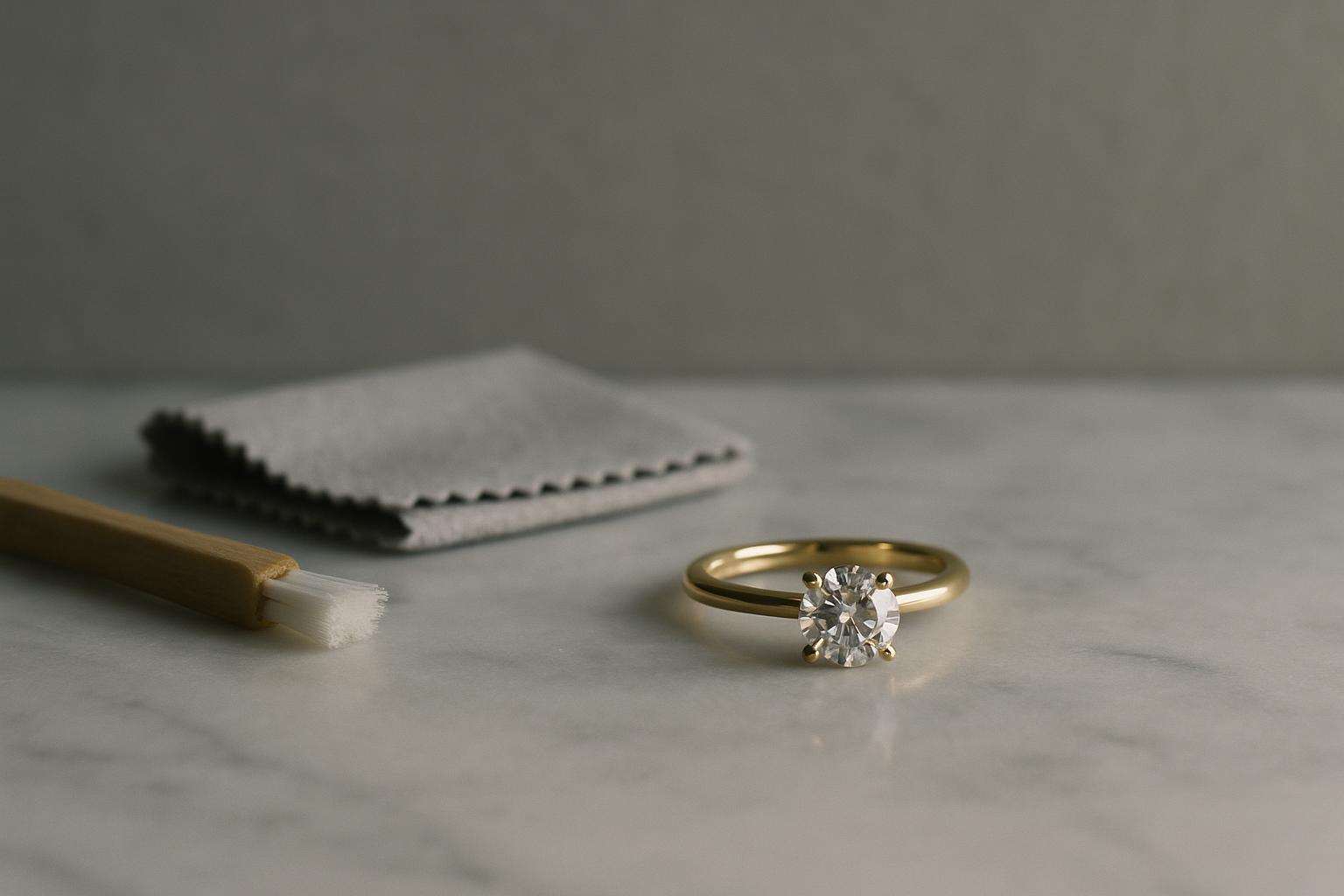
An engagement ring worn every day needs professional cleaning and inspection every six months, at-home cleaning once a week, prong retipping every five to ten years (cost: $120–$250 for a full four-prong set), and rhodium replating every one to two years for white gold (cost: $50–$150). Most major chains — Jared, Kay, Zales — provide the biannual service free of charge. Staying on this calendar is the single most cost-effective thing you can do to protect a ring worth thousands of dollars.
A stone lost from a ring on a Tuesday morning — somewhere between the gym and the office — is one of the most common jewelry disasters jewelers see. The stone rarely goes missing in a single dramatic event. It leaves gradually: a prong wears thin over months, develops a barely perceptible flex, and eventually releases the stone during a mundane motion. The entire failure is preventable with a maintenance schedule that takes less time per year than a single trip to the dentist.
This guide is organized as a working calendar. It covers every service your ring needs, at what interval, what to look for yourself between visits, and what each service should cost at a well-equipped jeweler in 2026. The numbers are verified against current trade sources and real repair shops, not dealer estimates from three years ago.
How Often Should You Have Your Engagement Ring Professionally Inspected?
Every six months is the professional consensus for a ring worn daily. Jewelers Mutual Group endorses biannual visits as the standard of care for high-value everyday pieces and notes that for rings worn constantly, quarterly visits are defensible. The six-month interval is not arbitrary: prongs that develop micro-movement or early wear can reliably be identified and corrected at that frequency before a stone is lost. Annual-only visits allow minor problems to compound into costly repairs. Graduate Gemologist Kristin Milne, writing for The Knot, recommends a minimum of three to four professional visits per year for daily-wear rings and advises owners who live near their jeweler to visit as often as is practical.
Setting type affects the required frequency. A four-prong solitaire concentrates the holding force across fewer, thicker prongs — each bears more stress, and a single prong failure is more consequential. A six-prong setting distributes wear across more points but each thinner prong is individually more susceptible to bending. Both warrant the same six-month schedule, but four-prong owners have less margin for delay if a prong problem is identified.
The good news on cost: professional cleaning and basic inspection are free at most major chains. Jared provides complimentary cleaning and expert inspection regardless of where the ring was purchased. Kay Jewelers includes free in-between cleanings and inspections at any time, and Zales' quick clean and inspection carries no charge. Many independent jewelers extend the same courtesy to build long-term client relationships. Where fees apply, a basic inspection runs $10–$25.
What Happens During a Professional Inspection — and What Can You Check Yourself?
During each professional visit, a trained bench jeweler or gemologist examines the ring under high magnification for a defined set of failure points:
- Prong tips. The jeweler checks whether tips have thinned, bent, or cracked. A prong worn past a safe thickness can release a stone without any warning or audible rattle.
- Stone security. Even micro-movement before audible looseness is detectable under magnification. The jeweler applies gentle pressure to the stone to check for any play in the setting.
- Band integrity. Out-of-round deformation, hairline stress fractures in the shank, and worn solder joints are checked visually and by feel.
- Metal surface. For white gold rings, the rhodium plating condition is assessed. Yellowing at high-contact points — the inner shank and prong bases — signals replating is due.
The inspection is followed by ultrasonic cleaning, which uses high-frequency sound waves to dislodge debris from deep crevices in the setting, and steam cleaning to restore full brilliance. The complete service typically takes fifteen to thirty minutes.
Between visits, three ninety-second checks matter: (1) Examine each prong tip under strong light — smooth, rounded, and symmetrical is normal; flattened, pointed, or uneven tips need attention. (2) Attempt to shift the center stone with a fingernail — any detectable movement, however slight, means a loose prong. (3) Drag the ring lightly across fine-weave fabric — a prong that snags has lost its tip. These checks happen weekly during cleaning and have collectively prevented more stone losses than any scheduled appointment, because problems are caught far earlier.
The Prong Retipping and Rebuilding Schedule — and What It Costs
Prongs are the most mechanically vulnerable part of any ring worn continuously. Like tire tread, they wear imperceptibly with each daily contact until the tips become too thin to hold a stone securely. The analogy is exact: you would not wait until a tire blew out to replace it, and you should not wait until a stone falls from a ring to repair its prongs.
For typical daily wear, most jewelers cite a retipping timeline of five to ten years, with the lower end of that range for active wearers who keep the ring on during exercise, cooking, gardening, and manual work, and the upper end for those who remove it during physical activity. All prongs on a given ring should be retipped simultaneously: they wear at comparable rates, and addressing only one leaves the others near the same threshold.
| Service | Gold | Platinum | Notes |
|---|---|---|---|
| Single prong retip | $35–$75 | $45–$90 | Tip only; base and body intact |
| Full 4-prong retip (solitaire) | $120–$200 | $160–$300 | All tips done simultaneously; most common service |
| Full 6-prong retip | $150–$280 | $200–$400 | Six-prong solitaire or cathedral setting |
| Single prong rebuild | $80–$250 | $100–$300+ | Prong broken or worn to base; stone removal required |
| Halo setting re-secure | $100–$250 | $150–$350 | Melee diamonds in halo; labor-intensive |
The distinction between retipping and rebuilding is structural. Retipping applies when the prong's base and body are sound but the tip has worn thin — a jeweler applies a small bead of new metal to restore the original geometry. Rebuilding is required when a prong has broken off, bent severely, or the damage extends past the tip into the prong body itself. Rebuilding involves removing the stone, reshaping or replacing the prong from its base, and resetting the stone — a more labor-intensive process costing two to four times the retipping price.
Antique and vintage settings with intricate metalwork typically carry a premium of 25% or more due to the care required to avoid damaging surrounding detail. Channel and pavé settings command 50% or more in additional labor, because resecuring or removing stones from continuous settings requires precision that a standard solitaire repair does not. If your ring has side stones or a pavé band, factor this into your maintenance budget. For guidance on protecting a ring with a pavé or halo setting, see our safe ring cleaning guide.
The economic case for preventive maintenance is straightforward. Replacing a lost center diamond — even a modest one-carat stone of average quality — costs several hundred to several thousand dollars and may be irreplaceable if it was a specific matched color or a family heirloom. Annual maintenance budgets of $50–$100 are a sound investment against that risk.
The White Gold Rhodium Replating Schedule
White gold is not naturally silver-white. The base alloy — gold mixed with palladium, nickel, or silver — is slightly yellow. The bright white finish on a white gold ring comes from a rhodium electroplating layer applied after manufacture. Rhodium is a platinum-group metal that trades at approximately $8,000 per troy ounce as of June 2026, and its hardness and reflectivity make it ideal for jewelry finishing. It is also thin — standard plating runs 0.75 to 1.0 microns — and it erodes with daily contact.
Most daily-wear white gold rings require replating every twelve to twenty-four months. Active wearers who exercise with the ring on, expose it to chlorine, or work with harsh cleaning products will see the plating wear at the high-contact points — the inner shank and prong bases — within six to twelve months. The early sign is a slightly warm or yellowish cast at the contact edges, most visible when the ring is placed face-down on a white surface.
| Setting Complexity | Typical Cost | Plating Thickness |
|---|---|---|
| Simple solitaire or plain band | $50–$100 | Standard 0.75–1.0 micron |
| Solitaire with halo or pavé band | $75–$150 | Standard; complex surface prep |
| Wide or ornate setting | $100–$200 | Standard to premium |
| Premium thick plating (1.5–2.0 micron) | +20–30% over standard | Lasts ~2x as long as standard |
Note that replating also follows any ring repair that involves soldering: the heat from soldering burns off or dulls the rhodium at the work site, so a prong retipping on a white gold ring should always include replating as part of the same service visit. Ask your jeweler to confirm this is included in the quoted price rather than discovering an additional charge after the repair.
Yellow gold, rose gold, and platinum rings do not require replating. Platinum develops a natural matte patina over time — called a patina — that some owners consider a desirable character mark and others prefer to have professionally polished back to a mirror finish, at a cost of $30–$80. Rose gold's elevated copper content makes its surface warm tone a permanent characteristic of the alloy, not a plating.
Your Complete Annual Maintenance Calendar
Consolidating all of the above into a practical, repeatable schedule makes it easier to follow consistently. The table below is organized by frequency, not by category, so you can use it as a working checklist rather than a reference document.
| Frequency | Task | Who Does It | Approx. Cost |
|---|---|---|---|
| Daily | Wipe with lint-free cloth after wear; remove before swimming, gym, harsh cleaning | You | Free |
| Weekly | Soak 20–40 min in lukewarm mild-soap water; scrub with soft toothbrush; rinse; dry | You | Free |
| Weekly (pre-cleaning check) | Inspect prong tips; test stone movement; snag-test on fine fabric | You | Free |
| Every 6 months | Professional ultrasonic + steam clean; full prong and setting inspection | Jeweler | Free at most chains |
| Every 1–2 years (white gold) | Rhodium replating | Jeweler | $50–$150 |
| Every 2–3 years | Insurance reappraisal to reflect current replacement value | Certified appraiser | $50–$150 |
| Every 5–10 years | Prong retipping (all prongs, same visit) | Bench jeweler | $120–$300 |
| As needed | Professional polish to restore scratched or matte metal | Jeweler | $30–$80 |
One structural note on appraisal timing: jewelry insurance policies pay out based on the appraised value on file. If your ring was appraised for $8,000 in 2022 and its current replacement value is $11,500 — a realistic increase given gold and diamond price movements since then — your policy leaves a $3,500 gap at replacement. Jewelers Mutual Group recommends reappraisal every two to three years for actively worn pieces. A fresh appraisal typically costs $50–$150 with a GIA-trained independent appraiser. For full guidance on the appraisal process and insurer requirements, see our ring appraisal guide.
Do Retailer Care Plans Replace This Calendar?
Several national retailers offer lifetime care programs that cover many of these services for a one-time upfront fee. Helzberg Diamonds' Lifetime Care Plan is the most comprehensive: it covers professional cleaning, inspections, ring resizing, lost-stone replacement, prong repair, and refinishing for the life of the jewelry, provided you visit a Helzberg location every six months to maintain the plan. The plan transfers if the ring is passed on.
The financial arithmetic is favorable for frequent repair users — a single prong retipping ($120–$200) plus two or three resizings ($30–$100 each) plus several rhodium platings ($50–$150 each) over a decade could total $600–$1,000 in out-of-pocket costs, potentially exceeding the plan's one-time fee. The practical constraint is location: all covered repairs must be performed at a Helzberg store, and the plan lapses if inspections are missed. It is not a substitute for standalone jewelry insurance: Helzberg's plan does not cover loss or theft, which is where BriteCo and Jewelers Mutual provide protection. The two products serve different risk categories and are complementary. For a detailed comparison of insurance options, see our standalone vs. homeowners insurance guide.
Whether or not a retailer care plan is in place, the maintenance calendar above applies. Care plans cover the cost of services already scheduled; they do not change the frequency at which those services are needed. The ring does not know it is under warranty. Prongs wear at the same rate regardless. The six-month professional inspection remains the irreducible minimum.
Frequently asked
How often should I have my engagement ring professionally inspected?
Every six months is the professional standard for a ring worn daily. Jewelers Mutual Group endorses biannual professional visits as the baseline of care for high-value everyday pieces, and for rings worn constantly they suggest going as often as every three to four months. The six-month interval exists for a specific reason: prongs and settings that develop micro-wear can be identified and corrected at that frequency before a stone is actually lost. Annual-only visits allow minor problems to escalate into costly repairs or complete stone loss. If you are active — gym, gardening, manual work — tighten the schedule to quarterly. Most major chains including Jared, Kay, and Zales provide free cleaning and inspection regardless of where you bought the ring, so there is no financial barrier to staying on schedule.
What does a professional ring inspection actually check for?
A trained bench jeweler or gemologist examines the ring under high magnification for several specific failure points. Prong tips are checked for thinning, bending, or cracking — a prong worn past a safe threshold can release a stone without warning. The jeweler also looks for loose stones (even micro-movement before any rattling is audible), out-of-round band deformation, hairline stress fractures in the shank, and wear at solder joints. For white gold rings, the condition of the rhodium plating is assessed. The inspection is typically followed by ultrasonic cleaning — which uses high-frequency sound waves to dislodge debris from deep in the setting — and steam cleaning to restore full brilliance. The whole service takes fifteen to thirty minutes and is complimentary at most national chains and many independent jewelers.
How much does prong retipping cost in 2026?
Current market pricing for a straightforward prong retip at a local jeweler is $35–$75 per prong, according to Robinson's Jewelers. For a four-prong solitaire — the most common engagement-ring setting — a complete retipping of all four prongs typically runs $120–$200 at mid-market shops, with platinum settings and high-cost-of-living cities pushing that figure above $250. Online mail-in services such as MyJewelryRepair.com start at $49.99 for a single prong retip, which can be cost-effective for straightforward yellow-gold settings. If a prong is broken all the way to its base rather than merely worn at the tip, the jeweler needs to rebuild rather than retip — that runs $80–$250 for a single prong in gold or platinum. The economics are clear: a $150–$200 preventive retipping is far cheaper than a $1,000+ stone replacement if a prong fails.
How often does a white gold ring need rhodium replating, and what does it cost?
White gold's bright silver finish comes from a rhodium electroplating layer applied at the factory — the underlying metal is actually a slightly yellow gold alloy. Daily wear erodes this plating gradually, and most white gold engagement rings show visible yellowing within one to two years of continuous daily wear. Active wearers who exercise, swim, or work with chemicals may need replating every six to twelve months. The standard professional advice is to plan on replating every twelve to twenty-four months. As of June 2026, rhodium trades at roughly $8,000 per troy ounce, and replating a standard engagement ring at a retail jeweler costs $50–$150 for most pieces, with complex or wider designs reaching $200–$300. Ask your jeweler about plating thickness: a 1.0-micron application lasts nearly twice as long as a 0.25-micron standard treatment and is worth the modest upcharge.
When do prongs need to be retipped versus fully rebuilt?
The distinction is structural. Retipping applies when the prong's base and body are sound but the tip — the small hook that actually grips the stone — has worn thin. A jeweler applies a small bead of new metal to restore the tip's original geometry. Rebuilding is required when a prong has broken off, bent severely, or worn past the tip into the shank of the prong itself. Rebuilding involves removing the stone, reshaping or replacing the prong from its base, and resetting the stone — a more labor-intensive process costing two to four times more. Signs that retipping has progressed to a rebuilding situation include a prong that visibly catches fabric (the tip is gone), a prong that moves when pressed lightly, or a stone with any detectable rattle. A preventive inspection every six months catches the retipping window reliably. Most jewelers recommend retipping all prongs simultaneously rather than addressing individual prongs piecemeal, since prongs on the same ring wear at comparable rates.
Is it worth buying a lifetime care plan from a retailer like Helzberg?
Helzberg's Lifetime Care Plan — available for a one-time fee at purchase — covers professional cleaning, inspections, ring resizing, lost-stone replacement, prong repair, and refinishing for the life of the jewelry, provided you visit a Helzberg store every six months for inspection. The plan transfers if the ring is passed on. The financial case is straightforward: a single prong retipping runs $120–$200, a rhodium replating $50–$150, and resizing $30–$100 — three services over five years could easily total $500–$800 out of pocket. Whether the one-time plan fee justifies this depends on the fee amount and your proximity to a Helzberg location, since all repairs must be done in-store. Important limitation: the Lifetime Care Plan does not cover loss or theft — for those risks, a separate jewelry insurance policy from a provider like BriteCo or Jewelers Mutual is required. The two products are complementary rather than substitutes.
Can I do anything at home between professional inspections to catch problems early?
Yes — and the at-home check is genuinely useful, not just a ritual. Before your weekly cleaning, hold the ring up to strong light and look at each prong tip: they should be smooth, rounded, and symmetrical. A prong that appears flattened, pointed, or noticeably thinner than its neighbors needs professional attention before the next scheduled visit. Then, with the ring pinched gently between thumb and forefinger, attempt to shift the center stone with a fingernail. Any detectable movement — however slight, with or without sound — means a prong has loosened and you need an unscheduled visit. Finally, run the ring lightly along a piece of fine-weave fabric: a prong that snags has worn past its tip. These three checks add ninety seconds to your cleaning routine and have caught more lost stones than any scheduled appointment, simply because they happen weekly rather than biannually.