Ring Styles & Settings
Bezel Engagement Rings: The Most Secure Setting Explained
Full bezel, half bezel, and why this ancient setting became the practical-luxury choice of 2026.
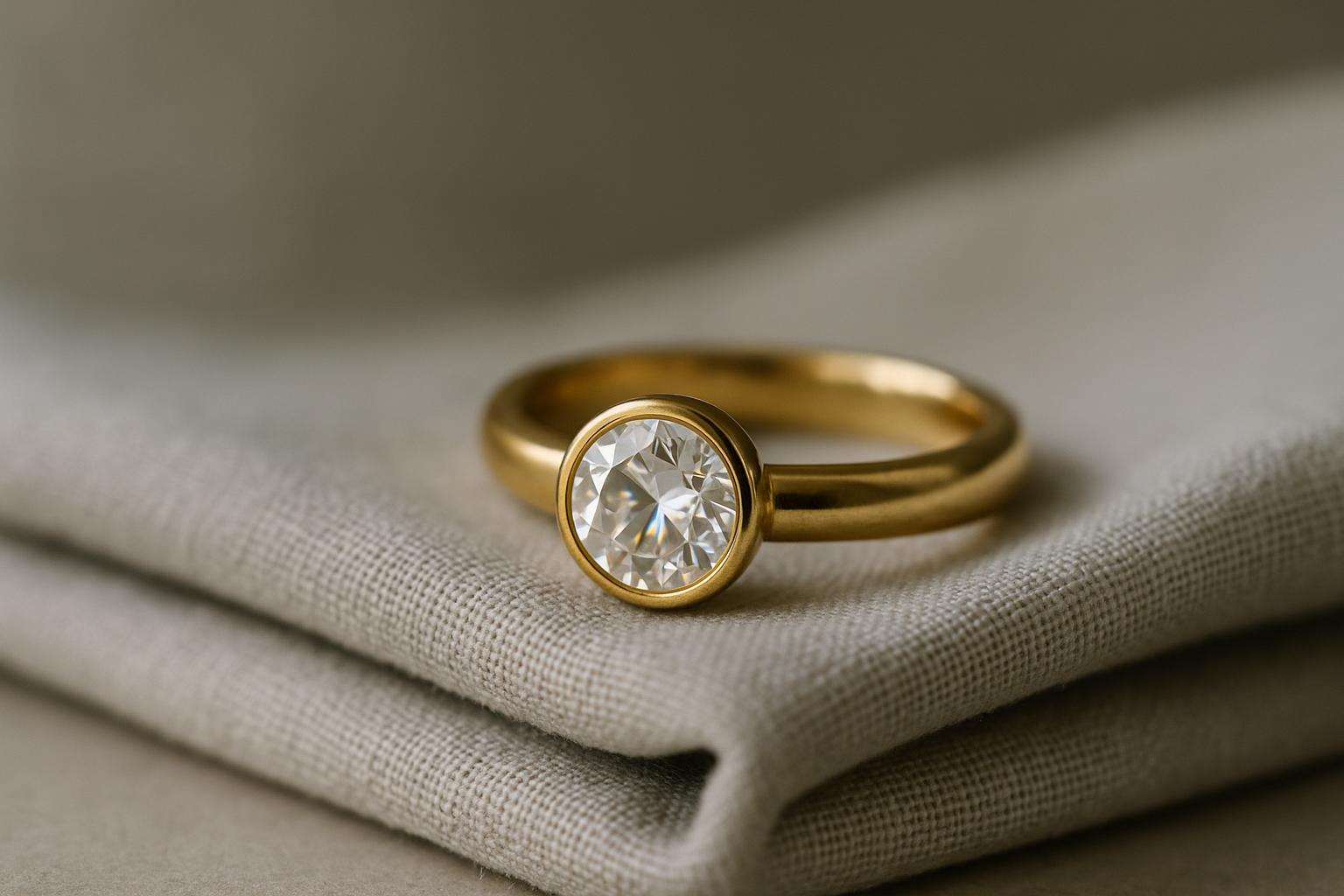
A bezel engagement ring wraps the diamond's girdle in a continuous metal rim, making it the most mechanically secure setting available and the practical first choice for active lifestyles. The trade-off is real: a full bezel reduces side-entry light by roughly 10–15% compared with prongs, and the rim reduces apparent face-up size. A half bezel recovers most of the sparkle and size while keeping the snag-free profile. Both variants cost more than comparable prong solitaires because they require more metal and more bench labor — a difference that has grown as gold prices have climbed.
There is a setting that jewelers have used to secure stones for longer than the prong has existed. Archaeological evidence places bezel-set jewelry in Ancient Egypt, Byzantine workshops, and Roman courts — a continuous metal rim fitted to a stone's exact outline was the standard hold type for most of jewelry history. Prongs only became dominant in the nineteenth century, when improved metalworking allowed the open-claw cathedral solitaire to emerge and maximize diamond brilliance. For nearly 150 years after that, prongs defined the engagement ring aesthetic. In 2026, the bezel is coming back — not as a historical curiosity but as the answer to a question more couples are asking: what setting lets me actually wear this ring?
The appeal is practical, not merely aesthetic. Prongs snag on latex gloves, climbing holds, woolen knits, and surgical gowns. They thin with wear, and a single damaged prong on a four-prong setting means 25% of the stone's mechanical hold is compromised. A bezel has no prongs to damage. The rim presses over the stone's girdle — the diamond's thinnest, most vulnerable equator — from every direction. The security hierarchy in this setting type is unambiguous: full bezel first, six-prong second, four-prong third, tension last for active wear. That ranking is not marketing; it follows directly from the mechanics of how each design holds a stone.
What Exactly Is a Bezel Setting?
A bezel is a custom metal collar, fabricated to match the precise contour of the specific stone it will hold. The process starts with the girdle measurement of your chosen diamond; a bench jeweler or CAD technician creates a rim that follows that exact outline, then the metal is pressed — or in precision work, hand-burnished — over the stone's edge once it is seated. The result is a ring where the diamond appears to emerge from the band rather than sit above it on claw feet.
Two distinct variants serve different purposes:
Full bezel: The rim completely encircles the stone's perimeter with zero gaps. Maximum security; minimum side light entry; the most pronounced framed aesthetic. This is the design that appears in Grace Kelly's iconic engagement ring — a 10.48-carat emerald cut flanked by two bezel-set baguette diamonds in a Cartier platinum mount from 1956 — and it is the design that contemporary jewelers are revisiting as yellow gold and architectural minimalism dominate 2026 bridal trends.
Half bezel (semi-bezel or partial bezel): Metal covers two opposing sides of the stone — typically the ends for elongated shapes, or the north and south poles for rounds — leaving the stone's flanks open. The half bezel recovers most of the sparkle lost in the full bezel by admitting lateral light, while still protecting the girdle at its most exposed positions. Frank Darling's signature half-bezel design, which they call "The Clutch," is built specifically on the observation that opposing bezels placed at the top and bottom of a stone also elongate its apparent face-up shape — a useful optical trick for round brilliants that a buyer wants to read as slightly more oval.
How Does a Bezel Affect Light Performance and Sparkle?
This is the trade-off that matters most at the bench, and the answer is more nuanced than the simple "bezels reduce sparkle" claim suggests.
A diamond's primary light performance — the brightness, scintillation, and fire that makes a round brilliant dance — operates predominantly through the table and crown facets. Light enters through the top of the stone, refracts through the interior, and exits back through the crown in white light flashes and spectral color bursts. This pathway is entirely unaffected by the presence or absence of a metal rim at the girdle. A well-cut diamond — Excellent or Ideal on the GIA scale — delivers its fundamental light performance whether it sits in a prong or a bezel.
What the bezel does affect is the secondary contribution of lateral light — light that enters from the sides through the open girdle zone that prongs leave exposed. This lateral light adds approximately 10–15% to total perceived brilliance in a prong setting, particularly to fire (spectral flashes), which is why side-lit prong rings have a different visual character than bezels under the same lighting. VRAI's gemology team describes the difference accurately: "a well-crafted bezel set diamond, light enters the table, reflects off the internal mirrors, and bounces right back to your eye" — the full-bezel ring sparkles less on the periphery, not at the center of the table.
One practical implication for buying: clarity grade interacts with setting choice. In SI1 or lower clarity stones, the additional lateral light from a prong setting helps scatter incoming light through inclusions, reducing their visibility through increased internal diffusion. If you are buying an SI1 round brilliant and trying to maximize the eye-clean appearance, a prong setting offers a modest but real advantage over a full bezel. For VS2 and above, the interaction is negligible — the inclusions are not significant enough to benefit meaningfully from the extra light.
Full Bezel vs. Half Bezel vs. Prong: Head-to-Head Comparison
| Feature | Full Bezel | Half Bezel | Four-Prong Solitaire |
|---|---|---|---|
| Stone security | Highest — girdle fully enclosed | Very high — girdle protected at most-exposed points | High with intact prongs; drops 25% if one prong fails |
| Side light / lateral fire | Reduced ~10–15% vs. prong | Reduced ~5% vs. prong; flanks open | Maximum lateral light return |
| Apparent face-up size | Reduced 5–20% depending on rim width | Reduced ~5%; minimal visual impact | Full diameter visible |
| Snag risk | None — smooth continuous rim | Minimal — no prong tips | Moderate — prong tips can catch fabric |
| Maintenance frequency | Annual inspection; no re-tipping | Annual inspection | Every 6 months for active wearers; periodic re-tipping |
| Typical setting cost premium vs. plain solitaire | +$300–$600 | +$200–$450 | Baseline |
| Resizing ease | Straightforward on plain shank | Straightforward on plain shank | Straightforward on plain shank |
| Best for | Active lifestyles, hands-on professions, modern minimalism | Active lifestyles + buyers who want near-maximum sparkle | Buyers prioritizing maximum brilliance and classic aesthetics |
Who Should Choose a Bezel Setting?
The bezel is not for everyone, and a jeweler who tells you otherwise is selling rather than advising. It is the right setting for a specific profile of wearer, and that profile has grown substantially in 2026 as the aesthetic values of the market have shifted.
The active professional. Nurses, surgeons, teachers, physical therapists, mechanics, climbers, and anyone who wears latex or nitrile gloves daily encounters the same problem with prong rings: prong tips catch glove interiors, accelerating prong wear and creating micro-tears in glove material. The snag-free profile of a bezel eliminates this. Pediatric healthcare workers face an additional consideration — prong tips can scratch patients during examinations. For these wearers, the sparkle trade-off is not a concern because the ring is frequently removed during work; the bezel's value is in durability during the moments when it is worn.
The minimalist aesthetic buyer. The broader 2026 bridal design shift toward what Connoisseurs describes as "practical luxury" — rings that look intentional and substantial rather than maximally sparkly — has brought a significant new audience to bezel settings. This buyer is not necessarily active; they simply want a ring that reads architectural and considered rather than traditional. Yellow gold bezels, in particular, have seen strong demand as yellow gold has staged its 2025–2026 comeback across the broader jewelry market.
The concerned stone-protection buyer. Diamonds are the hardest natural material, but their girdle edges are brittle under impact. An edge-on blow — dropping the ring on a tile floor, catching it against a door frame — can chip a diamond at the girdle. Prongs leave this zone exposed. The bezel protects it. For buyers who have previous experience losing a stone from a prong setting, or who simply prefer mechanical redundancy, the full bezel provides genuine peace of mind.
Who should probably not choose a full bezel. Buyers who have chosen an elongated shape specifically for its face-up size relative to carat weight — an oval or marquise selected to maximize perceived diameter — will lose some of that advantage to the rim. For these buyers, the half bezel is worth evaluating seriously, or a prong in a low-profile setting. Similarly, buyers below a 1-carat center stone in the $3,000–$5,000 budget range may find the bezel's visual size reduction more noticeable relative to the stone. The setting's architectural strength reads better at 1 carat and above.
The 2026 Bezel Moment: What's Driving the Trend
Several converging forces have made the bezel setting the most discussed engagement ring style of 2026. Celebrity rings have been part of the story: Dua Lipa's engagement ring from actor Callum Turner — a round brilliant estimated at 2.5–4 carats set in a chunky semi-bezel yellow gold band with a wide architectural shank — became one of the most referenced rings among couples beginning their ring search this year. Zendaya's reported engagement ring, a 5-carat east-west cushion set in a yellow gold bezel, pushed the orientation trend and the setting trend simultaneously. Miley Cyrus's bezel-set cushion in yellow gold added a third data point that confirmed what bench jewelers had already been observing in their own client conversations.
Grace Kelly's ring is worth addressing separately because it appears consistently in search results alongside modern bezel content. Her 1956 Cartier platinum piece — a 10.48-carat emerald cut flanked by bezel-set baguettes — is not a stylistic ancestor of the 2026 trend in a direct design sense. What it confirms is that the bezel's association with exceptional craftsmanship and enduring taste is not a recent invention; it predates the prong-dominant era and will likely outlast the current trend cycle.
Beyond celebrity influence, the bezel's 2026 resurgence reflects a genuine shift in how engaged couples think about ring ownership. The "set it and forget it" quality — wear it during workouts, during medical procedures, while gardening, without removing it for fear of snagging or stone loss — aligns with how rings are actually lived with rather than displayed. The rise of plain and semi-plain bands, the yellow gold resurgence, and the broader movement away from maximalist sparkle toward restrained, sculptural jewelry all point in the same direction.
At the retail level, both Blue Nile and Brilliant Earth carry dedicated bezel engagement ring collections with significant inventory depth. Independent boutique designers including Frank Darling and VRAI have built signature bezel collections — Frank Darling's "Daily Bezel" and "Breezy Solitaire" and VRAI's solitaire bezel in their lab-grown diamond line — that have driven substantial engagement from buyers who might previously have defaulted to a prong solitaire.
What to Discuss with Your Jeweler Before Deciding
Four conversations are worth having before committing to a bezel setting:
Confirm the fit precision. A bezel is only as secure as the fit between rim and girdle. A rim machined to close tolerances, pressed flat against the stone's edge by a skilled setter, holds the stone firmly. A rim with gaps — either because the stone's girdle diameter was measured loosely, or because the metal was not burnished fully against the stone — creates movement, which leads to eventual stone loss. Ask the jeweler or retailer to explain their bezel fabrication process. At custom-leaning ateliers like Frank Darling, the bezel is built to the specific stone; at volume retailers, it is fitted from a standard range. Both can produce excellent results, but the question is worth asking.
Understand the wedding band pairing. A full bezel setting with a flat shank typically requires a contoured or curved wedding band to sit flush against the engagement ring without a gap. A straight flat band will sit at a slight angle against the bezel's curved profile, creating a gap on the sides. If you plan to stack a wedding band, bring both rings to the jeweler at the same time or confirm the engagement ring design before ordering a wedding band. See our guide to setting types compared for more on how each setting family interacts with band stacking.
Choose your metal deliberately. Bezel settings are more metal-intensive than prong solitaires, and mid-2026 gold prices near $4,700 per troy ounce mean that metal choice has a larger impact on total ring cost than it did two years ago. A bezel in 14K white gold is meaningfully more affordable than the same design in platinum; the security and durability difference between 14K white gold and platinum for a bezel setting is small (both hold the stone equally well) but platinum's higher hardness does reduce the rate at which the rim softens over decades of wear. For long-term considerations, see our platinum vs. gold guide. If budget is a real constraint, 14K yellow gold bezels also benefit aesthetically from the current yellow gold trend — it is not a compromise choice.
Verify the stone's girdle condition first. Before a bezel setting is fabricated, the stone's girdle should be inspected for pre-existing chips or abrasions. The bezel will cover and protect the girdle — but it will also conceal any existing damage. If the stone has a chipped girdle, ask whether that affects the structural integrity of the setting. GIA-graded stones with documented girdle conditions (very thin to slightly thick, without chips noted) are the cleanest choice for bezel setting. For any stone you are having set — whether newly purchased or reset from another ring — have it inspected before fabrication.
The bezel is one of the oldest diamond-holding techniques in the craft, and in 2026, it is one of the most requested. For the right wearer — someone who lives actively, values architectural design, and wants a ring that performs as well in the third decade as the first — the security-sparkle trade-off resolves cleanly in the bezel's favor. For everyone else, the half bezel closes most of that gap while keeping the snag-free profile that makes this setting worth considering in the first place.
Frequently asked
Is a bezel setting more secure than prongs for an engagement ring?
Yes — by a meaningful margin. Expert consensus, including assessments from Mikado Diamonds and multiple independent gemologists, places the full bezel at the top of the setting security hierarchy. The reason is mechanical: a continuous metal rim presses over and around the diamond's girdle — the thinnest, most vulnerable part of the stone — from every direction simultaneously. There are no protruding prong tips to bend, catch, or chip off. A six-prong setting is the second-most secure option, followed by four-prong; tension settings and flush settings rank lower for different reasons. For nurses, climbers, athletes, tradespeople, or anyone who wears tight-fitting gloves regularly, the security difference is not trivial — a loosened prong on an active wearer's ring is a genuine stone-loss risk that the bezel design eliminates.
Does a bezel setting make a diamond look smaller?
Potentially, yes — and by more than buyers often expect. Because the metal rim covers the stone's outer edges, it reduces the visible table diameter. The effect ranges from subtle to noticeable depending on rim thickness and design: a narrow, well-fitted bezel may visually reduce the diamond by roughly 5–10%; a thicker, more architectural rim can reduce apparent diameter by as much as 15–20%. For buyers sensitive to perceived size, a half bezel (metal on two opposing sides only) recovers most of the exposed surface area. Round brilliant cuts tend to handle the rim the most gracefully; elongated shapes — oval, emerald, radiant — can actually read elegantly wider in an east-west bezel orientation because the long axis spans the finger without interruption. If maximum face-up size is the priority, prongs win; if clean design and security matter more, the size trade-off is worthwhile.
Does a bezel setting reduce sparkle?
It reduces side-entry light, not top-down brilliance. A diamond's primary light return comes through the table and crown facets, not the girdle edges. In a well-cut stone — Excellent or Ideal grade — the majority of the sparkle architecture operates independently of the setting. The rim does block some lateral light, which measurably reduces fire (spectral color flashes) compared to an open prong setting. The practical effect for most buyers: a full bezel with an Excellent-cut round brilliant shows approximately 10–15% less side brilliance than the same stone in a four-prong solitaire, but delivers equivalent top-down brightness. A half bezel narrows this gap considerably by leaving the stone's sides open. If your stone is SI1 clarity or below, the additional lateral light from prongs also helps scatter light through inclusions — a genuine reason to prefer prongs for lower clarity grades.
How much does a bezel engagement ring setting cost versus a prong solitaire?
Bezel settings cost more than comparable prong solitaires, for two reasons: more metal and more skilled bench labor. A continuous custom rim must be precision-fabricated to the exact girdle diameter of the specific stone — this is not a standard stamping operation. At Blue Nile, bezel solitaire settings in 14K white gold start in the $700–$1,000 range for the setting alone; their classic simple prong solitaires begin around $275. The platinum premium adds a further $400–$800 on top of the 14K price for the same design, because platinum is denser and the larger rim requires meaningfully more metal mass. As of mid-2026, with gold spot prices near $4,700 per troy ounce — up roughly 70% from early 2025 — this metal-mass differential is more pronounced than it was two years ago. Budget practically: plan to spend $300–$600 more on a bezel setting than on a comparable prong solitaire, and account for current metal prices when comparing quotes.
Can a bezel engagement ring be resized?
Yes, with some conditions. A plain-shank bezel ring — where the band metal is uninterrupted below the setting head — can be resized by a skilled bench jeweler using standard techniques, typically within one to two ring sizes in either direction. The bezel head itself does not usually need to be touched during a size adjustment on a plain band. Complications arise with two common design elements: if the shank carries channel-set or pavé diamonds running all the way around, resizing disrupts the stone channel and requires resetting; and if the bezel has a very tightly fitted custom tension element, adjustment can alter the fit tolerance. Brilliant Earth notes that bezel rings can often be resized, but complexity depends on band design and accent stone placement. Before purchasing, ask your jeweler specifically whether your chosen design accommodates resizing to your target range — and if you are unsure of your partner's size, a plain-shank bezel is the lower-risk choice than a fully pavé-banded design.
What diamond shapes work best in a bezel setting?
Rounds and elongated shapes both translate beautifully, but for different reasons. Round brilliants are the classic choice: the circular rim mirrors the stone's outline perfectly, producing a seamless, architectural solitaire. The 2026 trend, however, has shifted meaningfully toward oval and emerald cuts in bezels. An oval set in an east-west bezel — running horizontally across the finger — creates a wide, sculptural band ring that reads dramatically modern while keeping a low profile; Zendaya's reported ring is a widely cited example of this aesthetic. Emerald cuts in bezels align the clean geometric lines of the step-cut facets with the crisp rim, producing an almost architectural cohesion. Cushion cuts work well in yellow gold bezels, both for their rounded corners and their warm vintage personality. Princess cuts are less common in bezels because protecting the sharp corners with a rim can either obscure them entirely or require an imprecisely fitted rim — rounds and elongated shapes are cleaner technical fits.