Ring Styles & Settings
Hidden Halo Engagement Rings: What They Are & Who They Suit
The hidden halo adds sparkle from beneath the center stone — keeping a solitaire profile on top while revealing brilliance from the side.
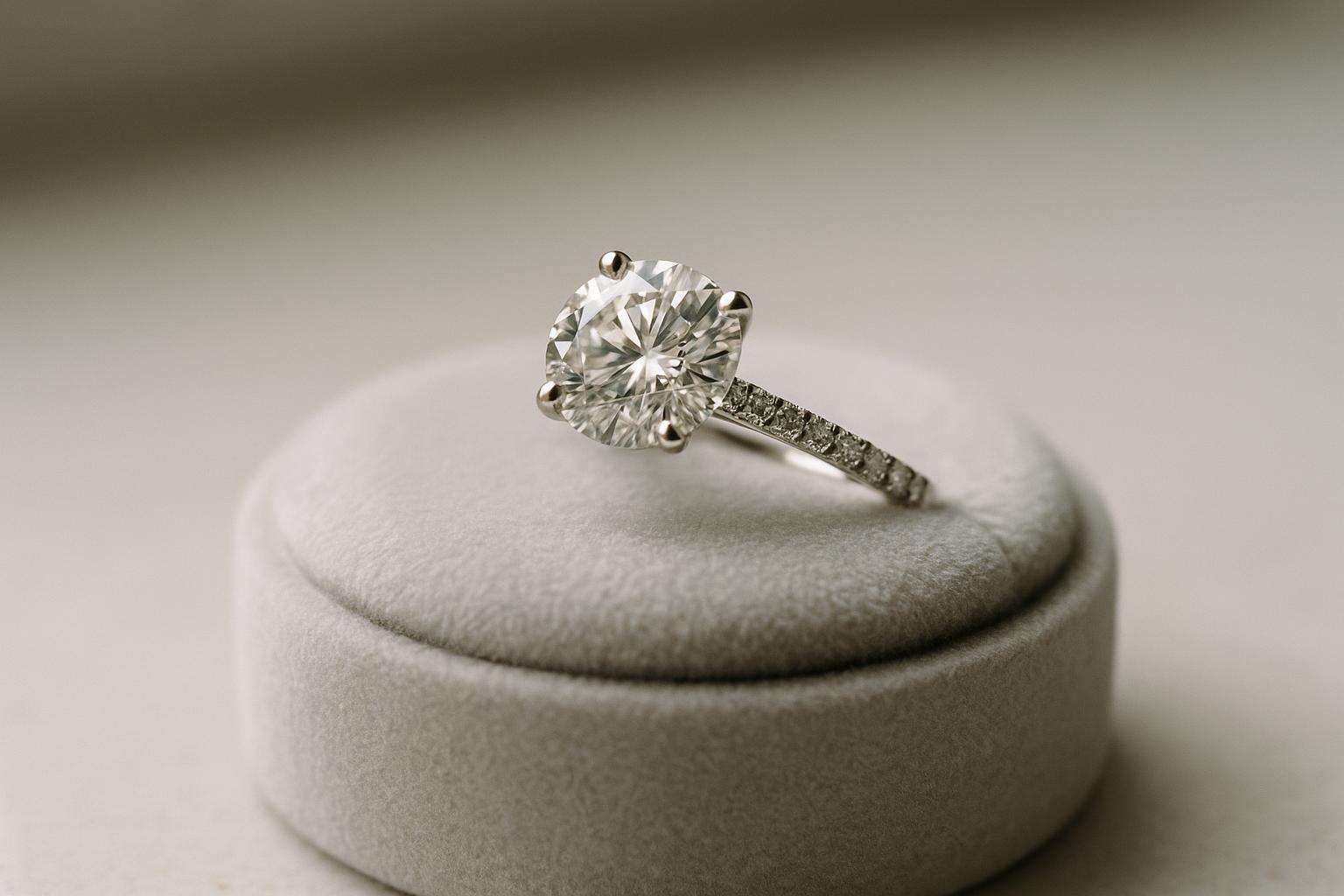
A hidden halo engagement ring places a ring of small pavé diamonds beneath the center stone, not around its crown. From above it looks like a solitaire; from the side, a halo of brilliance appears. It does not dramatically increase the stone's face-up size the way a traditional halo does, but it adds luminosity, profile depth, and a sense of craft that rewards close attention. Maintenance is higher than a solitaire — plan for weekly cleaning and semi-annual professional inspections. It suits buyers who love understated elegance on the top view and want the detail to be a private discovery, not a billboard.
What Is a Hidden Halo Engagement Ring, Exactly?
The name does exactly what it says: the halo is hidden. In a traditional halo setting, a row of small pavé or prong-set diamonds encircles the crown of the center stone, visibly enlarging its footprint from above. In a hidden halo — also called a secret halo or peek-a-boo halo in some catalogs — that same row of accent diamonds moves underneath, wrapping the gallery (the underside framework of the head) rather than the crown. Viewed straight down from above, the ring reads as a clean solitaire. Rotate it to a side profile and a glittering ring of diamonds emerges, catching light from below and from the side.
The design first appeared in mainstream retail catalogs in the early 2010s as a hybrid answer to two competing buyer preferences: the solitaire crowd who wanted nothing interrupting the center stone's silhouette, and the halo crowd who wanted extra sparkle and perceived size. As of 2025–2026, it is firmly established as one of the top-requested setting styles at major online retailers. Brilliant Earth returns over 100 results for hidden halo designs in their current catalog, with named styles ranging from the Freesia (bezel-set center, hidden halo gallery, low snag profile) to the Versailles (alternating round and marquise gallery diamonds) to the Ballad (a floral marquise pattern that reveals itself from below). Blue Nile offers the category in multiple metals and accent weights, including their French Pavé Hidden Halo Head variant that pairs round brilliant accents with marquise-shaped gallery details.
From a bench perspective, the setting is more labor-intensive than it looks. The gallery of a standard prong head is a simple open framework. A hidden halo head adds a second tier of metalwork — a miniature pavé band seated below the girdle of the center stone — that must be fabricated, set under magnification, and integrated seamlessly with the shank. That additional labor is why hidden halo settings cost meaningfully more than equivalent plain solitaire settings, even when the extra diamond carat weight involved is relatively modest.
Does a Hidden Halo Actually Make Your Diamond Look Bigger?
This is the question most buyers ask first, and it deserves a careful answer rather than a marketing one.
A traditional halo expands the visible crown diameter of the ring. Because the human eye perceives the entire surrounded shape as the center stone, a 1.00 ct round brilliant in a classic halo can read as a 1.50–1.75 ct stone from across a room. Industry sources, including product descriptions from James Allen, have historically cited a 15–30% perceived size gain for traditional halos in the top-down view. That effect is real and it is significant.
A hidden halo does not replicate it in the top view. The accent diamonds are underneath the stone, so they do not extend its face-up footprint. From directly above, the stone looks exactly as large as it is — no more, no less. What the hidden halo does add is luminosity and profile substance. The under-gallery diamonds scatter light upward into the pavilion and outward from the side, making the stone appear more radiant — brighter, with more apparent depth — particularly when the ring is in motion or viewed at an angle. There is a moderate perceived size benefit from the side: the added metalwork and diamond band beneath the stone lifts it fractionally higher off the finger and gives the profile a more substantial, jeweled appearance. But anyone choosing a hidden halo primarily for face-up size amplification will be underwhelmed compared with a traditional halo at the same setting price.
Where the hidden halo genuinely earns its position is with oval cuts showing a bow-tie shadow. The bow-tie is a dark, butterfly-shaped area visible through the center of many oval diamonds, caused by light leaking out of the pavilion at certain angles. A well-placed under-gallery halo pushes additional light into the pavilion from below, partially filling in that shadow and making the stone look livelier. Fascinating Diamonds notes this specifically as one of the most practical applications of the hidden halo setting, and it tracks with bench experience: the effect is real and worth factoring into the decision for oval buyers.
| Feature | Hidden Halo | Traditional Halo |
|---|---|---|
| Visible from above? | No — solitaire silhouette | Yes — crown surrounded by diamonds |
| Face-up perceived size gain | Minimal (luminosity only) | 15–30% larger |
| Side-profile sparkle | Significant | Moderate |
| Snag / catch risk | Lower than traditional halo | Higher (crown diamonds protrude) |
| Under-gallery cleaning | Requires weekly attention | More accessible from the side |
| Setting cost vs. plain solitaire | $500–$1,000 more | $500–$1,500 more |
| Best for | Clean top view + side sparkle | Maximum face-up visual impact |
Which Diamond Shapes Suit a Hidden Halo Best?
Not every diamond shape interacts with the under-gallery halo equally. The pairing matters because the halo's value depends on light being redirected into the stone from below — and that depends on the stone's faceting style and geometry.
Round Brilliant
The round brilliant is the natural benchmark. Its 57–58 facets are optimized to return light in all directions, and a GIA Excellent-cut round will bounce light into the hidden halo from the pavilion, creating a feedback loop of brilliance. If you are undecided on shape and the setting appeals to you, round is the pairing with the least risk and the most predictable result.
Oval
Arguably the most popular combination in the current market. The oval's elongated footprint already flatters fingers visually — it creates a lengthening illusion by pointing toward the tip of the finger. The hidden halo adds side sparkle without widening the top-view silhouette, which would undermine the slimming effect. And as noted above, the under-gallery placement can partially mitigate bow-tie shadow. For buyers who want a ring that looks large, flatters the hand, and reads as a solitaire on top, oval-plus-hidden-halo is the most efficient combination per dollar of total ring budget.
Cushion
Cushion cuts come in two broad optical families — modified brilliant (high sparkle, chunky facet pattern) and chunky/old-mine style (deeper, more vintage light return). Both integrate naturally with a hidden halo because the rounded corners follow the circular arc of the accent-diamond row without creating awkward gaps. The combination reads as classic-modern: the cushion's soft geometry feels vintage, and the clean top view keeps it contemporary.
Pear
The pear's pointed tip and rounded base mean the hidden halo cannot be a perfect circle — it must taper to accommodate the point. Well-executed pear hidden halos (look for designs that follow the outline of the stone rather than forcing a round gallery beneath it) add dramatic side sparkle and emphasize the shape's inherent elongation. From the side, a pear in a hidden halo setting has genuine presence.
Step Cuts: Emerald and Asscher
These are the unconventional choice, and that is precisely their appeal for a certain buyer. Emerald and Asscher cuts prioritize clarity over sparkle — they show fewer, larger facets arranged in parallel steps, creating a hall-of-mirrors depth rather than a fireworks display. The hidden halo cannot dramatically change their light behavior, but it introduces a ring of contrast: serene, glassy stone on top; active, scintillating accent diamonds underneath. The effect is architecturally interesting. If you are drawn to step cuts specifically because they are quiet and structured, verify that the hidden halo suits your visual preference rather than working against it. Step cuts also demand higher clarity grades — VS1 or better is the usual recommendation — and that clarity investment should remain the budget priority over the setting upgrade.
Princess
Princess cuts carry one structural concern in hidden halo settings: the four sharp corners require protective V-prongs to prevent chipping, and adding the gallery halo creates additional metalwork near those corners. The construction is achievable, but it demands a well-made setting from a reputable retailer. Inspect princess-cut hidden halo designs carefully, or have a trusted independent appraiser review the ring before purchase.
The Real Maintenance Picture: What Nobody Tells You at Purchase
Every engagement ring needs maintenance. A hidden halo needs more than most, and being clear-eyed about this upfront prevents frustration later.
The structural concern is the prongs holding the accent diamonds. The melee stones in the gallery halo are typically 1.2–1.5 mm in diameter, each held by its own tiny prong or bead. Those prongs are fine by necessity. Over time — through daily wear, occasional impact, and thermal cycling — they can flatten, bend, or work loose. A stone lost from the under-gallery is both an aesthetic problem and a practical one: once one stone goes, its neighbors have less support and are more vulnerable. The repair requires a jeweler to access the gallery, which on complex designs may mean partially disassembling the head. Expect repair costs 20–40% higher than equivalent solitaire work.
The cleaning concern is debris accumulation. The under-gallery is a sheltered space that traps hand cream, soap residue, cooking oils, and general hand grime. That buildup is invisible from the top but actively dampens the brilliance the setting was designed to create. The protocol recommended by With Clarity — and consistent with standard bench practice — is a weekly soak of ten to fifteen minutes in warm water with a few drops of mild dish soap, followed by gentle brushing with a soft toothbrush directed specifically at the underside of the setting, then a thorough rinse and pat dry. This is not optional or occasional maintenance for a hidden halo; it is the baseline cadence to keep the ring performing as intended.
Professional inspection every six months — not annually — is the appropriate schedule. A jeweler with a loupe can catch a marginally loose prong before it becomes a lost stone. They can also ultrasonically clean the gallery area far more thoroughly than any at-home method. If your budget for ring care has always been "nothing unless something breaks," a hidden halo will push back against that assumption.
One practical upside: the hidden halo's accent diamonds are beneath the stone, not projecting from the crown. This means the ring snags on fabric, knit sweaters, and hair significantly less than a traditional halo, whose crown diamonds can catch on anything with a loose weave. For buyers who find traditional halos impractical in daily life but want accent diamonds somewhere, the hidden halo offers a workable middle ground — more maintenance underneath, less snag risk on top.
Who Is This Ring For, Really?
The hidden halo is a specific proposition. It rewards people who value craft that reveals itself gradually — the kind of ring where a friend notices something sparkling from an unexpected angle and leans in to look closer. It is not the ring for someone who wants maximum face-up visual impact at a given budget; for that, a traditional halo or a slightly larger solitaire center stone will both serve better. It is not the ring for someone with a minimal-maintenance mindset; the under-gallery needs consistent attention.
It is well-suited for buyers who:
- Want a solitaire silhouette in photos and at a distance, with additional dimension in person
- Are choosing an oval or cushion cut and want to mitigate bow-tie shadow or add profile depth
- Work in environments where a protruding traditional halo would catch on things but still want more than a plain setting
- Appreciate jewelry that has a detail worth noticing — something that distinguishes the ring without announcing itself loudly
- Are comfortable with a consistent weekly cleaning habit and semi-annual jeweler visits
It is also worth pairing the setting decision with a realistic center-stone budget. The hidden halo setting adds $500–$1,000 to a plain solitaire setting at current market prices. For a buyer on a fixed total budget, that increment comes directly from the center stone. Given that the hidden halo's perceived size benefit in the top view is modest, most buyers are better served prioritizing cut quality in the center stone and letting the setting take whatever is left. A GIA Excellent-cut 0.90 ct round brilliant in a hidden halo will outperform a GIA Very Good-cut 1.00 ct round in the same setting, both optically and as a long-term value proposition.
For a broader look at how the hidden halo fits within the full landscape of setting choices — from plain solitaires to traditional halos, bezel wraps, and pavé shanks — see our complete engagement ring settings comparison. If you are weighing the hidden halo against a traditional halo specifically for maximum perceived size, our guide to setting architecture and stone height covers the optical mechanics in detail.
The hidden halo is a considered choice, not a default. When it fits the buyer, it fits very well. The ring has a quiet confidence to it — it does not need to shout. That is, in the end, its best argument for itself.
Frequently asked
What exactly is a hidden halo engagement ring?
A hidden halo — sometimes called a secret halo or peek-a-boo halo — is a row of small pavé-set diamonds positioned beneath the center stone rather than around its crown. From directly above, the ring reads as a clean solitaire. Tilt it to a profile view and a glittering ring of accent diamonds appears at the gallery, catching light from the side and lifting the center stone visually off the band. The effect is intentionally understated from the top and surprising from the side — a detail the wearer appreciates more than casual observers do.
Does a hidden halo actually make the center stone look bigger?
The honest answer is: from above, minimally; from the side, noticeably. A traditional halo adds its accent diamonds around the crown of the center stone, expanding the visible footprint by roughly 15–30% in the top-down view. A hidden halo does not extend the stone's face-up diameter at all — its diamonds are tucked underneath, so the top silhouette is unchanged. Where you gain is in luminosity and profile volume: the under-gallery diamonds scatter light upward into the pavilion and outward from the side, making the stone look more radiant and slightly more substantial when the ring is in motion or viewed at an angle. For buyers who genuinely need maximum face-up size amplification, a traditional halo still wins. For buyers who want a solitaire silhouette with bonus sparkle, the hidden halo is the better fit.
Which diamond shapes work best in a hidden halo setting?
Round brilliant diamonds are the natural pairing — their 57–58 facets already maximize light return, and the under-halo catches any light that escapes through the pavilion. Oval cuts are arguably the most popular combination in 2025–2026: the elongated shape creates a finger-lengthening illusion, and the hidden halo's under-gallery diamonds can push extra light into the bow-tie shadow that many oval diamonds show, partially masking it. Cushion and pear shapes also integrate well because their curved outlines follow the arc of the accent-diamond row naturally. Step cuts — emerald and Asscher — are a more unconventional choice; their hall-of-mirrors faceting does not throw light into the halo the way brilliant cuts do, but the contrast between crisp geometric lines on top and subtle sparkle underneath has its own appeal. Princess cuts can work but require V-prongs at the corners to protect the stone's vulnerable sharp edges from the setting's additional metalwork.
Is a hidden halo harder to maintain than a standard solitaire?
Yes — maintenance demands are higher than for a plain solitaire, though somewhat lower than for a full traditional halo. The under-gallery location traps oils, soap residue, and debris that are difficult to dislodge with a quick rinse. Weekly at-home cleaning using warm water, a drop of mild dish soap, and a soft-bristle toothbrush directed at the underside of the setting is the standard protocol recommended by jewelers, including With Clarity. Ultrasonic cleaners are generally safe for diamond-and-gold combinations but should be avoided if the ring contains fracture-filled stones or certain colored gems. Professional inspection every six months — not just annually — is prudent, because the small prongs holding the halo diamonds are fine and subject to wear. Budget for service costs roughly 20–40% higher than equivalent solitaire maintenance due to the additional labor involved in accessing the gallery.
How much does a hidden halo engagement ring setting cost?
Setting prices (stone not included) vary by retailer and metal. At Blue Nile — which now carries the James Allen collection following their April 2026 integration — hidden halo settings in 14K white gold typically range from approximately $1,070 to $1,504 for the setting alone, depending on accent diamond carat weight and shank design. Adding a pavé band raises the price toward the higher end of that range. Platinum settings carry a premium of roughly $400–$800 over the equivalent 14K gold design, reflecting platinum's higher density and purity. Brilliant Earth offers hidden halo settings at somewhat higher price points, reflecting their ethical-sourcing positioning. As a general benchmark, expect to pay $500–$1,000 more than a comparable plain solitaire setting for the privilege of the accent diamonds and additional labor. Lab-grown center stones reduce total ring cost by 30–50% versus natural diamonds of equivalent specifications, making the hidden halo more accessible at a given budget level.