Where to Buy
Best Vintage and Antique Engagement Ring Dealers in 2026
Six specialist dealers tested and compared — from a 50-year San Francisco institution to a fifth-generation Diamond District purveyor. Here is who earns your trust and your money.
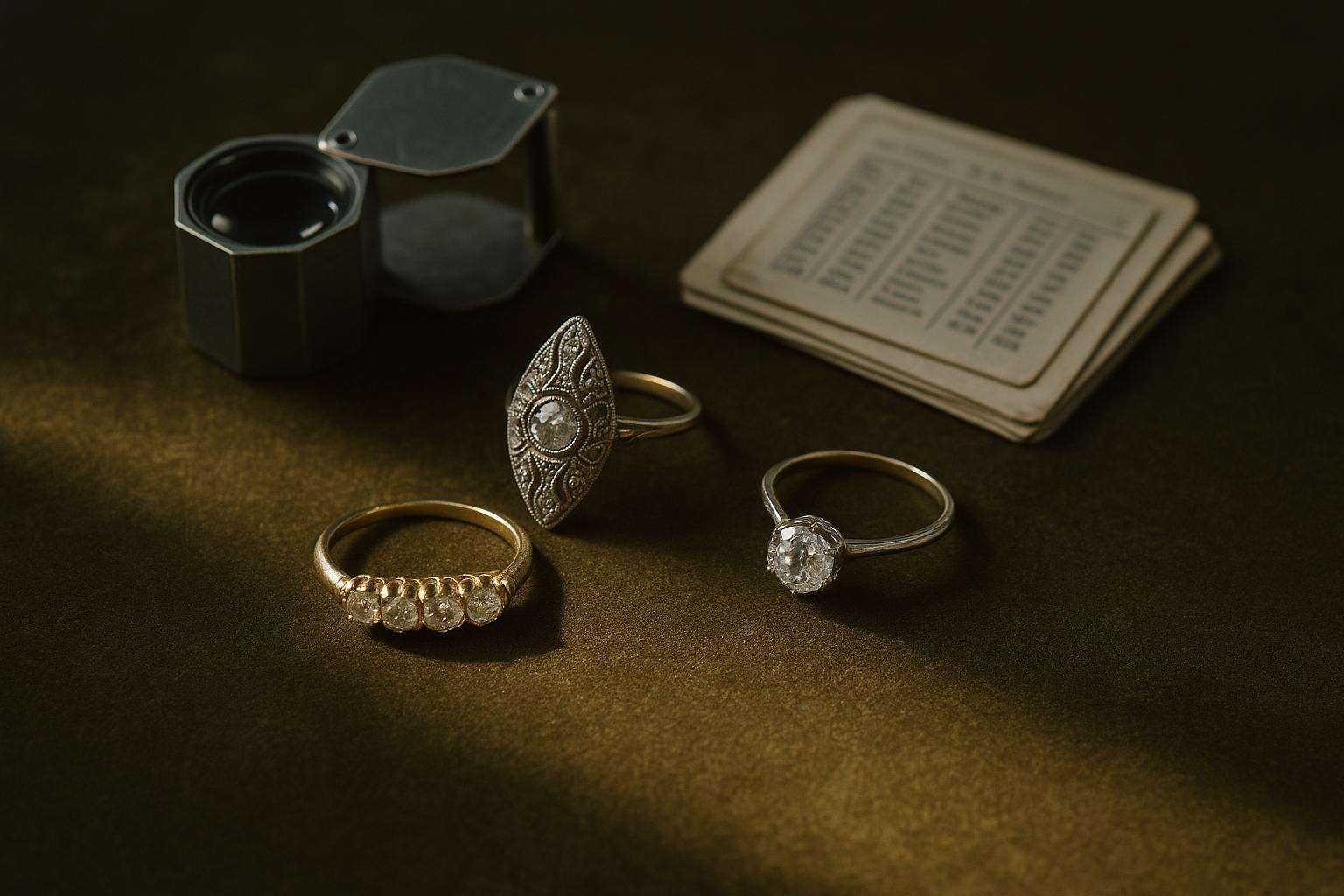
antique engagement ringsvintage ring dealers 2026Art Deco platinum ringsold European cut diamondsvintage ring authenticationestate diamond jewelry
The quick verdict
Lang Antiques earns the top position for breadth of authenticated inventory and institutional depth, but EraGem's 60-day return policy, Erstwhile's fifth-generation Diamond District expertise, and Estate Diamond Jewelry's accessible Art Deco e-commerce each win distinct buyer profiles decisively.
- Best overall
- Lang Antiques — Over 50 years of authenticated estate jewelry dealing, coverage of every major period from Georgian through Mid-Century, a free scholarly resource in the Antique Jewelry University, and an institutional track record unmatched by any other dealer in this comparison. The default first stop for a serious antique ring buyer.
- Best value
- Estate Diamond Jewelry — Strong Art Deco and Victorian inventory at accessible price points, GIA-trained staff appraisals, and clear educational content that helps buyers understand what they are buying — without requiring the collector's depth of knowledge that Lang Antiques rewards.
- Best for Maximum return flexibility
- EraGem — 60-day money-back return policy — double the 30-day industry standard at modern online retailers — combined with independently appraised and certified inventory on most pieces before listing. The right choice for buyers who need the ability to examine a ring in hand before fully committing.
How we evaluated
Each dealer was evaluated against five criteria weighted for a buyer purchasing a genuine antique or vintage engagement ring in 2026. Authentication documentation standards were assessed against published dealer practices and available third-party evidence. Return policies, inventory era coverage, and pricing were verified via live dealer websites on June 25, 2026. Institutional credentials — years in operation, staff gemological designations, and industry reputation — were cross-referenced against multiple independent sources. Ratings are comparative within this peer group of specialist vintage and antique dealers.
- Authentication and Documentation Standards. Whether the dealer provides hallmark identification, stone cut documentation, independent written appraisals, and clear period dating for individual pieces — the minimum standard a buyer needs to verify a provenance claim without their own gemological expertise.
- Inventory Depth by Era. The breadth and depth of inventory across the major period categories — Victorian, Edwardian, Art Deco, Retro, and Mid-Century — including whether the dealer carries genuine examples of each era rather than a token selection.
- Return Policy and Buyer Protection. Length of the return window, whether refunds are cash or store credit, and any conditions attached to returns. Critical for genuine antiques, which must be examined in hand to fully assess wearability and condition.
- Price Transparency and Value. Whether stated prices reflect independent appraisal values or dealer self-certification, and how the dealer's pricing compares to equivalent pieces in the secondary market. Presence of independently verified appraisals is the gold standard.
- Institutional Credentials and Track Record. Length of operation, staff gemological credentials (GIA, AGS), industry reputation, and the presence of educational resources that demonstrate genuine period expertise rather than general estate dealing.
Rating scale: Ratings are on a 1-5 scale, comparative within this specialist dealer peer group.
Last verified .
At a glance
| # | Name | Rating | Best for | Pricing |
|---|---|---|---|---|
| 1 | Lang Antiques | 4.8 | Buyers with a specific era or style in mind who want the deepest authenticated inventory, the most credentialed expertise, and the educational resources to understand exactly what they are purchasing — regardless of whether they ultimately buy from Lang or another dealer. | Entry Victorian and Retro pieces from approximately $500 to $1,500; documented Art Deco platinum and Edwardian filigree pieces with center stones from $3,500 to $20,000+; exceptional signed or collector-grade pieces priced individually. |
| 2 | Estate Diamond Jewelry | 4.5 | Buyers shopping specifically for Art Deco, Victorian, or 1940s Retro pieces who want an accessible online experience with GIA-trained staff appraisals and detailed editorial context — without needing the collector-depth expertise that Lang Antiques rewards. | 1940s Retro solitaires from approximately $1,550; Art Deco platinum filigree with center stones from approximately $3,500 to $15,000+; Victorian five-stone and cluster rings from approximately $1,200. Prices reflect secondary market benchmarks. |
| 3 | Trumpet & Horn | 4.3 | Buyers who have focused their search on Art Deco or Edwardian platinum pieces and want a curated, editorially rigorous selection rather than the broadest possible inventory to search through. | Art Deco and Edwardian pieces typically $1,500 to $30,000+ depending on platinum content, stone quality, and construction complexity. Pricing is consistent with specialist secondary-market benchmarks. |
| 4 | Erstwhile Jewelry | 4.5 | Buyers seeking the deepest period expertise, exceptional provenance documentation, or the specific capability of a custom setting built around a genuine antique period diamond — and willing to pay a premium for that level of credentialed craftsmanship. | Genuine antique rings from approximately $2,000 for Victorian simpler pieces to $80,000+ for exceptional Art Deco or Edwardian signed examples. Custom period-stone settings priced by consultation — typically $2,500 to $8,000+ for the setting commission beyond the stone. |
| 5 | EraGem | 4.2 | Buyers making their first genuine antique ring purchase who prioritize the security of a long return window and independently appraisal-backed inventory documentation — the most buyer-protective combination in this comparison for a first-time estate ring buyer. | Victorian and Edwardian pieces from approximately $1,000 to $5,000 for simpler examples; documented Art Deco and Edwardian platinum center-stone pieces from approximately $3,500 to $25,000+. Pre-listing independent appraisals provided on most pieces. |
| 6 | 1stDibs | 3.8 | Experienced buyers using the platform for secondary market price benchmarking and discovery across a wide range of styles and eras — after developing enough period knowledge to evaluate individual seller quality independently. | Widest price range of any platform reviewed: entry estate pieces from approximately $500 to signed museum-quality examples at $500,000+. Art Deco platinum filigree pieces with old European cut center stones typically $3,500 to $15,000 across the verified secondary market as of June 2026. |
Lang Antiques
The most authoritative specialist dealer in the U.S. — 50 years, all eras, free scholarly resource
Editor's pick
Lang Antiques has been operating in San Francisco for over 50 years and is widely regarded among bench jewelers and estate specialists as the leading U.S. authority on period jewelry. The inventory spans Georgian, Victorian, Edwardian, Art Deco, Retro, and Mid-Century pieces — all five major periods a buyer might be shopping across — and the staff expertise extends to a scholarly level that most dealers cannot approach. New acquisitions are posted monthly, which means the inventory turns and buyers who check regularly encounter pieces that have not been broadly marketed.
The free resource that distinguishes Lang from every other dealer in this comparison is the Antique Jewelry University (AJU), a publicly available educational platform the company has built and maintained covering hallmarks, period styles, cut history, metal analysis, and authentication methodology. For a buyer doing due diligence on any antique ring — whether from Lang or another source — the AJU is the most practically useful single resource available online. The fact that a commercial dealer invested in building and freely maintaining it is itself an indicator of institutional seriousness.
Lang Antiques authenticates pieces before listing using in-house expert staff. Written appraisals are available. Pricing is consistent with the secondary market for well-documented period pieces: entry-level Victorian and Retro pieces start around $500 to $1,500; documented Art Deco platinum pieces with center stones range from $3,500 to well above $20,000 depending on quality and provenance. Return policy should be confirmed directly with the dealer at time of inquiry — as is standard in the estate trade, terms for specific pieces should be established in writing before purchase.
Strengths
- Over 50 years of continuous operation as a specialist estate dealer — the longest track record of any dealer reviewed
- Full coverage of all major antique and vintage periods from Georgian through Mid-Century in active inventory
- The Antique Jewelry University (AJU): a free, publicly available scholarly resource on period jewelry authentication and history — no other dealer provides an equivalent
- In-house expert staff authentication with gemological credentials and period specialization
- New inventory posted monthly, providing regular opportunity for buyers with specific period searches
Weaknesses
- Return policy terms should be confirmed in writing before purchase — as with most specialist estate dealers, the standard flexible return of new-jewelry retailers does not apply uniformly
- The depth of inventory and expertise can be intimidating for a first-time antique buyer unfamiliar with period terminology and authentication markers
- Physical location in San Francisco means in-person viewing is only accessible to West Coast buyers without travel
- Best for
- Buyers with a specific era or style in mind who want the deepest authenticated inventory, the most credentialed expertise, and the educational resources to understand exactly what they are purchasing — regardless of whether they ultimately buy from Lang or another dealer.
- Pricing
- Entry Victorian and Retro pieces from approximately $500 to $1,500; documented Art Deco platinum and Edwardian filigree pieces with center stones from $3,500 to $20,000+; exceptional signed or collector-grade pieces priced individually.
Source: Lang Antiques — Antique, Vintage & Estate Jewelry · Visit Lang Antiques
Estate Diamond Jewelry
Art Deco and Victorian stronghold with GIA-trained staff — accessible e-commerce, strong education
Estate Diamond Jewelry is a New York-based specialist with a clear inventory emphasis on Art Deco, Victorian, and 1940s Retro pieces — the three eras that command the most buyer interest in the current market. The website combines transactional e-commerce with a substantial editorial section (era guides, cut explainers, pricing articles) that reflects genuine staff knowledge rather than marketing copy. For buyers who want Art Deco specifically, Estate Diamond Jewelry is one of the most accessible entry points: the inventory covers everything from simple platinum filigree bands to elaborate center-stone pieces, and the editorial content prepares a buyer to evaluate what they are looking at.
Staff carry GIA training, and pieces are appraised before listing. The published ranking of 1940s engagement rings — a category where surviving pieces are scarcer than Art Deco examples because many were melted for gold content during and after World War II — demonstrates genuine Retro-era inventory depth rather than a token selection. Diamond solitaires in 14K yellow gold from the 1940s are available from approximately $1,550. Art Deco platinum pieces with documented period construction and old European cut center stones are priced consistently with the secondary market.
Estate Diamond Jewelry's online shopping experience is notably smooth by estate-dealer standards: high-resolution imagery, detailed period and construction notes per piece, and a clear inquiry-to-purchase flow. Return policy details should be confirmed on the live site at time of purchase. The company maintains active educational content that is updated regularly, which is a practical indicator that staff expertise is current rather than legacy.
Strengths
- Deep Art Deco and Victorian inventory with specific documentation of construction period, metal type, and stone cut for each piece
- GIA-trained staff appraisals accompanying listings — a meaningful baseline of independent certification
- Accessible e-commerce experience with high-resolution imagery and detailed per-piece construction notes
- Substantive, regularly updated editorial content covering era history, cut identification, and pricing — demonstrates genuine institutional knowledge
- 1940s Retro inventory is a specific strength in a category where documented period pieces are genuinely scarce
Weaknesses
- Return policy should be confirmed on the live site; estate dealers do not always match the 30-day no-questions-asked standard of new-jewelry online retailers
- Coverage skews toward Art Deco, Victorian, and Retro; Georgian and early Victorian coverage is thinner than Lang Antiques
- No publicly available equivalent to Lang's Antique Jewelry University as a standalone authentication resource
- Best for
- Buyers shopping specifically for Art Deco, Victorian, or 1940s Retro pieces who want an accessible online experience with GIA-trained staff appraisals and detailed editorial context — without needing the collector-depth expertise that Lang Antiques rewards.
- Pricing
- 1940s Retro solitaires from approximately $1,550; Art Deco platinum filigree with center stones from approximately $3,500 to $15,000+; Victorian five-stone and cluster rings from approximately $1,200. Prices reflect secondary market benchmarks.
Source: Estate Diamond Jewelry — Antique & Estate Engagement Rings · Visit Estate Diamond Jewelry
Trumpet & Horn
Curated, editorially presented Art Deco and Edwardian inventory — transparent, buyer-forward experience
Trumpet & Horn takes a more curated, editorially presented approach than any other dealer in this comparison. The inventory is deliberately not the largest — the company carries a tightly edited selection of Art Deco, Edwardian, and Victorian pieces rather than attempting exhaustive coverage — and the result is a shopping experience that feels closer to a specialist gallery than a category retailer. Each piece is described with explicit era documentation, construction notes, and stone cut identification, which is exactly the information a buyer without gemological training needs to make a confident decision.
The emphasis on Art Deco and Edwardian platinum pieces is consistent across the inventory: these are the two eras most in demand among contemporary buyers and the two eras where authentication complexity is highest (the platinum filigree of the Edwardian period requires construction-technique knowledge that most casual estate dealers do not possess). Trumpet & Horn's editorial descriptions demonstrate this knowledge in practice, not just in marketing language. Pieces are described with reference to the specific construction indicators — milgrain edging, filigree gauge, solder joint quality — that distinguish genuine period work from vintage-inspired reproductions.
The online experience is smooth, with strong photography and clear pricing. Return policy and appraisal documentation should be confirmed directly at time of purchase. For buyers who find the Lang Antiques and Estate Diamond Jewelry inventories larger than they need for an initial search, Trumpet & Horn's curated scale is a practical advantage: less inventory to evaluate, more confidence that what is presented has been specifically selected for quality and authenticity.
Strengths
- Tightly curated inventory focused on Art Deco and Edwardian platinum pieces — the two most in-demand and authentication-complex eras
- Editorial piece descriptions explicitly document era indicators — milgrain edging, filigree construction, stone cut identification — rather than relying on marketing language
- Transparent, buyer-forward online experience with strong photography and clear pricing
- Curated scale is a practical advantage for buyers who find large-inventory dealers overwhelming
Weaknesses
- Smaller inventory than Lang Antiques or Estate Diamond Jewelry — buyers with very specific requirements may find the selection limiting
- Coverage of Victorian sub-periods and Mid-Century is thinner than Lang or Estate Diamond Jewelry
- Return policy details should be confirmed on the live site before purchase
- Best for
- Buyers who have focused their search on Art Deco or Edwardian platinum pieces and want a curated, editorially rigorous selection rather than the broadest possible inventory to search through.
- Pricing
- Art Deco and Edwardian pieces typically $1,500 to $30,000+ depending on platinum content, stone quality, and construction complexity. Pricing is consistent with specialist secondary-market benchmarks.
Source: Trumpet & Horn — Antique & Vintage Engagement Rings · Visit Trumpet & Horn
Erstwhile Jewelry
Fifth-generation Diamond District expertise — genuine antiques plus custom period-stone settings
Erstwhile Jewelry operates in New York City's Diamond District and carries the deepest institutional credentials of any dealer in this comparison on a per-generation basis: five generations of family expertise in antique and vintage jewelry. The company defines antique as pieces over 100 years old and vintage as pieces at least 50 years old — stricter than the general trade standard, and a meaningful signal of curatorial seriousness. Inventory covers all major periods, and the construction and authentication documentation per piece is among the most specific available from any U.S. dealer.
The capability that distinguishes Erstwhile from every other dealer in this comparison is their custom antique-stone setting service: buyers who want the optical character and natural-provenance authenticity of a genuine period diamond — an old European cut, an old mine cut, a rose cut — in a custom setting configuration can work with Erstwhile's craftsmen to commission a setting built around the period stone. This is the right solution for a buyer who wants an irreplaceable antique diamond (hand-cut, physically irreproducible as a lab-grown product) but whose partner's preference in setting style does not map to any surviving period example. It is a bespoke service requiring consultation and lead time, but it is unique in this comparison group.
Erstwhile also publishes substantive editorial content on vintage ring eras — "A Journey Through Time" is a specific resource on Victorian, Edwardian, Art Deco, and Retro periods that is cited by independent gemological educators. Return policy and individual piece appraisal documentation should be confirmed at time of inquiry. Pricing reflects the Diamond District's combination of deep expertise and premium positioning: exceptional pieces are priced at the high end of the secondary market, reflecting documented provenance and construction quality.
Strengths
- Fifth-generation family expertise in antique and vintage jewelry — the deepest institutional credentials in this comparison on a per-generation basis
- Stricter period definitions (antique = 100+ years; vintage = 50+ years) that signal genuine curatorial seriousness
- Custom period-stone settings: buyers can commission new settings built around genuine antique diamonds — a capability unique to Erstwhile in this comparison
- Operating in New York City's Diamond District, with access to in-person viewing for buyers able to visit
- Substantive editorial content on period eras, cited by independent gemological educators
Weaknesses
- Premium pricing that reflects Diamond District positioning and exceptional provenance — not the entry-level value destination
- Custom setting service requires consultation and lead time; not appropriate for buyers needing a fast decision-to-ring timeline
- Physical location advantage applies only to New York-area buyers; remote buyers are navigating a premium-tier online purchase without local verification
- Best for
- Buyers seeking the deepest period expertise, exceptional provenance documentation, or the specific capability of a custom setting built around a genuine antique period diamond — and willing to pay a premium for that level of credentialed craftsmanship.
- Pricing
- Genuine antique rings from approximately $2,000 for Victorian simpler pieces to $80,000+ for exceptional Art Deco or Edwardian signed examples. Custom period-stone settings priced by consultation — typically $2,500 to $8,000+ for the setting commission beyond the stone.
Source: Erstwhile Jewelry — Antique & Vintage Engagement Rings · Visit Erstwhile Jewelry
EraGem
60-day returns, independently appraised inventory, founded 2006 — the safest first purchase for a new antique buyer
EraGem was founded in 2006 and operates from a retail store in downtown Bellevue, Washington, with online sales worldwide. The business specializes in vintage and antique engagement rings spanning Victorian through Mid-Century periods, with a particular editorial emphasis on Edwardian platinum filigree — a category the company specifically highlights in its inventory architecture. EraGem's key differentiator in this comparison is its 60-day money-back return policy, which is double the 30-day standard common at modern online retailers and meaningfully more buyer-protective than the case-by-case policies that characterize most specialist estate dealers.
The authentication infrastructure is substantive: most pieces are independently appraised and certified before listing, which means buyers encounter an existing independent appraisal document rather than only a dealer self-assessment. This pre-listing appraisal standard is the most buyer-protective single practice in this comparison group, because it means the authentication work has been done by a credentialed third party before the purchase decision, not only commissioned after a dispute arises. Stone cut documentation, metal analysis, and era identification are included per listing.
EraGem's physical retail presence in Bellevue provides in-person viewing access for Pacific Northwest buyers, and the combination of a brick-and-mortar operation with robust online capability reflects a dealer that has invested in both buying channels. For a buyer making their first antique ring purchase without gemological training, the combination of a 60-day return window and pre-listing independent appraisals is the single most buyer-protective package available among the dealers reviewed here.
Strengths
- 60-day money-back return policy — the most generous return window of any dealer reviewed, double the modern online retailer standard
- Most pieces independently appraised and certified before listing — the strongest pre-purchase authentication standard in this comparison
- Specific editorial emphasis on Edwardian platinum filigree, reflecting genuine category depth rather than general coverage
- Physical retail store in downtown Bellevue, WA for in-person viewing — meaningful for Pacific Northwest buyers
- Founded 2006, with a documented track record as a specialist dealer operating across both online and in-store channels
Weaknesses
- Inventory depth and breadth is narrower than Lang Antiques across the full period range
- Physical location advantage limited to Pacific Northwest buyers
- Less institutional history than Lang Antiques (50+ years) or Erstwhile (five generations)
- Best for
- Buyers making their first genuine antique ring purchase who prioritize the security of a long return window and independently appraisal-backed inventory documentation — the most buyer-protective combination in this comparison for a first-time estate ring buyer.
- Pricing
- Victorian and Edwardian pieces from approximately $1,000 to $5,000 for simpler examples; documented Art Deco and Edwardian platinum center-stone pieces from approximately $3,500 to $25,000+. Pre-listing independent appraisals provided on most pieces.
Source: EraGem — Curated Fine Jewelry from Past to Present · Visit EraGem
1stDibs
Marketplace of 1,000+ vetted estate dealers — essential for price discovery, not a substitute for a specialist dealer
1stDibs is not a dealer — it is an online marketplace aggregating listings from over 1,000 vetted estate and antique dealers worldwide. Its position in this comparison is as a discovery and price-comparison tool rather than a single-source authenticated collection, and buyers who understand this distinction will use it correctly. For buyers who do not understand this distinction, 1stDibs is where frustrating and occasionally expensive misunderstandings about authenticity, return policies, and condition happen.
The platform's genuine strengths are scale and price transparency: if you want to understand what a 1.5-carat old European cut Art Deco platinum ring actually sells for across the full secondary market, 1stDibs is the most efficient source of that data. In 2024 to 2025, documented examples included a 1.51-carat old European cut Art Deco ring at $7,150 (reduced from $9,975) and a platinum Art Deco ring with 1.57 carats of diamonds and 16 French-cut sapphires at $9,750 — real secondary market data points that help a buyer calibrate expectations before approaching any individual dealer.
The platform vets dealers before listing them, which provides a baseline quality filter above a general classifieds site. However, 1stDibs does not appraise individual pieces, and return terms are set by individual sellers rather than by the platform uniformly. The 1stDibs buyer-protection guarantee covers authenticity disputes — if a piece is materially misrepresented, the platform will intervene — but it does not provide the equivalent of EraGem's 60-day money-back return window or Lang Antiques' institutional authentication depth. For a first-time antique ring buyer, I would always recommend starting with a specialist dealer and using 1stDibs for price-comparison context, not the reverse.
Strengths
- The broadest possible selection: 1,000+ vetted estate dealers worldwide in a single searchable platform
- Unsurpassed for secondary market price discovery — the best resource for understanding what comparable pieces actually trade for
- Platform buyer-protection guarantee covers authenticity disputes, providing a baseline recourse above general classifieds
- Useful for discovering period types and styles before approaching a specialist dealer with a focused brief
Weaknesses
- Not a dealer — return policies vary by individual seller and may be more restrictive than the platform's overall positioning suggests
- No platform-level independent appraisals on individual pieces; authentication quality depends entirely on the individual seller
- Requires buyer sophistication to evaluate individual seller quality — not appropriate as a first stop for a buyer without antique ring expertise
- Higher-end pieces from premium dealer accounts carry platform margin that may exceed what the same piece costs directly from a specialist dealer
- Best for
- Experienced buyers using the platform for secondary market price benchmarking and discovery across a wide range of styles and eras — after developing enough period knowledge to evaluate individual seller quality independently.
- Pricing
- Widest price range of any platform reviewed: entry estate pieces from approximately $500 to signed museum-quality examples at $500,000+. Art Deco platinum filigree pieces with old European cut center stones typically $3,500 to $15,000 across the verified secondary market as of June 2026.
Source: 1stDibs — Antique & Vintage Engagement Rings Marketplace · Visit 1stDibs
Which should you choose?
First-time antique ring buyer, $3,000 to $8,000 budget, Art Deco preferred ·
Goal:Genuine authenticated Art Deco platinum ring with independent appraisal and a meaningful return window
EraGem — EraGem's combination of a 60-day return window and pre-listing independent appraisals is the most buyer-protective package in this comparison for a buyer without gemological training. The Edwardian and Art Deco inventory is specifically deep, the authentication documentation is strong, and the return window provides the time to have the piece independently assessed after purchase. For a first-time buyer who cannot evaluate hallmarks and construction technique independently, these structural protections matter more than inventory breadth.
Experienced collector, flexible budget, seeking deep period expertise across all Victorian and Edwardian sub-periods ·
Goal:The widest authenticated inventory, scholarly-level period knowledge, and a dealer relationship that yields access to quality new acquisitions
Lang Antiques — Lang Antiques' 50-plus-year institutional track record, all-era coverage from Georgian through Mid-Century, monthly new acquisitions, and free Antique Jewelry University resource represent the strongest single package for a buyer who already has the knowledge base to shop at this level. The depth of inventory and the quality of staff expertise are unsurpassed in this comparison.
Buyer who wants a genuine antique diamond in a custom setting ·
Goal:An irreplaceable period stone — old European cut, old mine cut, or rose cut — set in a configuration matching a specific contemporary design preference
Erstwhile Jewelry — Erstwhile's custom period-stone setting service is the only offering in this comparison that addresses this specific buyer situation. The fifth-generation Diamond District expertise means the period stone selection, authentication, and setting commission are all handled by staff with the relevant credentials. For a buyer whose partner's design preference does not map to any surviving period ring, this is the correct path.
Buyer doing secondary market research before approaching any dealer ·
Goal:Understand what a specific type of antique ring actually trades for across the full market before committing to a price
1stDibs — 1stDibs is the most efficient tool for secondary market price discovery across the widest possible range of periods, styles, and condition levels. A buyer who spends 30 minutes on 1stDibs searching comparable pieces before approaching Lang Antiques, Estate Diamond Jewelry, or Erstwhile will negotiate from a position of genuine market knowledge. Use 1stDibs for research; buy from a specialist dealer.
Frequently asked
What is the difference between antique and vintage engagement rings?
In U.S. estate-trade usage, antique means 100 or more years old — so a ring made before 1926 qualifies as antique in 2026. Vintage generally refers to pieces at least 20 to 50 years old; most specialist dealers apply the term to rings from the 1920s through the 1970s. "Vintage-inspired" is a retail marketing term for newly manufactured rings designed with period aesthetic elements that are not genuinely old objects. The distinction matters financially: genuine antiques are priced against the secondary market, not against manufacturer margin stacks, and cohort supply is fixed. Always ask for documentation — hallmarks, an independent appraisal, and cut identification — before accepting any provenance claim.
How do I authenticate an antique engagement ring before buying?
Authentication relies on the convergence of multiple independent markers. Start with hallmarks: the inside of the shank or gallery typically carries metal-content stamps and, in British pieces, a date letter that can precisely locate the manufacture year. Next, assess stone cut: an old mine cut places the ring no later than the early 1900s; an old European cut is consistent with late Victorian through Art Deco (1890 to 1935); a modern round brilliant in a ring claimed to be pre-1930 is a strong sign the stone has been replaced. Examine construction technique at 10x: genuine hand-fabricated pieces show filing marks, subtle solder seams, and occasional tiny bubbles in joints — characteristics absent from modern laser-welded work. Finally, commission a written appraisal from an AGS Certified Gemologist Appraiser (CGA). For buyers working remotely, EraGem's pre-listing independent appraisals are the most buyer-protective structural alternative to commissioning your own appraisal.
Are vintage engagement rings cheaper than new rings?
At equivalent material quality, genuine antique and vintage rings frequently offer better value per dollar than new rings because dealers price against the secondary market rather than embedded retail margin stacks. Authentic Art Deco platinum filigree pieces start around $1,500 to $2,000 for simpler examples and rise to $7,000 to $10,000 for center-stone pieces with documented period settings — comparable in platinum and stone quality to new rings often costing significantly more. The key caveat is ongoing maintenance: older prong work requires more frequent professional inspection than modern rings. Budget $50 to $100 per year for routine maintenance checks, and factor in the possibility of prong restoration ($150 to $300 for a full four-prong retip) over the ring's life. Net of maintenance costs, a genuine antique is typically still the better value per dollar at comparable quality.
Which vintage ring dealer has the best return policy?
EraGem has the most generous return window of the dealers reviewed here: a 60-day money-back policy, which is double the 30-day standard at modern online retailers and significantly more flexible than the case-by-case return terms common at most specialist estate dealers. Lang Antiques, Estate Diamond Jewelry, Erstwhile, and Trumpet & Horn each have return policies that should be confirmed in writing before purchase — estate dealers often require pieces to be returned unworn, in original condition, with documentation, and within a stated window that varies by piece or dealer policy. 1stDibs return terms are set by individual sellers and vary substantially. For a buyer who needs the security of a firm, unconditional return window, EraGem is the clear choice in this comparison.
Which era of vintage engagement rings is most in demand in 2026?
Art Deco (circa 1920 to 1935) is consistently the most in-demand era among estate jewelry buyers in 2026, prized for bold geometric lines, architectural symmetry, platinum settings, and step-cut stones. Authentic examples are approaching or exceeding 100 years old, which places consistent upward pressure on prices as cohort supply is fixed. Edwardian platinum filigree (1901 to 1915) is a close second, valued for its extremely fine lace-like construction enabled by platinum's strength and characterized by milgrain edging and old European cut diamonds. Victorian pieces occupy a broader market across three sub-periods spanning 64 years. Mid-Century pieces (1950s to 1960s) have grown in popularity as the cohort crosses the 50-to-70-year vintage threshold, with their clean geometric diamond solitaire designs resonating with contemporary buyers seeking understated elegance.