Where to Buy
Independent Jeweler vs. Chain vs. Online: Which Should You Choose?
Kay, Zales, and Jared all share the same corporate parent. Here is what that means for your certification, your price, and your ring.
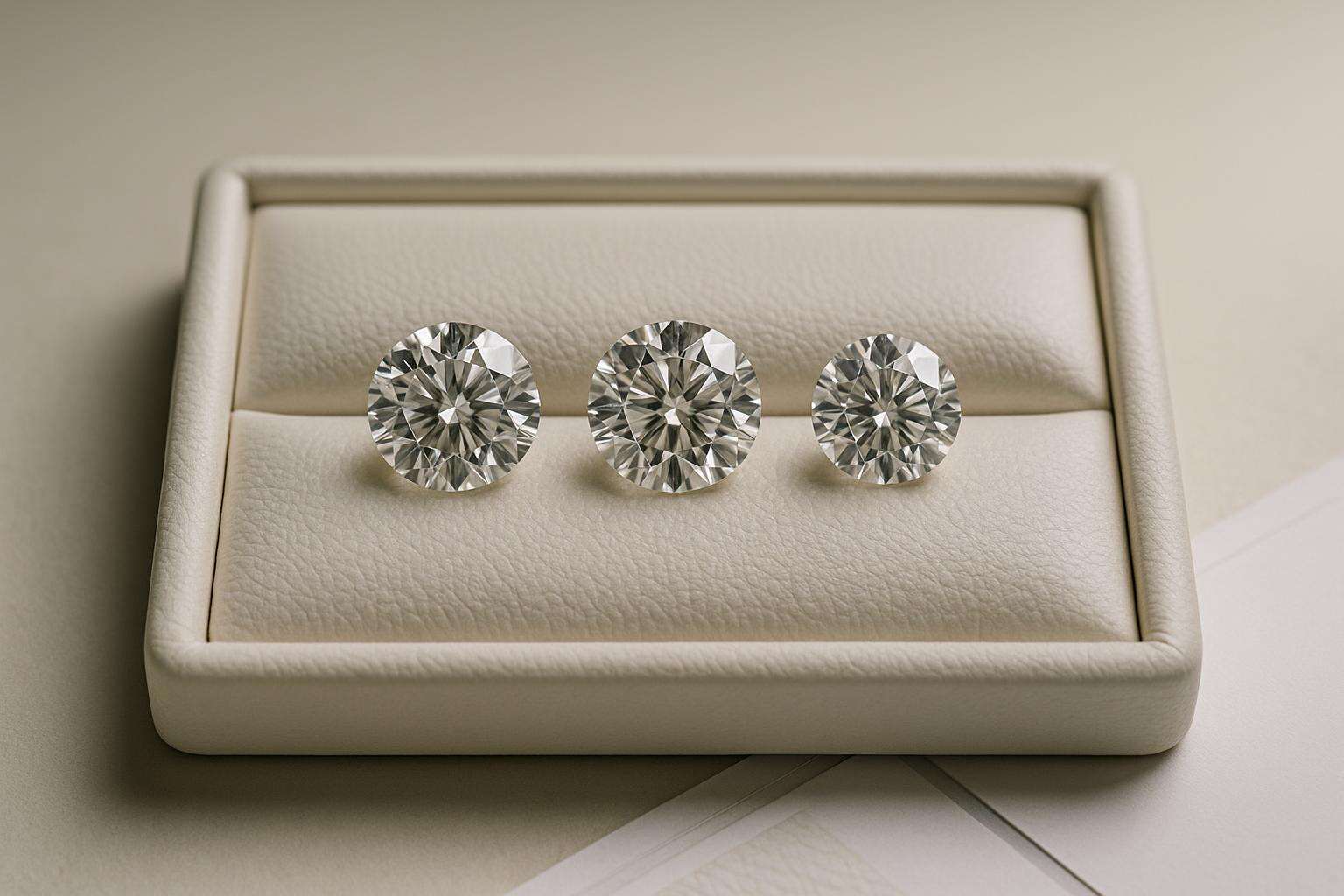
Kay, Zales, and Jared are all owned by the same company — Signet Jewelers, which also owns Blue Nile and, as of mid-2026, has absorbed James Allen into it. Certification quality varies sharply across the three mall brands: Jared offers GIA-certified stones with some consistency; Kay does so inconsistently; Zales rarely does. Online retailers (now primarily Blue Nile) offer universal GIA certification on natural diamonds at prices 20 to 40 percent below equivalent in-store offerings. Credentialed independent jewelers sit in a different category entirely: more personal, more negotiable, and better suited to custom work or any buyer who values local accountability. Know which version of the market you are shopping before you walk in anywhere.
There is a piece of information most engagement ring shoppers discover too late: three of the most recognizable jewelry chain names in America — Kay, Zales, and Jared — are wholly owned subsidiaries of a single publicly traded holding company, Signet Jewelers (NYSE: SIG). Signet is also the parent of Blue Nile, Diamonds Direct, and Banter by Piercing Pagoda. And as of the second quarter of 2026, Signet completed the shutdown of JamesAllen.com as a standalone retail website, folding the brand and its inventory into Blue Nile — a consolidation announced in March 2026 and expected to cost the company $60 to $80 million in net revenue in the transition year.
Understanding that structure is not a footnote to the buying decision. It is the buying decision. Shared corporate ownership means overlapping diamond sourcing channels, similar pricing architectures, and largely interchangeable inventory tiers at the lower end of the brand hierarchy. It means that "shopping around" across Kay, Zales, and Jared is not comparison shopping — it is walking between stores with the same owner. And it means that when you buy from Blue Nile today, you are buying from Signet.
This guide maps each channel honestly: what Signet's chain brands actually deliver at the store level, where independent jewelers hold a structural advantage, and what the post-James-Allen online landscape looks like in 2026. We will also address the certification question that most chain salespeople prefer you not ask.
What Does Signet Actually Sell, and How Do the Three Chain Brands Differ?
Signet's current brand strategy groups its properties into four customer families: "core milestone and romantic gifting" (Kay and Peoples); "style and trend" (Zales and Banter); "inspired luxury" (Jared and Diamonds Direct); and "digital pure play" (Blue Nile). That segmentation is a marketing framework, but it does map to real differences in what you find in the case — and critically, in the certification attached to it.
Jared is Signet's attempt at a premium in-store experience. Jared locations are typically standalone stores rather than mall kiosks, employ slightly better-trained staff with more product knowledge, and maintain an in-house bench jeweler for minor repairs and ring work. On the stone side, Jared diamonds are certified by six labs including GIA and AGS — the two organizations held to the strictest, most independently consistent grading standards in the trade. Secret-shopping evaluations have found GIA-certified stones prominently displayed in Jared's cases, with staff capable of explaining the documentation. Lab-grown diamonds at Jared carry IGI certification, which is the effective market standard for lab stones. The price premium over online equivalents is approximately 20 percent — a service premium, not a quality premium, since the same GIA-certified specification is available online at lower overhead cost.
Kay Jewelers occupies Signet's mass-market center. Kay's marketing budget — and its sustained presence in holiday television advertising — is its primary differentiator. On certification, Kay's GIA and AGS offering is inconsistent: some stones in the case carry GIA reports, many do not. A buyer who does not specifically ask to see only GIA-certified stones may be shown diamonds graded by labs whose standards run materially more generous. A stone graded VS2 by certain third-party labs can grade SI1 or lower by GIA standards applied to the same stone — a difference that is invisible to the shopper in the moment but visible in resale value and in what you actually paid. Kay also sends most repairs to centralized facilities rather than handling them in-store, extending turnaround times.
Zales is the weakest of the three on the dimensions that matter most for an engagement ring purchase. The majority of Zales diamonds carry certificates issued by Zales itself — an internal document with no independent standing in the gemological community. Some higher-end pieces carry IGI or GSI reports, but GIA certification is rare in the Zales case. Much of the base inventory runs I1 or I2 clarity — the bottom two clarity grades on GIA's scale, where inclusions can be visible without magnification and may affect structural integrity in the long run. For a fashion jewelry or fashion accessory purchase, Zales' price-accessibility positioning is coherent. For an engagement ring center stone, the certification gap makes it a difficult recommendation.
| Channel | GIA Certification | Price vs. Online | In-House Bench | Negotiable | Best For |
|---|---|---|---|---|---|
| Jared (Signet) | Yes, consistently | ~20% premium | Yes | Limited | In-store GIA shopping with service |
| Kay (Signet) | Inconsistent | 20–35% premium | No (centralized) | Minimal | Brand familiarity, financing access |
| Zales (Signet) | Rarely | Variable | No | Minimal | Fashion jewelry; not recommended for center stones |
| Blue Nile (Signet) | 100% natural; IGI for lab | Baseline reference | N/A (online) | No | Price efficiency, selection breadth |
| Independent Jeweler | Varies; GIA/AGS credentialed shops recommended | Low to mid | Usually yes | Yes | Custom work, heirloom resets, personal service |
What Happened to James Allen, and Is Blue Nile the Right Successor?
For several years, the online diamond market had two dominant players: Blue Nile and James Allen, both eventually acquired by Signet. Blue Nile was purchased in 2022 for $360 million; James Allen had been a Signet property since 2017 at $328 million. In March 2026, Signet announced it would shut down the JamesAllen.com website and migrate the brand, inventory, and customer data into Blue Nile — a transition completed by the end of Q2 2026. The consolidation followed two years of declining James Allen revenue and reflected Signet CEO J.K. Symancyk's stated priority of pruning the brand portfolio rather than expanding it.
For buyers who previously defaulted to James Allen for its high-magnification 360-degree stone videos and competitive GIA pricing, the transition is less disruptive than the headline suggests. Blue Nile certifies 100 percent of its natural diamonds through GIA, maintains IGI certification on all lab-grown stones, and operates with the same low-overhead pricing model that made James Allen competitive. The Astor by Blue Nile collection adds GCAL 8X light performance certification for buyers who want verified cut performance beyond GIA's standard report.
The practical outcome: the online market for GIA-certified engagement diamonds is now concentrated under Signet's Blue Nile, with independent online alternatives including Whiteflash (for super-ideal Hearts and Arrows cuts), Brian Gavin Diamonds (similar), Brilliant Earth (ethical sourcing emphasis), and Clean Origin (lab-grown focus). For most buyers prioritizing price efficiency and certified-stone selection, Blue Nile remains the reference point — but it is no longer an independent company. That matters for buyers who care about corporate consolidation in the industry, and it is worth knowing before positioning an online purchase as an alternative to "the chains."
Where Do Independent Jewelers Fit — and How Do You Find a Good One?
The chain-versus-online framing leaves out the channel that most experienced ring buyers actually recommend once they have been through the process: the credentialed independent jeweler. According to Hill & Co.'s 2025 Business of Jewelry Report, approximately 17,000 independent retail jewelers operate in the United States, collectively accounting for 50 percent of all jewelry sales by value. That market share is not driven by advertising budgets — it is driven by the structural advantages that independent shops deliver at the transaction level.
Independent jewelers typically employ long-tenured staff with genuine gemological credentials — GIA Graduate Gemologists or American Gem Society titleholders who have passed annual recertification exams. That depth contrasts sharply with chain stores, which experience high employee turnover and train staff primarily in sales technique rather than gemology. An independent with a GIA Graduate Gemologist on staff can look at two stones of nominally identical GIA grading and explain which one is actually better — a practical skill that a chain salesperson is rarely equipped to offer.
Price-wise, independents occupy useful middle ground. They carry lower overhead than mall chains — no national advertising budget, no corporate real estate mandate — but higher overhead than online-only retailers who warehouse inventory in a distribution center. The result is pricing that is typically below chain stores on equivalent certified stones, with room to negotiate that a fixed retail environment rarely allows. For repeat customers or buyers purchasing multiple pieces — engagement ring and wedding band together — the negotiation leverage is real.
The independent jeweler's clearest advantage appears on anything requiring craft judgment: custom ring design, heirloom stone resets, or an unusual stone type that does not fit a standard prong template. A chain store's in-house work capability, where it exists at all, is calibrated for standard repairs. An independent bench jeweler builds from scratch and applies the same person's eye to the design brief, the CAD approval, and the final finishing pass. That continuity of craft judgment is not available at scale.
The credentials to look for: GIA Graduate Gemologist (GG), American Gem Society Certified Gemologist (CG) or Certified Gemologist Appraiser (CGA), or Jewelers of America (JA) membership. The AGS titleholder designation requires annual recertification — meaning whoever holds it passed an exam within the last twelve months to keep it current. The GIA GG is a one-time qualification based on completed coursework and examinations. Either credential, or both, is a reliable signal that the person grading stones in the shop has the training to do it honestly. For detailed vetting steps and specific red flags, see our guide to choosing a local jeweler.
How to Choose: A Decision Framework by Buyer Type
There is no universally correct answer to the chain-versus-independent-versus-online question, because the correct answer depends on what you are actually optimizing for. Here is the framework I use with buyers who ask me:
If you are optimizing for price per certified diamond: Blue Nile is the current reference for GIA-certified natural stones online. The pricing floor for a GIA-certified, Excellent-cut, G-color, VS2-clarity 1.00-carat round brilliant runs significantly below what Jared or any chain will quote for the same specification. The 20-to-40 percent overhead gap is structural and not negotiable with a chain store manager. If budget is the primary constraint, start with Blue Nile's inventory as your benchmark, then use that number when talking to any other channel. See our comparison of online retailers for the full Blue Nile alternative landscape post-merger.
If you want in-person service and GIA certification: Jared is the only Signet chain worth considering for a serious engagement ring purchase, and even there, treat the GIA certification as the baseline requirement — do not leave without seeing the actual GIA report number and verifying it on GIA's Report Check tool. The 20-percent in-store premium over online is a service premium you may decide is worth paying for the ability to see the stone, try the setting, and have an in-house bench jeweler available for early adjustments.
If you want a custom design, an unusual stone, or a heirloom reset: A credentialed independent jeweler is the right channel, and the other options are largely irrelevant. Neither a chain store nor an online retailer is equipped for genuine custom fabrication or bench-level craft judgment. Look for GIA Graduate Gemologist or AGS credentials, verify membership in Jewelers of America or the AGS, ask to see previous custom work, and confirm they carry their own insurance on pieces in their shop. The vetting guide covers the full due-diligence checklist.
If you are weighing lab-grown versus natural: The channel choice interacts with the stone choice. Online retailers — Blue Nile, Brilliant Earth, Clean Origin — offer the widest inventory of IGI-certified lab-grown stones at the lowest overhead cost. Lab diamonds run 70 to 85 percent less than natural equivalents at identical GIA or IGI 4Cs specifications, which substantially changes the budget math for any tier. Our lab-grown vs. natural diamonds guide covers price, resale value, FTC disclosure requirements, and what detection technology can and cannot tell you about a stone's origin.
The honest summary: the chain jewelry market in 2026 is more consolidated than it has ever been, and most of the brands a shopper might consider as independent alternatives are owned by the same holding company. That consolidation is not inherently bad — it has produced a well-capitalized online platform in Blue Nile with strong certification standards — but it means the only genuine alternatives to Signet in the mass market are credentialed independent jewelers and the handful of online competitors who have remained outside Signet's acquisition strategy. Buying any major ring is a decision worth taking seriously enough to understand exactly whose store you are walking into.
Frequently asked
Are Kay, Zales, and Jared owned by the same company?
Yes. Kay Jewelers, Zales, and Jared all operate under Signet Jewelers (NYSE: SIG), the world's largest specialty retail jewelry company, headquartered in Akron, Ohio. Signet also owns Blue Nile, Diamonds Direct, Banter by Piercing Pagoda, and Rocksbox. As of Q2 2026, Signet completed the consolidation of James Allen into Blue Nile — the James Allen website has been wound down and its inventory, collections, and customer accounts migrated to Blue Nile. Shared corporate ownership means overlapping diamond sourcing, similar financing structures, comparable markup strategies, and — at Kay and Zales especially — largely interchangeable inventory tiers. Understanding this consolidation before you shop any of these brands is the single most valuable piece of context a ring buyer can have.
Which chain jeweler has the best diamond certification — Kay, Zales, or Jared?
Jared offers the strongest certification among the three Signet chains. Jared diamonds are certified by six labs including the Gemological Institute of America (GIA) and the American Gem Society (AGS) — the two labs held to the strictest grading standards in the industry. Lab-grown diamonds at Jared carry IGI certification. Jared locations also maintain in-house bench jewelers and tend to carry higher-quality stones than their sibling brands. Kay Jewelers offers GIA-certified stones inconsistently across its inventory; not every stone in the case carries a GIA or AGS report. Zales is the weakest on certification — the majority of its inventory carries Zales' own internal certificate, which has no independent standing, and much of the case stock runs I1 or I2 clarity. For any buyer who cares about verifiable grading, Jared is the only defensible choice among the three, and even there, an online retailer with universal GIA certification will typically undercut Jared's prices by 15 to 20 percent on equivalent stones.
Is it cheaper to buy an engagement ring online or in a store?
Online is consistently less expensive for equivalent certified stones. Brick-and-mortar chains carry the overhead of mall rents, large staff payrolls, and national advertising budgets — costs that are embedded in retail prices. Research and secret-shopping data consistently show chain jeweler diamonds priced 20 to 40 percent above comparable offerings for equivalent GIA-certified stones online. Blue Nile, operating with substantially lower overhead, can price at that same discount while still offering GIA certification on all natural diamonds and IGI certification on lab-grown. The trade-off is that you cannot handle the stone before purchase, though Blue Nile's 360-degree viewing tools partially compensate. For buyers who want in-person service, a credentialed independent jeweler typically occupies the middle ground: lower overhead than a mall chain, more personal service than a website, and more flexibility on negotiation — particularly if you are bringing your own stone or returning as a repeat customer.
What happened to James Allen? Is the website still operating?
As of mid-2026, James Allen's standalone website has been wound down as part of an internal Signet Jewelers consolidation. Signet announced the transition in March 2026, with completion targeted for the end of Q2 2026. The James Allen brand, diamond inventory, and customer accounts are being migrated into Blue Nile, which Signet also owns (acquired for $360 million in 2022). Signet acquired James Allen for $328 million in 2017; the decision to sunset the separate site followed a steep two-year sales decline. Blue Nile now absorbs the digital pure-play role that James Allen previously held alongside it. For buyers who preferred James Allen's 360-degree diamond video interface or its pricing model, Blue Nile is the practical successor — the inventory, tools, and GIA-certification standard are broadly comparable, and pricing remains competitive within the online market.
Why should I consider an independent jeweler over a chain or online retailer?
Independent jewelers hold a position that neither chains nor online platforms replicate well: long-tenured gemological expertise, local accountability, genuine customization access, and room to negotiate. According to Hill & Co.'s 2025 Business of Jewelry Report, approximately 17,000 independent retail jewelers in the United States collectively account for 50 percent of all jewelry sales by value. That market share exists for a reason. Independent jewelers typically employ staff with deep gemological knowledge — a structural advantage over chains, which experience high employee turnover. They are more likely to offer lifetime warranties with fewer restrictions, bespoke advice calibrated to a specific customer's taste and budget, and a community reputation built over decades. On price, independents generally run lower overhead than mall chains and are more open to negotiation than a fixed retail environment. For buyers considering a custom design, heirloom stone reset, or anything requiring bench work, a GIA-credentialed or AGS-titled independent is the clearest choice. See our guide to vetting a local jeweler for the credential checks and red flags to know before you walk in.
Does Signet owning multiple brands affect the quality of diamonds I'd find at Jared versus Kay?
Shared ownership does create overlapping sourcing channels and similar markup strategies across the Signet family, but quality meaningfully diverges at the brand level. Jared is positioned as Signet's premium brand — it maintains separate in-store gemologists, carries a higher proportion of GIA-certified stones, and targets a buyer willing to pay more for service quality and stone documentation. Kay occupies the mid-market, with more marketing-driven positioning and less consistent certification. Zales leans toward accessibility and fashion jewelry, with the weakest certification standards of the three. The practical implication: if you are committed to shopping at a Signet chain, Jared is the only one where GIA certification is a reliable expectation rather than an occasional offering. For serious buyers, though, the Signet consolidation means that the same stones available at Jared — GIA-certified, independently graded — are available online through Blue Nile at materially lower prices. The in-store premium at Jared is a service premium, not a quality premium.