Where to Buy
Online vs In-Store Engagement Ring Buying: Price, Trust & the Hybrid Approach
The markup gap is real, but so are the hidden costs. Here is exactly what you gain — and give up — buying each way, and why the smartest 2026 shoppers use both channels.
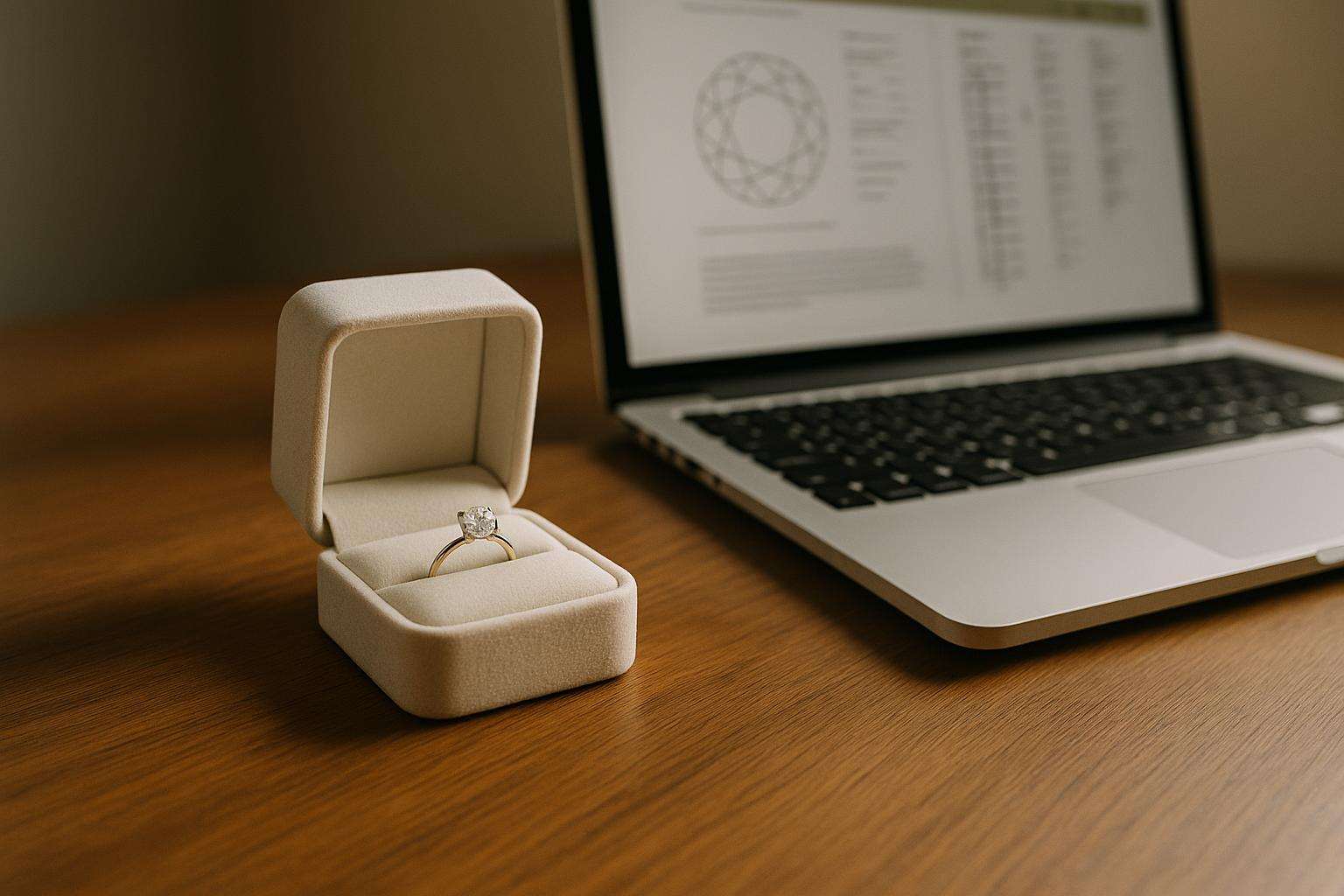
Online engagement ring retailers undercut brick-and-mortar stores by 20–40% on comparable certified diamonds because they carry no retail-floor overhead. But that gap narrows once return shipping, resizing costs, and appraisal fees are counted. The smartest 2026 approach is hybrid: research online until you understand exactly what a fair price looks like, then buy online or use that knowledge to negotiate in-store. Either way, independent certification is non-negotiable.
I have been working with diamonds at the bench and sourcing stones through both online and trade channels for over fifteen years. The question I field from couples more than almost any other is this: is it actually safe to buy a ring online, and am I really saving that much? The answer to both is yes — but with a set of conditions that most comparison articles gloss over. Let me walk you through the economics, the trust mechanics, the return-policy fine print, and the hybrid approach that the most informed buyers in 2026 are using.
Why Does Online Cost Less? The Markup Structure Explained
The price gap between online and in-store diamond retail is not a promotional fiction — it is built into the operating economics of each channel. A traditional brick-and-mortar jewelry store runs on keystone pricing: industry norms sit at 100–200% markup over wholesale cost for finished diamond jewelry, with premium-location stores and national chains reaching 200–300% to cover prime commercial rents, large staffed sales floors, and physical display inventory that may sit unsold for months. In 2026, with LBMA gold spot prices hitting roughly $4,200 per troy ounce — up approximately 54% on the 2025 average — fine jewelry floor prices are resetting upward, and brick-and-mortar overhead makes that pass-through nearly unavoidable.
Online retailers operate on a fundamentally different cost structure. The FTC's retail markup data puts online diamond retailers at an average 18% markup, with the most competitive running below 10%. That structural difference produces the documented 20–40% consumer saving on a comparable certified stone. Signet Jewelers, which owns both Blue Nile and traditional chains including Kay Jewelers and Zales, confirmed in its own post-acquisition analysis that its online brands undercut traditional jewelry retail by 25–40% on equivalent specifications.
A concrete example from the insight data: a GIA-graded 1.23-carat, F-color, VS2 diamond in a platinum solitaire setting found online at $7,450 versus roughly $9,950 for an equivalent in-store option — a saving of approximately $2,500 on a single purchase. For buyers in the $3,000–$8,000 range that accounts for most engagement rings, the channel difference is real money that can fund a larger stone, a better setting, or both.
Two important nuances. First, Brilliant Earth — one of the most prominent online-first retailers — reported a 60.3% gross margin in its fiscal year 2024 SEC filing, which confirms that online does not automatically mean thin margins. Premium online brands command pricing power through design, certification rigor, and sustainability positioning. Comparison shopping across two or three online retailers is still warranted. Second, independent local jewelers who own their inventory and operate with lower overhead than mall-based chains can sometimes price very competitively on specific stones. The in-store channel is not monolithic; a relationship with a skilled independent bench jeweler carries genuine value that no online retailer fully replicates.
What Are the Hidden Costs That Narrow the Online Savings?
The gross price gap is real. The net saving after accounting for friction costs is smaller, and ignoring that is how buyers end up disappointed. Here is what to count:
| Cost Factor | Online | In-Store |
|---|---|---|
| Base price on identical stone | 20–40% lower | Baseline |
| Return shipping (if not covered) | $20–$100 per shipment | None — in-person return |
| Ring resizing after delivery | $0 (free first resize at most retailers) to $150 if third-party | Often bundled or low-cost |
| Insurance appraisal | $50–$150 (if retailer does not provide) | Often performed in-house at purchase |
| Engraving return eligibility | Usually excluded from refunds | Store-dependent |
| Ongoing servicing (cleaning, prong checks) | Requires shipping or local jeweler | Often free in-store lifetime service |
| Warranty voiding risk | High if third-party repairs performed (VRAI, others) | Lower if using the same jeweler |
The most consequential of these is the warranty interaction with third-party repairs. VRAI explicitly voids all warranty coverage if resizing or repair is performed by a jeweler other than VRAI. This matters for couples who move cities after purchase or who simply prefer a local bench jeweler for routine maintenance. Before buying from any online retailer, read the warranty terms — specifically the clause governing third-party work — and factor that into your long-term cost of ownership, not just the purchase price.
Shane Co., by contrast, offers lifetime free cleaning, repairs, and resizing — and uniquely will replace a lost center stone if the ring is brought in for preventative maintenance every six months. That is a remarkably comprehensive policy that brick-and-mortar buyers should weigh against the premium they may pay on the initial stone. For the full return and warranty comparison across major retailers, we have laid out every term in detail.
Certification and Trust: What the Online Channel Gets Right
The trust framework in online diamond retail is entirely dependent on independent third-party certification, and in 2026, the reputable online retailers have made that framework genuinely robust. GIA and IGI reports on every stone are now the minimum standard — any retailer offering "in-house graded" diamonds or using obscure proprietary labs should be disqualified. Stock photography instead of actual-stone imagery is a second disqualifying signal. And a return policy that offers store credit rather than a full cash refund is a third.
The specific certification landscape has shifted in one important way this year. Signet Jewelers announced in March 2026 that JamesAllen.com will shut down as a standalone website by early August 2026, with the James Allen brand folded into Blue Nile as a proprietary collection. This follows a 49% two-year revenue decline at James Allen — from $278.4 million in fiscal 2024 to $142.5 million in fiscal 2026 — and a $13 million impairment charge on the trade name. All existing James Allen warranties and service plans will be honored under Blue Nile, and account histories can be merged or transferred. For new buyers, the practical implication is straightforward: Blue Nile is now the consolidated Signet digital platform for natural diamond purchases, absorbing James Allen's 360-degree HD imaging technology and pricing structure. In-Store Magazine confirmed the transition timeline directly from Signet's fiscal filings.
In-store trust operates differently. Physical inspection — seeing the diamond face-up in natural light, comparing multiple stones side by side, evaluating setting craftsmanship before committing — remains genuinely irreplaceable for some buyers. No amount of 360-degree imaging fully replicates the tactile and visual experience of holding a ring. But the certification asymmetry cuts against in-store as well: national chains including some well-known names sell stones certified by less rigorous labs such as GSI or the store itself, without GIA or IGI reports. Independent local jewelers vary widely. The rule is the same in both channels: a GIA or IGI report for every stone, regardless of where you buy.
Brilliant Earth occupies a notable middle position: it operates as an online retailer with more than 40 U.S. showrooms in cities including New York, Chicago, Los Angeles, Boston, and Dallas, offering appointment-based in-person stone viewing alongside its full online inventory. For buyers who want the price transparency and selection breadth of online retail combined with the physical confidence of in-store inspection, Brilliant Earth's hybrid model is the most complete offering in the market. Its sustainability positioning — 99% repurposed gold, blockchain-traced diamond options, carbon-offset shipping — commands a price premium over Blue Nile, but addresses the ethical sourcing concerns our ethical and sustainable hub covers in depth.
Return Policies: The Fine Print That Actually Matters
Return windows have become a genuine competitive differentiator among online retailers, and the variation is wider than most buyers realize. Taylor & Hart offers 90 days for engagement rings — the most generous standard policy in the market as of mid-2026. Clean Origin and Shane Co. both offer 60 days. Blue Nile, Brilliant Earth, and Whiteflash offer 30 days with full refunds. Brian Gavin sits at only 15 days with shipping and insurance costs deducted from refunds — the most restrictive in the reputable tier.
Three specific provisions are worth scrutinizing in any return policy before purchase:
- Refund vs. store credit. Always confirm you receive a cash refund, not store credit. A store-credit-only policy ties your money to that retailer regardless of satisfaction or circumstance. Most major retailers offer true refunds; always verify before ordering.
- When the window opens. Blue Nile starts its 30-day clock from shipment date, not delivery date. If there is a shipping delay, your effective inspection window is shorter than the number suggests. Blue Nile also limits complimentary return shipping labels to two per customer per year.
- Engraved and custom orders. Most retailers exclude engraved rings from cash refunds. Blue Nile charges a $25 re-polishing fee on returns; others offer only exchange or store credit on customized pieces. Designer and special-order brands — including Tacori, Verragio, and Simon G. — are commonly final sale regardless of retailer.
If there is any possibility of a declined proposal, the return logistics are worth thinking through before purchase. In-store returns are immediate and in-person — no repackaging, no shipping, no wait. Online returns require secure packaging, insured shipping, and typically 5–15 business days before the refund posts. This is not a reason to avoid online buying; it is a reason to choose a retailer with a long return window and free return shipping, and to understand the timeline before the ring leaves your hands.
The 2026 Hybrid Strategy: How to Use Both Channels
The most consistently well-informed buyers in 2026 are not purely online buyers or purely in-store buyers. They are hybrid shoppers who use each channel for what it does best. Industry data places over 45% of engagement ring purchases beginning with online research before any in-store contact; 83% of couples now shop for the engagement ring together, spending an average of 3.5 months on the search. That extended research window is where the online channel wins decisively.
Here is how the hybrid strategy works in practice:
- Build your specification baseline online. Use the filtering tools on Blue Nile, Brilliant Earth, or Clean Origin to identify what a well-specified stone looks like at your budget — cut grade, color, clarity, carat, certification. Understand the 4Cs well enough to know that Excellent cut at G color VS2 is a better purchase than Very Good cut at E color VVS1 for the same money. Our diamond 4Cs guide gives you the complete framework.
- Use online stone-level data that stores do not provide. ASET images, ideal-scope photographs, Hearts and Arrows imagery, and magnified video of individual stones are available from online retailers and almost never shown to in-store shoppers. This data reveals light performance in a way that casual visual inspection under jewelry-store lighting cannot.
- Visit in-store if physical confirmation matters to you. If you want to hold a stone before committing — particularly if the recipient has strong tactile or aesthetic preferences that are hard to assess from images — a Brilliant Earth showroom appointment or a visit to a well-credentialed independent jeweler gives you that experience.
- Use your online research to negotiate or confirm value. Walking into any store knowing exactly what a comparable stone costs online removes the information asymmetry that sustains high brick-and-mortar margins. A local jeweler who cannot explain the difference between their pricing and a Blue Nile equivalent on identical specifications is a jeweler who should be able to.
The practical outcome: buyers who run this comparison research consistently save several thousand dollars compared to buyers who begin and end in a single retail environment, according to multiple independent buyer surveys and 2026 engagement ring market analysis. For a complete decision framework on which retailers to evaluate in each category, our online retailers comparison runs Blue Nile, Brilliant Earth, and the specialist tier through a head-to-head review with current pricing and policies verified as of June 2026.
Frequently asked
How much cheaper is buying an engagement ring online vs in-store?
The documented savings range is 20–40% on a comparable, certified diamond when buying from a reputable online retailer versus a traditional brick-and-mortar store. Signet's own internal data — the company that owns both Blue Nile and Kay Jewelers — confirmed that its online brands undercut traditional jewelry retail by 25–40% on equivalent stones. On a $5,000 ring, that translates to a real saving of $1,250 to $2,000. The gap is structural: online retailers carry no retail-floor overhead, hold virtual rather than physical inventory displays, and operate with significantly lower staffing ratios. That said, the full 40% number applies primarily when comparing a well-priced online retailer to a premium-location chain store. A well-negotiated independent local jeweler can close the gap considerably. Always compare like-for-like: the same shape, cut grade, color, clarity, carat weight, and certification lab.
Is it safe to buy a diamond engagement ring online?
Yes, provided you observe three non-negotiable standards. First, every stone must carry an independent grading report from GIA, IGI, or GCAL — a retailer who certifies stones in-house or uses an obscure lab cannot be vetted. Second, the retailer must show you actual-stone imaging — a 360-degree video or high-resolution photographs of the specific stone you are purchasing, not stock photography. Third, there must be a published return policy with a genuine cash refund (not store credit only) and a defined window of at least 30 days. Any reputable online retailer — Blue Nile, Brilliant Earth, Clean Origin, Whiteflash, VRAI — meets all three standards. The FTC's Guides for the Jewelry, Precious Metals, and Pewter Industries require material quality disclosures; certified retailers are legally obligated to accurately represent what they sell.
What are the main hidden costs of buying a ring online?
Several costs can erode the apparent online discount. Return shipping on fine jewelry sent back to an online retailer runs $20–$100 per shipment for packages not covered under a free-label program. Ring resizing after delivery — if the retailer does not provide a free resize or if the ring is ordered incorrectly — costs $50–$150 at a local jeweler, and some retailers (VRAI explicitly) void their warranty if unauthorized third-party work is performed. An independent appraisal for insurance purposes, if not provided by the retailer, adds another $50–$150. Finally, if you need to exchange or return a ring with custom engraving, most retailers — including Blue Nile — exclude engraved rings from full cash refunds. Count these potential costs before comparing the final price against an in-store quote that bundles cleaning, resizing, and servicing into the relationship.
What return window should I expect buying online vs. in a store?
Online return windows have become competitive. Taylor & Hart offers 90 days for engagement rings — the most generous standard policy in the market. Clean Origin and Shane Co. both offer 60 days. Blue Nile, Brilliant Earth, and Whiteflash offer 30 days with full refunds and free two-way shipping. Brian Gavin is the outlier at only 15 days, with shipping and insurance deducted from refunds. In-store, traditional chains vary: Zales offers 30-day refunds, Shane Co. offers 60 days, and Cartier allows only 14. The procedural difference matters: in-store returns are immediate and in-person; online returns require secure repackaging, insured shipping, and a 5–15 business day processing delay before the refund posts. For buyers who want maximum flexibility, Clean Origin or Taylor & Hart provide the most comfortable return windows in either channel.
What happened to James Allen and how does it affect online buyers in 2026?
Signet Jewelers — which owns James Allen, Blue Nile, Kay Jewelers, and Zales — announced in March 2026 that it would shut down JamesAllen.com as a standalone website, folding the James Allen brand into Blue Nile as a proprietary collection. The announcement followed a 49% two-year revenue decline at James Allen, to $142.5 million, and a $13 million impairment charge on the James Allen trade name. JamesAllen.com is expected to go dark by early August 2026. All existing James Allen warranties, service plans, and purchase histories will be honored under Blue Nile. Customers can transfer their James Allen account to Blue Nile to maintain full order history access. For new buyers, this means Blue Nile is now the consolidated Signet online destination for natural diamonds, absorbing James Allen's 360-degree imaging technology and competitive pricing. Brilliant Earth remains the primary independent alternative with its sustainability positioning and 40-plus U.S. showrooms.
What is the hybrid shopping strategy and does it actually save money?
The hybrid strategy means using both channels for their distinct advantages: research online to understand specifications, pricing benchmarks, and what a fair price looks like for a given stone, then either purchase online with confidence or walk into a local jeweler prepared to negotiate. Industry data confirms that over 45% of engagement ring purchases now begin with online research, even when the final transaction occurs in a store. The practical benefit is documented: buyers who do this comparison research consistently save several thousand dollars compared to buyers who begin and end their search in a single retail environment. Online retailers provide stone-level ASET images, magnified video, and side-by-side specifications that most physical stores do not offer, giving buyers a data advantage they can carry into any purchasing context. The hybrid approach also reduces the emotional sales pressure common in high-stakes in-person retail.