Where to Buy
Super-Ideal Cut Specialists: Whiteflash vs Brian Gavin Diamonds
When a standard GIA Excellent is not enough — what Hearts and Arrows precision costs, what it delivers, and which super-ideal specialist is right for your ring.
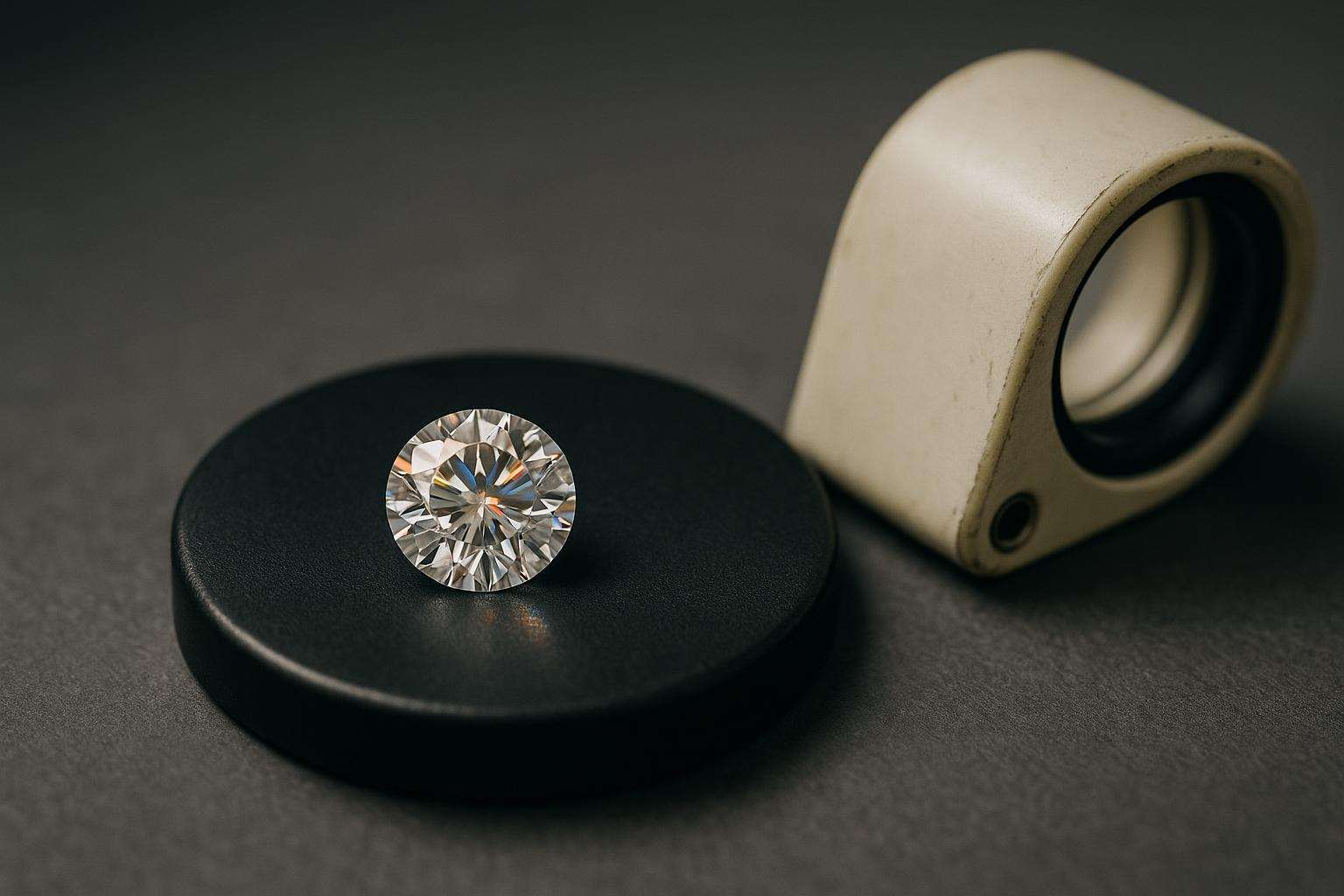
Whiteflash and Brian Gavin Diamonds sell Hearts and Arrows super-ideal cut diamonds verified by ASET imaging, per-stone ideal-scope photography, and a GIA report plus AGS Ideal® supplement that standard GIA Excellent certificates do not approach. The 10–25% price premium over mass retailers is physically justified — more rough material sacrificed, more polishing time, a 98% rejection rate of GIA Excellents — but whether you need it depends on your ability to evaluate the difference in person. For most buyers who want the super-ideal tier, Whiteflash delivers equivalent light performance at lower prices and with stronger buyer protections; Brian Gavin's Black line appeals to buyers who want to own the most numerically precise proprietary cut formula available.
I have been at a bench long enough to have set both a $700 Good-cut round and a $12,000 A CUT ABOVE. I can tell you what the difference looks like face-up in a mounting, in sunlight, in candlelight, and in fluorescent office lighting. I can also tell you what it looks like when a client who has spent an extra $2,500 for Hearts and Arrows precision puts the ring on and says, essentially, it sparkles so much. They are right. They are also the same people who paid an extra $2,500 for a distinction they could not articulate before they bought it. Both things can be true simultaneously. What I want to do in this article is give you the physics, the economics, and the specific comparisons so you can decide for yourself.
The two retailers worth discussing seriously in the U.S. super-ideal market are Whiteflash, founded in Houston in 2000, and Brian Gavin Diamonds, founded in 2009 by fifth-generation cutter Brian Gavin. These are not general online retailers who happen to carry some premium stones. They are specialists whose entire value proposition rests on cut precision that exceeds what GIA's standard Excellent grade verifies. Understanding what they sell — and what it costs — requires understanding what GIA Excellent actually covers.
What Is the GIA Excellent Category, and Why Does It Matter?
The GIA's round brilliant cut grade is one of the most important and most misunderstood pieces of information on a diamond certificate. GIA Excellent is not a single performance level. It is a category. The Excellent grade encompasses a range of table percentages (roughly 52–62%), crown angles, pavilion depths, and facet alignments that all qualify as top-grade on GIA's proportion model — but that produce meaningfully different light-return profiles depending on exactly where within those ranges a stone falls.
A diamond at the center of the Excellent distribution — crown angle close to 34.5°, pavilion angle close to 40.6–40.8°, table around 56%, depth around 61.5% — will return more light, produce more consistent contrast, and display more fire than a stone that merely clears the outer threshold of the Excellent grade. Both stones will carry the same one-word certificate entry. Both will be sold as premium-cut diamonds. The consumer has no way to distinguish them from the report alone.
This is the market inefficiency that super-ideal specialists have built their businesses around. Whiteflash and Brian Gavin each apply selection criteria on top of GIA's grading that identify — and reject — the wide majority of GIA Excellent diamonds that do not hit the bullseye. According to documented industry analysis, approximately 98% of diamonds that pass as GIA Excellent fail the additional quality gates applied by Brian Gavin and Whiteflash.
The verification tool for this tighter standard is ASET — the Angular Spectrum Evaluation Tool. ASET imaging photographs a diamond under a specific lighting condition and maps how it captures light from different angular sources as colored zones: red zones indicate strong direct light capture; green zones indicate oblique environmental light; blue zones represent contrast (the pattern created by the observer's head blocking the light source). A clean super-ideal ASET shows predominantly red coverage across the stone with minimal green intrusion under the table — evidence that the stone returns strong direct light from all principal directions without excessive leakage. Both Whiteflash and Brian Gavin provide per-stone ASET images for every diamond in their super-ideal lines. No mass-market online retailer does.
How Does Whiteflash's A CUT ABOVE Line Work?
Whiteflash's flagship product, the A CUT ABOVE® (ACA), carries what the company calls Dual Certification: a GIA Triple Excellent grading report plus a GIA-issued AGS Ideal® Light Performance supplement. The AGS supplement is the key distinction. AGS Laboratories (American Gem Society) closed as an independent operation in December 2022 and was integrated into GIA, which began issuing the AGS Ideal® Light Performance analysis as a digital supplement to eligible GIA reports in January 2023. This supplement applies the AGS three-dimensional ray-tracing model — the same methodology that made AGS grading the industry standard for documenting light performance beyond proportion measurement — and assigns a grade on a 0–10 scale where 0 is the highest. A GIA-issued AGS grade of 0 confirms the stone maximizes brightness with minimal light leakage, consistent fire, and even contrast distribution.
The ACA standard goes beyond even the AGS supplement. Table width is required to fall within 53–58% (versus the 52–62% range that qualifies as GIA Excellent), and every stone must display clean Hearts and Arrows patterning under a dedicated H&A viewer. Whiteflash reports that fewer than one in ten AGS Ideal (now GIA/AGS grade 0) diamonds qualifies for ACA certification under their additional selection criteria. The stones are physically held in-house in Houston, with GIA report dates predominantly from 2025 and 2026 — an indicator of active inventory rotation that matters for quality consistency in a market where diamond prices change week-to-week.
Every ACA purchase includes the full dual-certification report, ASET scope imagery, ideal-scope photography, and Hearts and Arrows analysis — enough documentation for a buyer who understands light performance to verify independently what they are paying for.
The Whiteflash Lifetime Upgrade Program applies to every ACA natural diamond: the original purchase price is credited in full toward a replacement ACA diamond costing at least 50% more. The bar is notably buyer-friendly — many competitors require the new stone to be double the original price. The standard return window is 30 days with a full money-back guarantee on in-stock purchases.
How Does Brian Gavin's Black Line Compare?
Brian Gavin is a fifth-generation diamond cutter from South Africa who co-founded Whiteflash in 2001 before establishing his own eponymous company, Brian Gavin Diamonds, in 2009. His flagship product, the Black by Brian Gavin® collection, launched in late 2016 and is built around a patent-pending cutting formula that targets the pavilion micro-angles to minimize what Brian Gavin calls the "green table effect" in ASET imagery — the faint zone of oblique light visible in the center of some super-ideal stones. The goal is a cleaner all-red ASET map than a standard AGS Triple Zero formula produces.
In practice, the Black line requires AGS 000 grades (now delivered via the GIA/AGS supplement), Hearts and Arrows patterning, IF–VS2 clarity, D–G color, negligible fluorescence, and what Brian Gavin calls the Gavin Effect: an eight-factor evaluation under 8x magnification that eliminates subtle light leakage and proportion imbalances. The result is, according to independent analysis, virtually indistinguishable in real-world light performance from Whiteflash's ACA. PriceScope community analysis — the most experienced group of super-ideal buyers discussing these stones publicly — broadly concludes that the two lines produce equivalent observable output, and that the Black formula's specific pavilion-angle targeting is a valid but not uniquely superior approach.
The Brian Gavin inventory is smaller than Whiteflash's by approximately half: roughly 1,700 lab-grown versus Whiteflash's 5,000, with natural diamond selection proportionally narrower. GIA report dates on Brian Gavin listings skew older than Whiteflash's, reflecting a lower stock rotation rate — not a quality issue, but an indicator of a more curator-focused selection rather than broad, freshly sourced inventory.
The most material operational difference is the return policy. Brian Gavin offers a 15-day inspection period — day one begins when the package is received — versus Whiteflash's 30-day window. Brian Gavin deducts original shipping and insurance costs from refunds, while Whiteflash's money-back guarantee covers the full purchase price. For international buyers or anyone who wants to evaluate the stone under multiple lighting conditions over several weeks, this difference is significant. Brian Gavin does offer a Lifetime Upgrade Policy crediting 100% of the original purchase price toward a larger Brian Gavin Signature stone, and a one-year buyback at 70% of current market price.
Side-by-Side: Key Differences at a Glance
| Factor | Whiteflash A CUT ABOVE | Black by Brian Gavin |
|---|---|---|
| Cut certification | GIA Triple Excellent + GIA-issued AGS Ideal® supplement (Dual Certification) | GIA Triple Excellent + GIA-issued AGS Ideal® supplement; Black formula via patent-pending process |
| Hearts & Arrows | Required; per-stone H&A imagery provided | Required; per-stone H&A imagery provided |
| ASET imaging | Per-stone; black-background presentation for high contrast readability | Per-stone; white-background presentation per AGS simulation style |
| Price premium vs Blue Nile (comparable spec) | ~10–20% | ~15–25% |
| Direct spec comparison (1.06ct, E, VS2, verified 2026) | $7,750 | ~$8,777 |
| Return window | 30 days, full money-back, free shipping | 15 days; shipping and insurance deducted from refund |
| Upgrade program | Lifetime; full credit toward ACA diamond costing ≥50% more | Lifetime; full credit toward BGD Signature stone (no minimum % specified); 1-year buyback at 70% market price |
| In-stock inventory (natural + lab) | Larger; ~5,000 lab-grown; full natural catalog; GIA report dates predominantly 2025–2026 | Smaller; ~1,700 lab-grown; curated natural selection; older report dates more common |
| Physical location | Houston, TX (showroom by appointment) | Houston, TX (headquarters) |
| Real-world light performance vs each other | Essentially equivalent per independent analysis; both produce clean ASET maps and crisp H&A patterns | |
When Is the Super-Ideal Premium Worth Paying?
Here is the framework I use with clients who are considering this tier.
Buy at a super-ideal specialist if: Cut quality is the stated primary priority — not size, not color, not budget efficiency. You have looked at ASET imagery and understand what you are evaluating. You want independent, per-stone documentation of light performance rather than a certificate grade. You are purchasing a 1.00-carat or larger round brilliant where the cut precision is most visually apparent. You plan to hold the ring long-term and value the upgrade program's favorable terms.
Buy from a mass retailer if: You are purchasing a fancy shape (oval, cushion, pear, marquise, emerald) — GIA does not grade fancy-shape cut, and super-ideal specialists' fancy inventory is much narrower. You are budget-constrained and prioritizing carat weight or color over cut distinction. You are buying a lab-grown diamond where the 70–85% cost advantage over natural makes a super-ideal premium proportionally larger relative to the total spend. You are a first-time buyer who will not have a reference point for the performance difference.
If you land in the second group, a well-chosen GIA Excellent from Blue Nile or Brilliant Earth provides genuine beauty and documented quality at a meaningfully lower price. The best GIA Excellent stones from mass retailers are not bad diamonds — they are very good diamonds. A super-ideal is a very good diamond whose precision has been independently verified at a level GIA's standard report does not reach.
A Note on Certification Transparency
One detail buyers should understand before purchasing in this tier: the AGS Ideal® supplement is now issued by GIA as a digital report, following the closure of AGS Laboratories in December 2022. The GIA AGS Ideal® Report page confirms the supplement is available for a $25 fee alongside any eligible GIA grading report, using AGS's proprietary light performance methodology. Both Whiteflash and Brian Gavin present this supplement as part of their dual-certification standard. This is accurate and transparent — the methodology is unchanged, and the analysis is as rigorous as it was under independent AGS operation. Some early coverage of the AGS closure expressed concern about the independence of GIA issuing its own AGS supplement; in practice, the analytical model is the same three-dimensional ray-tracing system, and the light performance grade carries the same physical meaning. The difference is administrative, not scientific.
For buyers who want to verify certification claims before purchasing, the JCK investigation into the AGS-GIA merger provides the most detailed independent account of what changed and what did not. The American Gem Society continues to operate as a trade organization and credentialing body; only the grading laboratory function migrated to GIA.
The diamond 4Cs guide covers cut grading in depth, including the full GIA Excellent spectrum and why cut is the most important of the four variables. For buyers deciding between natural and lab-grown before choosing a retailer, the lab-grown vs. natural comparison covers the current price gap, certification, and resale considerations at length. Super-ideal cut is a decision about precision within a category; natural vs. lab-grown is a different decision with different financial implications, and the two are independent.
Frequently asked
What is a super-ideal cut diamond, and how does it differ from GIA Excellent?
A super-ideal cut diamond is a round brilliant that meets tolerances considerably tighter than GIA's "Excellent" grade. The GIA Excellent category is wider than most buyers realize: it encompasses a broad range of table percentages, crown angles, and pavilion depths that all qualify as top-grade but produce meaningfully different amounts of light return, fire, and contrast. A super-ideal stone — verified by ASET (Angular Spectrum Evaluation Tool) imaging, Hearts and Arrows viewers, and ideal-scope photography — sits at the precise center of the GIA Excellent distribution, the subset where all four performance attributes (brightness, fire, scintillation, and contrast) are simultaneously maximized. Approximately 98% of diamonds that pass as GIA Excellent do not survive the additional gates applied by Whiteflash and Brian Gavin Diamonds. Whether the difference is worth a 10–25% price premium depends on whether you can perceive it in person — most buyers cannot in everyday conditions, though the difference is visible in a direct comparison under controlled lighting.
What does Hearts and Arrows mean, and how is it verified?
A Hearts and Arrows (H&A) diamond displays a pinwheel of eight symmetrically formed arrows when viewed face-up through a dedicated viewer, and eight symmetrically formed hearts when viewed face-down. This optical pattern is the visible consequence of extreme facet-to-facet precision: when all 58 facets of a round brilliant are aligned to within fractions of a degree, the reflected light creates the characteristic pattern. The pattern is verified using a Hearts and Arrows viewer (a scope with specific reflected-light geometry designed to reveal the pattern) alongside ASET imaging, which maps how efficiently the stone captures and returns light from different angles. Stones with genuine H&A patterning require 20–30% more rough diamond material to cut than a standard GIA Excellent — because achieving the symmetry means sacrificing more of the original rough — and require three to four times longer polishing time. Both Whiteflash and Brian Gavin Diamonds provide per-stone H&A images and ASET maps as part of every purchase, allowing buyers to verify claims independently before committing.
How does the AGS Ideal Report work in 2026 now that AGS Laboratories has closed?
AGS Laboratories (American Gem Society) ceased independent operations in December 2022 and merged into GIA (Gemological Institute of America). Beginning January 2023, GIA began offering the AGS Ideal® Light Performance analysis as a digital supplement to eligible GIA diamond grading reports, available for natural and laboratory-grown D-to-Z round brilliants and fancy shapes. The supplement costs $25 extra and provides the AGS three-dimensional ray-tracing light performance analysis — the same methodology that distinguished AGS grading from standard GIA cut assessment. A grade of 0 on the AGS scale (the highest, equivalent to the former AGS Triple Zero) confirms the stone maximizes brightness with minimal light leakage, consistent fire, and even contrast. For Whiteflash's A CUT ABOVE line, every stone carries a GIA Triple Excellent report plus this GIA-issued AGS Ideal® addendum — what Whiteflash calls "Dual Certification." The addendum subdivides the broad GIA Excellent category to identify the bullseye subset, providing independent verification that mass retailers do not offer.
Is Whiteflash or Brian Gavin better value for a Hearts and Arrows diamond?
For most buyers, Whiteflash represents better overall value. In a direct specification-matched comparison published in 2026 (1.06 carats, E color, VS2 clarity), a Whiteflash A CUT ABOVE diamond was priced at $7,750 versus a Brian Gavin Black at approximately $8,777 — a roughly 13% premium for the Brian Gavin stone, while expert reviewers and PriceScope community analysis conclude the real-world light performance difference between the two is negligible. Both produce verifiable H&A patterns and clean ASET maps. Beyond price, Whiteflash's 30-day money-back return window compares favorably to Brian Gavin's 15-day window, and Whiteflash's Lifetime Upgrade Program requires the new stone to cost at least 50% more — a less demanding bar than the 100% minimum at many competitors. Whiteflash's inventory is also approximately 50% larger, with predominantly 2025 and 2026 GIA report dates indicating active stock rotation. Brian Gavin's slight advantage is in cut philosophy nuance: the Black formula targets specific pavilion angles for maximum contrast flash, and buyers who have studied ASET imagery at depth may prefer that approach. For most buyers who are not cutting specialists, Whiteflash provides equal or superior documented performance at a lower price with better buyer protections.
Should I buy a super-ideal cut diamond if I am not a gemologist?
The honest answer is: it depends on whether you can evaluate what you are paying for. A super-ideal cut H&A diamond costs 10–25% more than a comparable-specification GIA Excellent stone from Blue Nile or Brilliant Earth. The difference is real and physically grounded — more rough material sacrificed, more polishing time, tighter rejection criteria — but whether it is visible in an engagement ring worn on a hand, in a restaurant, at a party, or under typical office lighting is less clear-cut than specialist marketing suggests. In a direct side-by-side comparison under controlled lighting, trained eyes can see the difference. In everyday wear, most people cannot. If you are the kind of person who researches cut quality at the ASET level, who will know what you paid for every time you look at the ring, and for whom that precision matters intrinsically — buy a super-ideal. If you are optimizing for face-up size, color, or total value per dollar, a well-chosen GIA Excellent from a mass retailer will satisfy most observers and preserve thousands of dollars for the setting, a larger carat weight, or a higher clarity grade.
Do Whiteflash and Brian Gavin sell lab-grown diamonds?
Yes, both retailers offer lab-grown diamonds, though natural diamonds remain their core identity. Whiteflash carries approximately 5,000 lab-grown options compared to roughly 1,700 at Brian Gavin — a materially larger selection for buyers who have decided on lab-grown. Both apply the same ASET and H&A verification standards to their super-ideal lab-grown lines as to natural diamonds, which is a meaningful differentiator over general lab-grown retailers: a certified super-ideal lab-grown diamond from Whiteflash or Brian Gavin provides the same light-performance documentation as their natural stone equivalents. For buyers prioritizing lab-grown value per carat without the super-ideal premium, dedicated lab-grown specialists like Clean Origin offer better per-carat pricing and a wider selection. The super-ideal specialists are the right choice when cut performance — not simply the lab-grown designation — is the priority.
What is the difference between ASET imaging and a GIA grading report's cut grade?
A GIA diamond grading report's cut grade (Excellent, Very Good, Good, Fair, or Poor for round brilliants) is determined by measuring the stone's proportions and evaluating them against GIA's established proportion-based model. It is highly reliable but deliberately broad: the Excellent category encompasses a wide range of proportion combinations that all technically optimize light performance. ASET (Angular Spectrum Evaluation Tool) imaging photographs how the stone actually captures light from different angular sources and maps it as colored zones — red (strong direct light), green (oblique environmental light), and blue (contrast from the observer's head blocking the light source). A clean ASET image with predominantly red coverage and minimal green in the central zone confirms the stone performs at the bullseye of the Excellent category, not merely within it. GIA introduced ASET technology through its absorption of AGS Laboratories and now includes a version of light performance analysis in the AGS Ideal® supplement. Mass retailers do not provide per-stone ASET imagery; super-ideal specialists provide it as standard for every stone they sell.