After the Yes
How to Wear Your Engagement Ring and Wedding Band
Ceremony protocol, which ring goes on first, soldering versus stacking, and how to choose a band that actually fits with your engagement ring — answered completely.
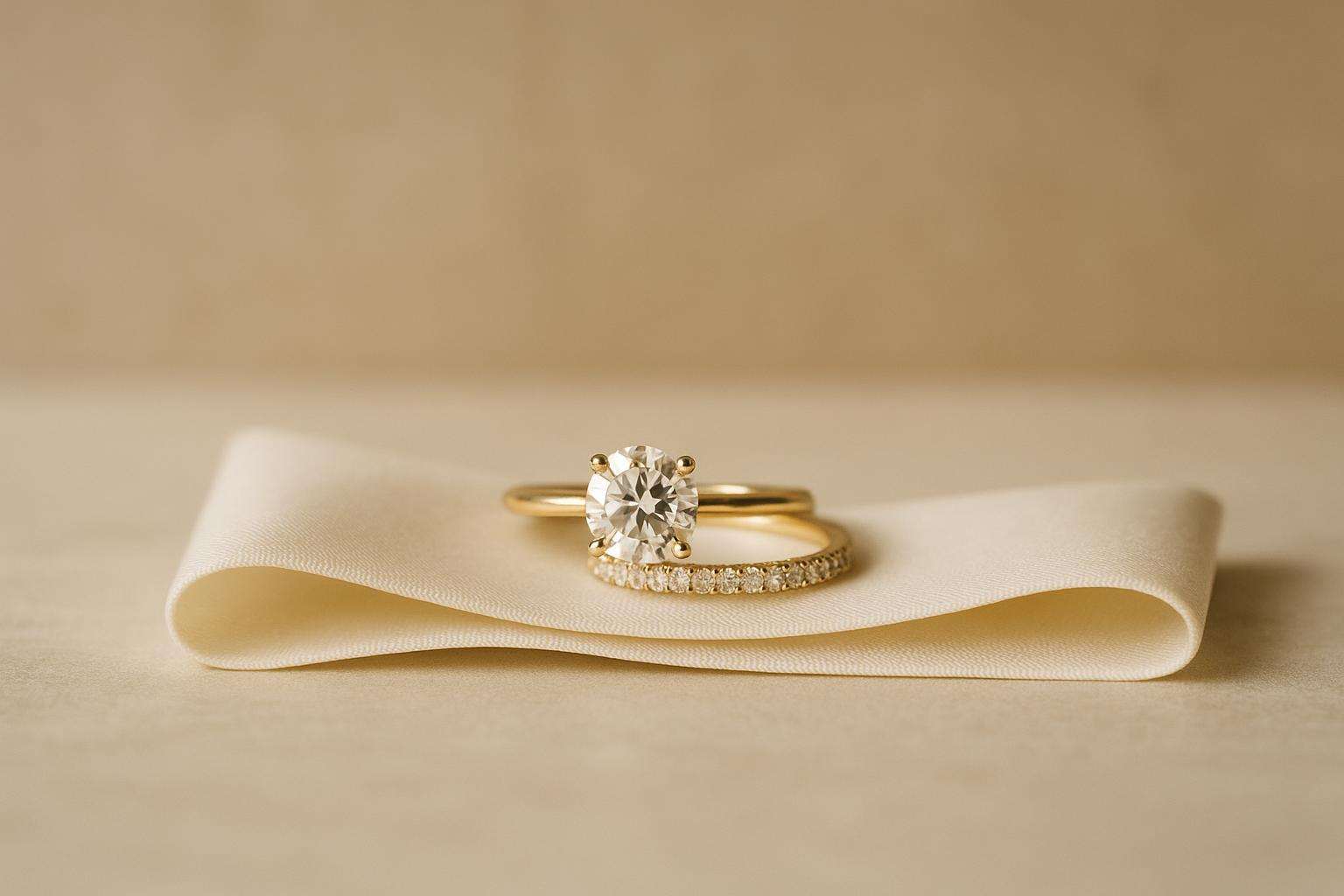
The near-universal Western convention is to wear the wedding band closest to the heart — at the base of the left ring finger — with the engagement ring stacked above it. On the wedding day, temporarily move the engagement ring to the right hand before the ceremony so the band can be placed first; return it to the left hand afterward. Whether to solder the two rings together is a personal decision best made after six months of wearing them as a pair. Band choice, metal match, and width all affect how comfortable and cohesive the finished stack looks and feels for everyday wear.
No piece of jewelry etiquette generates more confusion in the weeks between an engagement and a wedding than the question of how — exactly — to wear the two rings together. The questions arrive in clusters: Which ring goes closer to the hand? When do I switch them? Should they be soldered? What style of band pairs with my setting? Does the left-hand rule apply to everyone?
The answers are less complicated than the anxiety surrounding them suggests. Most of the conventions are rooted in a single principle — the wedding band, exchanged during the ceremony, sits innermost — and the practical decisions (band shape, metal, width, soldering) follow logically from there. This guide covers all of it, from the ceremony ring swap through the lifetime care implications of different pairing decisions.
Which Hand and Finger — and Does the Left-Hand Rule Apply to Everyone?
The Western convention is to wear both the engagement ring and wedding band on the fourth finger of the left hand, a tradition the Romans called the digitus annularis. The romantic explanation — that this finger houses a vena amoris, a vein running directly to the heart — is anatomically false; all fingers connect to the same circulatory architecture. But the tradition has survived the debunking intact. GIA's 4Cs education blog confirms this as the broadly observed Western norm while noting that it is cultural, not physiological, in origin.
The convention is not universal. In Germany, Russia, Greece, India, Poland, Spain, Norway, Colombia, and several other countries, both rings are traditionally worn on the right hand, reflecting Orthodox Christian custom or regional practice. In traditional Jewish ceremonies, the wedding ring is placed on the right-hand index finger during the ceremony, then moved by the wearer after — a detail that underscores how ceremony function and everyday wearing convention sometimes diverge. Boxwood Rose's comprehensive hand-placement guide documents these cross-cultural variations in detail.
The practical takeaway: if you or your partner have cultural ties to right-hand ring traditions, or simply prefer the right hand for reasons of comfort, dominant-hand use, or existing ring arrangements, there is no etiquette violation in wearing both rings on the right. The convention is a starting point, not an obligation. A related deep-dive on hand placement is covered in our companion piece on what hand an engagement ring goes on.
The Ceremony Ring Protocol: What Actually Happens on the Day?
The wedding band is placed on the left ring finger during the exchange of vows — directly on the finger, not over the engagement ring. This positioning matters symbolically: the band placed by your partner at the altar remains the innermost ring, closest to the hand, for the rest of married life. For that placement to happen cleanly, the engagement ring must not be on the left ring finger when the ceremony begins.
The standard practice is to move the engagement ring to the right ring finger immediately before the ceremony — not to remove it and hand it to someone else, not to leave it in the dressing room. Keeping it on your person, on the right hand, eliminates the risk of forgetting it, losing it in a bag, or creating stress during an already high-emotion morning. Many brides ask their maid of honor or a bridesmaid to remind them to make this swap during the final pre-processional moments.
After the ceremony — typically during the recessional or at the earliest quiet moment afterward — the engagement ring moves from the right hand back to the left, stacked above the newly placed wedding band. The resulting order from the base of the finger upward is: wedding band (innermost), engagement ring (outermost). The Knot's ring-etiquette guide describes this as the widely accepted post-ceremony convention, with the note that some couples later switch the order to personal preference — particularly if the engagement ring's setting profile makes the other arrangement more comfortable.
A small number of couples have the jeweler set the rings in final stacking order before the ceremony, wearing the engagement ring above the band from the moment the band is placed, without the traditional ring-swap. This is entirely acceptable; the ceremony-day swap is a convenience convention, not a rule with cultural or religious weight in most Western traditions.
Should You Solder the Two Rings Together?
Soldering — having a jeweler fuse the two rings into a single soldered unit — is permanent, and that permanence cuts both ways.
The case for soldering: A soldered pair does not spin. The two rings cannot rotate independently or separate, which eliminates the friction between them that slowly erodes the metal of both over years of daily wear. The stack looks more intentional and cohesive. If both rings are in the same metal, soldering effectively creates a custom two-part ring designed for your finger. PriceScope's ring-stacking guide notes that spinning and migration are the most frequently cited irritants for couples who wear both rings daily, and that soldering resolves both definitively.
The case against soldering: Once soldered, the rings cannot be worn separately — for exercise, outdoor work, travel, or any other circumstance where wearing one ring is preferable to the other. Individual resizing becomes a more complex operation: the soldered unit must be cut apart, each ring resized, and the pair re-soldered. If one ring ever needs significant repair or stone replacement, access is more restricted. Rings in different metals (a platinum band with a yellow gold engagement ring, for example) cannot reliably be soldered because the metals expand and contract at different rates, risking a solder joint failure.
Most jewelers recommend waiting at least six months to a year after the wedding before deciding. That window gives you time to determine whether the rings wear comfortably together, whether spinning is a genuine problem, and whether you ever want to wear them separately. If after six months you have not once worn them apart and the spinning frustrates you, soldering makes practical sense. If you regularly swap them for different occasions, the flexibility of an unsoldered stack is more valuable.
For couples who want to reduce spinning without the permanence of soldering, a sizing bead (a small solder ball added to the inside shank of one ring by a jeweler) or a non-permanent ring adjuster are effective alternatives. A sizing bead costs $30 to $60 and is reversible if removed later.
How to Choose a Wedding Band That Works With Your Engagement Ring
The band you choose will sit against — and in some cases directly against the underside of — the center stone setting of your engagement ring every day for decades. The design decisions that feel purely aesthetic in the jewelry case have real functional consequences for comfort, durability, and long-term wearability.
Shape: Straight, Curved, or Contoured?
A straight band is the most versatile choice and pairs well with the majority of solitaire engagement rings, especially those with a low profile or a bezel setting. It sits flush below the engagement ring when the two rings have matching shank widths. The one scenario where a straight band struggles is with high-set cathedral or prong solitaires: a gap opens between the base of the setting and the top of the band, which some couples find aesthetically uncomfortable and which can catch on fabric.
A curved, contoured, or notched band is designed to arch around the base of the center stone, closing that gap and creating a visually unified stack. It is purpose-built for solitaires with elevated settings. The trade-off is that a contoured band is less versatile if you ever want to wear the rings separately — its shape is engineered for the pairing, and it may look awkward worn alone.
Shadow bands are a variation of the curved band with a cut-out or shadow-shaped indentation that frames the base of the center stone rather than touching it — creating the visual unity of a contoured band with slightly more clearance.
Metal Match and Width
The most important functional decision is metal compatibility. PriceScope's stacking guide identifies metal hardness mismatch as the leading cause of premature ring wear: a softer gold band rubbing against a harder platinum engagement ring setting will lose metal faster than it should, and vice versa. Matching metals — platinum with platinum, 14k yellow gold with 14k yellow gold — is the lowest-maintenance pairing.
If you deliberately want to mix metals (yellow gold band with white gold or platinum solitaire, for example, which has become a popular aesthetic choice in recent years), ask your jeweler to confirm the two rings will not create a galvanic wear problem at their contact points. In most cases, well-made rings of different metals can coexist with minimal wear if their contact surfaces are smooth and polished.
Width matters aesthetically. A band that is narrower than the shank of the engagement ring creates a layered, graduated look that reads as intentional. A band that is the same width reads as a matched set. A band that is wider than the engagement ring shank risks visually competing with the center stone and can make the overall stack feel heavy. For most ring profiles, 2.5 to 3.5 mm is the range that balances visual presence with wearability; narrower than 2 mm is delicate and can kink with daily wear.
Stone-Set Bands: Pavé, Half-Eternity, and Full Eternity
Stone-set bands add brilliance but introduce a practical constraint: any stones on the under-shank of the band — the portion that contacts the engagement ring setting — can scratch prongs over time. A half-eternity band, in which stones run across the top half of the band only, avoids this problem entirely. A full-eternity band is more spectacular but must be used with care alongside raised prong settings; bezel and flush settings handle full-eternity pairing better.
| Engagement Ring Setting | Best Band Shape | Stone-Set Option | Practical Note |
|---|---|---|---|
| Low-profile solitaire (bezel or low prong) | Straight | Half-eternity or pavé | Any band width 2–4 mm sits flush; minimal gap |
| High-set cathedral solitaire | Curved / contoured | Half-eternity on top half only | Contour closes the setting gap; straight band leaves a visible gap |
| Halo engagement ring | Curved or shadow band | Pavé or plain metal | Halo's outer stones can scratch a band's upper edge — confirm clearance with jeweler |
| Three-stone ring | Straight or low-profile curved | Plain or channel-set | Three-stone shanks are often wider; matching width reads as intentional set |
| Vintage / antique-style setting | Milgrain or art deco straight band | Milgrain pavé or plain with milgrain edge | Period-consistent detail unifies the aesthetic; mixed-era pairings can work if intentional |
| East-west or bezel solitaire | Straight or slim curved | Any — under-shank contact is minimal | Low profile means most band styles sit cleanly; prioritize metal-hardness match |
Metal Durability and the Long View
Rings worn every day for decades experience meaningful cumulative wear. The metal you choose for the wedding band affects how the stack ages, particularly at the contact point between the two rings.
Platinum is the most durable of the common ring metals. It does not lose metal volume when scratched — the metal displaces rather than abrading away — and develops a satin-like patina over time that many wearers come to prefer. It is also the heaviest, which some people notice as substantial on the finger and others find reassuring. Platinum costs more upfront but requires no replating and retains its structural integrity for generations.
18k gold (75 percent pure gold) is softer than platinum but offers richer color — particularly relevant for yellow and rose gold bands, where the alloy warmth is part of the aesthetic. It outlasts 14k gold for everyday wear, though the difference is noticeable only over many years. 14k gold (58.5 percent pure gold) is the most affordable and most widely available option; it is durable enough for daily wear but will show more wear at the contact surfaces over decades than 18k or platinum.
If the engagement ring is platinum and the wedding band is 14k white gold, the band's softer alloy will show wear at the point of contact more quickly than either ring would wearing against its own metal. This is not a reason to avoid mixed metals — it is a reason to discuss the combination with your jeweler and budget for a future re-polish or re-plating of the softer ring. See our companion guide on platinum versus white gold and 14k versus 18k for a full durability and cost comparison.
Insurance and Appraisal: Do Both Immediately
Ring etiquette has a practical dimension that is easy to defer and costly to neglect. Every engagement ring should be appraised by a credentialed, independent appraiser within days of receipt — not weeks, not months. The appraisal is a signed document recording the ring's precise specifications and current replacement value, which differs from both the purchase price and the diamond grading report. After the wedding, re-appraise the engagement ring and band together as a stacked set so the insurance policy reflects the combined replacement value.
Standard homeowners and renters insurance caps jewelry coverage at $1,000 to $2,500 — insufficient for most engagement rings. Specialized ring insurance through providers like Jewelers Mutual costs approximately 1 to 2 percent of the insured value annually and covers loss, theft, accidental damage, and mysterious disappearance globally. Coverage typically begins the same day as application. For rings above $5,000 in value, a professional appraisal is required at claim time, making early appraisal a practical necessity rather than an optional extra. A detailed walk-through of your coverage options is in our full guide on standalone ring insurance versus a homeowners rider.
The rings you wear after the ceremony are, in the most tangible sense, the material record of that day. The decisions you make about how to wear them, how to pair them, and how to protect them are not burdensome obligations — they are the practical expression of the commitment they represent.
Frequently asked
Which ring goes on first — the engagement ring or the wedding band?
After the ceremony, the wedding band sits closest to the heart — meaning it occupies the base of the left ring finger, with the engagement ring stacked on top. During the ceremony itself, most couples temporarily move the engagement ring to the right hand so the wedding band can be placed directly on the left ring finger. Once the vows are exchanged and you leave the altar, you slide the engagement ring back over the band. The symbolism is intentional: the band, placed by your partner during the ceremony, remains the innermost ring throughout married life. GIA's 4Cs education blog describes this as the near-universal Western convention, though individual couples adjust the order freely once the ceremony is behind them.
Should I solder my engagement ring and wedding band together?
Soldering permanently fuses the two rings so they function as a single unit, which eliminates spinning, keeps the stack perfectly aligned, and reduces metal-on-metal friction that slowly erodes both rings over time. The trade-off is irreversibility: a soldered stack must be cut and re-soldered if either ring ever needs individual resizing or significant repair. Most jewelers recommend waiting at least six months to a year after the wedding before soldering — long enough to confirm the stack is comfortable day-to-day and that you do not want to wear the rings separately on occasion. If you choose not to solder, a ring adjuster or sizing bead inside the band can reduce spinning without permanent alteration. Both approaches are valid; the right answer depends on your lifestyle and how much you value flexibility.
What kind of wedding band pairs best with a solitaire engagement ring?
A straight, low-profile band in the same metal as the engagement ring is the most universally flattering pairing for a solitaire: it complements without competing, sits flush against the setting, and works whether the two rings are ever soldered. For solitaires with tall prong settings or cathedral profiles, a contoured or curved band arches around the center stone, closing the gap that a straight band would leave. Pavé or channel-set bands add sparkle while keeping the silhouette clean. Eternity bands — diamonds encircling the full band — are beautiful but impractical with raised settings because the stones on the under-shank can scratch the prongs; a half-eternity design avoids this. Width matters: bands narrower than the engagement ring's shank look balanced; a band that is wider than the shank visually competes with the center stone.
Do I have to wear my engagement ring on my left hand?
No. The left-hand convention is a Western tradition rooted in the Roman concept of the vena amoris — a vein of love believed to run from the left ring finger to the heart. Modern anatomy confirms no such dedicated vein exists; the tradition is cultural, not physiological. In Germany, Russia, India, Greece, Poland, Spain, Norway, Colombia, and several other countries, both the engagement ring and wedding band are worn on the right hand, reflecting Orthodox Christian or regional custom. Jewish tradition historically places the wedding ring on the right hand during the ceremony, moving it afterward. Couples from any of these backgrounds, or who simply prefer the right hand for practical reasons (dominant hand, existing ring collection, personal preference), may wear their rings however they wish. There is no etiquette obligation governing hand choice outside of the ceremony itself, which follows whatever tradition is meaningful to the couple.
How do I stop my engagement ring from spinning on my finger?
Rings spin when the finger is narrower than the ring's interior diameter — most commonly because rings are sized for the knuckle but the finger is slimmer below it. Four practical solutions exist. First, stack the wedding band beneath the engagement ring: the combined width creates more friction against the finger and dramatically reduces spinning. Second, ask your jeweler to add a sizing bead (a small platinum or gold bead soldered to the inside of the shank) — this adds minimal material but creates enough friction to anchor the ring. Third, consider soldering the engagement ring and band together; a fused pair spins far less than a single ring worn alone. Fourth, ring noodles (silicone ring size adjusters) are a non-permanent, inexpensive option suitable for people who experience significant knuckle-to-finger size difference seasonally or due to temperature fluctuation.
How soon after the engagement should I insure my ring?
Immediately — ideally within days of receiving the ring, and certainly before attending any events where it could be lost, damaged, or stolen. Standard homeowners and renters insurance policies cap jewelry coverage at $1,000 to $2,500, which is insufficient for most engagement rings. Jewelers Mutual — the most widely cited specialized insurer in this category — prices standalone ring insurance at approximately 1 to 2 percent of the insured value annually. A $5,000 ring costs roughly $50 to $100 per year; coverage typically begins the same day as application. For rings valued above $5,000, a professional appraisal is required at claim time, so get that appraisal done early. See our full guide on standalone ring insurance versus a homeowners rider for a complete cost comparison.
Can I wear my engagement ring during the wedding ceremony, or should I take it off?
The most practical approach is to move the engagement ring to your right hand before the ceremony begins — not to remove it entirely. Removing it increases the chance of forgetting it in the dressing room, misplacing it, or creating anxiety at an already high-stress moment. Moving it to the right hand keeps it safe on your person while leaving the left ring finger open so your partner can place the wedding band directly on the finger during the exchange of vows. Once the ceremony concludes, slide the engagement ring from the right hand back onto the left hand, positioning it above the wedding band. Many brides ask a trusted bridesmaid or the maid of honor to remind them to make this swap immediately before the processional.