After the Yes
What Hand Does an Engagement Ring Go On?
The left-hand fourth-finger tradition has deep roots — but right-hand customs are equally valid in dozens of cultures. Here is the full picture.
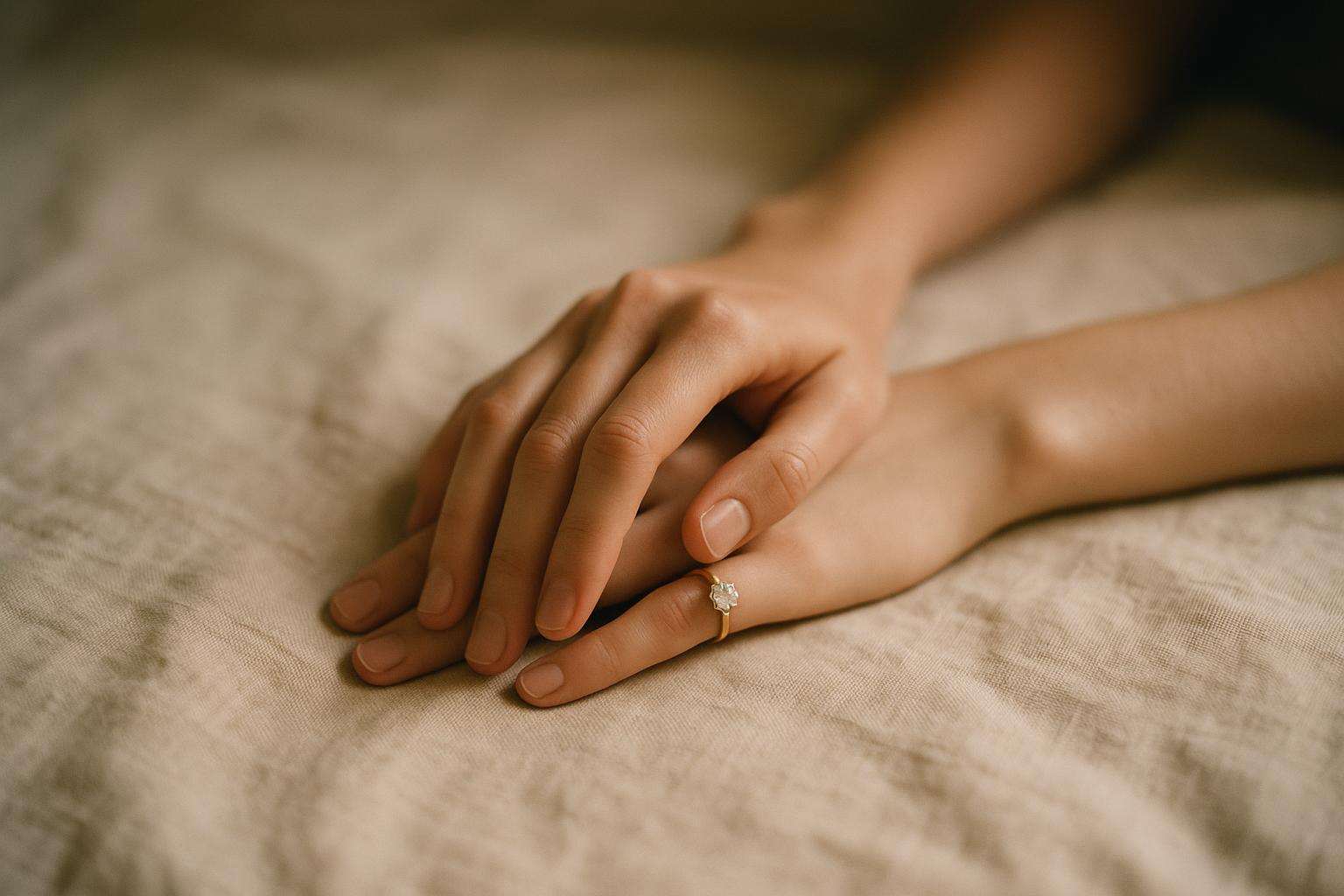
In the United States, United Kingdom, Canada, and Australia, the engagement ring goes on the fourth finger of the left hand. In Germany, Russia, India, Greece, Norway, Spain, Poland, and many other countries, the right hand is the correct choice. Both conventions are entirely proper — the "right" hand is the one that matches your cultural tradition.
Why Do Most Western Countries Use the Left Hand?
The left-hand convention common across the English-speaking world descends from a Roman custom documented as far back as the second century CE. Roman writers described a belief in the vena amoris — a "vein of love" — thought to run from the fourth finger of the left hand directly to the heart. The anatomical claim is false: every finger connects to the same circulatory system via the ulnar and radial arteries, and no single vessel runs a privileged course from any one digit. But the poetic idea proved durable. As GIA's 4Cs editorial team notes, the tradition endured through medieval Europe, was reinforced by the Church of England's 1549 Book of Common Prayer (which specified placing the ring on the left hand during the marriage rite), and has remained standard across the United States, Canada, the United Kingdom, Australia, and New Zealand ever since.
The left ring finger's physical characteristics also make it a practical choice for a ring worn continuously. It is typically the least dominant finger on the non-dominant hand, exposed to somewhat less mechanical stress than the fingers of the right hand during daily tasks. For most right-handed people, that means less risk of knocking the ring against surfaces and slightly less prong wear over time — though any ring worn every day still requires professional inspection every one to two years.
Which Countries Wear the Engagement Ring on the Right Hand?
The right-hand tradition is widespread, historically deep, and in no way less valid than the left-hand convention. The table below summarises the dominant customs by region.
| Country / Region | Dominant Hand | Primary Reason |
|---|---|---|
| United States, Canada, UK, Australia, New Zealand | Left | Roman vena amoris tradition; Church of England rite |
| France, Ireland, Sweden | Left (predominant) | Western European Catholic and secular tradition |
| Germany, Austria, Switzerland (German-speaking) | Right | Pre-Christian Germanic custom; Protestant and Catholic practice both use right |
| Russia, Ukraine, Bulgaria, Serbia | Right | Eastern Orthodox Christian liturgical tradition |
| Greece, Cyprus | Right | Greek Orthodox tradition |
| Poland, Czech Republic, Hungary | Right (historically predominant; urbanising) | Catholic and Orthodox heritage; some younger couples shift to left |
| Spain, Portugal, Colombia, Venezuela | Right | Iberian Catholic tradition carried to Latin America |
| Norway, Denmark (historically) | Right (traditional); Left gaining prevalence | Lutheran Nordic tradition; globalisation shifting younger practice |
| India (Hindu tradition) | Right | Right hand considered auspicious; left associated with impurity in some regional customs |
| Jewish tradition | Right index finger (during ceremony); may move after | Halacha specifies the right index finger for the ring during the ceremony so witnesses can clearly observe; many couples move it to the left ring finger afterward |
The right-hand tradition in Central and Eastern Europe is rooted in Orthodox and Eastern Catholic Christianity, in which the right hand carries spiritual authority — blessings are given with the right hand, oaths are sworn on it, and sacramental objects are received in it. Wearing a ring that symbolises a sacred covenant on the right hand is therefore theologically consistent, not merely cultural habit. Similarly, in India, the right hand (the dakshina hasta) is the auspicious, giving hand across Hindu, Jain, and many other religious traditions, making it the natural choice for a ring that represents commitment and blessing.
If your family background spans more than one tradition — a Norwegian-American marrying a Greek-American, for example — there is no single correct answer. Many couples in this position choose to discuss the question openly before the proposal and then wear the ring on whichever hand feels most natural to them as a couple, sometimes drawing on both heritages in the ceremony itself.
How Does the Engagement Ring Relate to the Wedding Band, and What Is the Correct Stacking Order?
In the Western left-hand tradition, the wedding band sits on the inside of the stack, closest to the hand, with the engagement ring worn on top of it. This order comes directly from the ceremony protocol: on the wedding day, the bride or partner wearing the ring temporarily moves the engagement ring to the right hand before the ceremony begins, so that the wedding band can be placed first on the bare left ring finger during the exchange of vows. After the ceremony, the engagement ring is returned to the left hand and slipped on outside the band. The wedding band thus ends up in the symbolically primary position — closest to the heart — with the engagement ring framing it from the outside.
Some couples find the stacking order cumbersome to execute on the wedding day and choose to simply wear both rings in whatever order is comfortable. Others ask their jeweler to solder the two rings together permanently after the wedding, which prevents the rings from rotating independently and keeps the aesthetic consistent. Soldering is a permanent modification and makes future resizing considerably more complex, so it is worth discussing carefully with your jeweler — particularly if significant weight changes or knuckle size differences over time are a possibility.
Band pairing and design
If you are choosing a wedding band to pair with an existing engagement ring, consider the following practical factors:
- Profile compatibility: A contoured or curved band designed to nestle against the engagement ring's shank eliminates uncomfortable gaps and prevents the rings from shifting relative to each other during wear.
- Width: A band width of 2.5 to 3.5 mm strikes the balance between visual presence and structural resilience. Bands narrower than 2 mm can develop micro-kinks over time if the engagement ring's setting exerts lateral pressure.
- Metal match: Mixing metals is a deliberate aesthetic choice and entirely acceptable, but mixing hardness levels — platinum against 14k gold, for example — can cause the softer metal to show wear faster. Platinum wears more slowly than 18k gold, which outlasts 14k; if long-term appearance matters, matching metal families reduces differential wear.
- Prong settings: If the engagement ring has prong-set stones, have the prongs inspected professionally every one to two years. Daily wear, especially with a band pressing against the base of the setting, loosens prongs gradually. A bezel or flush setting is more protective of the stone but trades some light return for durability.
For a deeper look at how the engagement ring and wedding band relate in terms of design, ceremony protocol, and long-term wear, see our guide to how to wear your engagement ring and wedding band.
Practical Questions: Switching Hands, Travel, and Insurance
Is it acceptable to switch hands for activities?
Yes. Many people temporarily move their engagement ring to the right hand — or remove it entirely — during activities that expose it to risk: working with heavy machinery, contact sports, gardening, cooking with acidic ingredients, or any situation where a snag could bend a prong or loosen a stone. This is not a breach of any etiquette convention; it is sensible ring care. The ring's meaning is not diminished by temporarily occupying a different finger.
What about left-handed people?
Left-handed people often ask whether they should wear the engagement ring on the right hand to protect it from the greater mechanical stress their dominant hand experiences. There is no universal answer, and etiquette does not address it. Many left-handed people wear the ring on the left hand as convention dictates and accept slightly faster wear; others prefer the right hand for practical reasons and find that their cultural background — particularly if they have roots in right-hand-tradition countries — makes that an equally natural choice. This is genuinely a personal decision, and either hand is defensible.
Insurance and documentation
Regardless of which hand you wear your engagement ring on, the most important protective step after receiving it is to get it appraised and insured promptly. Standard homeowners and renters policies typically cap jewellery coverage at $1,000 to $2,500 — insufficient for most engagement rings. Specialized insurers such as Jewelers Mutual price standalone ring coverage at roughly 1 to 2% of the insured value annually, and coverage can begin the same day as application. For rings valued above $5,000, most insurers require a professional appraisal at claim time, making early appraisal a practical necessity. Our full guide to engagement ring insurance covers the major standalone insurers, what is and is not covered, and how to document your ring for a smooth claim process.
If you have just received your ring and are in the first hours of being engaged, the announcement question is likely equally pressing. Our guide on how to announce your engagement covers the five-tier notification sequence — from parents to social media — and helps you navigate the first days gracefully.
A Note on Respecting All Traditions
Questions about ring-wearing customs can feel surprisingly charged, particularly in multicultural families or when partners come from different religious backgrounds. It is worth remembering that the left-hand tradition is not inherently more modern, more romantic, or more correct than the right-hand tradition — it is simply the dominant convention in English-speaking countries, and it carries no moral or etiquette superiority over equally ancient customs practiced by hundreds of millions of people around the world. Both the Roman vena amoris narrative and the Orthodox Christian right-hand tradition are thousands of years old. Both are beautiful. The most meaningful ring is the one worn in the way that feels truest to the couple wearing it.
If you are navigating a cross-cultural proposal and unsure how to handle the ring-hand question as part of a broader conversation about blending traditions, the most useful first step is simply an open conversation with your partner about what each of your backgrounds means to you — before the ring is on anyone's finger.
Frequently asked
What hand does an engagement ring go on in the United States?
In the United States, the engagement ring is worn on the fourth finger of the left hand — commonly called the ring finger. This convention traces to the ancient Roman belief in the vena amoris, or "vein of love," thought to run directly from that finger to the heart. Modern anatomy has disproved the claim, but the tradition remains firmly established across the U.S., Canada, the United Kingdom, Australia, and most English-speaking countries. According to GIA's 4Cs editorial team, this left-hand convention is the dominant standard throughout the Western world, though it is not universal.
Which countries wear the engagement ring on the right hand?
A substantial number of countries favour the right hand for both engagement and wedding rings. These include Germany, Austria, Norway, Denmark, Russia, Ukraine, Poland, Spain, Portugal, Greece, India, Colombia, Venezuela, and several other Latin American nations. The right-hand tradition in much of Central and Eastern Europe reflects Orthodox Christian liturgical practice, in which the right hand carries spiritual significance. In India, the right hand is traditionally the auspicious hand for ceremonial purposes. In Germany and Austria, the custom dates to pre-Christian Germanic tradition and has persisted uninterrupted into modern times. Couples with heritage from any of these cultures should feel entirely confident following their own tradition — there is no single universal rule, and neither hand is incorrect.
What happens to the engagement ring during the wedding ceremony?
The most common Western practice is to temporarily move the engagement ring to the right hand at the start of the ceremony. This clears the left ring finger so the wedding band can be placed directly on the finger first — symbolically closest to the heart — during the exchange of vows. After the ceremony, the engagement ring is returned to the left hand and worn on top of (or outside) the wedding band. Some couples choose to have a jeweler solder the two rings together after the wedding to prevent them from spinning independently and to preserve the aesthetic. Soldering is permanent and makes future resizing more complex, so it is worth discussing with your jeweler before committing. According to The Knot, the "band on the inside, closest to the heart" convention is widely observed but not obligatory — what matters is what feels right to the couple.
Can I wear my engagement ring on a different finger or hand than tradition suggests?
Absolutely. Ring-wearing conventions are social customs, not legal requirements, and there is no etiquette authority that would fault you for wearing your ring in a way that feels comfortable, expressive, or culturally appropriate to you. Some people wear the engagement ring on the middle finger or index finger if the ring finger is not comfortable; others switch hands for athletic activities or professions that make the dominant hand vulnerable to damage. The only practical consideration is insurance documentation: your insurer will note the ring's description but does not restrict which finger or hand you wear it on. If you have a specific cultural or religious tradition that differs from the local norm, follow your tradition with confidence.
Does the engagement ring go on before or after the wedding band when stacking?
In the Western left-hand convention, the wedding band sits closest to the hand (on the inside of the stack), with the engagement ring worn on top of it. This order reflects the ceremony protocol described above — the band is placed first during vows, and the engagement ring is returned outside it afterward. From a practical standpoint, wearing the wedding band on the inside also protects its surface from the constant friction of an engagement ring's setting above it. For design and comfort, choosing a wedding band that is contoured or shaped to nestle against the engagement ring's profile avoids uncomfortable gaps and minimises the risk of the rings shifting. A minimum band width of 2 mm is recommended to maintain structural integrity in the stack, with 2.5 to 3.5 mm being the sweet spot for most engagement ring profiles according to jewelers at PriceScope.
Should I insure my engagement ring before wearing it?
Yes — and the sooner the better. Standard homeowners and renters insurance policies typically cap jewelry coverage at $1,000 to $2,500, which is below the value of most engagement rings. Specialized jewelry insurers such as Jewelers Mutual and BriteCo offer standalone policies that cover loss, theft, accidental damage, and mysterious disappearance globally. Jewelers Mutual prices coverage at roughly 1 to 2% of the insured value annually — a $5,000 ring costs approximately $50 to $100 per year. To open a policy on a ring valued above $5,000, most insurers require a professional appraisal; for rings under that threshold, the sales receipt typically suffices. Coverage can begin the same day as application in most cases. Getting ring insurance before you begin wearing the ring daily — rather than after a loss occurs — is the single most important protective step a newly engaged person can take.