Budget & Financing
7 Ways to Save on an Engagement Ring Without Sacrificing the Look
Lab-grown diamonds, shape swaps, clarity sweet spots, metal choices, and buy-shy carat strategy — every lever that actually moves the price, quantified.
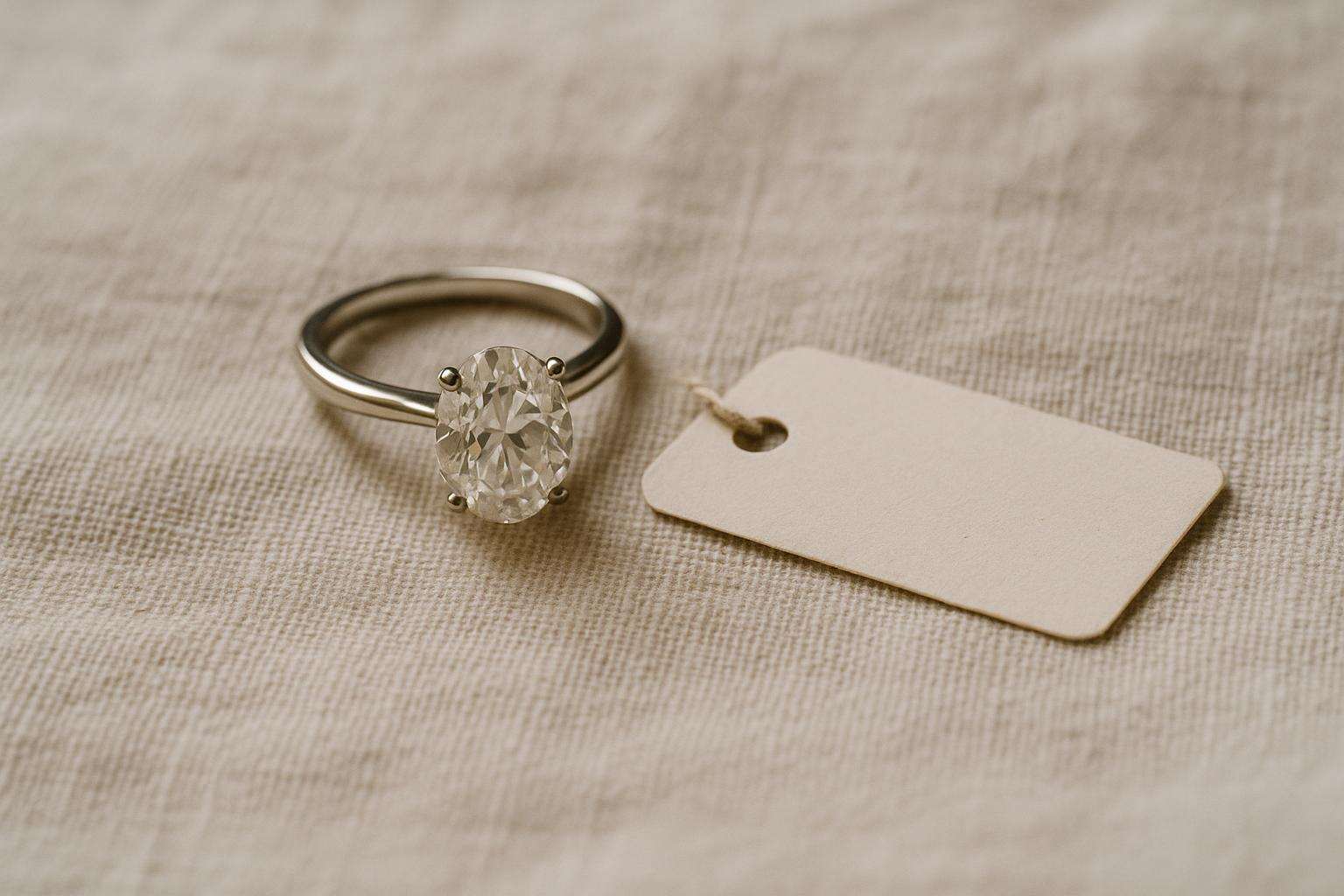
The engagement ring market in 2026 offers more savings levers than at any prior point in the modern era. Lab-grown diamonds alone can cut a stone's cost by 70–83% versus a natural equivalent. Add a fancy shape instead of round, choose a clarity grade that looks identical in a finished ring, buy just below a carat benchmark, or swap platinum for white gold — any one of these moves saves hundreds; combining two or three can save thousands. The ring on the other end is not a compromise. It is a better-informed purchase.
The average American couple spent approximately $5,200 to $6,500 on an engagement ring in 2025–2026, depending on which survey you consult — but nearly two-thirds of buyers spent less than $6,000, and a meaningful third came in under $3,000, according to The Knot's 2024 Jewelry and Engagement Study. Those figures do not reflect buyers who sacrificed quality. Many simply knew which variables actually change how a ring looks and which ones only change what it costs.
This guide covers seven strategies that accomplish exactly that. Each is grounded in the mechanics of diamond pricing and verified against current 2026 market data. The strategies are stackable: you can apply one, two, or all seven depending on your budget and priorities. For the full picture of what these budgets buy in actual ring specs at each tier, see our companion guide to engagement ring budget tiers.
Strategy 1: Choose a Lab-Grown Diamond — the Single Largest Lever
No other single decision moves the price as far as choosing a lab-grown diamond over a natural one. In 2026, a 1.00-carat lab-grown diamond in Excellent cut, G color, and VS2 clarity is available for approximately $800–$1,000 loose, versus $3,800–$4,200 for a natural diamond of identical certified quality — a savings of roughly 75–80% on the center stone alone.
Scaled to a complete ring: BriteCo's insured-ring dataset shows the average lab-grown diamond ring in 2025 cost $5,187, versus $10,760 for a natural-diamond ring — a saving of $5,573, or 52%, at the average market level. The average carat weight in a lab-grown purchase was simultaneously larger, at approximately 1.9 carats, as buyers reallocated savings into stone size.
Lab-grown diamonds are physically and chemically identical to mined diamonds — the same crystal structure, the same hardness (10 on the Mohs scale), the same fire and brilliance. They carry GIA and IGI certifications graded on the exact same 4Cs scales. A standard jeweler's loupe cannot distinguish them from natural stones; specialized spectroscopic equipment is required. The FTC's Guides for the Jewelry, Precious Metals, and Pewter Industries require retailers to disclose lab origin clearly — and reputable retailers do so.
The relevant trade-off is resale value. Lab-grown diamonds currently sell for approximately 10–20% of purchase price on the secondary market, versus 40–60% for natural diamonds. Buyers who plan to upgrade, sell, or view the ring as a store of value should weigh this carefully. Buyers who view the ring as a lifelong personal symbol may rationally conclude the upfront savings — enough to fund the honeymoon, the wedding bands, or a down payment contribution — outweigh a hypothetical future liquidation discount.
Lab-grown stones accounted for 61% of all U.S. engagement ring purchases in 2025, according to The Knot, up 239% from 2020. This is no longer a niche choice.
Strategy 2: Choose a Fancy Shape Instead of Round — 20 to 35% Savings with Equal or Greater Visual Presence
Round brilliant diamonds carry the highest per-carat premium of any shape, for two compounding reasons: the cutting process wastes up to 50–60% of the original rough diamond material (more than any other shape), and round brilliants represent the plurality of consumer demand, which keeps prices elevated by concentration of desire. Fancy shapes — oval, pear, marquise, cushion — are priced lower per carat and, in the case of elongated shapes, appear larger face-up than a round of the same carat weight.
| Shape | Typical savings vs. round | Face-up size vs. round (same carat) | Best for |
|---|---|---|---|
| Oval | 20–30% | ~10% larger apparent diameter | Classic look, finger-elongating effect, highest current demand among fancy shapes |
| Pear | 20–30% | ~10–12% larger footprint | Distinctive teardrop silhouette, strong elongating effect, vintage or modern settings |
| Marquise | 25–35% | ~12% larger face-up than round | Maximum face-up size per dollar, dramatic architectural look, lower demand = lower price |
| Cushion | 15–25% | Roughly equivalent to round | Soft square or rectangular shape, romantic and vintage feel, very high current demand |
| Princess | 20–30% | Slightly smaller face-up than round | Modern geometric look; faces up smaller than the carat weight suggests — inspect carefully |
The marquise and pear cuts offer the strongest combination of savings and apparent size, though both require attention to the "bow-tie" optical effect — a dark shadow across the center of elongated cuts caused by light leakage — which varies by individual stone. Always inspect the specific stone via high-resolution video before purchase. Oval has become the most popular fancy shape, representing roughly 25% of all shape selections in 2025, which has slightly compressed its discount versus earlier years; marquise and pear remain genuinely underpriced relative to their visual impact.
For a shape-by-shape comparison including face-up size tables at each carat weight, see our complete diamond shapes guide.
Strategy 3: Target the Clarity Sweet Spot — SI1 and VS2 Look Identical to VS1 in a Finished Ring
Diamond grading distinguishes inclusions visible under 10x magnification from those visible to the naked eye. Only the latter matters in a finished, mounted ring worn in daily life. For most round brilliant cuts under 1.5 carats, VS2 and well-selected SI1 diamonds appear completely inclusion-free to the unaided eye — indistinguishable from VS1, VVS2, or Flawless grades that carry significantly higher prices.
The financial reality: the price premium for VS1 over VS2 on a 1.00-carat round brilliant is typically 10–20%; stepping from VS2 to SI1 saves an additional 5–20% on the stone. A real-world example from With Clarity's 2026 pricing data: two 1.01-carat H-color round brilliants, both eye-clean — one VS2 at $5,800, one SI1 at $4,750, a difference of $1,050 for a distinction invisible to any unaided observer.
Important caveats that every buyer should understand:
- "Eye-clean" is not guaranteed by grade. Inclusion type and position matter. A small transparent pinpoint near the girdle (often hidden by a prong) is invisible in a finished ring; a dark carbon crystal under the table is not. Always request and inspect high-resolution imagery and a 360-degree video of the specific stone before purchase.
- Brilliant cuts are most forgiving. Round, oval, cushion, and radiant cuts scatter light across 58 or more angled facets, breaking up inclusions within the brilliance. SI1 is viable on individual inspection for all of these shapes under 1.5 carats.
- Step cuts require a higher clarity floor. Emerald and Asscher cuts have large, open parallel facets that function like windows into the stone's interior, making inclusions far more visible than in brilliant cuts. For these shapes, VS2 is the practical minimum; VS1 is recommended for stones above 1.5 carats.
- Size changes the calculus. For stones above 2.00 carats, upgrade clarity by one grade to maintain the same eye-clean probability, as larger surfaces reveal inclusions more readily.
The clarity and eye-clean threshold guide covers inclusion types, shape-specific grade tables, and how to read a GIA report's plotted diagram to identify where inclusions sit.
Strategy 4: Buy Shy of Carat Benchmarks — 10 to 25% Savings for No Visible Difference
Diamond prices jump non-linearly at psychologically significant carat weights: 0.50, 0.75, 1.00, 1.50, 2.00, and 3.00 carats. These are "magic sizes" in the trade — retailers price inventory to reflect the premium buyers will pay for a round number, even when the physical difference from a stone 0.05 or 0.10 carats lighter is imperceptible in a mounted ring.
The diameter difference between a 0.93-carat and a 1.00-carat round brilliant is approximately 0.15 millimeters — less than the thickness of two sheets of paper, and invisible in a set ring. The price difference at the 1.00-carat threshold is typically 10–15% per carat; at the 2.00-carat threshold it can reach 20–25%. Applied to a baseline of $4,200 for a natural 1.00-carat round brilliant in Excellent cut, G color, VS2 clarity: a 0.92-carat stone of equal quality might run $3,600–$3,800, saving $400–$600 for no observable trade-off.
The buy-shy targets that consistently deliver the best savings:
- 0.90–0.95 ct instead of 1.00 ct → saves 10–15%
- 1.40–1.45 ct instead of 1.50 ct → saves 10–15%
- 1.85–1.95 ct instead of 2.00 ct → saves 15–25%
- 2.85–2.95 ct instead of 3.00 ct → saves 10–15%
A subtler benefit of buying shy: cutters sometimes sacrifice optimal proportions to reach an exact benchmark weight from a given piece of rough, which means diamonds cut to precisely 1.00 or 2.00 carats are statistically more likely to fall outside ideal cut-proportion ranges. Buying 0.93 carats is not only less expensive — it correlates with a slightly higher probability of encountering well-proportioned cuts at that weight, because the cutter faced less pressure to hit a target number.
Strategy 5: Shop Online Rather Than In-Store — 20 to 40% Structural Price Advantage
Major online diamond retailers — Blue Nile, James Allen (now operating within the Blue Nile group), and Brilliant Earth among them — consistently price comparable certified stones 20–40% below traditional brick-and-mortar retail. The gap is structural, not promotional: physical stores carry the overhead of storefront rent in high-traffic retail locations, trained sales staff, on-site security, and an extensive inventory of diamonds sitting in display cases, often financed until a buyer appears. Every one of those costs is priced into the retail margin. Online retailers eliminate most of it.
Industry analysis places traditional jewelry retail markup at approximately 200–300% over wholesale cost; luxury chain and branded boutique markup can reach 400–475%. Competitive online retailers have pushed their effective markup on certified diamonds to below 20% in many categories — sometimes below 10% — on individual stones. On a $5,000 ring, that structural difference can mean $1,000–$2,000 in direct savings, or a meaningfully larger or higher-quality stone for the same spend.
The practical steps to buy online safely: (1) confirm the stone's GIA or IGI certificate number on the grading lab's own website before purchase, (2) use the retailer's 360-degree video tool to inspect the specific stone for any visible inclusions or bow-tie effects, (3) verify the return policy — reputable retailers offer 30-day no-questions returns on unmounted stones. Factor in modest potential costs: resizing by a local jeweler ($50–$150) and a professional appraisal for insurance purposes ($50–$150). Even with both, the price advantage of online purchasing typically holds. For a head-to-head evaluation of the major online retailers, see our online retailers compared guide.
Strategy 6: Choose the Right Metal — 14K White Gold Saves $300 to $1,200 on the Setting
Platinum and 14K white gold appear virtually indistinguishable when new — both present as bright white metal in a finished ring. The price difference on a comparable solitaire setting runs from $300 to over $1,200, depending on complexity. In 2026, a standard platinum solitaire setting typically runs $1,200–$2,000 versus $500–$800 for the equivalent in 14K white gold, according to current retail data from Versani and Goodstone.
Platinum costs more despite raw platinum spot prices currently sitting far below gold (approximately $960–$1,020 per troy ounce for platinum versus $4,700–$5,000 per ounce for gold in mid-2026) because platinum is 40% denser than gold — so the same ring design uses significantly more grams of metal by weight — and because jewelry-grade platinum (PT950) is 95% pure metal, compared to 58.3% for 14K white gold. Platinum also requires higher working temperatures and more skilled labor to set stones.
The long-term maintenance trade-off: white gold requires rhodium re-plating every one to three years (approximately $50–$150 per service at most jewelers) to maintain its bright white finish. Platinum develops a natural patina over time that can be polished rather than replated. Over a 20-year period, the cumulative replating cost for white gold can reduce but not eliminate the initial price gap.
For buyers choosing a warm-metal look — which is a strong trend, with yellow gold reaching 36% of all engagement ring settings in 2024 — there is no price penalty: yellow and rose gold settings are priced comparably to white gold at the same karat. The metal-trend shift to yellow gold carries no additional cost and is worth considering aesthetically if the warmer palette suits your partner's style.
Strategy 7: Consider Moissanite or a Colored Gemstone for a Different Kind of Ring
For buyers whose budgets are genuinely constrained, or who want to allocate funds to a more elaborate setting, stone shape, or other priorities, two alternatives to a diamond center stone are worth an honest look.
Moissanite (silicon carbide) is the closest diamond alternative in hardness (9.25 on the Mohs scale, versus 10 for diamond) and optical properties. A 1.00-carat equivalent moissanite from Charles & Colvard (the original moissanite brand), Brilliant Earth, or Clean Origin typically runs $300–$600, versus $800–$1,500 for a comparable lab-grown diamond. The aesthetic difference: moissanite has a higher refractive index than diamond and produces more colorful fire — vivid rainbow flashes under direct light — that some buyers find spectacular and others prefer not to have. It is a legitimate, durable gemstone, not a simulant, and carries its own durability advantages for daily wear. The savings relative to a natural diamond of similar visible size can reach 90%+.
Colored gemstones — particularly sapphire, which has a Mohs hardness of 9 and is entirely appropriate for daily wear — can offer both budget savings and a deeply personal aesthetic. A high-quality 1.00-carat natural blue sapphire typically runs $400–$2,000 depending on origin, color saturation, and treatment status, versus $3,000–$15,000 for a natural diamond of comparable visible quality. Sapphires have been used in engagement rings for centuries and carry no lesser tradition than diamonds; they are simply a different choice. For more on colored-stone durability and selection, see our colored gemstone rings guide.
How These Strategies Stack — and Which Combination Delivers the Most
The seven strategies above are not mutually exclusive. Most of the best-value rings in 2026 combine at least two or three of them. Here is how the savings compound on a hypothetical natural-diamond ring that might otherwise cost $8,000:
| Swap made | Approximate saving | Visual impact |
|---|---|---|
| Choose lab-grown diamond instead of natural | $3,000–$3,500 on the stone | None detectable to the unaided eye |
| Choose oval shape instead of round | $400–$700 on the stone | Different silhouette; appears slightly larger face-up |
| Choose VS2 instead of VS1 clarity | $300–$600 on the stone | None detectable to the unaided eye for a brilliant cut |
| Buy at 0.92 ct instead of 1.00 ct | $400–$600 on the stone | 0.15 mm diameter difference; invisible when set |
| Choose 14K white gold instead of platinum setting | $500–$800 on the setting | Identical appearance when new; replating needed every 1–3 yrs |
| Buy from a reputable online retailer | $800–$2,000 overall | None — same certified stone, lower overhead margin |
Applied together, those six adjustments to a hypothetical $8,000 baseline can bring the same-looking ring to $2,500–$3,500 — a savings of $4,500 to $5,500. What the buyer ends up with is not a lesser ring. It is a ring with identical visual properties at a fraction of the cost, purchased by someone who understood the variables that drive price versus the variables that drive appearance.
The historical premise that a ring's value is a proxy for the commitment behind it was not traditional wisdom — it was advertising, specifically a De Beers campaign engineered beginning in the 1930s. Only 24% of engaged respondents in a 2025 Talker Research survey said they had actually followed the two-months-salary rule. The couples who spend thoughtfully, allocate their resources to the features that matter most to them, and begin their engagement without unnecessary debt have made the stronger decision by any measure.
For the full picture on how budgets translate into specific ring specs at the $1K, $3K, $5K, and $10K levels — with named retailer examples and current pricing — see the ring budget tiers guide. And if you are weighing whether to finance a portion of the ring purchase, our financing options comparison covers jeweler cards, BNPL platforms, and the deferred-interest traps to avoid.
Frequently asked
Does choosing a lab-grown diamond mean lower quality?
No. Lab-grown diamonds are physically and chemically identical to mined diamonds — the same crystal structure, the same hardness (10 on the Mohs scale), the same optical properties. They are graded on the same GIA or IGI cut, color, clarity, and carat scales. The only thing that differs is origin: lab-grown diamonds are created in controlled manufacturing environments rather than extracted from the earth. A gemologist cannot distinguish a lab-grown from a natural diamond with a loupe or even a standard diamond tester; specialized spectroscopy equipment is required. The relevant trade-off is not quality — it is resale value. Lab-grown diamonds currently sell for approximately 10–20% of purchase price on the secondary market, versus 40–60% for natural diamonds. For buyers who view the ring as a lifelong personal commitment symbol rather than a tradeable asset, this difference is largely academic.
What is the 'buy shy' strategy and how much does it actually save?
"Buy shy" means purchasing a diamond whose carat weight falls just below a round-number benchmark — 0.90–0.95 carats instead of 1.00, or 1.40–1.45 carats instead of 1.50. Diamond prices jump sharply at benchmark weights (0.50, 0.75, 1.00, 1.50, 2.00 carats) because consumer demand concentrates at round numbers and retailers price accordingly. The physical diameter difference between a 0.93-carat and a 1.00-carat round brilliant is roughly 0.15 millimeters — imperceptible once the stone is set in a ring. The price difference at the 1.00-carat threshold is typically 10–15%; at the 2.00-carat threshold it can reach 20–25%. On a natural 1.00-carat round brilliant priced at approximately $4,200, choosing a 0.92-carat stone of equal quality might save $400–$600 for no visible trade-off. The buy-shy strategy applies equally to lab-grown diamonds, though the absolute dollar savings are smaller given already-low prices.
Which diamond shape saves the most money versus a round brilliant?
The marquise cut offers the largest per-carat savings versus a round brilliant of the same quality — up to 35% less in some comparisons — because it generates less cutting waste from rough, and because consumer demand for the shape remains below its visual-impact potential. Oval and pear cuts save approximately 20–30% versus round. The meaningful secondary advantage of all three elongated shapes is that they appear larger face-up than a round of identical carat weight: elongated shapes distribute their surface area across a wider span of the finger. Oval diamonds have surged in popularity and now represent approximately 25% of shape selections in 2025, second only to round. Marquise and pear remain below-average in relative demand, which continues to keep their pricing competitive. For buyers who want the most visual presence per dollar, marquise or pear is the strongest combination of savings and apparent size.
Is SI1 clarity safe to buy, or should I stick with VS2?
For round brilliant cut diamonds under 1.5 carats, a carefully selected SI1 can be a very strong choice. The brilliant cut's 58 angled facets scatter light in multiple directions, breaking up and masking inclusions within the brilliance. Industry data indicates that a majority of SI1 round brilliants at 1.00 carat achieve eye-clean status — meaning no inclusions are visible to the unaided eye at normal viewing distance. The financial difference: choosing SI1 over VS2 typically saves 5–20% on the stone. However, "eye-clean" is not guaranteed by the SI1 grade alone. Inclusion type and position matter considerably: a small transparent pinpoint near the girdle is invisible in a finished ring; a dark crystal under the table is not. Always inspect the actual stone via a high-resolution video from the retailer before committing. For stones above 1.5 carats, or for step-cut shapes like emerald or Asscher, VS2 is the safer floor — the open facets of step cuts act like windows, making inclusions more visible than in brilliant cuts.
Should I choose 14K white gold or platinum for the setting?
For most buyers, 14K white gold is the practical choice. In 2026, a platinum solitaire setting typically costs $1,200–$2,000 versus $500–$800 for the equivalent in 14K white gold — a gap of $300–$1,200 on the setting alone. Platinum is denser and purer (95% platinum vs. 58.3% gold in 14K), which is why it costs more despite raw platinum spot prices currently sitting far below gold. The long-term trade-off worth knowing: white gold requires rhodium re-plating every one to three years (approximately $50–$150 per service at most jewelers) to maintain its bright white appearance, while platinum develops a natural patina that can simply be polished. Over a 20-year ownership period, the maintenance cost for white gold can partially close the upfront price gap. For buyers on a tight current budget, 14K white gold saves real money today; for buyers who want to avoid periodic maintenance and prize long-term durability, platinum's premium is more defensible as an investment in the ring's lifetime.
How much can I save by buying online instead of in a local jewelry store?
Reputable online diamond retailers — including Blue Nile, James Allen, and Brilliant Earth — typically offer 20–40% lower prices than comparable brick-and-mortar stores for the same certified stone and setting. The structural reason is overhead: physical stores must cover storefront rent, security, trained staff, and a substantial inventory of stones sitting in display cases. Those costs are priced into every sale. Online retailers can pass much of that difference to buyers. The practical caveat: buying online requires trusting high-resolution photography and 360-degree video tools to evaluate a stone rather than viewing it in hand. Always confirm the stone's GIA or IGI certificate number on the grading lab's own website before purchasing. Factor in modest potential hidden costs — ring resizing ($50–$150) and a professional appraisal for insurance ($50–$150) — but even with those, the online price advantage typically holds. For in-depth comparison of major online retailers, see our online retailers compared guide.
Can I save money by choosing a moissanite instead of a diamond?
Yes — moissanite offers the largest absolute savings of any center-stone alternative. A 1.00-carat equivalent moissanite typically runs $300–$600 (from brands such as Charles & Colvard, Brilliant Earth, and Clean Origin), versus $800–$1,500 for a comparable lab-grown diamond and $3,000–$15,000 for a natural diamond of similar visible size. Moissanite (silicon carbide) has a Mohs hardness of 9.25 — highly durable for daily wear, second only to diamond at 10. The aesthetic difference to be aware of: moissanite has a higher refractive index than diamond and produces more colorful "fire" (rainbow flashes) under direct light. Some buyers find this beautiful; others prefer the more restrained sparkle of a diamond. Moissanite is not a diamond and should not be represented as one, but it is a legitimate, durable gemstone with a distinct aesthetic that suits many buyers very well. The savings can be significant enough to fund the entire wedding band or a higher-quality setting.