Celebrity Rings
Meghan Markle's Engagement Ring: The Three-Stone Yellow Gold Story
A cushion-cut diamond from Botswana, two side stones from Princess Diana's collection, and a yellow gold band that shifted a decade of bridal-metal trends — here is every detail, plus how to get the look.
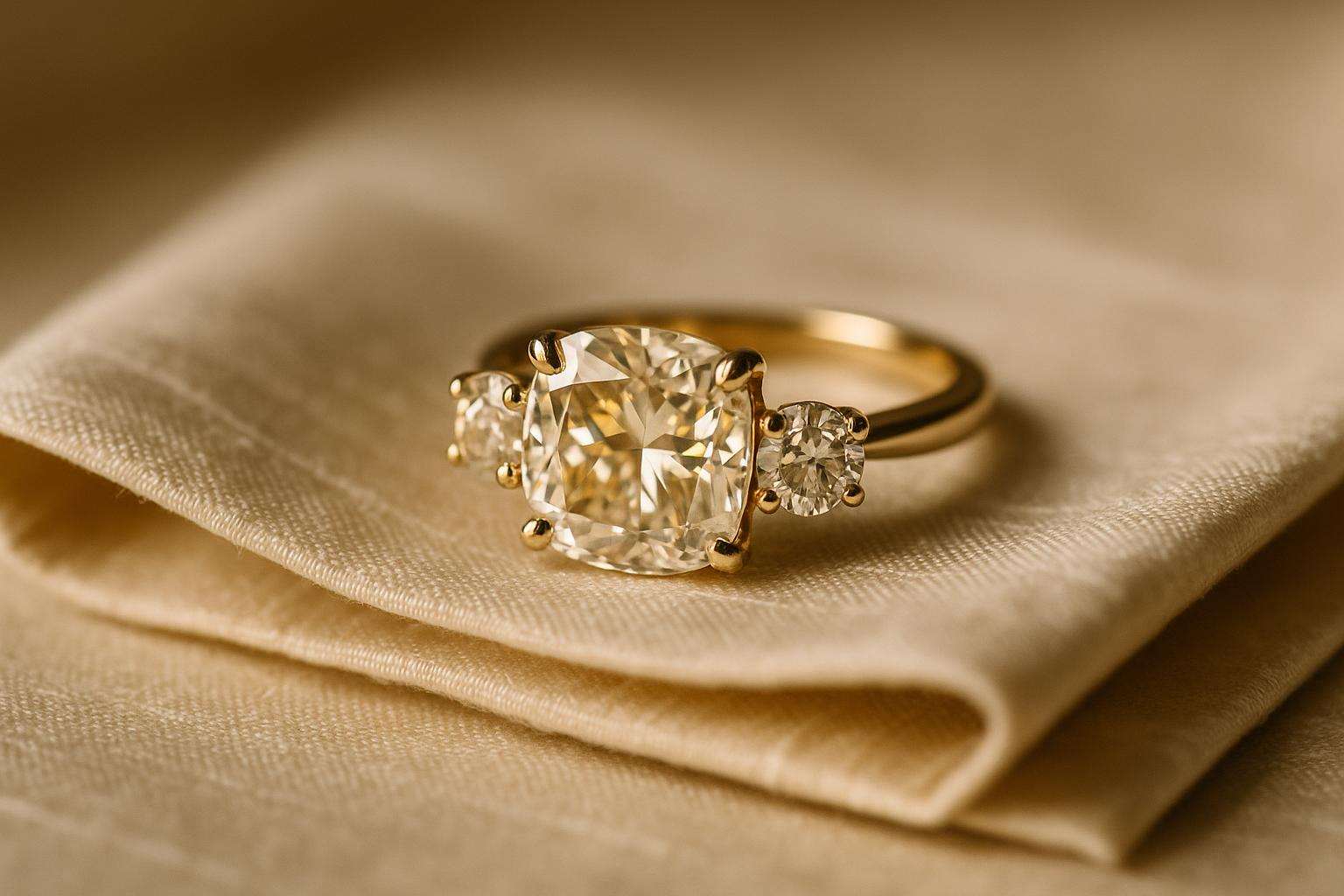
Meghan Markle's engagement ring — a cushion-cut Botswana diamond of approximately three carats, flanked by two round brilliant stones from Princess Diana's collection, all set in yellow gold by London court jeweller Cleave & Company — is one of the most-studied rings in recent bridal history. Its three-stone setting and warm metal choice were both personally significant and, in retrospect, prescient: yellow gold has become the dominant engagement ring metal of 2026. This guide explains every detail of the ring, the 2019 Lorraine Schwartz redesign, what the cushion cut means for everyday wearers, and how to recreate the look at every budget.
When Prince Harry got down on one knee at Nottingham Cottage in November 2017, the ring he produced crystallised several things at once: a deeply personal tribute to his late mother, a statement about a new chapter for the royal family, and — though neither of them knew it yet — a quiet reset of the bridal jewellery market. Meghan Markle's engagement ring has since generated an estimated 6,000 searches per month in the United States alone, and industry analysts at National Jeweler consistently cite it as a documented inflection point in the yellow gold resurgence that now defines 2026 bridal trends.
This is not a ring you simply read about and move on from. It is a ring that teaches you things: about how heirloom stones change the emotional physics of a piece, about the practical advantages of a three-stone setting, about why yellow gold flatters warm skin tones in ways white metal cannot, and about the ethical case for Botswana-origin diamonds. What follows is everything you need to know — ring designers, carat estimates, the 2019 redesign story, and a clear path to getting the look regardless of your budget.
Who Designed the Ring, and What Does It Contain?
Prince Harry designed the ring himself and commissioned Cleave & Company — a London court jeweller and medallist formally appointed by warrant to the late Queen Elizabeth II and headquartered at 1 Buckingham Place — to execute the piece. The company's founder, Peter Scott, trained under celebrated goldsmith Andrew Grima and built Cleave's reputation on the manufacture of state honours and bespoke royal commissions. Jeweller David Thomas worked through Cleave to execute Harry's design. The firm's Royal Warrant listing confirms its court status.
The ring contains three principal stones:
- Center stone: A cushion-cut diamond of approximately three carats, sourced from Botswana. Harry has described visiting Botswana as a teenager and returning with Meghan early in their relationship — the diamond is an intentional geographical marker of their shared history.
- Side stones: Two round brilliant diamonds drawn from Princess Diana's personal jewellery collection, specifically from one of her diamond tennis bracelets. Markle said in the engagement announcement interview: "It's so important to me to know that she's a part of this with us." Harry added: "She is with us on this crazy journey together."
The band was Harry's choice: plain yellow gold, made at Meghan's request. At a time when white gold and platinum still dominated U.S. and UK bridal sales, that choice was personal before it was prescient.
| Element | Detail |
|---|---|
| Designer | Prince Harry, executed by Cleave & Company (London); jeweller David Thomas |
| Center stone | Cushion-cut diamond, approx. 3 carats, Botswana origin |
| Side stones | Two round brilliants from Princess Diana's collection (ex-tennis bracelet) |
| Metal | Yellow gold (original band); micropavé yellow gold band post-2019 |
| Setting style | Three-stone (trilogy), low-profile |
| Estimated value (original, 2017) | Approx. £120,000 (~$150,000 USD) |
| Estimated value (post-2019 redesign) | Approx. £200,000–£300,000 (~$250,000–$380,000 USD) |
| Year of engagement | November 2017 |
What Happened in 2019? The Lorraine Schwartz Redesign
In June 2019 — shortly after the birth of their son Archie — Meghan appeared at Trooping the Colour wearing what was clearly a redesigned ring. The plain yellow gold band had been replaced by a considerably thinner band set with micropavé diamonds: small stones held in precise arrangements of tiny prongs, adding an estimated 0.75 carats of diamond weight to the piece. The commission went to Lorraine Schwartz, the Beverly Hills-based celebrity jeweller whose client list spans Beyoncé, Angelina Jolie, and Jennifer Lopez. Schwartz later described the project simply: "Harry wanted to make it special. He's the loveliest person ever. So romantic, so thoughtful."
The redesign coincided with a complementary gift: an eternity band set with birthstones representing each family member — peridot for Meghan, emerald for Archie, and sapphire for Harry — with the stones set on the inside of the band, against the skin. The two rings together form a stacked look that Meghan has worn consistently since.
The decision to alter a ring containing heirloom stones from Princess Diana drew some public commentary, but from a jewellery standpoint it is entirely standard practice: rings worn daily accumulate wear, and resetting in a new band or adjusting proportions after a pregnancy (which can temporarily alter ring size) is routine. The Diana side stones and the Botswana center stone were preserved unchanged throughout the redesign; only the band was modified.
Why Yellow Gold Was the Right Choice — and What It Means for Your Ring
The yellow gold decision is worth examining beyond the anecdote, because it carries real practical implications for anyone replicating the look. Yellow gold has now reclaimed the top position in U.S. engagement ring metal sales: The Knot's 2026 Real Weddings Study (surveying more than 10,000 U.S. couples) places yellow gold at 39% of engagement ring metal selections, nearly double its share from five years ago, ahead of white gold at 35% and platinum at 13%. National Jeweler explicitly cites Markle's ring as a documented tipping point in this shift.
There are three practical reasons yellow gold performs well with the Markle ring's configuration specifically:
- Skin-tone harmony. Meghan Markle has a warm-to-olive skin undertone, which yellow gold flatters naturally — the metal's amber warmth creates harmonious contrast rather than competing with the skin. Austen & Blake and multiple bridal editors describe this as one of the most commonly misunderstood pairing principles: warm undertones do not merely tolerate yellow gold, they are typically best served by it.
- Color grade latitude. In a yellow gold setting, the warm metal blends with any residual warmth in the diamond's body color, making tint essentially invisible. A cushion-cut diamond at H or even I color in yellow gold will appear just as white face-up as a D-color stone in platinum — at a dramatically lower price point. This matters because cushion cuts, compared to round brilliants, show color slightly more readily due to their larger, slower-moving facets.
- Total-cost advantage. Yellow gold requires no rhodium plating (unlike white gold, which needs re-plating every 12–18 months at approximately $60–$120 per service call). Over a lifetime of wear, yellow gold has a materially lower maintenance cost than its white-metal equivalent. For more on metal-maintenance economics, see our gold color guide.
The Three-Stone Setting: What It Means and How to Buy One
Meghan Markle's ring belongs to the three-stone (also called trilogy or trinity) family — one of the oldest formal engagement ring configurations, in which a larger center stone is flanked by two smaller side stones. The most widely cited symbolic meaning is past, present, and future: the first stone for shared memories, the center for the present, and the third for what lies ahead. The Markle ring adds a second layer of meaning through the Diana side stones, turning the three-stone framework into something closer to a genealogical statement.
From a design standpoint, the three-stone setting does several things a solitaire cannot:
- It distributes visual weight across the finger, making the ring read as substantial even at moderate center-stone carat weights.
- The side stones frame and accentuate the center stone, effectively increasing its perceived size without adding center-stone cost.
- The configuration offers more points of interest and movement when viewed from above — three stones produce a richer light interaction than one.
The trade-off is maintenance: three stones mean three sets of prongs to inspect twice a year rather than one. A solitaire is simpler to maintain long-term, though a well-made three-stone setting in yellow gold with round brilliant side stones is among the most structurally robust ring types. For a full comparison of three-stone versus halo versus solitaire — including cost impacts and resizing considerations — see our setting types guide.
Side stone proportions matter. The Markle ring uses side stones that are noticeably smaller than the center stone, at roughly 40–50% of the center stone's visible diameter — a classically proportioned three-stone that does not compete with the main stone. Some modern interpretations use equal-size three-stone designs or taper the side stones outward with baguette or trapezoid shapes. For the Markle look specifically, round brilliant side stones at a 1:2 ratio to the center stone are the correct reference point.
The Botswana Diamond: Why Origin Matters Here
Harry's choice to source the center stone from Botswana is not merely sentimental; it also represents one of the more ethically transparent diamond-sourcing decisions available for a newly mined stone. Botswana's diamond industry operates through Debswana, a 50/50 joint venture between the Botswana government and De Beers, which means the country receives half the revenue from every diamond mined domestically. Diamond proceeds have funded healthcare, education, and infrastructure in a country that has transformed from one of the world's poorest nations at independence in 1966 to an upper-middle-income economy today.
This is a materially different ethical profile from diamonds with opaque chain-of-custody documentation. The Botswana origin claim is verifiable through the country of export at certification (Kimberley Process Certificates identify Botswana as origin), and several specialist retailers — including Do Amore — have cited the Markle ring specifically as an example of ethically sourced mainstream celebrity jewellery. For a fuller explanation of what origin claims actually mean and where the Kimberley Process falls short, see our conflict-free diamonds guide.
How to Get the Look: A Practical Guide by Budget
The Markle ring's core visual elements — cushion-cut center stone, round brilliant side stones, yellow gold band, low-profile setting — are all widely available. The question is which component choices fit your budget. Here is a practical framework:
| Budget | Center Stone | Side Stones | Metal | Approx. Total |
|---|---|---|---|---|
| Entry ($3,000–$6,000) | Lab-grown cushion, ~1.5–2 ct, G/H color, VS2 clarity | Lab-grown round brilliants, 0.30–0.40 ctw | 14k yellow gold | $3,500–$5,500 |
| Mid ($8,000–$15,000) | Natural cushion, ~1.0–1.5 ct, G/H, VS2 | Natural rounds, 0.30–0.50 ctw | 14k or 18k yellow gold | $8,000–$14,000 |
| High ($20,000–$40,000) | Natural cushion, ~2.0–2.5 ct, G/H, VS1–VS2 | Natural rounds, 0.50–0.70 ctw | 18k yellow gold | $22,000–$38,000 |
| True replica (~3 ct natural) | Natural cushion, ~3.0 ct, G–H, VS2 | Natural rounds, 0.70–0.90 ctw | 18k yellow gold, bespoke setting | $60,000–$120,000+ |
For most buyers, the entry or mid-tier configuration with a lab-grown center stone delivers the most faithful visual recreation of the Markle aesthetic. Lab-grown cushion-cut diamonds carry GIA or IGI certification and are physically and chemically identical to mined stones — the distinction matters for resale value and provenance preference, but not for day-to-day appearance. At the entry tier, a well-cut 1.5-carat lab-grown cushion in G color and VS2 clarity in a 14k yellow gold three-stone setting will be visually indistinguishable from the original ring to any observer without a loupe. See our guide on what your budget actually buys for a complete carat-weight and quality breakdown across price tiers.
One buying note specific to cushion cuts: this shape tends to carry weight in its depth rather than its face-up diameter, meaning a 1.5-carat cushion may appear smaller face-up than a 1.5-carat oval of identical weight. If maximum face-up size is your priority, consider a slightly elongated cushion (length-to-width ratio of 1.10–1.20) or ask your jeweller to select a stone with a shallower depth percentage (below 68%) — the face-up diameter will read closer to a 1.7–1.8-carat round brilliant equivalent. Our diamond shapes guide covers this in detail with a face-up size comparison table for all ten major cuts.
Frequently asked
What are the exact details of Meghan Markle's engagement ring?
Meghan Markle's engagement ring, designed by Prince Harry with London court jeweller Cleave & Company, is a three-stone ring set in yellow gold. The center stone is a cushion-cut diamond of approximately three carats, sourced from Botswana — a country with personal significance to the couple as a place Harry first visited as a teenager and where the two spent time early in their relationship. Flanking the center stone are two round brilliant diamonds from Princess Diana's personal collection, drawn from one of the Princess's tennis bracelets. Harry and Meghan confirmed the details in a BBC interview at the time of their November 2017 engagement announcement. In 2019, jeweller Lorraine Schwartz replaced the original plain yellow gold band with a thinner micropavé diamond band, adding approximately 0.75 carats of smaller stones. Current value estimates for the updated ring range from approximately £200,000 to £300,000.
Why did Prince Harry choose yellow gold for the ring?
Yellow gold was Meghan Markle's stated personal preference, and it suited her warm skin tone. At the time of the 2017 engagement, white gold and platinum had dominated U.S. and UK bridal ring sales for nearly two decades. Harry's choice was both personal and, with the benefit of hindsight, prophetic: National Jeweler and The Knot's 2026 Real Weddings Study (10,000+ U.S. couples) both cite Markle's ring as a documented inflection point in the yellow gold resurgence — yellow gold now accounts for 39% of U.S. engagement ring metal selections, more than doubling its market share over the past five years. In warm-toned skin settings, yellow gold also reduces the visual emphasis on diamond color, meaning slightly warmer color grades (I–J range) appear as white as higher grades in a platinum setting — a practical budget advantage.
How much did Meghan Markle's engagement ring cost, and what is it worth today?
In 2017, the original ring was estimated at approximately £120,000 (around $150,000 USD at the time of the engagement). That estimate incorporated the three-carat Botswana cushion-cut center stone, the two Diana heirloom side stones, and Cleave & Company's bespoke setting work. After the 2019 redesign by Lorraine Schwartz — which added a micropavé diamond band and additional accent stones around the center stone — updated industry estimates range from approximately £200,000 to £300,000 (roughly $250,000–$380,000 USD). These figures are appraisal-style estimates by independent jewelry experts; no official valuation has been published. The heirloom provenance of the Diana side stones adds sentimental value that is not fully captured by market pricing alone.
What is a three-stone engagement ring, and what does it symbolize?
A three-stone engagement ring — also called a trinity ring or trilogy ring — features one larger center stone flanked by two smaller side stones, all set in a row along the band. The most common symbolic interpretation is that the three stones represent a couple's past, present, and future: the first stone for shared memories, the center stone for the life being lived now, and the third for the life ahead. The design has been used for centuries, but its cultural moment arrived in the early 2000s when De Beers launched a major trilogy ring marketing campaign in the U.S. and UK. From a design standpoint, the three-stone setting creates a visually balanced silhouette that draws the eye across the ring rather than focusing solely on a single center stone — a flattering effect on most hand shapes. See our full guide to setting types for a cost and visual comparison of three-stone vs. solitaire vs. halo styles.
What are the pros and cons of a cushion-cut diamond for an engagement ring?
The cushion cut is a square or rectangular shape with rounded corners and — in its modern brilliant variant — 58 facets that produce broad, romantic flashes of light rather than the pin-point scintillation of a round brilliant. Its primary advantages are: lower price per carat (typically 20–25% less expensive than a round brilliant of equivalent grade), high fire (colored spectral flashes), and a vintage aesthetic that pairs naturally with yellow or rose gold. The modern modified cushion cut, sometimes called a crushed-ice cushion, adds extra pavilion facets for higher scintillation. The main caution: cushion cuts tend to carry weight in their depth, meaning they can appear smaller face-up than their carat weight suggests compared with elongated shapes like oval or marquise. For a cushion cut in yellow gold — the Markle configuration — gemologists recommend H or better color in white gold and I–J color in yellow gold settings, with VS2 clarity minimum to maintain an eye-clean appearance. See our diamond shapes guide for a full face-up size comparison across all ten major cuts.
Are the diamonds from Princess Diana's collection — and is the Botswana center stone ethically sourced?
Harry confirmed in the 2017 BBC engagement interview that the two round brilliant side stones came from Princess Diana's personal jewelry collection, specifically from one of her diamond tennis bracelets. This heirloom provenance means the side stones require no chain-of-custody verification — they predate modern traceability systems and carry a documented royal provenance. The center stone is a newly mined diamond sourced from Botswana, which Harry cited as personally meaningful to both of them. Botswana is widely regarded as an example of ethical diamond mining: a 50/50 revenue-sharing structure between the government and the Debswana mining partnership (a joint venture between De Beers and the Botswana government) means the national economy benefits directly from every diamond sold. The country's diamond revenues fund education, healthcare, and infrastructure at a national scale. Do Amore and other ethical-sourcing analysts have noted this Botswana provenance as one of the more transparent origin stories in recent celebrity ring history. For a broader look at what diamond sourcing claims actually mean, see our guide to conflict-free diamonds and the Kimberley Process.
How can I get a ring that looks like Meghan Markle's without spending £200,000?
The key design elements are: (1) a cushion-cut center diamond, (2) two round brilliant side stones approximately 40–50% of the center stone's diameter, (3) a yellow gold band, and (4) a low-profile setting. All four are widely available from online and independent jewellers at a wide range of budgets. For the most budget-efficient approach: consider a lab-grown cushion-cut diamond as the center stone — lab-grown diamonds are physically and chemically identical to natural stones, carry GIA or IGI grading certificates, and typically cost 70–85% less per carat at equivalent quality grades, bringing a 3-carat equivalent within reach of a $3,000–$6,000 total budget. Pair it with a 14k yellow gold three-stone setting (widely available from Brilliant Earth, With Clarity, and independent custom jewellers) for a ring that captures the aesthetic at a fraction of the original cost. If you prefer natural diamonds, a well-cut 1.5-carat cushion in G or H color and VS2 clarity in 14k yellow gold with two natural round side stones lands in the $8,000–$15,000 range depending on setting complexity. Our budget tiers guide shows you exactly what you get at each price point.