Ring Styles & Settings
Yellow vs. Rose vs. White Gold for Engagement Rings (& Skin-Tone Pairing)
The 2026 yellow-gold resurgence explained, rose gold's universal flattery decoded, and the honest maintenance math on white gold — plus the skin-tone pairing guide jewelers actually use.
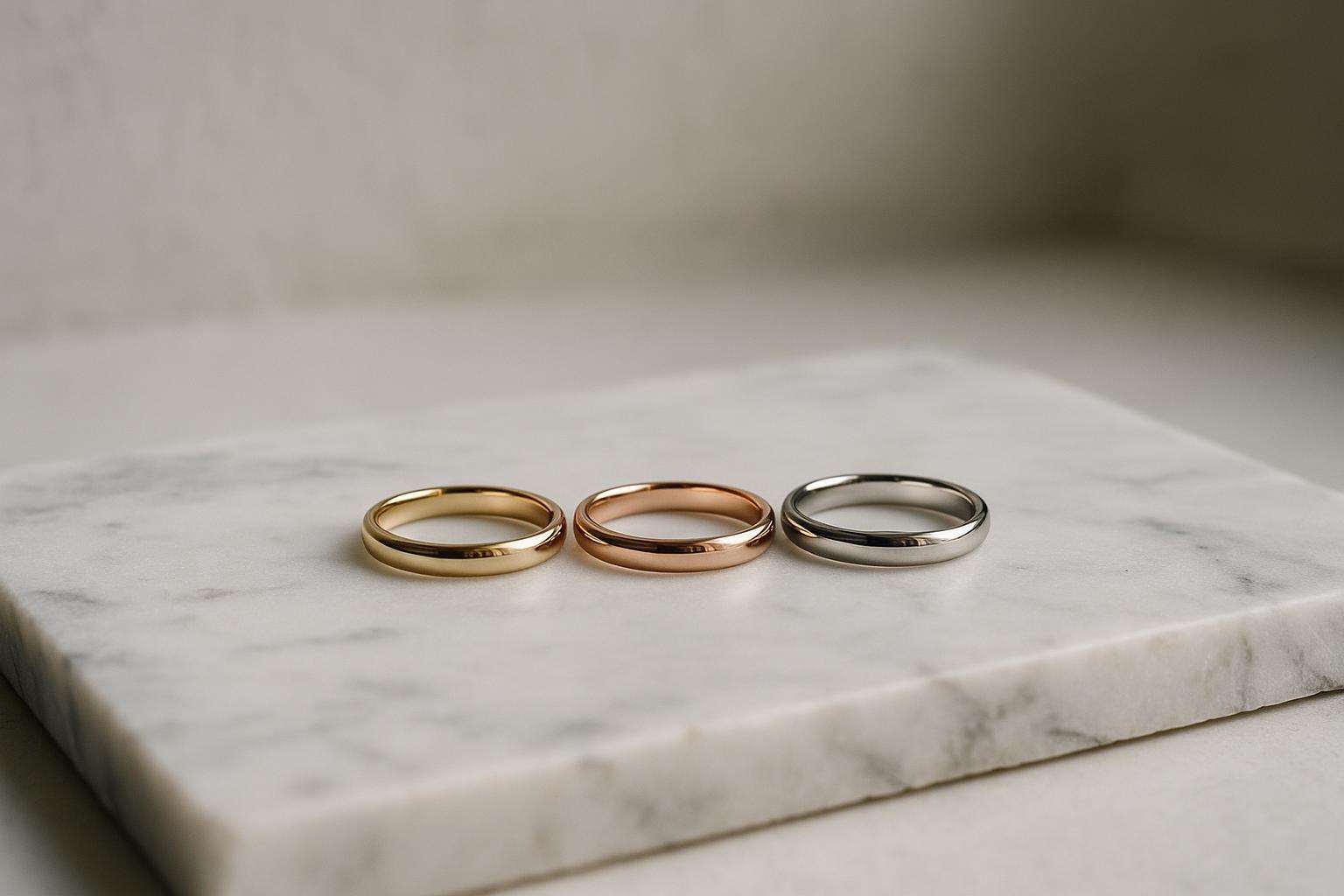
Yellow, rose, and white gold all contain the same amount of gold at identical karats — the color comes from the secondary alloy metals. Yellow gold dominates U.S. engagement ring sales in 2026 at roughly 39% and requires the least maintenance. Rose gold's color is permanent (no replating) and flatters the widest range of skin tones. White gold requires rhodium plating every 12–18 months at $60–$120 per visit. For daily wear, 14k outperforms 18k in scratch resistance for all three colors. The right choice is the one that fits your existing jewelry wardrobe and the maintenance reality you will actually live with.
I have worked the bench long enough to know that the metal conversation happens too late in most ring consultations. Couples spend an hour deciding between a 1.10-carat and a 1.20-carat stone, then take about ninety seconds choosing the metal — even though the metal is the only part of the ring visible from across a room, the part their partner will touch every morning for fifty years, and the factor that will determine whether the ring looks the same at the tenth anniversary as it did on the proposal day.
This guide covers the three gold color options available for virtually every engagement ring setting — yellow, rose, and white — across the dimensions that actually matter: composition, maintenance commitment, skin-tone pairing, karat considerations, and the 2026 market context that helps explain why you are probably seeing more yellow gold now than you were five years ago. It deliberately does not cover platinum or alternative metals; those topics have their own pages in our platinum vs. white gold guide and alternative metals comparison.
Why Is Yellow Gold Having Such a Moment in 2026?
The trend data is unambiguous. According to National Jeweler's reporting on The Knot's 2026 Real Weddings Study — drawn from more than 10,000 U.S. couples — yellow gold now accounts for approximately 39% of engagement ring metal selections, edging out white gold (35%) and well ahead of platinum (13%). Yellow gold's share has more than doubled over the preceding five years. To understand how significant that is: in the early 2010s, yellow gold accounted for fewer than 15% of engagement ring metal choices in the United States. The category spent nearly two decades in near-exile.
The reversal has several documented drivers. Celebrity influence matters more in engagement jewelry than in almost any other consumer category, and Meghan Markle's 2017 yellow gold three-stone ring — designed with Cleave & Company using a cushion-cut Botswana diamond flanked by two round brilliants from Princess Diana's collection — is consistently cited by industry analysts as a cultural turning point. The ring reached an audience far beyond jewelry enthusiasts; it demonstrated to a generation of buyers that yellow gold was not a relic but a statement. Industry observers including jewelry historian Marion Fasel noted that "there used to be just a law that the metal on an engagement ring would be white and reflect on the stone" — a convention that ring visibly broke.
The second driver is aesthetic: the broad consumer shift toward what is variously described as "quiet luxury," "old money," or "heritage" styling. Yellow gold reads as warm, enduring, and anti-trend in the best sense. It pairs naturally with the chunky gold chains, hoop earrings, and layered fine jewelry that dominate fashion content across every age cohort. When your everyday jewelry is yellow gold, a yellow gold engagement ring coordinates rather than clashes — an operational consideration that drives real purchasing decisions.
Third is the maintenance reality. Yellow gold requires no rhodium plating. It develops a natural patina that many wearers find beautiful and that any jeweler can polish away if you prefer the original mirror finish. It is, in the truest sense, low-maintenance — and that appeals to a generation that has watched family members budget for repeated replating visits on white gold rings.
What Makes Rose Gold Different — and Why It Flatters Almost Everyone?
Rose gold is neither a new metal nor a new trend, but it occupies a distinct position in the 2026 market that is worth understanding clearly. It currently accounts for approximately 13–15% of engagement ring metal sales and is described by retailers as combining "vintage charm and modern minimalism" — a genuinely accurate characterization. Rose gold emerged as a recognized bridal metal in the early 2010s and, after a period of ubiquity, receded slightly before returning with renewed editorial endorsement heading into 2026.
The composition of rose gold is straightforward: it is gold alloyed with copper, with a small addition of silver. The higher the copper proportion, the more vivid the rose hue. 14k rose gold (58.3% gold) contains more copper relative to gold than 18k rose gold (75% gold), producing a more saturated, distinctly pink tone; 18k rose gold is softer in color, sometimes described as a warm blush or champagne-rose. Most engagement ring buyers prefer 14k for the characteristic blush saturation and the durability advantage of higher alloy content.
The most practically important fact about rose gold for buyers: its color is permanent. Unlike white gold, whose bright white surface is a rhodium electroplate that wears away, rose gold's pink tone is throughout the metal — it is the alloy, not a coating. A rose gold ring will develop a gentle patina over decades but will never require color restoration. This makes it functionally equivalent to yellow gold in terms of maintenance, and superior to white gold.
On skin-tone pairing, rose gold has the most credible claim to universality of any ring metal:
- Cool undertones (blue or pink in the veins): Rose gold's pink warmth prevents the washed-out effect that platinum and white gold can produce on very fair cool skin, while avoiding the stark contrast of yellow gold on blue-toned complexions. It is widely recommended by stylists as the most flattering warm metal for cool-undertone wearers who find yellow gold too bold.
- Warm undertones (green in the veins, golden or olive skin): Rose gold's copper-based warmth blends naturally with warm golden and olive tones, creating a cohesive, sun-kissed appearance. It does not read as stark the way white gold can against warm skin, and it is less directional in pairing than yellow gold.
- Neutral undertones: Neutral-undertone wearers can carry essentially any metal, but rose gold is a particularly elegant choice because its position between yellow and white reads as neither exclusively warm nor exclusively cool — it resolves the question of which camp you belong to by belonging to both.
- Deep skin tones: Rose gold creates striking luminous contrast against deep skin, offering an alternative to yellow gold that reads equally warm but with a more distinctly pink quality that many wearers find fresh and contemporary.
The Real Maintenance Math on White Gold
White gold is the metal choice that most benefits from honest explanation, because the retail experience often undersells the ongoing commitment it requires. Let me be direct about the mechanics.
White gold is not naturally white. Gold in its pure form is yellow; the "white" appearance of white gold comes from the alloy metals blended into it — typically palladium, silver, and sometimes nickel — which shift the color toward a pale gold-white. But that pale warmth is still not the bright, icy white buyers expect in an engagement ring, which is why every white gold ring sold in the United States is rhodium-plated at manufacture. Rhodium is a platinum-group metal applied by electroplating; it is extremely hard, highly reflective, and naturally mirror-bright. It is also a surface coating that wears away.
For a ring worn daily, the rhodium layer typically requires re-application every 12–18 months. The timeline depends on your specific hand chemistry, how often you use cleaning products or lotions without removing the ring, and how abrasive your daily activities are. Professional rhodium replating at a retail jeweler currently runs approximately $60–$120 per visit for a standard engagement ring setting. Over ten years, that is a real accumulated cost of $400–$1,200 — and unlike a stone or setting upgrade, there is nothing aesthetic to show for it; you are simply restoring the ring to the condition it was in when you bought it.
Between replating visits, white gold gradually reveals its underlying color: first a slight warmth, then progressively more yellow — particularly visible against the band's inner surfaces and in low-light conditions. The 18k alloy shows its warm base tone sooner than 14k because its higher gold proportion and lower alloy content mean less of the whitening metals are present. This is not a defect or a quality failure; it is simply how the material works. Buyers who understand it before purchase manage the expectation gracefully. Buyers who discover it six months in are often frustrated.
None of this is a reason to avoid white gold — its appeal is genuine, and for buyers who want the clearest possible backdrop for a colorless diamond, white metal remains the technically optimal choice. But it is an ongoing ownership commitment, not a one-time purchase.
| Factor | Yellow Gold | Rose Gold | White Gold |
|---|---|---|---|
| Color source | Gold + silver + copper alloy (warm) | Gold + copper (higher copper ratio) | Gold + palladium/silver + rhodium plate |
| Color permanence | Permanent; natural patina only | Permanent; no replating needed | Surface rhodium wears; replating required |
| Replating cost | None | None | $60–$120 every 12–18 months |
| 2026 market share (U.S.) | ~39% (leading) | ~13–15% | ~35% |
| Best skin-tone pairing | Warm and olive undertones; also deep skin | Most universally flattering across all undertones | Cool undertones; maximizes diamond brilliance |
| Diamond color effect | Warms stone appearance; ideal with H–J color | Warms stone; ideal with H–I color | Makes stone appear cooler/whiter; ideal with D–H color |
| 14k hardness (Mohs) | 3.5–4 | 3.5–4 | 3.5–4 (before rhodium) |
| Nickel allergy risk | Low (most formulas use copper/silver) | Very low (copper-dominant alloy) | Moderate (some 14k formulas use nickel hardener) |
How Do Karat and Color Interact?
Karat and color are independent variables, but they interact in ways that matter for your buying decision. Both yellow and rose gold are available in 14k and 18k (and less commonly 10k and 22k); white gold is almost exclusively sold in 14k and 18k for engagement ring applications.
In yellow gold, the karat difference is visually meaningful. 18k yellow gold has a noticeably deeper, more saturated amber tone — often described as "buttery" or "rich" — that many buyers associate with heirloom and vintage jewelry. 14k yellow gold is lighter and more subdued, reading as a classic modern gold. If you have compared a strand of yellow gold chain from an estate piece to a contemporary 14k setting and found the modern one looked "thin" in color, that is the karat difference you were observing.
In rose gold, the difference is subtler but real: 14k rose gold's higher copper proportion produces a more vivid, clearly pink blush, while 18k rose gold has a softer, more muted tone — sometimes described as champagne-pink or blush. If you want the characteristic rose gold look, 14k delivers it more distinctly.
In white gold, the karat affects how quickly the rhodium shows wear. 18k white gold — with more gold and less of the whitening alloy metals — reveals its underlying warmth sooner as the rhodium plate erodes. This is a practical argument in favor of 14k white gold: its higher alloy content keeps the "white" look for longer between replating visits.
On durability, the same principle applies across all three colors: 14k is harder and more scratch-resistant than 18k, regardless of color. Dana Rebecca Designs and Gem Breakfast both cite laboratory hardness data showing 14k gold requires approximately 43% more force to dent than 18k, and measures 3.5–4 on the Mohs scale versus 2.5–3 for 18k. For a ring worn through daily hand-washing and physical activity, 14k is the durability choice in every color.
The Mixed-Metal Option: Having Both
One development in 2026 that effectively removes some of the pressure from the "choose one color" decision is the mainstream acceptance of mixed-metal designs. Two-tone engagement rings — most commonly a yellow gold band with white gold or platinum prongs holding the center stone — are among the most requested custom configurations from bench jewelers this year, according to reporting in National Jeweler.
The most practical version of this approach is an existing setting architecture that most buyers do not think to request: yellow gold band, white gold prongs. The white metal prongs hold the diamond and reflect back up through it, preserving the stone's colorless appearance, while the band reads warm and classic. This is especially useful for buyers with H or I color diamonds — grades that are excellent value in a yellow gold setting but can look very slightly warm in an all-white setting — because the white metal at the prong level keeps the stone looking bright while the yellow band does not call attention to any residual stone color.
Mixing an engagement ring and wedding band in different metals — yellow gold engagement ring with white gold band, or rose gold engagement ring with yellow gold band — is equally accepted in 2026. The most cohesive stacks share a design language: similar profile heights, consistent surface finish (both high-polish, or both matte), and ideally some repeated design element such as a shared edge detail or matching stone size if pavé is involved. See our setting types compared guide for more on band-pairing architecture.
A Practical Skin-Tone Pairing Framework
Skin-tone pairing guidance in jewelry is sometimes presented as hard rules, but it is better understood as a starting framework for trying things on with intention. Here is what the evidence actually supports:
Warm undertones (golden, peachy, olive — veins appear greenish in natural light): Yellow gold is classically most harmonious because the amber metal creates tonal continuity with warm skin pigment. Rose gold is equally flattering and slightly more versatile for mixing with silver-toned accessories. White gold can read as high-contrast against distinctly warm skin, which is either an advantage or a disadvantage depending on whether you want the ring to recede or announce itself.
Cool undertones (pink, blue, mauve — veins appear bluish-purple in natural light): White gold and platinum are the conventional recommendation, because cool metals blend with cool skin undertones and create the clearest backdrop for a colorless diamond. Rose gold is also a strong option for cool-undertone wearers — its pink quality harmonizes with pink-toned skin in a way that yellow gold, which can appear stark, does not. Yellow gold on decidedly cool, fair skin is a bold contrast choice; worn intentionally, it works beautifully as a design statement.
Neutral undertones (veins appear blue-green — neither clearly warm nor cool): Neutral-undertone wearers are the most genuinely unconstrained by this framework. All three colors work. Choose based on maintenance preference, diamond color, and your existing jewelry wardrobe.
Deep skin tones: Yellow gold creates luminous, warm contrast and is deeply rooted in fine jewelry tradition across many cultures globally. Rose gold offers warm contrast with a distinctly contemporary feel. White gold and platinum create strong visual pop — the bright cool metal reads clearly against deep skin. All three are excellent choices; the decision comes down to personal aesthetic and the stone you are setting.
A field test more reliable than any written guide: hold a piece of yellow gold and a piece of white gold jewelry against the inside of your wrist in natural north-facing daylight, without direct sunlight. Observe which metal seems to disappear into your skin harmoniously and which creates an edge. That observation — done with real metal, in real light — will tell you more than any undertone theory.
Once you have settled on a gold color, the practical buying decisions flow from there: karat (14k for daily wear, 18k if you prioritize richer color and have no durability concerns), stone color (diamonds of H–J color work particularly well in yellow and rose gold; D–H in white gold), and setting architecture. Our setting types comparison covers how different setting families interact with metal choice in terms of visible metal surface area and design character.
Frequently asked
Which gold color is most popular for engagement rings in 2026?
Yellow gold is the most popular engagement ring metal in 2026, accounting for approximately 39% of U.S. metal selections according to The Knot's 2026 Real Weddings Study — more than double its share five years ago. White gold follows at roughly 35% and platinum at 13%, with rose gold at around 13–15%. The yellow gold resurgence is driven by celebrity influence (notably Meghan Markle's 2017 three-stone yellow gold ring), the broader "quiet luxury" and vintage-inspired aesthetic, and the practical advantage that yellow gold requires no rhodium plating and ages gracefully without maintenance. That said, the best metal choice is still personal: if you lean toward cool-toned jewelry, white gold remains a strong option, and rose gold has returned as a romantic alternative with broad appeal across skin tones.
Does gold color (yellow, rose, white) affect the price of an engagement ring?
The color of a gold alloy — yellow, rose, or white — has no effect on raw material cost at identical karats. A 14k yellow gold ring and a 14k rose gold ring of the same weight cost exactly the same in metal value, because all three are the same gold alloyed with different secondary metals (copper and silver for yellow, higher copper for rose, palladium or nickel for white). The one practical pricing exception is white gold: because it requires rhodium electroplating at manufacture and periodic re-plating during ownership, its total long-term cost of ownership is modestly higher — by roughly $60–$120 per re-plating visit every 12–24 months. Over a decade, that adds $300–$600 to white gold's real cost that yellow and rose gold simply do not carry.
What gold color is most flattering for warm skin tones?
For warm undertones — skin with golden, peachy, or olive hints — yellow gold is classically recommended because its amber warmth creates harmonious tonal continuity rather than harsh contrast. The GIA and multiple bench jewelers also recommend rose gold for warm skin, noting that the copper-blush alloy blends seamlessly with golden undertones for a sun-kissed appearance. White gold or platinum, conversely, can read as stark against distinctly warm skin — though this is ultimately personal preference, and no metal is objectively wrong. A practical test: hold a strip of yellow and a strip of white fabric against your wrist in natural daylight. Whichever reads more balanced is a guide to your undertone, and from there your gold color choice almost selects itself.
Does rose gold fade or change color over time?
No — rose gold's blush color is permanent. Unlike white gold, whose bright white finish comes from a rhodium electroplate that gradually wears away, rose gold's pink hue is intrinsic to the metal alloy itself: the copper-gold mixture that creates the warm pink tone is throughout the metal, not a surface coating. As a rose gold ring wears, it may develop a very slight patina that many owners find adds to its antique character, but the color will not fade to another hue or require restoration plating. This is one of rose gold's key practical advantages over white gold for buyers who want low maintenance. The karat does affect the depth of the rose: 14k rose gold (58.3% gold, higher copper proportion) produces a more vivid blush, while 18k rose gold has a more muted, dusty-pink tone due to its lower copper content.
Should I choose 14k or 18k gold for an engagement ring worn every day?
For daily wear, most bench jewelers and major retailers — including Brilliant Earth, Gem Breakfast, and GoodStone — recommend 14k gold. The higher alloy proportion in 14k (41.7% hardening metals vs. 25% in 18k) makes it meaningfully harder: laboratory testing puts 14k at roughly 43% more force-resistant before denting than 18k, and on the Mohs scale 14k measures 3.5–4 versus 2.5–3 for 18k. For an engagement ring worn through daily hand-washing, workouts, and incidental contact, that difference is real and cumulative. 18k gold's practical advantage is its richer, more saturated color (noticeably deeper in yellow gold) and slightly better hypoallergenic profile, since higher gold purity means less alloy filler and reduced nickel risk. If you have a documented nickel sensitivity, or if you prioritize the deeper buttery yellow of 18k, it is a legitimate choice — but for most buyers who will wear the ring every single day, 14k is the better-engineered option. Approximately 75–90% of all U.S. engagement rings are set in 14k gold for exactly this reason.
How often does white gold need to be rhodium plated, and what does it cost?
For an engagement ring worn daily, the rhodium plating on white gold typically needs to be re-applied every 12–18 months, though this varies depending on your hand chemistry, how often you clean the ring, and how actively you use your hands. Rings exposed to lotions, cleaning products, and salt water lose their plating faster. Professional rhodium re-plating at a retail jeweler currently runs approximately $60–$120 for a standard ring, a cost that has risen in recent years. Over ten years of wear, budget $600–$1,200 in cumulative replating costs for a white gold ring — a real ownership cost that yellow and rose gold rings simply do not carry. The alternative is accepting the gradual reveal of the underlying gold alloy's natural warm tone, which some owners find adds vintage character; others find it distracting against colorless diamonds.
Can I mix gold colors — for example, yellow gold engagement ring with white gold wedding band?
Yes, and in 2026 mixed-metal stacking is one of the most requested bridal jewelry aesthetics. Traditionally considered a style error, pairing yellow and white gold (or rose and white gold) in a ring stack is now widely embraced. The most popular combination is a yellow gold engagement ring band with white gold prongs holding the center stone — this keeps the diamond appearing bright and colorless (white metal reflects back into the stone) while the band reads warm and classic. For stacking an engagement ring with a wedding band in different metals, the most cohesive results come when the two rings share a design language: similar profile heights, consistent widths, and comparable surface finishes (both high-polish, or both matte). There are no rules that forbid mixing, and the flexibility it gives you to pair with the rest of your jewelry wardrobe is a real benefit.