Diamonds & Stones
Marquise Engagement Rings: The Comeback Cut Explained
The marquise delivers more face-up diamond than any other shape per carat — but symmetry and bow-tie control separate a stunning stone from a costly mistake.
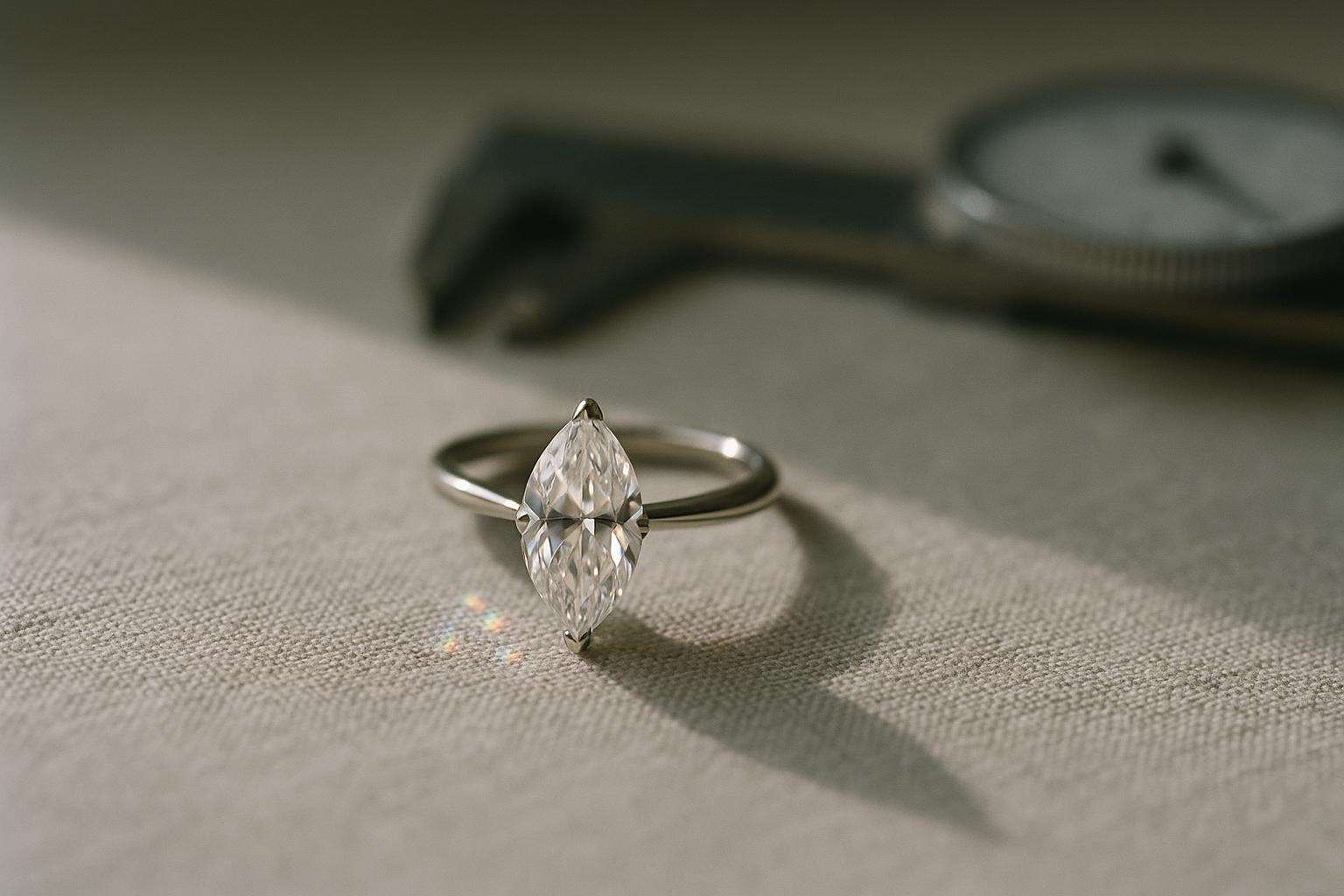
The marquise cut delivers more face-up diamond per carat than any other shape — roughly 15% more visible surface area than a round brilliant of equal weight — while costing 20–25% less. But this shape punishes poor execution: symmetry must be Excellent, the bow-tie effect requires visual evaluation (certificates don't report it), and the pointed tips need V-prong or bezel protection. Get those three things right and the marquise is one of the most compelling value propositions in diamond shopping today.
In December 2024, Benny Blanco proposed to Selena Gomez with a marquise-cut diamond estimated by jewelry designers at 6–8 carats, set on a yellow-gold pavé band. National Jeweler noted that the choice carried personal resonance — Gomez had referenced "marquise diamonds" in her 2015 song Good for You, suggesting the cut had long been a private wish. The ring's estimated value runs from $100,000 to $630,000 depending on the source, but its cultural impact is unambiguous: searches for marquise engagement rings surged, and what had been a niche enthusiast choice crystallized into one of 2026's defining shapes.
The marquise is not a new invention. It dates to eighteenth-century France, reportedly commissioned by King Louis XV to honor the Marquise de Pompadour, and reached peak commercial popularity in the 1980s before fading for roughly three decades. Its revival is not mere nostalgia. Data from the Natural Diamond Council's 2025 Trends Report — compiled from more than four million transactions across 2,500 U.S. specialty jewelers — records approximately 12% year-over-year unit growth for marquise across all diamond jewelry categories. Stuller's 2025–2026 bridal buying data, cited in National Jeweler's 2026 trend analysis, names marquise among the three shapes with the most significant growth alongside emerald cut and elongated cushion. The insight is consistent: buyers who spent years choosing between round and oval are now actively choosing something that looks chosen rather than algorithmically recommended.
This guide covers everything a buyer needs to evaluate a marquise diamond confidently: why this shape produces such unusual face-up size, how to read the critical proportions, how to evaluate the bow-tie effect (which no certificate will do for you), which settings protect the stone's vulnerable tips, and how pricing has shifted as demand grew. Internal links throughout point to the deeper guides in our diamonds hub when a topic deserves more space than a section allows.
Why Does the Marquise Look So Much Larger Per Carat?
The relationship between carat weight and physical size is a source of persistent confusion. Carat is a unit of mass — exactly 200 milligrams — not a measurement of diameter or spread. A poorly proportioned 1-carat round brilliant can measure as little as 6.1 mm across; a well-cut one runs to 6.5 mm. The marquise exploits this weight-versus-spread disconnect more aggressively than any other shape.
A 1-carat marquise measures approximately 10 mm × 5 mm — a pointed ellipse that stretches roughly 54% longer than the diameter of an equivalent round, while distributing its identical mass in a shallower, wider crown profile. That geometry produces a face-up crown surface area roughly 15% greater than a round brilliant of the same weight, per data cited by The Diamond Pro and corroborated by VRAI's published diamond size chart. The elongated silhouette runs lengthwise along the finger, which does two things simultaneously: it makes the stone appear dramatically larger than its carat weight suggests, and it creates a visually slimming effect on the wearer's hand that many buyers describe as uniquely flattering.
The comparison extends to pricing. Among all the standard diamond shapes, the full price-per-carat hierarchy places the marquise 20–25% below round brilliants of equivalent grade — a gap that has compressed slightly as demand grew in 2025–2026 but remains structurally meaningful. A buyer spending $5,000 on a natural marquise can access a face-up size that would cost $6,500 or more in a round. Combined with lab-grown options, which carry roughly 67% additional savings over natural diamonds at equivalent grades, the marquise is arguably the most size-efficient center stone available in 2026.
What L:W Ratio and Proportions Should You Target?
The length-to-width (L:W) ratio is the single most important number to check when evaluating a marquise diamond. It is calculated by dividing the stone's longest measurement (point to point) by its widest measurement (across the belly). GIA's own marquise diamond buying guide notes that stones submitted to the laboratory most commonly fall in the 1.6–2.2 range, but the numbers alone do not tell you what the stone looks like on a hand.
| L:W Ratio | Silhouette Character | Best Setting Context | Bow-Tie Risk |
|---|---|---|---|
| Below 1.75 | Wide and oval-adjacent; belly dominates | East-west horizontal orientation | Moderate — center band can form if depth is excessive |
| 1.75–2.00 | Classic balanced; graceful without appearing fragile | Solitaire, three-stone, pavé bands | Typically manageable with Excellent symmetry |
| 2.00–2.25 | Traditional elongated; maximum finger-slimming | Slender pavé, yellow-gold solitaire | Higher — tighter bow-tie band; inspect carefully |
| Above 2.25 | Very narrow and dramatic; tips appear vulnerable | Full bezel for tip protection; bold statement | Highest risk; only acceptable with exceptional cut |
The sweet spot most gemologists recommend is 1.85 to 2.10, with the 2.00 ratio considered the classic ideal. Within that range, depth percentage should fall between 58% and 64%, and table percentage between 55% and 62%. Outside these ranges, light performance deteriorates regardless of the L:W ratio — a wide, shallow stone leaks light from the pavilion; an excessively deep stone retains mass invisibly in the base rather than spreading it across the face. These proportion figures are visible on GIA certificates and should be confirmed before any purchase.
One caveat: GIA does not issue a formal cut grade for marquise diamonds — or for any fancy shape — the way it does for round brilliants. Any retailer-assigned "Ideal" or "Hearts and Arrows" designation for a marquise reflects that retailer's own internal standard, not a GIA laboratory determination. Use proportion ranges and visual inspection together; neither alone is sufficient.
How to Evaluate the Bow-Tie Effect Before You Buy
The bow-tie effect is the defining technical challenge of the marquise cut, and it is the one quality factor that GIA certificates do not address. Understanding it determines whether a marquise purchase becomes a cherished heirloom or a regrettable impulse.
The bow-tie is a dark, horizontal shadow that crosses the center of the stone face-up, roughly where a formal bow tie would sit. It forms because elongated pavilion facets in certain zones direct light away from the viewer rather than reflecting it back through the crown. The shadow darkens when the viewer's head blocks ambient light — its intensity varies with lighting conditions, which is exactly why static photographs taken under a single bright overhead light can make a stone with a severe bow-tie look deceptively clean.
Among the five fancy shapes susceptible to the effect — oval, pear, marquise, heart, and radiant — marquise diamonds carry the highest risk and typically display the most severe shadows when poorly proportioned. The narrow pointed silhouette concentrates light leakage into a tighter central band, making even a mild bow-tie more visually obvious than the same shadow would appear in a wider oval. Goodstone's gemological guide to the bow-tie effect notes that a completely bow-tie-free marquise often appears flat and dull — a faint shadow actually enhances the stone's depth and contrast. The target is a soft, diffused shadow that brightens as the stone moves, not a hard, fixed dark band that dominates the face-up view regardless of lighting.
Because the effect is invisible on certificates, the only reliable method is visual evaluation. All major online retailers — Blue Nile, James Allen, and Brilliant Earth — now provide 360-degree video tools that show each listed stone rotating under standardized lighting. Review the video under at least two lighting modes: a direct spotlight (which mimics best-case showroom conditions) and a diffuse or natural light simulation (which approximates everyday wear). A bow-tie that is invisible under the spotlight but prominent under diffuse light will be visible on the hand in most real-world settings. Excellent polish and symmetry grades substantially reduce bow-tie severity — they are necessary conditions for a well-performing marquise, though not sufficient on their own.
For an in-depth treatment of how the bow-tie compares across all five susceptible shapes, see our diamond shapes guide, which includes a dedicated bow-tie severity comparison section.
Which Settings Work Best — and How to Protect the Tips
The marquise's pointed tips are its most structurally exposed feature. A sharp diamond tip, even at high hardness (Mohs 10), can chip if struck edge-on against a hard surface. Setting choice is therefore not purely aesthetic; it is part of the long-term integrity plan for the ring.
V-prong settings are the most traditional choice and the most common for marquise diamonds. A V-shaped metal cradle sits over each pointed tip, protecting the vulnerable edge while keeping the stone visible and open to light. Well-executed V-prongs in platinum or 18k gold maintain their shape longer than those in softer metals and can be retipped by a skilled jeweler as they wear. The visual result is dramatic — the stone appears to float in its setting with maximum light interaction.
Full bezel settings encircle the entire stone in a continuous metal rim, offering the strongest tip protection available. The trade-off is a slight apparent compression of the stone's elongated silhouette — the metal rim adds visual width, reducing the sharp pointed drama that is part of the marquise's identity. Bezel marquises have become one of 2026's more prominent styling trends, particularly in yellow gold, where the combination of warm metal and sculptural silhouette reads as a deliberate design choice rather than a safety concession.
Partial-bezel or cap-prong settings offer a middle path: small metal caps protect only the tips while leaving the stone's belly open, preserving the elongated outline without sacrificing structural security at the points.
East-west orientation — setting the marquise horizontally across the finger rather than along it — is increasingly popular in 2026 and changes both the visual character and the protection requirements. A horizontal marquise presents its widest dimension across the finger, creating a broad, sculptural look rather than a finger-elongating one. It also distributes tip exposure differently, with the points facing toward each side of the ring rather than toward the wearer's knuckle and nail. Partial bezel or wide V-prong designs work well in this orientation.
Whatever setting you choose, confirm the metal gauge and prong placement with your jeweler before ordering. Prong tips on marquise diamonds should be inspected annually for wear. A retipping service — typically $50–$150 per prong depending on metal — is far less costly than repairing a chipped tip. Our ring maintenance schedule guide covers inspection cadence and what to expect from routine care.
The Marquise in 2026: Pricing, Market Position, and What's Changed
The marquise's price-to-size value equation looks different in 2026 than it did five years ago. For most of the 2010s, marquise diamonds traded at 25–35% below round brilliants of equivalent grade — in part because demand was genuinely low and inventory was plentiful. Sustained celebrity exposure and social media momentum have compressed that discount toward 20–25%, with some well-cut examples in popular ratios approaching round-brilliant pricing at high-demand carat weights like 1.50 and 2.00 carats.
The value case nonetheless remains compelling. At current Blue Nile pricing, a 1-carat G/VS2 marquise natural diamond prices roughly 20–25% below an equivalent round. At 2 carats, the gap in absolute dollar terms is significant — potentially $5,000–$8,000 in savings depending on color and clarity specifications. For buyers whose primary objective is maximum face-up size within a defined budget, the marquise remains the most efficient choice among natural diamonds.
Lab-grown marquise diamonds strengthen that case substantially. The approximately 67% discount that lab-grown stones carry over natural equivalents applies equally to the marquise, meaning a 2-carat lab-grown marquise at G/VS2 is attainable for $2,500–$3,500 at major retailers as of mid-2026 — a price point that would have seemed implausible for that visual size as recently as 2022. Jillian Sassone, founder and creative director of Marrow Fine, told National Jeweler that she has seen marquise demand grow consistently and expects it to continue through 2025 and beyond. The Natural Diamond Council's 2025 dataset records approximately 12% year-over-year marquise growth at the retail trade level — among the highest growth rates of any diamond shape tracked.
The design vocabulary around the marquise has also modernized. The setting styles that dominated the shape's 1980s peak — high cathedral solitaires with yellow gold six-prong settings — have given way to lower-profile modern versions: bezel-set marquises on slender yellow-gold bands, east-west horizontals on thin pavé shanks, and toi et moi designs pairing a marquise with a contrasting round or pear. These new contexts make the marquise legible as a 2026 choice rather than a vintage throwback.
For buyers weighing the marquise against other elongated shapes, our oval engagement rings guide covers the oval's somewhat lower bow-tie risk and similar face-up size advantage in detail. The diamond shapes guide puts all ten shapes side by side with a price hierarchy table, face-up size comparisons at 1 carat, and personality notes for each. If the marquise is a serious contender, the shape and setting decisions above should be made before finalizing a budget — because the proportions you want may alter how much carat weight you need, and the setting metal will affect total price. Those decisions are interconnected, and getting them in the right order is what separates a confident purchase from a regretted one.
Frequently asked
Why does a marquise diamond look bigger than a round of the same carat weight?
Carat is a unit of mass, not physical dimension. A 1-carat round brilliant measures roughly 6.5 mm in diameter; a 1-carat marquise measures approximately 10 mm × 5 mm, spreading its identical mass across a longer, shallower face-up footprint. The result is approximately 15% more crown surface area than a round of identical weight — the largest face-up spread of any standard diamond shape. That elongated outline also runs parallel to the finger rather than concentrating in a single point, so even at conservative carat weights the marquise visually fills more of the hand. Lab-grown marquise diamonds, which cost roughly 67% less than natural stones of equivalent grade, make a 2-carat-plus face-up size attainable on a moderate engagement ring budget.
What is the ideal length-to-width ratio for a marquise diamond?
The length-to-width (L:W) ratio divides the stone's point-to-point length by its widest span across the belly. Most buyers and gemologists place the sweet spot between 1.85 and 2.10. Stones below 1.75 can appear stubby and are sometimes mistaken for an oddly cut oval; stones above 2.25 become very narrow and fragile-looking at the tips. The classic 2.00:1 ratio — twice as long as wide — delivers the balanced, finger-elongating silhouette most associated with the cut. Different buyers do prefer different proportions: a 1.80 ratio has a bolder, fuller belly that suits wider bands, while a 2.15 ratio suits slender pavé designs. Either choice is valid as long as the stone has been evaluated visually for bow-tie severity, which no certificate number can predict on its own.
What is the bow-tie effect, and is it always a problem in marquise diamonds?
The bow-tie effect is a dark, horizontal shadow that forms across the center of certain elongated diamond shapes — oval, pear, marquise, heart, and radiant — when pavilion facets direct light away from the viewer rather than back through the crown. Marquise diamonds carry the highest bow-tie risk of any shape because their narrow pointed silhouette concentrates light leakage into a tight central band. However, a completely bow-tie-free marquise often appears dull and flat; a faint shadow adds contrast and depth. The goal is a soft, diffused shadow that brightens when the stone moves, rather than a hard, dark band that stays fixed regardless of lighting. GIA certificates do not report bow-tie severity — visual inspection via a 360-degree video tool (available at Blue Nile, James Allen, and Brilliant Earth) is the only reliable method. Always evaluate the stone moving in multiple lighting environments, not just under a single bright spotlight.
Why does symmetry matter more for a marquise than for other shapes?
The marquise is geometrically demanding: two pointed tips at opposite ends must align precisely along a single axis, and the curved wing on each side must mirror the other with near-perfect fidelity. Any deviation is immediately visible because the elongated outline acts as a natural straightedge — a misaligned tip or an uneven wing creates an asymmetric silhouette that the eye reads as defective rather than distinctive. GIA grades polish and symmetry on a five-point scale (Excellent, Very Good, Good, Fair, Poor); for marquise purchases, Excellent symmetry is non-negotiable, and Very Good is the absolute floor. Poor symmetry also intensifies the bow-tie effect, because facet misalignment scatters light unpredictably. When reviewing a stone's GIA certificate, check that symmetry is listed as Excellent and confirm this visually before purchasing.
What settings best protect a marquise diamond's pointed tips?
The pointed ends of a marquise diamond are its most vulnerable structural feature — sharp tips can chip if struck on a hard surface without adequate protection. Three setting approaches address this effectively. V-prongs (also called claw tips) cradle each point individually in a V-shaped metal channel, providing targeted coverage while keeping the stone visible. Bezel settings wrap a continuous rim of metal entirely around the stone, protecting every edge including the tips; the trade-off is a slight compression of the elongated outline, which makes the stone appear marginally wider than it is. Partial-bezel or cap settings cover only the tips in a small metal cap, balancing security with openness. For active lifestyles, a full bezel offers the greatest long-term security. V-prongs offer the most visual drama and keep the stone open to light. Regardless of setting style, ensure your jeweler uses platinum or 18k gold for the tip prongs — softer metals wear down faster under impact.
How much less does a marquise diamond cost than a round brilliant of the same grade?
Marquise-cut diamonds have historically priced 20–30% below round brilliants of equivalent carat weight, cut quality, color, and clarity. In 2026, that discount has compressed somewhat as marquise demand has risen sharply — National Jeweler's trend data notes approximately 12% year-over-year unit growth in the shape — but the gap remains meaningful. At current Blue Nile inventory, a 1-carat G/VS2 marquise prices roughly $2,500–$3,000, compared to $3,900–$4,400 for an equivalent round brilliant. Lab-grown versions of both shapes carry an additional ~67% discount off natural prices, making a 2-carat lab-grown marquise attainable for around $2,000–$3,000 at comparable grades — a face-up equivalent to a natural 2.3-carat round. The practical implication: buyers who prioritize visible size on the finger get more for their money with the marquise than with any other shape at equivalent quality grades.