Diamonds & Stones
Moissanite vs Diamond: An Honest Comparison
Hardness, fire, price, and the named brands you need to know — what moissanite actually is, how it compares to diamond, and how to decide which is right for you.
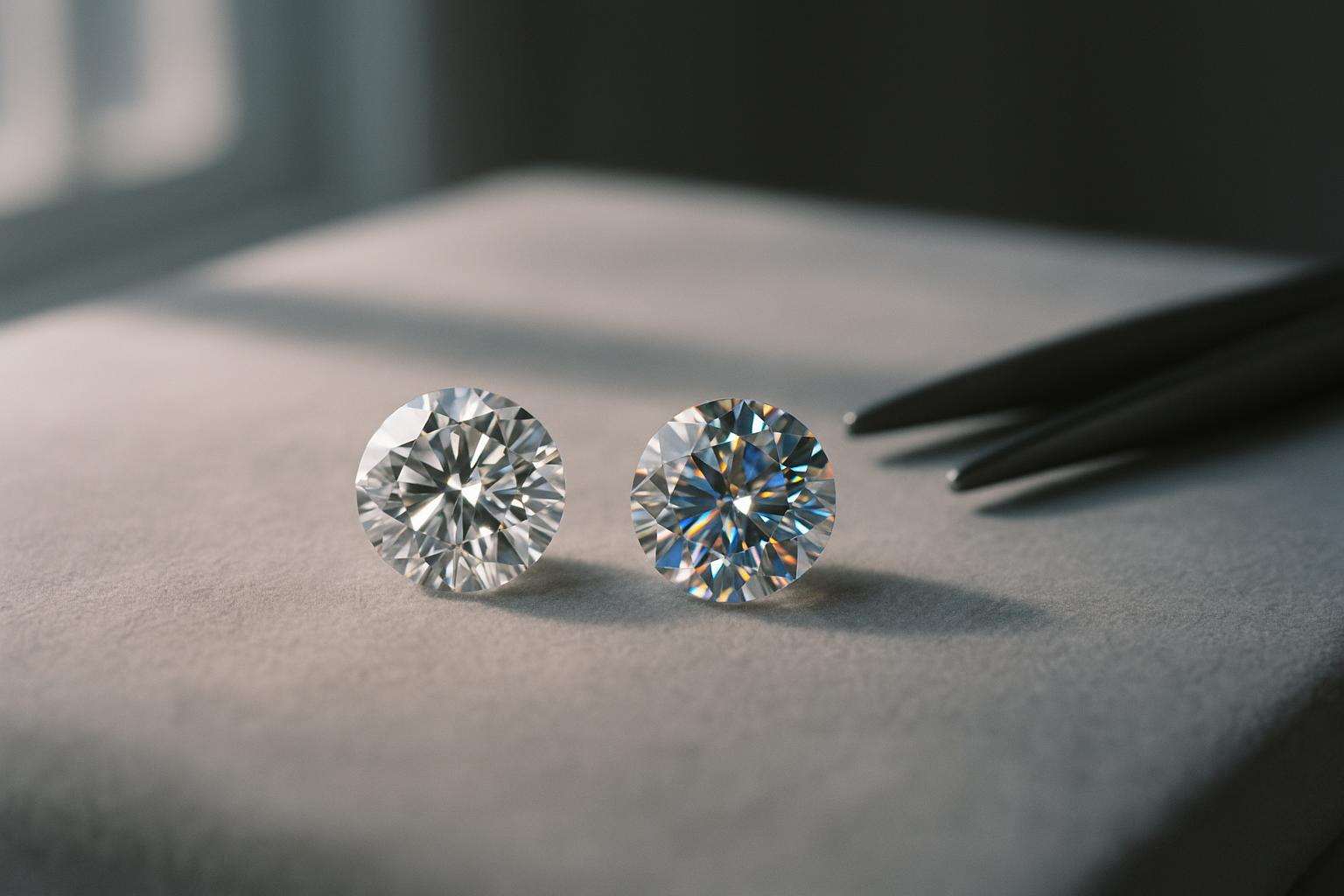
Moissanite is a real, durable gemstone — silicon carbide scoring 9.25 on the Mohs scale — not a diamond imitation. It costs roughly 85–90% less than a natural diamond of equivalent size, produces 2.4 times the colorful fire, and will not cloud or degrade with age. The trade-offs are real: moissanite's fire reads as noticeably more rainbow-colored in direct light (a matter of aesthetic preference, not quality), it carries minimal resale value, and it lacks the cultural weight some buyers place on a natural diamond. For buyers who prioritize visual size, durability, and ethics within a defined budget, it is one of the most compelling center-stone options available. For buyers who value provenance, tradition, or resale potential, a natural or lab-grown diamond remains the stronger choice.
In 1893, a French chemist named Henri Moissan was excavating a meteorite crater in Canyon Diablo, Arizona, when he discovered tiny crystals of an unknown mineral. He initially mistook them for diamonds. They were silicon carbide — later named moissanite in his honor after he won the Nobel Prize in Chemistry. Natural gem-quality moissanite is, as a result of that cosmic scarcity, essentially unavailable; every moissanite sold in jewelry today is laboratory-created. Charles & Colvard, founded in 1995, commercialized the growing process and held the original production patents until they expired, opening the market to competitors. That expiration is why the moissanite market in 2026 looks very different from a decade ago.
This is an honest comparison. It will not tell you moissanite is "just as good" as a diamond, because that depends entirely on what you mean by good. It will tell you precisely what the differences are, what they mean in a real ring worn daily, and what the named brands actually offer — so you can make this decision with full information rather than marketing copy.
How Are Moissanite and Diamond Different Physically?
Diamond and moissanite are distinct materials at the atomic level. Diamond is pure crystallized carbon; moissanite is silicon carbide. Both are exceptionally hard, both are formed under extreme conditions, and both are used in cutting-tool applications as well as jewelry — but their crystal structures produce meaningfully different behavior.
Hardness and toughness are the first practical concern for a stone worn daily. Diamond scores 10 on the Mohs scale — the maximum, and the hardest known natural material. Moissanite scores 9.25 to 9.5. Both values sit well above the 7 threshold at which gemstones begin accumulating surface scratches from silica dust and common household abrasives encountered in daily wear. The practical difference for a ring worn for decades is negligible: neither stone will show surface scratching from normal use. There is one subtle inversion worth noting: diamond has four planes of perfect cleavage, meaning a precisely angled impact on a corner or edge can chip it despite its superior Mohs rating. Moissanite has no comparable cleavage vulnerability. In practice, neither stone chips easily in normal wear, but the cleavage distinction is real and is why protective settings — six-prong, bezel — are recommended for any stone.
Optical properties are where the two stones differ most visibly. Diamond has a refractive index (RI) of 2.42–2.49 and a dispersion value of 0.044. Moissanite's RI is 2.648–2.691, and its dispersion value is 0.104 — approximately 2.4 times the fire of diamond, as documented by Harro Gem's optical analysis. Dispersion is the property that splits white light into spectral colors (the rainbow flashes commonly called fire); moissanite produces notably more of it. Moissanite is also doubly refractive: light entering the stone splits into two rays, which intensifies the color flash and causes back facets to appear doubled under magnification. Diamond is singly refractive and returns predominantly white brilliance.
Whether moissanite's higher fire reads as beautiful or as over-the-top depends entirely on the individual observer and the lighting environment. In diffuse indoor light or overcast outdoor conditions, the difference is subtle. Under direct sunlight or spotlight, moissanite produces a more pronounced disco-ball rainbow effect that some wearers love and others find excessive. Neither is wrong; they are genuinely different aesthetic products.
| Property | Diamond | Moissanite | Practical Meaning |
|---|---|---|---|
| Chemical composition | Carbon (C) | Silicon carbide (SiC) | Distinct gemstone species; not a simulant |
| Mohs hardness | 10 | 9.25–9.5 | Both resist daily-wear scratching; diamond marginally harder |
| Cleavage | Perfect in 4 directions | None | Moissanite slightly more chip-resistant at corners |
| Refractive index | 2.42–2.49 | 2.648–2.691 | Moissanite bends light more; higher overall brilliance |
| Dispersion (fire) | 0.044 | 0.104 | Moissanite produces ~2.4× more rainbow color flash |
| Refraction type | Single | Double | Moissanite facets appear doubled under magnification |
| Origin | Natural (mined) or lab-grown | Lab-grown only (natural is meteoritic and unavailable) | All moissanite is lab-created; this is disclosed by law |
| Detectability | Identified by GIA/IGI report | Passes basic thermal testers; fails dual thermal-electrical testers; visible by loupe (doubling) | A trained gemologist or modern dual tester identifies it accurately |
What Do Moissanite and Diamond Actually Cost?
Price is where moissanite makes its strongest argument. As of mid-2026, market pricing across major retailers is as follows:
- 1-carat natural diamond (Excellent cut, G color, VS2 clarity, GIA certificate): $4,000–$7,500 at reputable online retailers.
- 1-carat lab-grown diamond (equivalent grades, IGI certificate): $1,200–$2,500.
- 1-carat Charles & Colvard Forever One moissanite (colorless, D–F, lifetime warranty): $400–$800 as a loose stone.
- 1-carat Harro Gem or NEO Moissanite (premium competing brands): $300–$600 per carat.
- Budget / unbranded moissanite: $200–$350 per carat; wholesale unbranded material starts under $100 per carat with variable quality control.
The price gap widens dramatically at larger sizes. Diamond prices rise exponentially at benchmark carat weights (1.00, 1.50, 2.00 carats), while moissanite scales more linearly. A completed 3-carat moissanite ring in 14K gold typically costs $1,500–$2,500; a natural diamond ring of equivalent visual dimensions can exceed $60,000. For buyers prioritizing face-up size, this math is difficult to argue with.
One important caveat: the dramatic fall in lab-grown diamond prices over 2022–2025 has narrowed the gap between lab-grown diamonds and premium moissanite more than many buyers realize. A 1-carat lab-grown diamond at $1,500 is now genuinely competitive with a 1-carat Forever One moissanite at $600 — not identical in price, but much closer than the comparison looked five years ago. Buyers comparing these two options should run current quotes at the time of purchase, because both markets are in flux. Our lab-grown vs. natural diamond comparison covers that decision in full.
Which Moissanite Brands Should You Know?
Not all moissanite is equivalent. The expiration of Charles & Colvard's original patents created a market of brands ranging from excellent to inconsistent. Here are the names that matter in 2026:
Charles & Colvard — Forever One is the originator and volume leader. Their Forever One line is colorless (D–E–F), grown in the US using the 4H crystalline silicon carbide polytype, and comes with a lifetime warranty covering clouding and color change. Every stone 4 mm and larger is engraved on the girdle for authentication — relevant for insurance documentation and future identification. The brand carries a premium that some reviewers characterize as a significant markup over visual performance parity with newer competitors. That premium buys documentation credibility and brand recognition, which matter for some buyers and not at all for others.
Harro Gem is a Canadian producer that has built a following among buyers who prioritize cut precision and specialty faceting styles. Their catalog includes Hearts & Arrows round brilliants, Old European Cut, rose cut, 100-facet Starburst, Jubilee Cut, crushed-ice oval and cushion, and Old Mine Cut — a range of specialty cuts that Charles & Colvard does not offer. All Harro Gem stones come with VVS clarity and E–F color, a certificate of authenticity, and a lifetime warranty. Buyers who want a specific vintage-inspired or non-standard faceting style typically find Harro Gem the most capable provider. Custom cutting to specification is available for shapes not in stock.
NEO Moissanite was founded by an early Charles & Colvard employee and offers certification and lifetime warranties comparable to Forever One. NEO is frequently cited as a strong mid-range option offering better value than Forever One for buyers who are confident in the category but do not need the C&C brand name. Their shape selection includes marquise, which some competitors do not stock in quantity.
MoissaniteCo is primarily a retailer rather than a producer, offering a broad inventory across brands and price points with solid return policies. It is a useful destination for buyers who want to compare stones from multiple producers in one place.
A practical note on unbranded moissanite: material sold without brand documentation at very low prices (under $150 per carat) has highly variable color consistency, with some stones showing greenish or grayish tint under certain lighting. For an engagement-ring center stone, a named brand with documentation and warranty is the defensible choice.
What Are the Real Trade-Offs to Understand Before Deciding?
Honest comparison requires stating the trade-offs clearly, not just the advantages of the lower-cost option.
Fire and brilliance character: Moissanite's higher dispersion produces more colorful rainbow flashes — objectively measurable and visible in direct or strong artificial light. Many wearers love this. Some find it reads as less refined than the predominantly white brilliance of a well-cut diamond. There is no correct answer here, but you should look at moissanite in the lighting conditions you spend most time in — office fluorescent light, natural daylight, restaurant candlelight — before deciding. Most online retailers provide high-resolution video for exactly this purpose.
Resale value: Moissanite has a limited secondary market. Estate jewelers and pawn shops typically pay only the metal scrap value of the setting. Peer-to-peer platforms (I Do Now I Don't, DiamondBistro) offer the best recovery, where branded premium moissanite (Forever One, Harro Gem) may recover 25–45% of original retail price depending on size and buyer demand. A natural diamond with a GIA grading report is a substantially better resale vehicle — though "investment" framing overstates even diamonds' resale performance, since most retail jewelry loses 30–50% of its purchase price immediately on resale. The key proportionality point: because moissanite costs so much less at retail, the absolute dollar loss on resale is typically far smaller.
Cultural and emotional weight: For some buyers and families, a diamond carries specific meaning — tradition, endurance, rarity — that moissanite cannot replicate regardless of visual similarity. This is a legitimate consideration and not one that should be argued away. For others, it is entirely irrelevant. Only you and your partner can weigh it accurately. If in doubt, the conversation is worth having before purchase rather than after.
Identification: A moissanite cannot fool a dual thermal-electrical tester or a trained gemologist with a loupe. Its double refraction is detectable under any 10× magnification. This is only relevant if identity disclosure matters to you — but it should be noted that the FTC requires moissanite to be disclosed as moissanite, and any retailer misrepresenting it as diamond is violating federal guidance. A GIA or IGI lab report removes all ambiguity for insurance, appraisal, and estate purposes.
For a broader context on how moissanite fits within the full spectrum of diamond alternatives — from sapphire and morganite to salt-and-pepper diamonds — see our guide to opal, moss agate, and alternative center stones. And if you are weighing moissanite primarily on price and want to understand whether a lab-grown diamond might close the gap for your budget, our full lab-grown vs. natural diamond comparison provides the complete picture, including FTC disclosure requirements and detection methods.
The decision between moissanite and diamond is not a question of good versus bad. It is a question of what you are optimizing for. If visual size, durability, and ethical sourcing at a defined budget are your primary criteria, moissanite is among the most intelligent choices in the engagement-ring market. If provenance, tradition, resale value, or the specific optical character of diamond matter to you, diamond — natural or lab-grown — is the answer. The right ring is the one that reflects your values honestly, not the one that signals the largest sacrifice.
Frequently asked
Is moissanite a fake diamond?
No. Moissanite is not an imitation or simulant in the legal sense — it is a distinct gemstone species: silicon carbide (SiC), with its own chemical composition, crystal structure, optical properties, and hardness. It is not marketed or sold as a diamond, and the FTC's Guides for the Jewelry, Precious Metals, and Pewter Industries require sellers to clearly identify it as moissanite, not diamond. It does share some visual characteristics with diamond — high brilliance, colorless body — but its dispersion, double refraction, and precise refractive index are measurably different from diamond's. A buyer who knowingly chooses moissanite is choosing a genuine gemstone, not a fake anything.
Can a jeweler tell moissanite from diamond?
Yes — if they use the right tools. A basic thermal diamond tester will not reliably distinguish moissanite from diamond because both stones have high thermal conductivity. Many standard pen-style testers read moissanite as diamond. However, a dual thermal-electrical tester separates them accurately, because moissanite is slightly electrically conductive and diamond is not. A trained gemologist using a loupe or microscope can also identify moissanite visually: its double refraction causes back facets to appear doubled under magnification — a characteristic diamonds never show. GIA and IGI spectrographic lab reports are the definitive identification method.
Does moissanite get cloudy over time?
No — moissanite does not cloud, yellow, or degrade with age under normal conditions. Its silicon carbide crystal structure is chemically stable and resistant to the household chemicals, lotions, and UV exposure that damage softer stones. The surface does accumulate soap, lotion, and oil film over time — the same film that dulls any gemstone — but a soak in warm water with a drop of dish soap and a gentle scrub with a soft toothbrush restores full brilliance. Charles & Colvard's lifetime warranty specifically covers clouding and color change, and independent long-term wear reports consistently confirm the stone's optical stability. This makes moissanite a lower-maintenance stone than, for example, opal or emerald.
What is the difference between Forever One, Forever Brilliant, and Forever Classic?
All three are Charles & Colvard product lines using silicon carbide moissanite, differing primarily in color grade. Forever One is colorless, grading D–E–F on the GIA color scale — the closest match to the most prized diamond colors and the highest-priced line. Forever Brilliant falls in the near-colorless G–H–I range; it shows no discernible warmth face-up in most settings and is offered at a lower price point. Forever Classic (the original line) shows faint body color in the J–K range and is still available through some authorized retailers. For an engagement-ring center stone, Forever One is the standard recommendation for buyers who want the clearest, most diamond-like color. Each stone 4 mm and larger carries a girdle engraving for authentication.
Does moissanite have resale value?
Moissanite's secondary market is limited. Pawn shops and most estate jewelers typically do not purchase moissanite loose stones; when they do, they pay only the metal scrap value of the setting. Peer-to-peer resale platforms — Mercari, I Do Now I Don't, DiamondBistro — are more viable channels, where branded premium moissanite (Forever One, Harro Gem) may recover roughly 25–45% of original retail price depending on size, documentation, and buyer demand. The silver lining is proportionality: because moissanite costs 85–90% less than an equivalent natural diamond at retail, the absolute dollar loss on resale is typically far smaller than it would be on a diamond of the same visual size. If resale value matters to you, a natural diamond with a GIA grading report remains the better investment vehicle — though it too loses significant value the moment it leaves a retailer.
How much does moissanite cost compared to diamond?
As of mid-2026, a 1-carat Charles & Colvard Forever One moissanite retails at approximately $400–$800 as a loose stone; competing premium brands such as Harro Gem and NEO Moissanite run $300–$600 per carat. By comparison, a 1-carat natural round brilliant diamond at G color and VS2 clarity costs roughly $4,000–$7,500 at reputable online retailers, and a 1-carat lab-grown diamond of equivalent quality runs $1,200–$2,500. The moissanite price advantage widens dramatically at larger sizes: a 3-carat premium moissanite ring typically costs $1,500–$2,500 complete, versus $20,000–$60,000 for a natural diamond ring of equal visual dimensions. Moissanite pricing also scales more linearly with size, unlike diamonds whose per-carat price rises exponentially at benchmark weights.
Which moissanite brand should I choose?
The right brand depends on your priorities. Charles & Colvard Forever One is the original, the most widely recognized, and includes a lifetime warranty plus girdle engraving for authentication — relevant if you ever need to verify the stone's identity for insurance purposes. However, it carries a brand premium that some consider excessive given current market competition. Harro Gem (Canada) is the premium choice for buyers who want specialty cuts — Hearts & Arrows, Old European Cut, rose cut, crushed-ice cushion — and offers VVS clarity, E–F color, and excellent customer service at prices that often undercut Forever One. NEO Moissanite is a strong mid-range option with good warranties. MoissaniteCo is a reliable retailer for broad selection and competitive pricing. For most buyers, Harro Gem or Forever One are the two names worth comparing directly before purchase.