Diamonds & Stones
Emerald & Asscher Step Cuts: Why Clarity Matters More
The hall-of-mirrors effect is everything — but those same open facets that create serene, architectural glow will also put every inclusion on display. Here is what the clarity threshold actually means for step cuts, and why the price math still works in your favor.
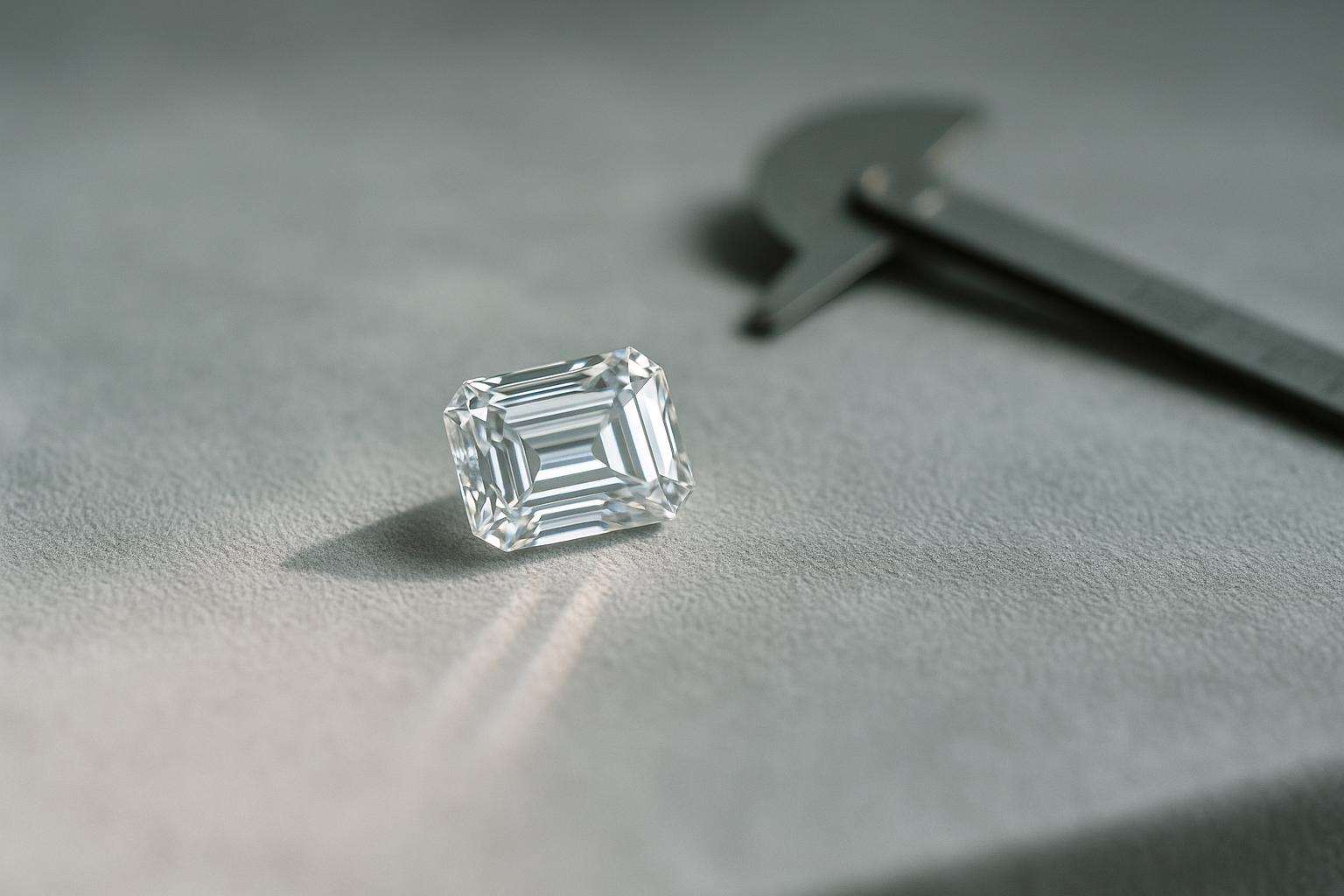
Emerald and asscher cuts are the most unforgiving diamond shapes for clarity — their large open step facets act as windows, not mirrors, making inclusions that would be invisible in a round brilliant clearly apparent. The practical rule: VS2 minimum for stones under 1.5 carats, VS1 or better for anything larger. The payoff is real: step cuts run 25–40% less per carat than round brilliants of comparable grade, and the mandatory clarity upgrade still leaves most buyers ahead on price. But the purchase requires proportion verification that no retailer label can substitute for — and this guide walks you through exactly that.
There is a moment, when you hold an emerald-cut diamond under northern window light, where the stone seems to stop sparkling and start breathing. The rapid-fire scintillation of a round brilliant gives way to something slower: long, luminous corridors of reflected light moving across wide parallel facets in deliberate sequence — the phenomenon gemologists have always called the "hall of mirrors." It is a fundamentally different optical experience, and it has drawn buyers from Grace Kelly to Beyoncé for more than a century. But that serene architectural glow comes with an exact technical price, and understanding it is the difference between buying a step-cut diamond with confidence and discovering an expensive mistake after the proposal.
What Makes a Diamond a Step Cut — and Why Does It Change Everything?
Diamond cuts fall into two broad optical families. Brilliant cuts — round, oval, cushion, pear, marquise, radiant — maximize light scintillation through dozens of precisely angled triangular or kite-shaped facets that break incoming light into rapid-fire flashes. Step cuts — emerald, asscher, baguette — use long, parallel rectangular facets arranged in tiers above and below the girdle. Instead of fracturing light into sparkle, step facets return light as broad, sustained reflections that slide across the stone's interior as the viewing angle changes. The effect is architectural rather than kinetic.
That facet geometry explains every technical property that distinguishes step cuts in the buying process. In a round brilliant, the dense overlap of 58 small facets scatters light in multiple directions simultaneously, masking inclusions within the overall brilliance pattern. A small crystal inclusion near the girdle of a round brilliant SI1 is almost never visible to the unaided eye — the scintillation pattern absorbs it. In an emerald cut, those same inclusions reflect repeatedly across the broad parallel surfaces, drawing the eye directly to any imperfection in the same way a streak draws the eye across a clean window pane. The stone's optical transparency is its appeal; that same transparency is its technical liability.
The same dynamic applies to color. In a round brilliant, body color tints are scattered and diluted by the scintillation pattern. In a step cut, color pools in the open table, where it is most visible, making color tints more apparent than in brilliant cuts of the same grade. Both effects — heightened clarity visibility and heightened color visibility — stem from the same source: the absence of light-scattering brilliance. Understanding this single cause makes every buying recommendation for step cuts logically inevitable rather than arbitrary.
Emerald Cut Diamonds: The Buying Standard in Depth
The emerald cut is a rectangular step-cut diamond with beveled corners, typically featuring 58 facets and a length-to-width ratio between 1.30 and 1.50. It is the most commercially available step cut and, as of 2026, holds approximately 8% of the U.S. engagement ring market according to The Knot's 2026 Real Weddings Study — a figure that has grown steadily as the shape's Art Deco associations have attracted younger buyers seeking architectural elegance over maximalist sparkle.
Clarity. VS2 is the practical minimum for an emerald cut diamond under 1.5 carats, and VS1 is the standard for stones 1.5 carats and above. The reason is empirical: a VS2-graded emerald cut has an estimated 55–70% probability of being eye-clean; an SI1 drops to 20–35%. That is not a meaningful odds advantage — it means the majority of SI1 emerald cuts will show visible inclusions in a mounted ring under normal viewing conditions. For context, an SI1 round brilliant has roughly an 85% probability of being eye-clean. The step-cut clarity premium is not a retailer upsell; it reflects the optical physics of the shape.
One useful nuance: VS2 inclusions in an emerald cut are not automatically visible. Inclusion type and position matter significantly. A small, colorless feather near the girdle on a VS2 certificate may be completely invisible in a finished ring; a dark crystal positioned under the center table will be visible regardless of grade. Always request a loupe photograph or high-resolution video of any emerald cut VS2 stone before purchasing, and confirm eye-clean status directly with the retailer. At VS1 and above, the probability of a visible inclusion drops to a level that does not require stone-by-stone negotiation for buyers who prefer grade-based confidence.
Color. G is the recommended minimum for emerald cuts in platinum or white gold settings. The open table of a step cut concentrates body color in the most visible facet of the stone; a G-color emerald cut reads as white face-up, while an I-color stone — which would be visually acceptable in a round brilliant — may show warm undertones. In yellow gold or rose gold settings, H color is the practical standard, as the warm metal absorbs residual tint. Going below H in white metal settings is a visible compromise on a step cut in a way it would not be for the same buyer on a round brilliant.
Proportions. The GIA does not issue a formal cut grade for emerald cuts. Every proportion value must be verified from the GIA certificate directly. Target ranges for an optically well-performing emerald cut:
| Proportion | Target Range | What Goes Wrong Outside It |
|---|---|---|
| Table % | 60–68% | Below 58%: shallow, glassy, no depth; above 72%: flat and lifeless |
| Depth % | 61–68% | Below 58%: window effect, see-through stone; above 74%: dark nail-head center |
| Length-to-Width Ratio | 1.28–1.45 (optimal: ~1.35) | Below 1.20 reads almost square; above 1.50 elevated risk of proportional imbalance |
| Polish & Symmetry | Excellent or Very Good | Good or below: facet misalignment disrupts the parallel reflection pattern |
| Girdle | Thin to Slightly Thick | Very thin: structural fragility at corners; very thick: weight hidden in girdle, smaller face-up |
Any designation of "Ideal Cut" or "Premium Cut" on a retailer's emerald cut listing is the retailer's own assessment — not GIA certification. Verify proportions from the certificate; do not rely on retailer labels.
Pricing. Emerald cuts run 25–40% below round brilliants of identical grade. At Blue Nile in May 2026, a 1-carat natural F/VS1 emerald cut listed at approximately $3,350, compared to roughly $4,400 for a comparable round brilliant — a $1,050 savings (24%). After factoring in the clarity upgrade from VS2 (round) to VS1 (emerald), the net advantage narrows but remains real: typically $500–$800 at the 1-carat tier, widening substantially above 2 carats. One pricing anomaly worth knowing: the buy-shy premium that affects round brilliants at benchmark weights also appears in emerald cuts. A 1.62-carat G/VS1 emerald cut listed at $13,690 at Blue Nile was priced $1,200 less than a 1.50-carat G/VS1 at $14,890 — because demand concentrates at the 1.50-carat mark, inflating price at that benchmark. Buying just above a benchmark weight often delivers more diamond for less money in step cuts.
Celebrity context. The emerald cut's association with Old Hollywood glamour is earned: Grace Kelly's engagement ring from Prince Rainier of Monaco featured a 10.48-carat emerald cut flanked by tapered baguette diamonds — a ring later valued at tens of millions of dollars. Beyoncé's ring from Jay-Z is an estimated 18-carat emerald cut. Amal Clooney's ring from George Clooney features a seven-carat emerald cut. These rings share a consistent aesthetic grammar: architectural restraint, emphasis on the stone's interior depth, and the instinctive pairing of the step-cut's linear geometry with simple baguette or solitaire settings that refuse to compete with the hall-of-mirrors effect.
Asscher Cut Diamonds: The Square Step Cut with an Art Deco Lineage
The asscher cut is, in structural terms, a square emerald cut — same parallel step facets, same hall-of-mirrors optical effect, same clarity and color requirements — but with a shorter length-to-width ratio (1.00–1.03 for the standard square), more deeply cropped corners producing a characteristic octagonal outline, and a higher crown that deepens the visual well of reflections visible through the table. Where an emerald cut reads as horizontal and elongated, the asscher reads as centered and symmetrical — a shape that has been described as looking directly down a kaleidoscope.
Its history is inseparable from its maker. Joseph Asscher of Amsterdam patented the original asscher cut in 1902 — the world's first patented diamond cut — and the shape became the signature aesthetic of the Art Deco period, its sharp geometry a perfect match for the 1920s and 1930s taste for angular, architectural luxury. The original patent expired during World War II, during which the Nazi occupation seized the Asscher family's Amsterdam headquarters and deported nearly all of the company's 500 master polishers. Fewer than ten percent survived. The Asscher family rebuilt the company after the war; it was granted the Dutch Royal Predicate in 1980, becoming the Royal Asscher Diamond Company, a designation renewed by Queen Beatrix in 2011 for a further 25 years. In 2001, Edward Asscher introduced the Royal Asscher Cut — a 74-facet variant offering deeper optical complexity than the 58-facet original — which remains exclusively cut by the company under current international patent protection. Lita and Mike Asscher, the sixth generation of the family, co-lead the firm today from its original headquarters at Tolstraat 127 in Amsterdam.
Clarity and color. The asscher's requirements mirror the emerald cut's: VS2 minimum under 1.5 carats, VS1 or better for larger stones, and G color minimum in white metal settings. The square outline actually concentrates optical depth in a tighter area than the elongated emerald cut, which can make the parallel reflections even more pronounced — and inclusions sitting under the center table even more visible. Multiple gemologists characterize SI1 asscher cuts as a category to avoid entirely. The asscher's square format also means any color asymmetry or inclusion positioned off-center is particularly apparent, since the balanced outline provides no lateral distraction.
Pricing. Asscher and emerald cuts are priced comparably per carat, with emerald cuts trading at a slight premium in some ranges due to current demand for the elongated silhouette. A 1-carat asscher in G–H color, VS2 clarity averaged approximately $3,030 at Blue Nile in recent surveys — marginally below the equivalent emerald cut. Both shapes sit 25–35% below equivalent round brilliants before the clarity premium is applied. The asscher accounts for only 1.5–2% of all cut diamonds, making quality inventory genuinely scarcer than for emerald cuts; buyers willing to search will find excellent stones but should plan for a longer selection process than for round brilliants or ovals.
Celebrity examples. Gwyneth Paltrow's engagement ring from Chris Martin of Coldplay was an asscher cut set on a double pavé band. Pippa Middleton's ring from James Matthews features a three-carat asscher cut in a diamond cluster setting. Both rings reflect the shape's consistent aesthetic identity: geometric precision, vintage associations, and settings that emphasize the stone's structural character rather than softening it.
Step Cuts vs. Brilliant Cuts: A Practical Comparison
| Factor | Round Brilliant | Emerald Cut | Asscher Cut |
|---|---|---|---|
| Optical character | Rapid sparkle; high brilliance, fire, scintillation | Long, glassy hall-of-mirrors flashes | Deep windmill/hall-of-mirrors effect |
| Minimum clarity (eye-clean) | VS2; SI1 viable on inspection under 1.5ct | VS2; VS1 for 1.5ct+ | VS2; VS1 for 1.5ct+; SI1 not recommended |
| Minimum color (white metal) | G–H reliable | G minimum; H viable in warm metal | G–H; step-cut pooling slightly more visible |
| GIA cut grade available? | Yes (Excellent–Poor) | No — verify proportions from certificate | No — verify proportions from certificate |
| Price vs. round (same grade) | Baseline | 25–40% less per carat | 25–35% less per carat |
| Bow-tie effect risk | None | None | None |
| Face-up size vs. round (same carat) | Baseline | Similar to round; elongated shape covers more finger length | ~5–8% smaller face-up; weight concentrated in depth |
| Settings that work best | All setting types | Solitaire, bezel, three-stone with baguettes | Solitaire, vintage milgrain, square halo |
How to Buy a Step Cut Diamond Without Getting It Wrong
The practical buying sequence for an emerald or asscher cut is slightly different from a round brilliant purchase, because the absence of a GIA cut grade shifts one major verification step to the buyer.
Step one: Set clarity first, not last. For brilliant cuts, most buyers start with carat and work down from there; clarity is often the final budget variable. For step cuts, reverse the order. Establish your clarity floor — VS2 under 1.5 carats, VS1 at 1.5 carats and above — and treat it as non-negotiable before considering any other variable. Lowering clarity to afford a larger step-cut stone is the single most common error buyers make with these shapes, and the visual result is apparent every time the ring is worn.
Step two: Pull the GIA certificate and check the numbers. Verify table percentage (60–68%), depth percentage (61–68%), and length-to-width ratio (1.28–1.45 for emerald; 1.00–1.05 for asscher). A stone outside these ranges is not automatically disqualifying — some buyers deliberately prefer a higher L:W ratio on an emerald cut — but the deviation should be intentional and visually confirmed, not discovered after purchase.
Step three: Watch the stone move. All major online retailers — James Allen, Blue Nile, Brilliant Earth — provide 360-degree video at 20x magnification as standard practice in 2026. For step cuts, watch the video specifically for: (1) any dark or cloudy zone under the table, which indicates a depth or proportion issue; (2) any visible inclusion that catches the light in the hall-of-mirrors reflections; (3) symmetry in the parallel step reflections — they should be even and balanced from corner to corner. An asymmetric reflection pattern in an asscher cut typically indicates cutting symmetry deficiencies that will affect the stone's visual identity.
Step four: Confirm eye-clean status with the retailer before purchasing. No grade alone guarantees this for a step cut. A brief email or chat message — "Can you confirm this stone is eye-clean face-up at normal viewing distance in a mounted setting?" — provides a documented confirmation that shifts accountability appropriately.
Step cuts reward the buyer who takes those four steps seriously with something a brilliant cut cannot quite replicate: a stone whose beauty becomes more apparent with proximity rather than less, a transparent window into the diamond's interior that rewards the quiet observation of daily life rather than the bright-light theater of a jewelry case. The clarity standard is not a tax on the shape — it is the prerequisite for the effect that makes the shape worth choosing. For a deeper look at how clarity grades translate to eye-clean outcomes across all shapes, see our clarity and eye-clean threshold guide. And if you are weighing an emerald or asscher cut against the full field of ten diamond shapes, the complete price and size comparison lives in our diamond shapes guide.
Frequently asked
What is the minimum clarity grade for an emerald cut diamond?
Most gemologists recommend VS2 as the absolute minimum for an emerald cut diamond under 1.5 carats, and VS1 or better for stones 1.5 carats and above. The emerald cut's large, open parallel step facets function essentially as windows into the stone's interior: inclusions that would be completely invisible in a round brilliant — masked by 58 overlapping, light-scattering facets — can float visibly across an emerald cut's broad table. An SI1 emerald cut has an estimated 20–35% probability of being eye-clean, compared with roughly 85% for an SI1 round brilliant of the same carat weight. That is a coin flip no engagement-ring buyer should accept without inspecting the specific stone via high-resolution video. VS2 inclusions in an emerald cut are typically minor under 10x magnification but can still be noticeable — the safest approach is to request a loupe image or ask the retailer to confirm eye-clean status for any VS2 stone you are considering.
How does an asscher cut differ from an emerald cut?
Both are step-cut shapes sharing the same architectural facet philosophy and the same hall-of-mirrors optical effect, but they differ in outline and facet count. The emerald cut is rectangular with a standard length-to-width ratio between 1.30 and 1.50; the asscher cut is square, with a recommended length-to-width ratio of 1.00–1.03. The asscher also has a higher crown and more deeply cropped corners than the emerald cut, giving it a distinctive octagonal silhouette. The original asscher — patented in 1902 by Joseph Asscher of Amsterdam — features 58 facets. The modern Royal Asscher Cut, introduced in 2001 and still exclusively cut by the Royal Asscher Diamond Company, carries 74 facets arranged to deepen the hall-of-mirrors depth. Because the square asscher distributes its weight more vertically, it typically faces up smaller per carat than the elongated emerald cut — a key consideration for buyers weighing size against shape preference.
Are step cuts cheaper than round brilliant diamonds?
Yes, meaningfully so — but the clarity premium required for step cuts partially narrows the effective savings. Emerald and asscher cuts are priced approximately 25–40% below round brilliants of identical grade because the step-cutting process retains more rough crystal material, reducing per-carat production cost. A 1-carat natural F/VS1 emerald cut listed at Blue Nile in May 2026 was approximately $3,350, compared to roughly $4,400 for an equivalent round brilliant — a savings of about $1,050 (24%). However, if a round brilliant buyer needs only VS2 clarity while an emerald cut buyer needs VS1, the real-world price gap narrows. For most buyers at the 1-carat tier, the step-cut price advantage remains substantial even after the clarity upgrade — typically $500–$800 in net savings. At 2–3 carats, the advantage widens dramatically: an equivalent clarity step cut can save $10,000 or more relative to a round brilliant.
Does GIA issue a cut grade for emerald or asscher cut diamonds?
No. GIA does not issue a formal cut grade for emerald, asscher, or any other step-cut diamond. The GIA cut-grading system applies exclusively to round brilliant diamonds. Any designation such as "Ideal Cut" or "Excellent Cut" on a retailer listing for an emerald or asscher cut reflects that retailer's own internal assessment — not laboratory certification. For step cuts, buyers must evaluate quality directly from the GIA certificate's listed proportions: table percentage (target 60–68%), depth percentage (target 61–68%), and length-to-width ratio (emerald: 1.28–1.45; asscher: 1.00–1.05 for the classic square). Depth below 58% produces a shallow, window-like stone with no optical depth; depth above 74% creates a dark, nail-head appearance. Neither fault will be flagged on the certificate — the responsibility for proportion verification falls entirely on the buyer or their gemologist.
What color grade works best for step cut diamonds?
Step cuts show body color more readily than brilliant cuts — the open facets allow color tints to pool visibly in the broad table rather than being scattered and masked by scintillation. For emerald and asscher cuts, G color is the practical sweet spot in white metal settings: visually white face-up without the premium of D–F colorless grades. H color works well in yellow gold, where the warm metal absorbs any residual stone tint. Most gemologists advise staying at G or better for step cuts in platinum or white gold settings, whereas a round brilliant buyer can comfortably go to H or I with the same face-up result. For buyers prioritizing maximum budget efficiency, an H-color step cut in a warm metal setting — yellow gold or rose gold — is a sound choice, delivering effectively white appearance at a further color discount over G.
What are the ideal length-to-width ratio ranges for emerald and asscher cuts?
For emerald cut diamonds, the industry consensus sits between 1.30 and 1.50, with 1.35 being the single most popular ratio. A ratio nearer to 1.30 gives a fuller, almost-square rectangular silhouette; ratios approaching or exceeding 1.50 produce a more dramatically elongated look that emphasizes finger coverage but can make the stone appear disproportionate on smaller hands. For asscher cut diamonds, the target range is 1.00–1.03 for the traditional square appearance; anything above 1.05 begins to read as a short rectangle and loses the characteristic octagonal symmetry that defines the shape. Unlike elongated brilliant shapes, neither emerald nor asscher cuts carry bow-tie shadow risk — the step-cut facet arrangement does not create the central light-leakage zone that affects oval, pear, and marquise diamonds. The critical visual pitfall for step cuts is proportion-driven optical depth (too shallow or too deep), not elongation-related bow-tie effects.