Proposals
Seasonal Proposal Ideas: Why 47% of Proposals Happen November Through February
Christmas, New Year's Eve, Valentine's Day, and spring — the calendar's four great proposal windows, with execution tips grounded in survey data from 18,000 newlyweds.
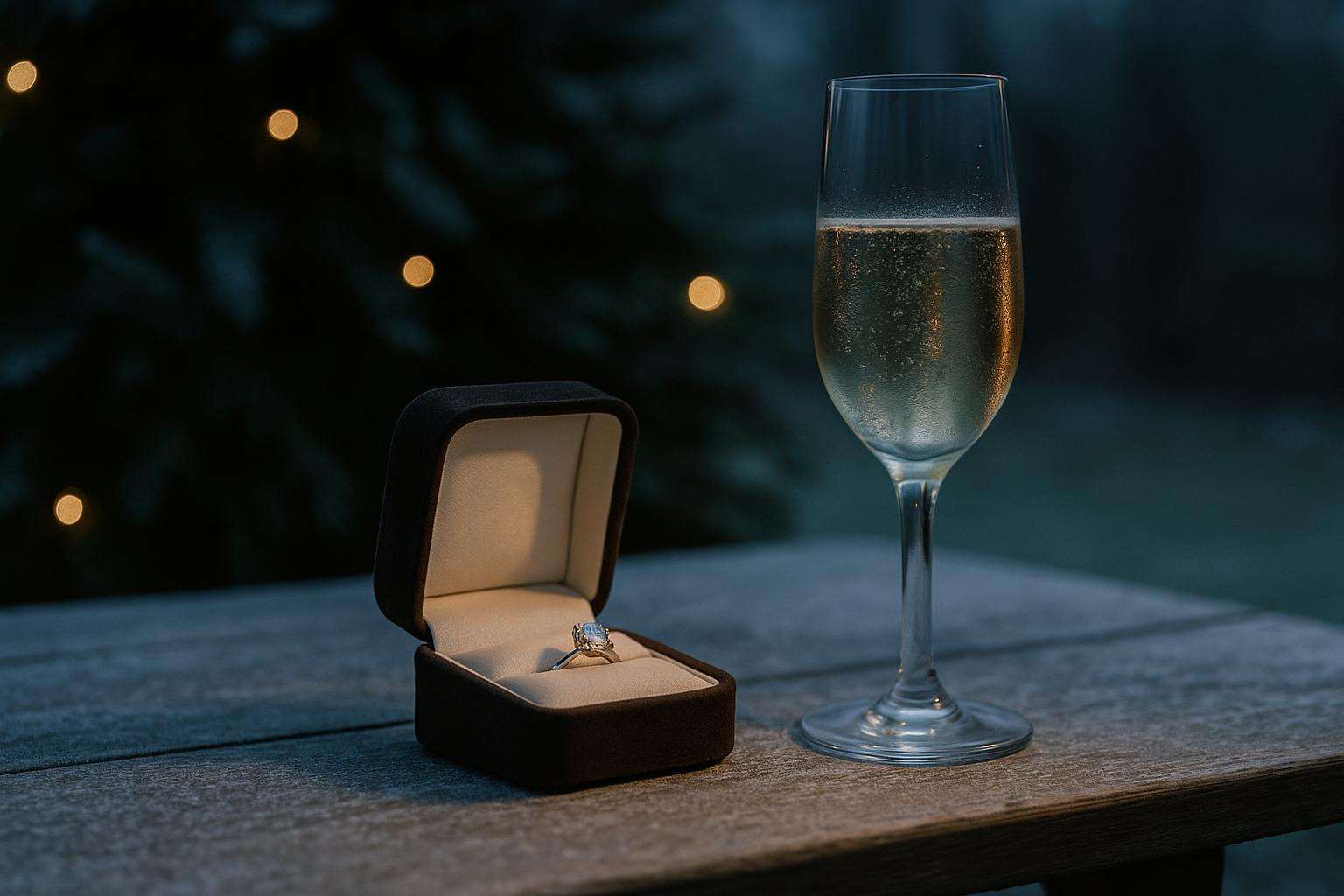
Approximately 47% of U.S. marriage proposals occur between Thanksgiving and Valentine's Day — a pattern documented across surveys of tens of thousands of couples. The concentration is real and logistically useful: family is assembled, venues are prepared for romance, and the season carries genuine emotional resonance. Each window within engagement season has a distinct character, specific logistical demands, and a short list of decisions that determine whether it becomes genuinely memorable or merely seasonal. This guide covers all four: Christmas, New Year's Eve, Valentine's Day, and spring.
The idea of an "engagement season" is not a jeweler's marketing invention. It is a well-documented demographic pattern. The Knot's 2025 Real Weddings Study — fielded among 10,474 U.S. couples married in 2025 — found that approximately 47% of all annual proposals occur between Thanksgiving and Valentine's Day. WeddingWire's Newlywed Report, drawn from a survey of 18,000 U.S. newlyweds, adds the granular breakdown: December alone accounts for roughly 16% of annual proposals, while every other month of the year clusters between 7% and 9%. Mills Jewelers, citing the Knot data, confirms the window spans late November through mid-February with that consistent 47% concentration.
The practical reason the window dominates is twofold and straightforward. First, the romantic associations — candlelight, fireplace evenings, twinkling lights, champagne at midnight — are ambient and already in place; a proposal benefits from the atmosphere without manufacturing it. Second, family is reliably assembled for major holidays, which means the immediate celebration — the first toast, the phone calls, the dinner table reaction — does not require a separate logistics operation. The proposal and the celebration share the same evening.
What the aggregate data does not tell you is that each seasonal window within engagement season has a distinct character, a specific set of logistical demands, and a different emotional register. A Christmas Eve proposal and a New Year's Eve proposal are separated by seven days on the calendar but by quite different experiential dynamics. This guide works through each window in turn, drawing on survey data and execution guidance to help you decide which season fits your relationship — and then how to make it work.
Why Do So Many Couples Get Engaged in December?
December is the highest-volume proposal month in the United States by a margin that is not close. According to the WeddingWire Newlywed Report, it accounts for roughly twice the proposal volume of any individual summer month. The five most popular single proposal days of the year, per WeddingWire, are: Christmas Day, Christmas Eve, New Year's Eve, New Year's Day, and Valentine's Day — in that order. Christmas Day and Christmas Eve together represent the two highest-volume proposal dates on the calendar by a significant margin.
The ApoteoSurprise survey of 1,800 respondents across the U.S. and Europe adds useful motivational context: the majority of those who propose in December cite the family-gathering dimension as a decisive factor. When the people who matter most are already in the same room, the proposal does not require a separate event to deliver the celebration. The evening becomes both the moment and the party.
Christmas Proposal Execution Tips
The most resonant Christmas proposals weave the ring into the holiday's existing rituals rather than staging an entirely separate ceremony within it. Several approaches have well-documented success rates among proposal planners:
| Approach | Best For | Core Mechanic | Primary Logistics Note |
|---|---|---|---|
| Ornament box reveal | Couples who share tree-trimming as a tradition | Custom ornament that opens to reveal the ring — worked into a family or couples decoration ritual | Order ornament early; confirm dimensions fit the ring box; have a second ornament on hand if the first does not open cleanly |
| Advent calendar countdown | Partners who appreciate anticipation-building | One small daily gift from December 1 building to the ring on December 24 or 25 | Requires 24 days of preparation; works best in a private-living setting; loses impact if partner travels mid-month |
| Secret Santa engineering | Families with an established Secret Santa tradition | Coordinate with a trusted family organizer to route the ring box as a final Secret Santa gift | Requires one co-conspirator to be completely reliable; have a fallback plan if the gift order changes |
| Christmas Eve fireplace moment | Partners who prefer intimacy before the holiday chaos begins | Propose alone together on Christmas Eve evening, then share news with family on Christmas Day | The cleanest logistics option; creates a private memory before the public celebration; most flexible timing |
One logistical detail that The Knot specifically flags for December proposers: book your photographer early. The holiday period is broadly off-schedule for many vendors, and last-minute booking in December is significantly less reliable than in other months. If you want a proposal photographer — and the decision on that deserves its own conversation, addressed in our proposal photography guide — secure them four to six weeks in advance, ideally by late October.
What Makes New Year's Eve a Compelling Proposal Moment?
New Year's Eve is the third most popular proposal day of the year, according to WeddingWire's survey data. Its structural advantage is an organic countdown: the midnight transition provides built-in drama, fireworks as a natural backdrop, and a shared public ritual of renewal and anticipation that makes the emotional stakes of a proposal feel native to the moment rather than imposed upon it.
The practical execution insight that proposal planners consistently share is precise: do not propose at the stroke of midnight. Noise and crowd congestion peak in the sixty seconds surrounding the countdown, and what should be a quiet, clear moment becomes nearly impossible to hear. The recommended window is two to five minutes before midnight — while the crowd is still assembling, energy is building, and you have a natural conversational moment before the world explodes into celebration. The fireworks and cheering that follow the proposal amplify the joy rather than competing with the question itself.
For New Year's Eve proposals at a private dinner rather than a public event, the timing calculus is simpler. Propose before or after midnight, but with deliberate intention — “before” creates anticipation through the evening's celebration; “after” lets the new year literally begin with the engagement. Either works; the choice is purely about the emotional narrative you prefer.
The Helzberg 2025 Engagement and Ring Shopping Survey, conducted among 1,000 U.S. adults aged 20 to 40, found that 83% of respondents prefer a private proposal over any form of public setting. New Year's Eve at a large public event is one of the most public proposal environments possible. If you are not certain your partner would welcome a witnessed moment — in front of a crowd or even a restaurant dining room — a private New Year's Eve setting (a rented suite, a terrace, a private room) preserves the holiday's emotional energy without the audience-pressure variable. Our public vs. private proposals guide covers this decision in depth.
Is Valentine's Day Actually a Good Day to Propose?
Valentine's Day occupies an interesting position in engagement data: it is widely perceived as the most romantic proposal occasion, but it ranks fifth on the actual proposal frequency list, and survey evidence suggests its appeal is asymmetric by gender. The ApoteoSurprise survey found that 31% of men consider Valentine's Day the most romantic day to propose, but only 19% of women agree. In practice, just 3% of proposals occur on February 14th — a figure that reflects the gap between romantic reputation and actual use.
The case for Valentine's Day proposals is genuinely solid in one dimension: logistics. The infrastructure is already in place. Restaurants are prepared, hotel packages are structured around the occasion, florists are fully stocked, and the cultural script of the day means your partner arrives expecting romance. You are not constructing an atmosphere from scratch; you are working with one that already exists.
The case against is equally plain: predictability. Proposals on Valentine's Day are widely anticipated. If your partner has any expectation that you might propose on a romantic occasion, February 14th is the date they will have in mind. For proposers who value genuine surprise, or whose partners have explicitly expressed that they would rather not be proposed to on the most obvious possible day, this is a real consideration.
The practical resolution most proposal planners recommend: if you choose Valentine's Day, add at least one element that is specifically yours. Not a generic romantic restaurant, but the restaurant where you had your first date. Not a hotel with a rose-petal package, but a venue with a connection to your relationship's history. The date provides the ambient romance; the personalization provides the genuine meaning. A Valentine's Day proposal executed this way is absolutely memorable. A fully conventional Valentine's Day proposal risks being indistinguishable from every other Valentine's Day proposal, which is the one outcome worth avoiding.
What Are the Best Spring Proposal Opportunities?
Spring represents the second-largest seasonal proposal opportunity after the November-through-February window. The anchor date is March 20 — the Spring Equinox — designated as National Proposal Day. Cherry blossom season follows immediately, running from late March through mid-April across much of the United States (with significant regional variation; Washington, D.C.'s peak typically falls in late March to early April, while Portland, Oregon and Seattle follow in April).
The appeal of cherry blossom proposals is well-established: the visual beauty is extraordinary, the setting is inherently romantic, and the imagery photographs exceptionally well. The constraint is equally well-established: peak bloom typically spans only one to two weeks, and the window can shift by a week or more year to year depending on winter temperatures. Rain — which can strip petals within hours at peak bloom — is an ever-present variable. For any proposal timed to cherry blossoms, The Knot specifically recommends early-morning timing: light is optimal for photography, petals are undisturbed, and foot traffic in public gardens is minimal. A backup plan — an indoor location identified and scouted in advance — is not optional; it is essential.
Spring offers several other strong proposal environments that carry less weather risk and require shorter planning windows:
- Botanical gardens during spring planting cycles (late March through May) deliver curated natural beauty with consistent management. Many botanical gardens offer permits for private proposal use for a modest fee, and early-morning or late-afternoon access is often quieter than midday.
- Vineyard proposals at bud-break (late March through April across much of California, Oregon, and Washington) capture the vineyard in its most quietly beautiful state — rows of new growth, no harvest-season crowds. Many vineyards offer private cave or barrel-room access for proposals; contact the estate's event coordinator at least four to six weeks in advance.
- Sunrise or sunset proposals at a meaningful outdoor location — a beach, a hillside, a park where you have spent time together — gain natural amplification from spring's longer days and increasingly warm evenings without any logistical dependency on a specific bloom or natural event.
One consideration that applies to all outdoor spring proposals: seasonal proposals naturally generate high-quality documentation. Whether you hire a photographer or arrange for a trusted friend to capture the moment, spring light — particularly the golden hour in April and May — is among the most flattering of the year for outdoor photography. If this matters to you, our guide to hiring a proposal photographer covers timing, cost tiers, and how to arrange a hidden-photographer setup.
How Should You Choose the Right Season for Your Proposal?
The data on engagement season is descriptive, not prescriptive. The fact that 47% of proposals occur November through February does not mean it is the right window for every couple; it means it is the right window for nearly half of couples, for reasons that are worth examining in your specific context.
The most useful question is not "which season is most popular" but rather: what conditions make this moment feel most true to your relationship? A couple whose most significant memories together are summer evenings at a lakehouse will not find a Christmas proposal more resonant simply because December produces more proposals nationally. A partner who finds cold weather genuinely uncomfortable will not be at their best emotionally if they are shivering on a December rooftop, regardless of the view.
Apply the season's ambient strengths and then personalize against them. Christmas works because of shared ritual and family assembly — but only if those things are present in your relationship. New Year's Eve works because of built-in emotional stakes — but only if your partner thrives in that energy rather than finding it overwhelming. Cherry blossom season works because of extraordinary natural beauty — but only if your partner finds that setting genuinely moving rather than crowded and tourist-heavy.
The research on what makes proposals memorable is consistent across every survey: proposees remember the words spoken and the sense that their partner genuinely knew them. The season and setting provide the frame; the personalization provides the meaning. Any season, executed with genuine knowledge of your partner, will produce the answer you are hoping for. For the full planning sequence — ring, timing, setting, and the question itself — our step-by-step proposal guide covers the complete process from the first decision to the first toast.
Frequently asked
What percentage of proposals happen during the holiday season?
According to The Knot's 2025 Real Weddings Study, approximately 47% of all U.S. proposals occur between Thanksgiving and Valentine's Day — a span often called “engagement season.” WeddingWire's Newlywed Report, drawn from 18,000 couples, adds granular detail: December alone accounts for roughly 16% of annual proposals, while every other month clusters between 7% and 9%. The concentration is driven by a combination of romantic associations (twinkling lights, fireside evenings, shared celebrations) and the practical advantage of family already being assembled for holidays, making an immediate celebration effortless.
What is the most popular day of the year to propose?
WeddingWire's Newlywed Report ranks the five most popular individual proposal days as: Christmas Day, Christmas Eve, New Year's Eve, New Year's Day, and Valentine's Day — in that order. Christmas Day and Christmas Eve together represent the two highest-volume proposal dates on the calendar. Valentine's Day, despite its cultural reputation as the quintessential proposal day, actually ranks fifth. The ApoteoSurprise survey of 1,800 respondents found that while 31% of men consider Valentine's Day the most romantic day to propose, only 19% of women agree — and just 3% of proposals actually occur on February 14th.
Should I propose on Valentine's Day?
Valentine's Day proposals are well-supported logistically — restaurants, hotels, and event venues are staffed and stocked for romance — but the date's predictability can blunt genuine surprise. Survey data from ApoteoSurprise found that only 3% of proposals actually happen on February 14th, and only 19% of women (versus 31% of men) consider it the most romantic proposal date. If you choose Valentine's Day, proposal planners consistently recommend adding at least one unexpected element — a venue with personal significance, an unusual timing (sunrise rather than dinner), or a detail only you two would recognize — to distinguish your moment from a generic occasion. A thoughtful Valentine's Day proposal is absolutely memorable; a purely conventional one may land as predictable.
When is National Proposal Day?
National Proposal Day falls on March 20th, coinciding with the Spring Equinox. It is the informal anchor of the spring proposal season, which runs roughly from the equinox through mid-April when cherry blossom season peaks across much of the United States. For proposers who want a spring date with cultural resonance but prefer to avoid the Valentine's Day crowds, March 20 offers a compelling alternative: days are lengthening, outdoor settings are coming alive, and the equinox itself carries a meaningful symbolism of beginning and renewal that many couples find appropriate for an engagement.
How far in advance should I plan a holiday proposal?
The planning timeline depends on how much logistics are involved. For a home or personal-location proposal during the holidays, a two-to-four week runway is usually sufficient for decor, a photographer, and champagne logistics. For a restaurant or venue proposal, book at least four to six weeks ahead — December is among the most competitive reservation months of the year. For a proposal with a hired photographer, The Knot advises booking even earlier during the holiday window since many vendors take personal time. For spring proposals timed to cherry blossoms, plan eight to twelve weeks in advance and monitor bloom-forecast websites (such as the National Park Service Bloom Watch), as peak bloom can shift by more than a week year to year and rain can strip petals within hours.
What are some creative Christmas proposal ideas?
The most effective Christmas proposals weave the ring into the holiday's existing rituals rather than staging a separate scene. Documented approaches include: ornament box (a custom ornament that opens to reveal the ring, worked into tree-trimming); advent calendar countdown (one small daily gift building to the ring on December 24 or 25); Secret Santa engineering (coordinating with a trusted family member to route the ring to the right person); and a Christmas Eve fireplace moment before the rest of the household wakes. The Knot advises arranging a photographer well in advance of December, as the holiday period pulls many vendors off their regular schedules. The strongest Christmas proposals feel like a natural crescendo of the season, not a performance inserted into it.
What are good spring proposal ideas beyond cherry blossoms?
Cherry blossoms are the most photographed spring proposal backdrop, but the window is narrow — typically one to two weeks — and weather-dependent. Equally strong spring alternatives include: botanical garden visits during spring planting cycles, which offer a curated environment with minimal coordination; vineyard proposals at the start of growing season (bud-break in late March through April), when vineyards are photogenic and far less crowded than harvest season; sunrise beach or clifftop proposals, which take advantage of lengthening spring days; and National Proposal Day on March 20 with a personal-location moment. For any outdoor spring proposal dependent on specific natural conditions — blossoms, wildflower blooms, vineyard bud-break — always scout the location in person and have an indoor contingency identified.