Ring Styles & Settings
Alternative Ring Metals: Palladium, Titanium, Tantalum & Cobalt Chrome Explained
Four non-traditional metals that outperform gold and platinum in specific real-life scenarios — and the resize, repair, and resale trade-offs you need to know before you buy.
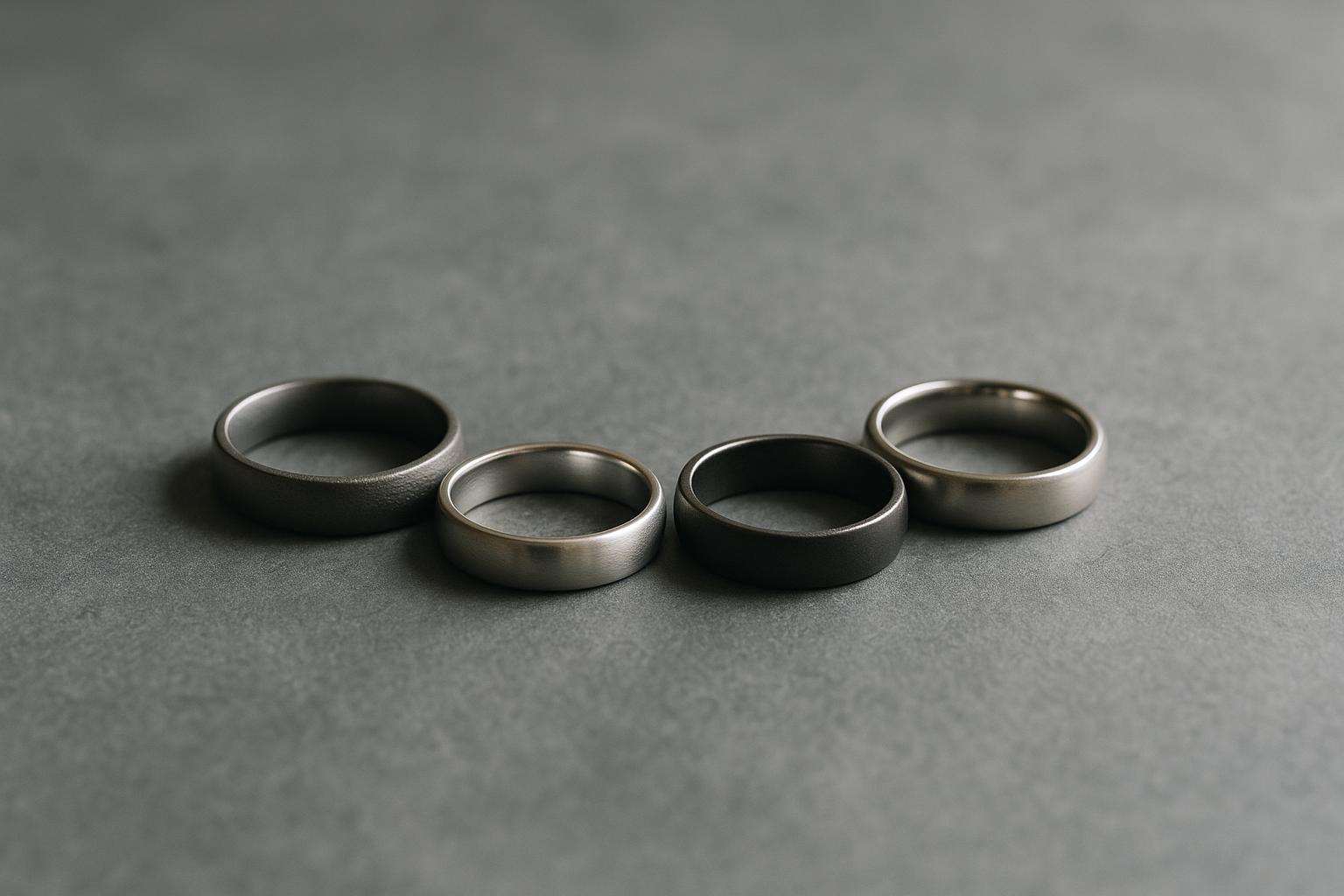
Palladium, titanium, tantalum, and cobalt chrome each address a genuine gap that gold and platinum cannot fill: palladium delivers the platinum look at lower weight and price; titanium offers aerospace-grade strength at entry-level cost; tantalum provides a dark, ductile alternative that can actually be resized; cobalt chrome replicates platinum's bright-white finish without any rhodium maintenance. All four are hypoallergenic. None carry precious-metal resale value (except palladium). Only palladium and tantalum can be conventionally resized. Know which limitation applies before you commit.
The traditional choice of metal for an engagement ring or wedding band has always been straightforward: gold in one of its karats and colors, or platinum. These remain the market standard for good reasons — precious metal value, wide jeweler support, established resizing and repair infrastructure, and cultural familiarity. But a meaningful and growing segment of buyers comes to those metals with specific constraints that gold and platinum handle poorly: severe nickel allergies that rule out most 14k white gold alloys, professions that punish soft metal surfaces (surgery, construction, metalworking), wrists that find platinum's density exhausting, or budgets that make even 14k gold settings feel like a stretch.
Four alternative metals have earned real traction in the bridal market — not as novelties, but as genuinely engineered answers to those specific problems. This guide examines each one with the same precision I'd apply at the bench: composition, hardness, weight, resize protocol, named brand availability, current pricing verified against live retailer data as of June 2026, and an honest assessment of when each metal earns its place and when it does not. If you are still deciding between standard metal options, see our companion guides on platinum vs. white gold vs. 14k vs. 18k and yellow vs. rose vs. white gold — the decision tree below assumes you have already considered and set aside the traditional spectrum.
What Makes a Metal "Alternative" — and Why Does It Matter for a Ring?
The term alternative metal in bridal jewelry refers to any ring material outside the precious-metal spectrum of gold (in its various karats) and platinum. The category includes industrial and transition metals — titanium, tantalum, cobalt chrome — as well as palladium, which is technically a platinum-group precious metal but occupies a distinct commercial and practical position from its more famous relatives.
The distinction matters for three reasons that are easy to overlook at point of purchase. First, resizability: precious metals (gold, platinum, palladium) can be cut, added to, and resoldered by jewelers; the hardest industrial metals (titanium, cobalt chrome, and tungsten, though tungsten is outside the scope of this guide) cannot. A ring you cannot resize is one you must get exactly right the first time — and must replace if your finger changes size significantly over a lifetime of wear. Second, repairability: setting a stone, re-tipping a prong, or repairing a cracked shank in titanium or cobalt chrome requires specialized equipment that most high-street jewelers do not own. Third, appraisal and resale: non-precious metals carry no spot-market value and are not accepted by insurance appraisers at meaningful figures; if theft, loss, or resale is a consideration, a gold or platinum setting remains the defensible choice.
With those constraints clearly stated, here is what each metal actually delivers.
Palladium: The Forgotten Platinum-Group Metal
Palladium sits in the same periodic group as platinum — Group 10 of the transition metals — and shares most of platinum's practical virtues at a lower density and, historically, a lower price. Jewelry-grade palladium is typically 95% pure, identical to the standard for platinum. It is naturally white, never requires rhodium plating (unlike white gold), and is genuinely hypoallergenic across virtually all wearers. At approximately 12.0 g/cm³ density compared with platinum's 21.4 g/cm³, it is roughly 44% lighter — a difference that is immediately perceptible on the hand and is welcomed by wearers who find platinum's heft uncomfortable.
Like platinum, palladium displaces metal rather than removing it when scratched, meaning a patina develops over years rather than surface material being lost. That patina can be polished away at a competent jeweler if the mirror finish is preferred. Critically — and unlike titanium, cobalt chrome, or tungsten — palladium can be resized, though it requires a jeweler experienced with high-melting-point metals. Standard laser welders do not perform reliably on palladium (they tend to produce weak or pitted joints), and palladium-specific solder is not universally stocked; expect to contact several jewelers before finding one with both the material and the experience. The resizing cost is comparable to platinum: approximately $60–$150 depending on the complexity of the work and local labor rates.
Named brands and current availability. Tiffany & Co. carries a full palladium wedding band collection for both men and women, including the Charles Tiffany Setting in palladium and diamond-set styles. Larson Jewelers markets palladium bands from 2mm to 12mm widths, positioning the metal as a lighter-weight platinum analog. Padis Jewelry, Do Amore, and Temple & Grace all stock palladium bands. Price range: plain palladium bands from specialist retailers typically run $400–$900; Tiffany's palladium styles carry the house premium. Palladium is not widely stocked by chain jewelers, so independent and specialty retailers are the reliable channel.
When palladium makes sense: buyers who want the platinum look and hypoallergenic guarantee, prefer a lighter ring, and are willing to seek out specialist jeweler support for sizing and any future repairs. It is a practical choice for a plain or lightly detailed wedding band; for a complex stone-set engagement ring with multiple prongs and intricate metalwork, the narrower jeweler support base is a genuine inconvenience over a lifetime of ring ownership.
Titanium: Maximum Strength at Minimum Weight and Cost
Titanium's physical profile is extreme by any measure: it has the highest strength-to-weight ratio of any element used in jewelry, a Mohs hardness of 6, and a density of just 4.5 g/cm³ — less than a quarter of platinum's. Aerospace and surgical-implant industries adopted it for exactly these properties, and its use in rings follows the same logic. It is non-reactive, non-corrosive, non-magnetic, and biocompatible, making it the most truly hypoallergenic of the four metals discussed here. Medical professionals, tradespeople, outdoor workers, and athletes who cannot risk a soft-metal ring deforming or scratching during work find titanium's durability compelling.
The commercial trade-off is stark: titanium rings cannot be conventionally resized. The metal's hardness and heat resistance make the standard cut-and-solder protocol physically impossible; a ring that no longer fits must be replaced. This is not a hypothetical inconvenience — finger size changes with age, weight fluctuation, pregnancy, and extremity conditions, and a ring intended for life needs to accommodate those changes. For buyers who accept this constraint, the math is straightforward: Blue Nile lists titanium bands starting at $110, with two-tone titanium-and-tantalum styles at $570. The category is among the most affordable in bridal metals by a significant margin.
One persistent myth deserves direct correction: titanium rings can be safely removed in a medical emergency. Hospital emergency departments and fire stations equipped with diamond-blade or tungsten-carbide power ring cutters can cut through aerospace-grade titanium in under five minutes without heat or discomfort to the patient. The ring is destroyed in the process, but no orthopedic intervention is required and no finger is endangered by the metal itself. The fear of impossible emergency removal — widely circulated online — is not supported by medical practice. The non-resizability is real; the safety concern is a myth.
Named brands and availability. Blue Nile carries matte black titanium, standard grey titanium, and two-tone titanium-tantalum styles. Brilliant Earth lists titanium options. Manly Bands, Alara Jewelry, and JustMensRings.com specialize in the category with extensive collections. Titanium Kay focuses exclusively on alternative metals with a deep titanium inventory.
When titanium makes sense: buyers who prioritize maximum durability and minimum weight at the lowest possible price point, accept that the ring cannot be resized, work or train in environments that would destroy a softer metal, or need a non-precious-metal option for budget or lifestyle reasons. It is rarely the right choice for a stone-set engagement ring — setting and prong maintenance in titanium requires specialized tooling unavailable at most jewelers — but as a wedding band for the right wearer, it is functionally unmatched.
Tantalum: The Dark Alternative That Can Actually Be Resized
Tantalum occupies a distinct position among alternative metals for a reason that matters more than aesthetics: it is the one hard industrial ring metal that can, in most configurations, be resized by a skilled jeweler. This makes it the most practical choice among the industrial-metal alternatives for buyers who want the visual and tactile properties of a modern non-precious metal without permanently locking into a single size.
The metal is a rare transition element with a natural dark gunmetal-grey color and a subtle blue undertone that has no equivalent in any precious metal. Its density — approximately 16.6 g/cm³ — gives it a satisfying, substantial feel similar to 14k gold: denser than titanium, lighter than platinum. It is ductile (it bends rather than shatters under impact, unlike tungsten carbide), biocompatible, and hypoallergenic. Tantalum is used in surgical implants and electronic capacitors because of its corrosion resistance and chemical inertness. Blue Nile certifies all tantalum in its inventory as conflict-free, an increasingly relevant consideration for ethically conscious buyers. For a deeper look at sourcing transparency, see our guide to recycled and ethically sourced metals.
Named brands and current pricing. Benchmark Rings is the dominant name in the category. Its solo tantalum collection begins at $735 for designs such as the Americana 1776 and the Briarwood. Gold-tantalum hybrid styles — combining tantalum with 14k yellow, white, or rose gold accents — range from $1,445 to $3,220 for styles like The Heir. Revolution Jewelry carries tantalum bands from approximately $452 for a starter ring to $2,319 for tantalum-and-14k-gold combinations. Blue Nile lists a low-dome comfort-fit tantalum band at $470. Most non-luxury tantalum bands from independent retailers fall in the $300–$600 range. Donald Haack Jewelers stocks combination cobalt-chrome-and-tantalum inlay bands for buyers who want elements of both materials.
| Metal | Density (g/cm³) | Resizable? | Hypoallergenic? | Requires Plating? | Starting Price (band) | Best For |
|---|---|---|---|---|---|---|
| Palladium | 12.0 | Yes (specialist jeweler) | Yes | No | ~$400 | Platinum-look buyers; lighter weight; nickel allergy |
| Titanium | 4.5 | No | Yes | No | ~$110 | Active/trade lifestyles; lowest budget; maximum hardness |
| Tantalum | 16.6 | Yes (skilled jeweler) | Yes | No | ~$300–$470 | Dark/modern aesthetic; heft of gold; resizability needed |
| Cobalt Chrome | ~8.3 | No | Yes | No | ~$160 | White-metal look; no rhodium maintenance; budget |
When tantalum makes sense: buyers who want the hard-metal durability and modern aesthetic of an industrial metal but are not willing to permanently surrender the option of resizing; anyone drawn to a dark, distinctive look unavailable in any precious metal; grooms who want a ring with genuine heft without paying platinum prices. Its resizability advantage over titanium and cobalt chrome is significant enough that it warrants serious consideration as a default alternative-metal recommendation for buyers who do not specifically need titanium's light weight or cobalt's platinum-white color.
Cobalt Chrome: The No-Maintenance Platinum Look
Cobalt chrome was developed for aerospace turbines and orthopedic joint replacements — contexts where bright-white appearance, extreme hardness, and chemical inertness under mechanical stress are simultaneously required. As a ring metal, it delivers exactly those properties: a naturally bright platinum-white color that requires no rhodium plating, a surface hardness approximately four times that of platinum, and a hypoallergenic biocompatibility derived from its surgical-implant lineage.
The visual comparison with platinum and freshly plated white gold is genuinely close. The critical maintenance difference: white gold's bright-white appearance depends on a rhodium electroplate that wears through in 12–18 months of daily use, requiring re-application at approximately $60–$120 per visit. Cobalt chrome's white color is the metal itself — it does not fade, yellow, or require any periodic treatment. For buyers who love the white-metal bridal aesthetic but resent the maintenance cadence of white gold, this is a material argument, not just a budget one.
The limitations are direct: cobalt chrome cannot be conventionally resized, and its extreme hardness makes prong-setting and repair difficult outside specialized shops. It is also non-magnetic and safe in MRI environments. Weight sits between titanium and platinum at approximately 8.3 g/cm³ — substantial without being heavy, often described by first-time wearers as more weighty than expected in a way that reads as quality rather than burden.
Named brands and current pricing. Benchmark Rings and ArtCarved both produce cobalt chrome wedding bands, available through authorized retailers including Padis Jewelry and Mayfair Jewelers. Blue Nile lists a 6mm cobalt chrome band at $160, compared with $820 for an equivalent 14k white gold style. Revolution Jewelry offers cobalt chrome styles from $559 (Celtic pattern) to $2,145 (floral pattern bands). Cobalt chrome with specialty inlays — meteorite, wood, carbon fiber — represents an increasingly popular design category, with inlay styles from Revolution Jewelry running $1,192–$1,491 for meteorite inlays. Titanium Kay carries a dedicated cobalt chrome inventory at budget-friendly pricing.
When cobalt chrome makes sense: buyers who want the platinum-adjacent white-metal bridal look without the rhodium maintenance expense, prioritize surface scratch resistance over lifetime resizability, and are working within a budget where white gold's pricing feels disproportionate. Like titanium, it is a wedding-band choice rather than an engagement-ring-setting choice for most buyers — the stone-setting repair infrastructure is limited compared with precious metals.
The One Question You Must Answer Before Choosing Any of These Metals
Before the aesthetics, the price comparisons, or the brand recommendations, there is a single practical question that determines whether any of these four metals is appropriate for your specific ring: Does this ring need to be resizable over a lifetime of wear?
If yes, the answer narrows immediately to palladium or tantalum — the two alternative metals that a skilled jeweler can actually cut, size, and close. If the ring is a plain or lightly engraved wedding band with no stones and the wearer is confident their ring size is stable, titanium and cobalt chrome become legitimate options. If the ring will hold a center stone with prongs that must be re-tipped every few years, the question becomes whether a jeweler you trust can service that metal — and for titanium and cobalt chrome, that answer is frequently no outside specialty shops.
The resale and insurance question is worth a brief honest note: none of these four metals will be appraised by a traditional fine jeweler at a figure approaching purchase price, and standalone ring insurance policies (see our guide to standalone vs. homeowners jewelry insurance) typically cover replacement value at original retail, not precious-metal spot value — making the no-resale-value concern less practically relevant than it initially appears for insured pieces. What is relevant is that a lost or stolen palladium ring will be replaced at palladium retail, not at gold prices; and a titanium band may simply be treated as a non-insurable item by some underwriters.
Alternative metals earn their place when they solve a specific real problem. Palladium solves the lightweight-platinum problem. Titanium solves the indestructible-budget-band problem. Tantalum solves the dark-resizable-heirloom problem. Cobalt chrome solves the no-maintenance-white-metal problem. Identify your problem first, then match the metal to it — and if none of these problems are yours, the traditional gold and platinum options our platinum vs. gold guide covers in full remain the better-supported choice for a lifetime of ring ownership.
Frequently asked
Can alternative metal rings be resized?
It depends entirely on the metal. Palladium can be resized — it is a precious metal that can be cut, sized, and resoldered, though it requires a jeweler experienced with high-melting-point platinum-group metals, since standard laser welders do not perform reliably on palladium and mismatched solder can leave a visible seam. Expect to pay $60–$150 and call ahead to confirm the jeweler works with palladium specifically. Titanium, tantalum, and cobalt chrome generally cannot be conventionally resized: their hardness and heat resistance make the standard cut-and-solder process either impossible or structurally compromising. For these metals, getting your size right at purchase is essential — consider using a ring sizer tool for at least a week across varying temperatures before ordering, as finger circumference changes with heat, cold, and activity.
Are alternative metals safe to wear in MRI machines?
Titanium and tantalum are non-magnetic and MRI-safe — this is one of the reasons both are used extensively in surgical implants and orthopedic devices. Cobalt chrome alloys are also generally considered MRI-compatible in jewelry form, though the specific alloy composition matters; inform your imaging technician before any scan. Palladium is a precious metal in the platinum group and is also non-magnetic and non-reactive, making it MRI-safe in practice. By contrast, traditional gold alloys that contain iron or nickel can occasionally cause minor MRI artifacts, though standard 14k and 18k gold jewelry is generally permitted in most imaging protocols. When in doubt, always disclose all jewelry to the technician conducting the scan.
Can a titanium ring be cut off in an emergency?
Yes — the persistent claim that titanium rings are impossible to remove in a medical emergency is a myth. Hospital emergency departments, fire stations, and trauma centers routinely remove titanium rings using power ring cutters fitted with diamond-coated or tungsten-carbide blades. The process typically takes under five minutes and does not generate dangerous heat when performed correctly with professional equipment. The ring will be destroyed in the process, but finger and hand safety are never compromised by the metal itself. The practical caveat: not every small urgent-care clinic stocks the specialized diamond blade cutters required, which is why trauma centers and fire departments are the preferred first contact in a genuine emergency. The non-resizability of titanium is a real limitation; the emergency-removal fear is not.
Is palladium a good alternative to platinum for engagement rings?
For buyers who love platinum's naturally white color and hypoallergenic properties but want a lighter, slightly more affordable option, palladium is a compelling alternative. It is a platinum-group precious metal, naturally white without rhodium plating, and genuinely hypoallergenic. It develops a similar matte patina over time and, like platinum, displaces rather than loses metal when scratched. The key differences: palladium is roughly 40% less dense than platinum, making it noticeably lighter on the hand — a preference, not a drawback. It is resizable by a skilled jeweler, unlike titanium or cobalt chrome. Its primary limitation is availability: fewer jewelers carry it, resizing requires a specialist, and stone setting in palladium is more technically demanding than in gold. For a plain wedding band, it is an excellent platinum-adjacent choice. For a complex stone-set engagement ring, platinum remains the more broadly supported option.
What is tantalum and why is it growing in popularity for wedding rings?
Tantalum is a rare transition metal with a natural dark gunmetal-grey color and a subtle blue undertone that sets it visually apart from any precious metal — and from the silvery appearance of titanium and cobalt chrome. Its appeal is partly aesthetic (the color is genuinely unique in bridal jewelry), partly tactile (it has a satisfying heft similar to 14k gold, denser than titanium but lighter than platinum), and partly practical: unlike titanium, tungsten, or cobalt chrome, tantalum is ductile enough to be resized by a skilled jeweler, which is a significant advantage for a ring intended to be worn for life. It is hypoallergenic, shatterproof — it bends rather than cracks under impact — and can be safely removed by emergency personnel. Blue Nile certifies all its tantalum as conflict-free. Benchmark Rings is the most prominent specialized brand, with solo tantalum bands starting at $735 and gold-tantalum hybrid styles running to $3,220.
Does cobalt chrome look like platinum or white gold?
Closely, yes — and without any plating or maintenance required. Cobalt chrome produces a bright, platinum-white surface finish that is the metal itself, not a coating. White gold requires rhodium electroplating at manufacture and re-plating roughly every 12–18 months of daily wear to maintain its bright white appearance; cobalt chrome requires none of that upkeep. Side by side with a freshly rhodium-plated white gold band, cobalt chrome is nearly indistinguishable in color. The material differences that matter: cobalt chrome is approximately four times harder than platinum, making it significantly more scratch-resistant but also non-resizable. A 6mm cobalt chrome band from Blue Nile starts at $160 — versus $820 for a comparable 14k white gold style — making it the most affordable entry point among alternative metals that genuinely replicate the white-metal bridal look.
Do alternative metal rings have resale value?
In short: no, not in the precious-metal sense. Titanium, tantalum, and cobalt chrome carry essentially no precious-metal spot value and are not accepted by jewelry appraisers or resale buyers at anything approaching purchase price. They trade as secondhand goods, not as metal commodities. Palladium is a genuine precious metal traded on spot markets, so a palladium ring does carry some intrinsic metal value — but the fabrication premium paid at retail means resale returns a fraction of original cost, as with all jewelry. If resale value or heirloom potential are priorities, platinum or gold remain the appropriate choice. Alternative metals are compelling for lifestyle and budget reasons; they are not stores of value.