Ring Styles & Settings
Toi et Moi Rings: The Two-Stone Trend Explained
From Napoleon's 1796 gift to Joséphine to Ariana Grande's oval-and-pearl stunner — the definitive guide to choosing, styling, and buying a toi et moi engagement ring.
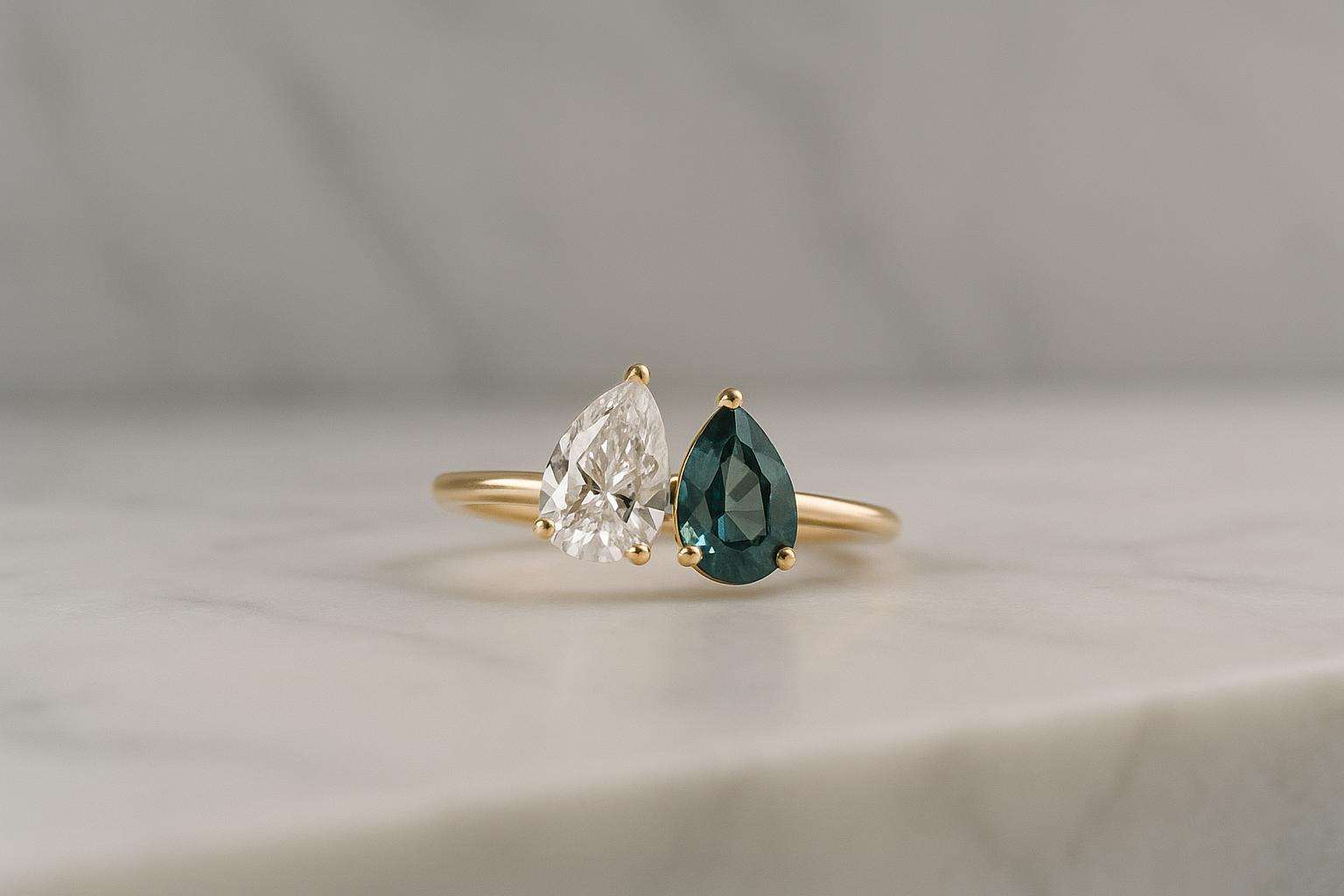
A toi et moi ring features two stones of comparable size set side by side on a single band — no dominant center stone, no hierarchy. The design traces to Napoleon's 1796 proposal to Joséphine, resurfaced through Jackie Kennedy's Van Cleef & Arpels diamond-and-emerald ring in 1953, and became the most-searched engagement ring style in the world following Ariana Grande's 2020 announcement and Megan Fox's 2022 reveal. In 2026 it is the clear trend leader. The key decisions are stone pairing (hardness, color harmony, and shape), matched setting height (more important than most buyers realize), and wedding-band compatibility. Lab-grown stones have made the style accessible at almost every budget.
Where Did the Toi et Moi Ring Come From?
The story begins in the winter of 1796. Napoleon Bonaparte, then a twenty-six-year-old general, was preparing to marry Joséphine de Beauharnais — a widow six years his senior whose family and his own disapproved of the union. He commissioned a yellow gold ring set with two pear-shaped stones placed side by side: a blue sapphire and a diamond, each weighing approximately one carat. The inscription inside the band read, in spirit if not literally, you and me.
The choice was unconventional for the era, when elite marriages were typically political arrangements signified by solitaire diamonds or elaborately set portrait miniatures rather than symbolic gem pairings. Napoleon's decision to place two stones of equal standing on a single band was, as jewelry historians have noted, a romantic declaration as much as an aesthetic one. The ring remained in the Bonaparte family for over two centuries before selling at auction in France in March 2013 for approximately $1 million — nearly fifty times its pre-sale estimate — a figure that speaks to the enduring power of the design and its provenance.
The style's next significant moment came in 1953, when John F. Kennedy presented Jacqueline Bouvier with a ring designed by Van Cleef & Arpels: two emerald-cut stones set side by side — a 2.88-carat diamond and a 2.84-carat emerald — on a band of baguette-cut diamonds and emeralds. Like Napoleon's ring, it placed two stones of near-equal size in a co-equal position, neither subordinate to the other. Jackie later sent the ring back to Van Cleef & Arpels in 1962 to be redesigned with additional round and marquise-cut diamonds surrounding the original pair. The ring is now preserved at the John F. Kennedy Library and Museum in Boston.
Between the Kennedys and the present day, the toi et moi style remained a specialty of estate jewelers and period-conscious collectors — respected but niche. That changed decisively in December 2020, when Ariana Grande announced her engagement to real estate agent Dalton Gomez with photographs of her ring: an 8-carat oval diamond set at an angle beside a round pearl on a platinum band, created by jeweler Jack Solow of Solow & Co. in New York City. The pearl, reportedly chosen because Ariana's late grandfather had given her grandmother a pearl from his tie pin, made the design as personally meaningful as it was visually arresting. Search interest in toi et moi rings increased dramatically within days of the announcement and has not meaningfully retreated since.
In January 2022, Machine Gun Kelly proposed to Megan Fox with a ring he designed in collaboration with jeweler Stephen Webster: two 3-carat pear-shaped stones — a D-color antique-cut diamond representing his April birthstone and an untreated Colombian emerald representing her May birthstone — set on an 18K white gold split band with pavé diamond shoulders. The ring's split-shank construction allows it to separate into two individual rings held together by a magnetic clasp, forming the shape of an obscure heart when joined. The estimated value has been placed variously between $300,000 and $500,000, depending on the assessor, with the rarity of the untreated Colombian emerald at that size being the primary pricing variable. Taylor & Hart's analysis of the ring's design notes that the stones mirror each other in cut and weight while contrasting dramatically in color — the essential toi et moi logic carried to a very high-budget expression.
How Do You Choose the Right Stone Pairing?
The decision that matters most in a toi et moi ring is not the setting style or the metal — it is which two stones you place next to each other and whether they work together physically and visually over decades of daily wear.
The hardness rule
For a ring worn daily, both stones need to sit at Mohs 7 or above to withstand the microscopic abrasion of everyday life. Diamonds are Mohs 10; sapphires and rubies (corundum) are Mohs 9; emeralds and aquamarines are 7.5–8. These all meet the minimum. Stones that fall below that threshold — opal (5.5–6.5), moonstone (6–6.5), turquoise (5–6) — are not appropriate for a center-stone position on a ring worn every day. They will develop visible surface scratches and eventually lose their polish. If a softer stone carries personal significance, a pendant or earring is a more durable format. The only exception worth discussing: alexandrite (Mohs 8.5) is an excellent daily-wear stone that changes color from green in daylight to reddish-purple under incandescent light — for the right buyer, it makes a genuinely striking toi et moi partner to a diamond.
Shape and visual balance
The two stones do not need to be identical in shape or weight, but they need to appear visually balanced when viewed from above. A 2-carat oval diamond set beside a 0.4-carat round ruby will read as a solitaire with a tiny accent, not a toi et moi — the proportion difference overrides the side-by-side placement. A rough guideline: keep the two stones' face-up area within approximately 20–25% of each other. For shapes with very different proportions, this often means the stones differ meaningfully in carat weight but achieve comparable visual presence — a 1.2-carat marquise beside a 1.5-carat oval, for instance, may look balanced despite the weight difference because the marquise's elongated footprint gives it comparable visual spread.
The most popular shape pairings in 2026, per search data and retailer trend reporting, are:
| Shape Combination | Visual Effect | Best For |
|---|---|---|
| Pear + Pear (opposing) | Symmetric, balanced; butterfly silhouette | Classic toi et moi look; elongates the finger |
| Oval + Pear | Flowing, asymmetric; modern romantic | Most versatile; suits most hand proportions |
| Emerald cut + Round | Architectural contrast; structured meets soft | Step-cut aesthetic buyers; stone-quality showcase |
| Oval + Marquise | Maximum elongation; dramatic statement | Wider hands; buyers wanting maximum finger coverage |
| Round + Round | Symmetric; clean and simple | Understated buyers; works best with delicate band |
| Pear + Marquise | Both elongated; highly finger-lengthening | Smaller hands; maximizes apparent size per carat |
Shape choice also affects snagging risk. Pear and marquise cuts carry pointed tips at one or both ends; if the stone is held in a prong setting, those prong-capped points catch on fabric, knit, and latex gloves with some regularity. The mitigation is a V-prong or partial bezel at the point — ask your jeweler to specify these on any pointed-tip shape in a toi et moi setting.
Color harmony and contrast
Two paths: harmonious or contrasting. Harmonious pairings — aquamarine and blue sapphire, morganite and pink tourmaline, champagne diamond and cognac sapphire — create a unified, tonal effect that reads as elegant and understated. Contrasting pairings — diamond and deep green emerald, diamond and vivid blue sapphire, diamond and ruby — create visual drama and tend to photograph more distinctively. The risk with high-contrast pairings is that one stone can visually overwhelm the other if the two stones are not carefully proportioned; the saturated colored stone tends to read as the dominant element even when the diamond is larger. If using two diamonds, match their color grades closely: a G-color stone placed directly beside a J-color stone will show a visible warmth difference in most lighting conditions.
What Are the Setting and Practical Decisions?
Toi et moi rings involve all the same setting decisions as any engagement ring — prong vs. bezel, metal type, shank width — plus a toi et moi-specific decision that most buyers underestimate: matched stone height.
When two stones of different species, cut proportions, or sizes are placed next to each other, their heights above the finger often differ. A well-cut diamond with standard pavilion depth and a natural sapphire sourced from a different rough parcel may produce heads of noticeably different heights in a stock setting. If one stone sits several millimeters higher than the other, the ring's profile looks accidental rather than designed, and the taller stone's prongs become a snag risk. The fix is to specify head heights explicitly when ordering a custom ring, or to request the side-profile view from a retailer showing both stones mounted before you accept the finished piece. Jewelers recommend keeping the two stones' table surfaces within approximately 0.5mm of each other for a balanced profile.
For setting security, all the principles that apply to single-stone settings apply here with the added complexity of two stones to maintain. Prong settings maximize light entry and brilliance but require annual inspection to check for loosened or worn tips — this is especially important on pointed-tip shapes like pears and marquises where a single compromised prong can allow the stone to rotate or loosen. Bezel settings trade some light return for dramatically improved security and a snag-free profile; the bezel setting guide covers this trade-off in detail. The bypass or split-shank toi et moi designs — where the two halves of the shank curl toward the two stones from opposite sides — are visually beautiful but expose more stone surface on the underside; confirm prong count and security with your jeweler before ordering.
On metal choice: yellow gold is the dominant choice in 2026 for toi et moi rings, partly because the warm tone unifies a diamond-plus-colored-stone pairing — any residual warmth in the diamond reads as intentional harmony with the gold rather than a color deficiency — and partly because the yellow-gold revival in engagement rings broadly has made warm metals the visual signature of the current trend moment. White gold and platinum remain the cleaner backdrop for all-diamond paired designs where you want maximum colorless brilliance. For a full breakdown of metal options, see our platinum vs. white gold guide.
Wedding-band compatibility deserves consideration before purchase. Toi et moi settings sit wider and often higher than solitaires; a straight flat wedding band will leave a visible gap. The practical solution is a curved or contoured band designed to nestle beneath the two-stone head. Ordering both rings simultaneously from the same jeweler — or at minimum specifying the engagement ring's shank dimensions to your band jeweler — gives the cleanest result.
What Does a Toi et Moi Ring Cost in 2026?
The price range is genuinely wide, because two stones means two cost variables. Entry-level toi et moi rings using lab-grown diamonds in 14K gold start at approximately $2,000–$5,000 complete for stones in the 0.75–1.00 carat-per-stone range — a price point that was essentially unavailable five years ago and reflects how dramatically lab-grown diamond pricing has moved. At that budget, James Allen's toi et moi collection and Brilliant Earth's toi et moi range both offer ready-to-ship two-stone designs in yellow, white, and rose gold; James Allen's pricing runs approximately $500–$1,500 lower than Brilliant Earth's for comparable specifications, a gap that reflects Brilliant Earth's sourcing and design brand positioning rather than differences in materials or certification.
Natural diamond pairs in the 1.00–1.50 carat range in 14K gold typically run $8,000–$15,000 depending on cut quality, color, and clarity. Mixed-stone designs pairing a natural diamond with a natural sapphire or emerald occupy a similar range, with untreated colored stones from premium origins (Colombian emerald, Kashmir sapphire, Burmese ruby) carrying a premium at any size that scales steeply with carat weight. Platinum settings add roughly $400–$800 over a 14K equivalent for the same design.
A practical note on the lab-grown question as it applies specifically to toi et moi rings: because both stones are center-position focal points rather than a center stone plus accent melee, the visual case for lab-grown is particularly strong here. Two 1.5-carat lab-grown diamonds in GIA or IGI certified Excellent-cut, G-color, VS2-clarity in 14K gold can be assembled for approximately $4,000–$6,000 total — the same specification in natural diamonds would run $22,000–$28,000. For buyers who prioritize size and optical performance over natural provenance, the math is compelling. Our lab-grown vs. natural diamond comparison covers the full trade-off including resale implications.
The key buying principle across all budgets: the two stones will be viewed side by side under direct light every day. Any mismatch in cut quality, color grade, or finish will be immediately visible in a way that it would not be in a solitaire. Prioritize matched quality between the two stones over maximizing individual stone size. Two well-cut, well-matched 1.00-carat stones will outperform two mismatched 1.50-carat stones in daily visual appeal — and in the integrity of the design.
Frequently asked
What does 'toi et moi' mean?
Toi et moi is French for "you and me." In jewelry, the phrase describes a ring design in which two gemstones sit side by side on a single band, intended to represent two people — or two souls — coming together. The design is inherently romantic in concept: neither stone dominates the other; both are given equal standing on the band. The term entered wide usage after Napoleon Bonaparte presented Joséphine de Beauharnais with a pear sapphire and pear diamond ring in January 1796, and it has since become the canonical name for any two-stone ring in which the stones share center position rather than flanking a dominant center stone (which would be a three-stone ring).
What is the difference between a toi et moi ring and a three-stone ring?
The distinction is structural. In a three-stone ring, a larger center stone is flanked by two smaller side stones — the geometry is one of hierarchy, with a clear focal point. In a toi et moi ring, there is no center stone: two stones of comparable size share the top of the band as co-equal focal points, typically set at a slight inward angle so they appear to lean toward each other. Toi et moi rings are generally wider across the finger than three-stone rings and require a curved or contoured wedding band to sit flush alongside. The symbolic reading differs too: three-stone rings traditionally represent past, present, and future, while toi et moi rings represent two distinct individuals united in one piece.
What stone combinations work best in a toi et moi ring?
The most enduring combinations pair visual contrast with hardness compatibility. Diamond-and-sapphire remains the classic (it echoes Napoleon's original), offers excellent durability for both stones (Mohs 10 and 9 respectively), and creates striking cool-warm or light-dark contrast. Diamond-and-emerald replicates Jackie Kennedy's Van Cleef & Arpels design but requires more care, as emeralds (Mohs 7.5–8) are more susceptible to chipping. For buyers wanting two diamonds, matching color grades closely is essential — a G-color stone set next to a J-color will show noticeable contrast in direct light. Colored gemstone pairings trending in 2026 include diamond and teal sapphire, oval diamond and pear morganite, and diamond and alexandrite. Avoid pairings that include stones below Mohs 7 (such as opal or moonstone) for a daily-wear engagement ring — softer stones chip and abrade under normal hand use. See our colored gemstone rings guide for a full hardness table.
Does stone height matter in a toi et moi ring?
Yes — and it is one of the most commonly overlooked decisions when ordering a toi et moi ring. If one stone sits significantly higher than the other (due to deeper pavilion proportions, a taller head, or a larger girdle diameter), the elevated stone will visually dominate the design and create a practical snag point at its prongs. Jewelers recommend keeping the two stones' table heights within approximately 0.5mm of each other for a balanced, intentional look. When pairing stones of different species — say, a diamond and a sapphire — work with a bench jeweler to specify head heights explicitly in the custom order, rather than relying on stock settings designed for matched-shape pairs. A quick check: ask to see the ring from the side profile before finalizing. If one stone towers over the other, request a lower head or a stone with shallower proportions.
How much does a toi et moi engagement ring cost in 2026?
The price range is wide because two stones means two cost variables. Entry-level toi et moi rings using lab-grown diamonds in 14K gold start around $2,000–$5,000 complete for stones in the 0.75–1.00 carat-per-stone range. Natural diamond pairs in the 1–1.5 carat range in 14K gold typically run $8,000–$15,000. Mixed-stone designs (natural diamond plus natural sapphire or emerald) occupy a similar range depending on origin and treatment status of the colored stone — untreated Colombian emeralds, like the one in Megan Fox's ring, carry a meaningful premium at any size. Platinum settings add roughly $400–$800 over a 14K gold equivalent. Celebrity-inspired larger-stone designs exceed $50,000. At James Allen and Blue Nile (now under the same Signet corporate umbrella following the April 2026 merger), toi et moi setting prices start around $600–$900 before stones; Brilliant Earth's equivalent settings start at approximately $1,200–$1,500 and run higher, reflecting their design and sourcing brand positioning.
What shape combinations are most popular in toi et moi rings in 2026?
The single most-requested silhouette in 2026 is two pear-cut stones pointing away from each other — the classic butterfly or opposing-pears layout. The second most common is pear plus oval, which creates a flowing, asymmetric look that elongates the finger. Emerald-cut plus round or cushion is the architectural choice: the rectangular emerald and the curved round create structure-with-softness contrast. Round-plus-round remains clean and symmetric but can read as slightly heavy unless the band is kept very slender. For maximum finger elongation, oval plus marquise is the most dramatic option — both shapes are elongated, so the combined width across the knuckle is substantial. Shape choice also affects snagging risk: pear and marquise cuts have pointed tips that can catch on fabric or hair; if the wearer is active, a bezel or partial bezel setting on those pointed ends significantly reduces snag frequency.
Will a toi et moi ring stack with a wedding band?
It can, but it requires planning. Most toi et moi settings sit wider and often higher off the finger than a standard solitaire, which means a straight flat wedding band will leave a visible gap between the engagement ring and the band. The practical solution is a curved or contoured wedding band custom-shaped to nestle beneath the two-stone setting. Some couples order a nesting band at the same time as the engagement ring so both pieces are designed together from the start — this gives the cleanest flush fit. If you already own a toi et moi ring and are choosing a band afterward, bring the engagement ring to your jeweler and have the band bent or formed to match its exact underside contour. Alternatively, a slim, slightly curved eternity band in a matching metal can create a clean-enough fit without custom bending.