Celebrity Rings
Megan Fox's Engagement Ring: The Emerald and Diamond Toi et Moi Explained
A pear-cut Colombian emerald beside a pear-cut diamond on thorn-shaped bands by Stephen Webster — the one-of-a-kind ring that put emerald-diamond pairings on every wish list.
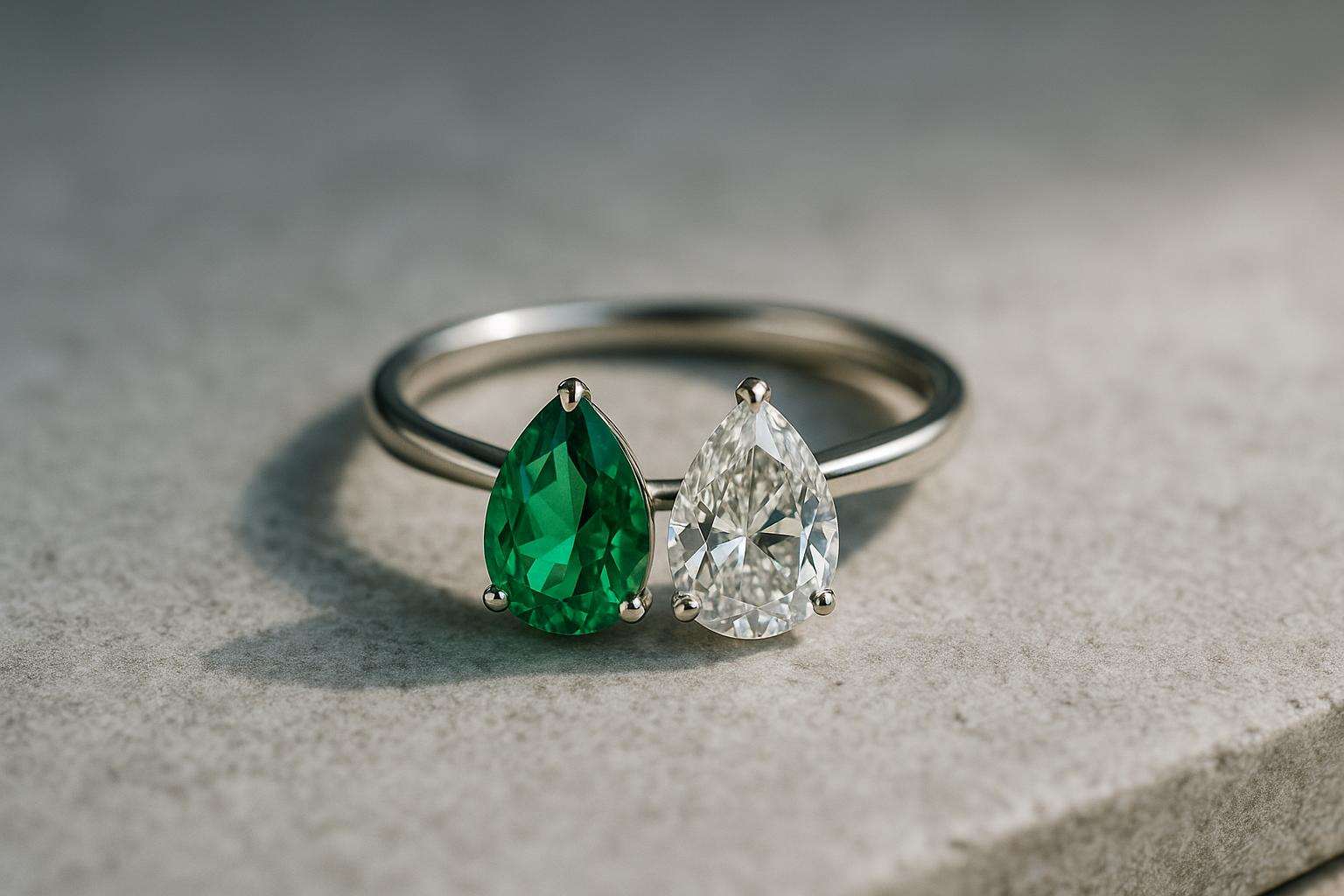
On January 11, 2022, Machine Gun Kelly proposed to Megan Fox beneath a banyan tree in Puerto Rico with a custom Stephen Webster ring pairing a pear-cut D-color diamond (approximately 2.9 carats) and an untreated natural Colombian pear-cut emerald (3–5 carats) on magnetic 18K white gold thorn-shaped bands. The ring is estimated at $300,000–$400,000, launched Webster's Thorn Embrace Collection, and is widely credited with accelerating both the toi et moi trend and mainstream interest in emerald-and-diamond pairings. Fox and MGK are no longer together as of early 2026 but co-parent their daughter Saga Blade. The ring's design legacy stands entirely on its own merits.
When Machine Gun Kelly posted a photograph of his proposal to Megan Fox in January 2022, the image stopped the internet cold — not just because of the proposal itself, but because of what was on her finger. Two pear-shaped stones, one a cool, brilliant white diamond and the other an intensely vivid green emerald, sat side by side on a pair of intertwining bands that looked like something between a piece of armour and a romantic poem. The ring was unlike anything that had appeared in mainstream engagement-ring conversation before. Within days, jewelers were fielding calls about emerald-and-diamond pairings. Within months, Stephen Webster's workshop had turned the design into a full collection. Within a year, the emerald-and-diamond toi et moi had become one of the most-requested engagement ring configurations in the industry.
What follows is a precise account of the ring, the stones, the design logic, and what it all means for anyone drawn to the look.
What exactly is Megan Fox's engagement ring?
The ring is a toi et moi design — the French term for "you and me," a format in which two distinct stones sit side by side on a single band (or in this case, on paired bands). Fox's ring carries this concept further than most: rather than a single shank split to hold two stones, the design consists of two entirely separate bands, each bearing one pear-shaped center stone, joined at the center by a magnetic mechanism so that the pair clasps together into the form of an abstract heart when worn.
The two bands are crafted in 18-karat white gold and shaped along their length into pointed, thorn-like spikes — a signature element of designer Stephen Webster's aesthetic, built into his collections for more than 25 years. The bands are set with approximately 0.30 carats of pavé round diamonds along their surfaces, so even the setting itself catches light. The overall effect is intensely sculptural: more closely related to a piece of high-art jewelry than to a conventional engagement ring.
Webster has confirmed the two center stones publicly. The diamond is a pear brilliant cut, D color (the highest rating on the GIA's colorless scale), described by Webster as approximately 2.9 carats in weight, with a cut described as antique in character — meaning the facet arrangement has a softer, slightly more vintage light pattern than a contemporary precision-cut pear. The emerald is a natural, untreated pear-cut Colombian gem, which Webster has described as weighing between 3 and 5 carats; independent estimates from gemologists who reviewed published photographs place it at 5 to 6 carats, though without a laboratory report the exact weight is unverifiable. The stones represent each partner's birthstone: diamond for April (MGK's birth month) and emerald for May (Fox's birth month). That personal symbolism was central to MGK's design brief — he wanted the ring to be, in Webster's words, "100 percent connected to Megan and himself."
Why does an untreated Colombian emerald of this size matter so much?
The choice of stone is what elevates this ring beyond a beautiful toi et moi design into a genuinely museum-grade jewel. To understand why, it helps to know how unusual a high-quality, untreated Colombian emerald actually is.
Nearly every emerald sold commercially — including those in fine jewelry — has been treated with cedar oil or synthetic resin injected into the stone's surface-reaching fractures. This treatment improves the apparent clarity and color saturation, making emeralds look cleaner and more vivid than they would in their raw state. The treatment is legal, widely accepted in the trade, and required to be disclosed under FTC guidelines. But it is also essentially universal: untreated emeralds of meaningful size are extremely rare.
Sotheby's describes the combination of Colombian origin, no-oil treatment status, and vivid color as the "trifecta" that defines the highest tier of emerald quality in the collector and auction market. Colombia remains the benchmark origin for fine emeralds — its mines, including Muzo, Chivor, and Coscuez, produce stones with the deep, warm green that gemologists call velvety, a quality linked to the presence of trace chromium and vanadium that does not replicate well in emeralds from other sources. A Colombian-origin untreated emerald of 3 to 5 carats with vivid color is the kind of stone that appears in major auction house sales, not off-the-shelf retail inventory. It is the equivalent, in emerald terms, of a D/Flawless natural diamond: existent, but rare enough that most buyers will never encounter one through standard retail channels.
When Webster built his Thorn Embrace Collection off the back of Fox's ring, he sourced his emeralds specifically from the Muzo mine in Colombia — one of the world's oldest and most prestigious emerald sources, operating continuously since the sixteenth century. The collection consists of eight pieces, all featuring vivid Muzo emeralds set alongside colorless and black diamonds in the thorn-adorned vocabulary that the Fox ring introduced.
| Element | Specification | Source |
|---|---|---|
| Stone 1 | Pear brilliant diamond, D color, ~2.9 ct, antique-cut character | Stephen Webster, publicly confirmed |
| Stone 2 | Pear-cut natural Colombian emerald, untreated, 3–5 ct (designer-stated range; some expert estimates go higher) | Stephen Webster; independent gemologist review |
| Metal | 18K white gold; two separate thorn-shaped bands | Stephen Webster |
| Accent diamonds | ~0.30 ct pavé-set round brilliants on band shoulders | Ethica Diamonds analysis |
| Mechanism | Hidden magnets joining two bands into abstract heart form | Stephen Webster; multiple press accounts |
| Estimated value | $300,000–$400,000 (expert estimate; no published appraisal) | Brilliant Earth SVP; Mark Broumand; Ethica Diamonds |
| Ethical sourcing | Colombian origin; recycled white gold; fair-labor standards confirmed by Webster's studio | Stephen Webster |
How did this ring accelerate the toi et moi trend — and where does it stand in 2026?
The toi et moi format already had a 226-year history when Fox received her ring. Napoleon Bonaparte's 1796 proposal to Joséphine de Beauharnais used a pear diamond beside a pear sapphire — widely cited as the origin of the name. Jackie Kennedy received a diamond-and-emerald toi et moi from JFK in 1953. What had been missing from the modern market was not the design itself but a contemporary reference point compelling enough to translate the style into mainstream bridal desire.
Fox's ring provided exactly that, but it did so with a specific material vocabulary that proved influential beyond the two-stone format alone. The diamond-and-colored-gemstone pairing (as opposed to two matched diamonds) became the format of choice for couples who wanted their toi et moi ring to carry visible meaning rather than simply follow a trend. The emerald's vivid green against the white diamond's brilliance created an unambiguous visual contrast — the two stones are unmistakably different from each other and equally unmistakably made to be together. That tension is what the toi et moi format is built on at its philosophical core.
The Natural Diamond Council describes toi et moi as one of the most-requested engagement ring formats heading into 2026, with Google Trends data showing a 147% increase in searches for the style between 2024 and 2025. According to reporting from Chaitra Fine Jewels, toi et moi inquiries grew from 8% of engagement ring consultations in 2023 to 28% by 2025 at their studio. The colored-gemstone variant — specifically the diamond-plus-emerald combination — has been the fastest-growing subset of that demand, accelerated both by Fox's ring and by the general 2025–2026 resurgence of colored stones in bridal jewelry after decades of white-diamond dominance.
The lab-grown diamond market has further democratized the format. A toi et moi ring pairing a 1.5-carat lab-grown pear diamond with a 1.5-carat lab-grown or natural emerald is achievable at budgets well below $10,000 — a scale that would have been impossible with all-natural stones of that size just a decade ago. For buyers drawn to the Fox ring's aesthetic but working with realistic budgets, that convergence is genuinely good news.
What to know about buying a pear-cut emerald for an engagement ring
The pear-cut emerald is among the most demanding stone choices in an engagement ring. Emeralds present a different set of buying considerations than diamonds, and the pear cut adds its own specific requirements. Here is what to understand before pursuing this combination.
Emerald hardness and durability. Emeralds rate 7.5–8 on the Mohs scale — respectable, but below the 9 of sapphires and rubies and the 10 of diamonds. More relevantly, natural emeralds almost always contain jardin — internal fractures and inclusions that are considered characteristic of the stone and are accepted as a quality feature rather than a defect, as they would be in a diamond. The presence of jardin means emeralds are more brittle than their Mohs rating alone suggests: they can chip or crack at fracture points under impact in ways that a sapphire or diamond of similar hardness would not. For an engagement ring worn daily, the setting choice is critical. The pointed tip of a pear-cut emerald in particular should be protected by a V-prong or partial bezel — the point is the most mechanically vulnerable location in any pear-shaped stone.
Treatment disclosure. When purchasing an emerald, always ask for laboratory documentation. A report from GIA, Gübelin, or GRS (Gemological Research Switzerland) will state the country of origin and the treatment level. The standard treatment scale runs from none (no-oil, the most valuable) through minor, moderate, and significant. For an emerald intended as a center stone in a ring costing $5,000 or more, a lab report is non-negotiable. Without one, you have no basis for evaluating the stone's true value or for insuring it accurately. The FTC's disclosure requirements apply to sellers, not buyers, but knowing to demand documentation is the buyer's best protection.
Colombian origin premium. Colombian emeralds command a premium over stones from Zambia, Brazil, or Afghanistan because the trace element profile of Colombian material produces a warmer, more saturated green that the market has long considered the benchmark. Within Colombia, Muzo-origin stones — as used by Webster in the Thorn Embrace Collection — carry an additional premium because of the mine's centuries-long reputation and the particularly intense, slightly bluish-green of its finest material. If Colombian origin matters to you, verify it via a lab report; the claim cannot be confirmed by eye alone.
Pear-cut proportions for emerald. The same length-to-width considerations that apply to pear diamonds apply to pear emeralds, with one additional consideration: the symmetry of the outline affects both beauty and structural integrity. In a pear-cut stone, the rounded shoulder on one side and the pointed tip on the other must be well-matched across the center axis. A stone with uneven shoulders or a tilted point will not only look asymmetrical but will place uneven stress on its setting prongs. A length-to-width ratio between 1.50 and 1.70 works well for most pear-cut emeralds in a toi et moi setting. Avoid ratios above 1.75 for emerald, as the long, narrow profile both increases stress on the fragile tip and reduces the stone's visual presence from the side. Our deeper guide to sapphire, emerald, and colored gemstone rings covers durability, certification, and sourcing in full.
Get the look: emerald-and-diamond toi et moi rings at every budget
The Fox ring is a once-in-a-generation commission. But its visual grammar — a vivid green stone beside a colorless pear diamond, two shapes that echo each other while remaining distinct — is fully achievable at a wide range of budgets, particularly since lab-grown stones entered the market at scale.
| Budget | Realistic specification | Key trade-offs |
|---|---|---|
| Under $3,000 | Lab-grown pear diamond 0.75–1.0 ct (G–H / VS2, IGI-certified) + lab-created emerald or natural treated emerald 0.75–1.0 ct; 14K white or yellow gold | Lab-created emeralds are chemically identical to natural but carry no rarity premium; a natural emerald at this budget will be heavily treated — acceptable aesthetically, but document the treatment grade |
| $3,000–$8,000 | Lab-grown pear diamond 1.0–1.5 ct (F–G / VS1–VS2) + natural Colombian emerald 0.75–1.5 ct with minor treatment; 14K or 18K gold | Natural Colombian emerald with minor treatment is the standard commercial quality; ask for GIA or GRS report; yellow gold complements the emerald's warm green better than white gold at this tier |
| $8,000–$20,000 | Natural pear diamond 1.0–1.5 ct (GIA-certified, G–H / VS2) + natural Colombian emerald 1.0–2.0 ct with minor-to-none treatment; 18K gold or platinum | At this level a GIA report on the diamond and a GRS or Gübelin report on the emerald are standard practice; a custom jeweler or reputable independent can match stone heights and proportions to achieve toi et moi balance |
| $20,000+ | Natural pear diamond 1.5–3.0 ct (GIA-certified, D–G / VS1–VS2) + natural Colombian emerald 2.0 ct+ with minor-to-none treatment; custom thorn or bypass setting; platinum or 18K gold | Commission a GIA-credentialed custom jeweler for proper V-prong protection on both points; consider the Thorn Embrace line directly from Stephen Webster for the closest interpretation of the Fox design; insure at purchase — see ring insurance and care |
For buyers interested in the Fox ring's specific aesthetic — the thorn-shaped band detail, the magnetic two-band construction — Stephen Webster's Thorn Embrace Collection offers several pieces that reference the design vocabulary directly, available via stephenwebster.com. These are finished pieces in the $5,000–$50,000+ range depending on stone size and configuration, not custom commissions. For a custom commission of comparable ambition, expect a 6–12 week lead time and a jeweler with both colored-stone expertise and CAD-to-bench production capability. Our guide to custom engagement ring design covers the process, timeline, and cost in full.
Where to find pear-cut emeralds and two-stone settings
Brilliant Earth stocks toi et moi settings and carries a selection of natural and lab-created emeralds. Their Viridian Toi et Moi Diamond Ring pairs a lab-created pear-cut emerald with a pear-cut diamond in 18K yellow gold and represents one of the cleanest ready-to-wear interpretations of the Fox ring's pairing at an accessible price point. Their sourcing disclosures include treatment information on colored stones, which is the minimum standard to expect from any reputable retailer.
Blue Nile offers a range of two-stone settings and can source both GIA-certified pear diamonds and natural emeralds through their custom ring builder. For emeralds specifically, always request the laboratory report before committing — Blue Nile's custom process allows this.
For high-end natural Colombian emeralds with documented Muzo or Chivor origin, specialist dealers such as The Natural Emerald Company, JR Colombian Emeralds, or Sotheby's auction offerings provide stones with full provenance documentation. At the collector tier, a GRS or Gübelin report confirming Colombian origin and treatment level is the expected standard. For the corresponding diamond, a GIA-certified pear brilliant with an Excellent or Very Good polish and symmetry grade is the baseline requirement — GIA does not issue a formal cut grade for pear shapes, so these polish and symmetry grades are the closest available proxy for light-performance quality.
For a full understanding of how pear-shaped stones perform versus other shapes, and where the emerald-and-pear combination fits in the broader design landscape, see our toi et moi rings guide and our overview of what different budgets actually buy in the 2026 engagement ring market.
Frequently asked
What stones are in Megan Fox's engagement ring?
Megan Fox's engagement ring is a toi et moi design featuring two pear-shaped center stones: a D-color antique-cut pear diamond (approximately 2.9 carats, as stated publicly by designer Stephen Webster) and an untreated natural Colombian pear-cut emerald estimated at 3 to 5 carats by gemologist commentators, with Webster himself citing the range as between 3 and 5 carats. The two stones are set on separate 18K white gold thorn-shaped bands held together by hidden magnets. The bands also feature approximately 0.30 carats of pavé-set round diamonds along their shoulders. The stones represent the birthstones of each partner: diamond (April) for Machine Gun Kelly and emerald (May) for Fox.
How much is Megan Fox's engagement ring worth?
Multiple independent jewelers have estimated the ring's value between $300,000 and $500,000. Kathryn Money, Senior Vice President at Brilliant Earth, placed the figure at $300,000 to $400,000. U.S. jeweler Mark Broumand offered a similar estimate of approximately $300,000, while Ethica Diamonds, accounting for the full bespoke craftsmanship and the rarity of an untreated Colombian emerald of that size, placed the figure closer to $400,000 (equivalent to roughly £400,000 at prevailing exchange rates). The custom magnetic mechanism, thorn-band construction, and one-of-a-kind design commission from a luxury London jeweler add meaningfully to the value beyond the raw stone costs. No official appraisal has been published, so all figures are informed expert estimates.
Who designed Megan Fox's engagement ring?
The ring was custom-designed by Stephen Webster, a British fine jeweler based in London whose work has long incorporated Gothic and natural motifs — thorns, skulls, and organic forms — in high jewelry. Machine Gun Kelly collaborated closely with Webster throughout the design process. Webster has said in interviews that MGK wanted the piece to be "completely unique and 100 percent connected to Megan and himself." The resulting design — two thorn-shaped bands magnetised together into an abstract heart, each bearing a pear-cut birthstone — inspired Webster to create a limited Thorn Embrace Collection of eight emerald-set pieces using Muzo Colombian emeralds. The Thorn Embrace line remains available via Stephen Webster's website.
What is an untreated Colombian emerald and why does it matter?
Nearly all natural emeralds on the market have been treated with cedar oil or resin to fill surface-reaching fractures, improving apparent clarity and colour. An untreated emerald — sometimes described as no-oil — carries no such enhancement, meaning whatever you see is the stone in its entirely natural state. Untreated Colombian emeralds command substantial premiums over treated stones of the same weight and colour because their clarity is entirely inherent, not cosmetically enhanced. Sotheby's notes that Colombian origin combined with no-oil status is the benchmark for top-tier emerald quality in the auction and collector market. For buyers, independent laboratory certification — from GIA, Gübelin, or GRS — confirming both Colombian origin and no-oil treatment status is the essential document when purchasing any high-value emerald.
Are Megan Fox and Machine Gun Kelly still engaged?
No. As of early 2026, Megan Fox and Machine Gun Kelly are no longer together romantically. After their January 2022 engagement, the relationship went through public periods of uncertainty beginning in early 2023. The couple welcomed a daughter, Saga Blade Fox-Baker, born on March 27, 2025, but sources confirmed to People magazine in January 2026 that the pair had ended the relationship and were focused on co-parenting. TMZ reported the same month that despite occasional public outings together, the two are not romantically involved. Fox's engagement ring remains part of the public record as one of the most discussed celebrity rings of the decade, regardless of the couple's subsequent history. This article reports on the ring itself and its design — not as a reflection of the relationship's outcome.
What is the significance of the thorn bands on Megan Fox's ring?
The thorn motif was specifically requested by Machine Gun Kelly and reflects Stephen Webster's long-standing design language — Webster has incorporated diamond-set thorn forms into his collections for more than 25 years. MGK described the thorn bands as representing the idea that "love is pain": the bands were designed to interlock in the shape of a heart, and the magnetic clasping mechanism means the two halves are functionally inseparable unless deliberately pulled apart. The pointed thorn forms are blunted for practical daily wear, so the symbolism is poetic rather than literal. The design also serves a structural purpose: the split-band format allows each stone — the diamond and the emerald — to sit on its own individual band, which is then joined to its partner by the magnetic connection, creating the unified ring form. This construction is what distinguishes it from a conventional toi et moi ring where two stones share a single shank.
What should I know about pear-shaped stones before buying a toi et moi ring like Megan Fox's?
Pear-shaped stones, whether diamonds or coloured gemstones, require attention to three factors in a toi et moi setting. First, length-to-width ratio: the ideal range for pear-cut diamonds is generally 1.45–1.75, with ratios near 1.50–1.65 creating the classic teardrop silhouette. Both stones in a matched toi et moi pair should share similar ratios so neither stone reads as disproportionate beside its companion. Second, the bow-tie effect: pear-cut diamonds can exhibit a dark horizontal shadow across the centre when light does not reflect properly. A subtle bow-tie adds depth; a severe one is a quality defect. Always inspect pear-cuts via 360-degree video or in person before purchase. Third, the point is the most vulnerable part of a pear-shaped stone — ensure it is protected by a V-prong or partial bezel. For coloured stones such as emeralds, note that emeralds have more natural internal features (called jardin) than diamonds and are somewhat more brittle; a protective setting that minimises exposure of the point is especially important. See our pear-shaped engagement rings guide for detailed proportion tables and setting recommendations.