Celebrity Rings
Zendaya's Engagement Ring: The East-West Cushion Explainer
A 5.02-carat cushion cut, a Georgian button-back setting, and the sideways orientation rewriting engagement ring style in 2026.
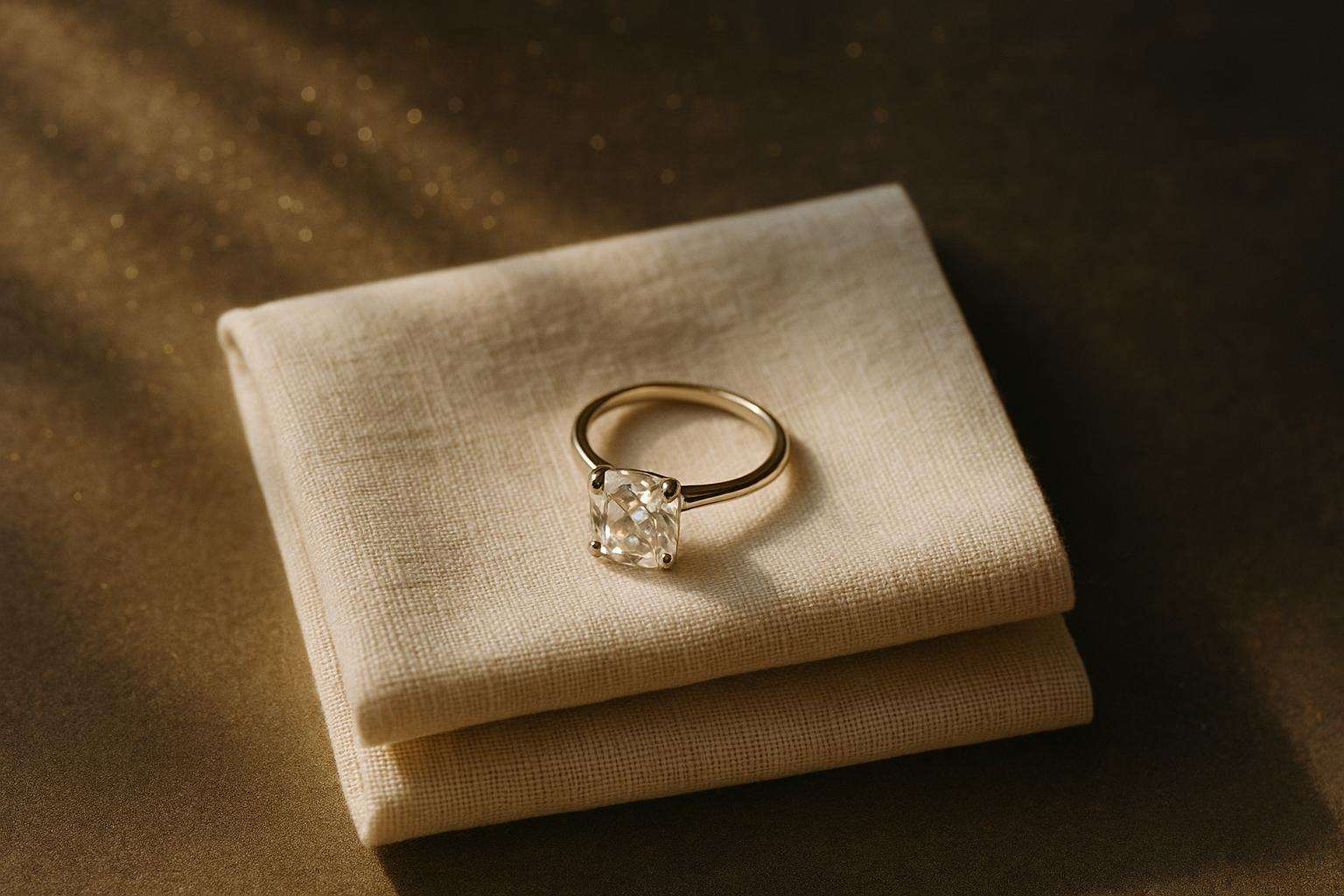
Zendaya's ring — a 5.02-carat cushion cut set sideways in a Georgian-style button-back collet by London jeweler Jessica McCormack — launched east-west cushion settings into one of 2026's most-searched engagement ring styles. The orientation is genuinely practical (lower profile, less snagging) and flattering across a wide range of hand shapes, and the cushion cut's soft corners make it one of the best shapes for the horizontal mount. GIA does not issue a cut grade for cushion cuts, which means shoppers need to know what to evaluate on the grading report themselves.
What exactly is Zendaya's engagement ring?
When Zendaya stepped onto the 2025 Golden Globes red carpet wearing a ring on her left hand, the jewellery world immediately started identifying it. Within days, the consensus was clear: the ring is the Jessica McCormack 5.02ct East-West Cushion Diamond Button Back Ring, crafted in an 18k white gold and yellow gold mixed-metal band. Tom Holland had proposed in late December 2024, reportedly at Zendaya's family home in a deliberately intimate setting — no flash mob, no drone show. It was a private moment, which feels fitting given the couple's carefully guarded relationship.
Jessica McCormack is a London-based luxury jeweller who launched her brand in 2008 and has since built a reputation for reviving Georgian-era setting techniques in contemporary pieces. Her clients have included Zoë Kravitz, Margot Robbie, and Victoria Beckham. The button-back setting is her signature: a cut-down collet, derived from 18th-century jewellery-making practice, in which a solid metal enclosure wraps behind and around the stone's girdle rather than holding it with open prongs. In the Georgian period this technique served partly to protect diamonds from the soot and dim candlelight of the era, but it also creates a distinctive sculptural presence — the stone appears to merge with the band rather than sit atop it. Entry-level Jessica McCormack button-back rings start from around £2,500; the bespoke commissions her atelier is known for reach into the millions. The 5.02-carat east-west variant Zendaya wears sits firmly at the top of the range.
Expert appraisers quoted by E! Online and Marie Claire have estimated the ring's value at between $120,000 and $200,000, a range that reflects the significant uncertainty involved in pricing a bespoke piece when the diamond's specific color and clarity grades have not been publicly confirmed. What is publicly documented is that the stone is described by the designer as a cushion cut of exceptional quality, and that it is set in east-west orientation — the longest axis of the diamond running horizontally across the finger.
As of June 2026, Zendaya and Tom Holland are confirmed to be married. Tom Holland disclosed the news in an Esquire cover story interview, confirming that close family members "were all there" after being asked about AI-generated fake wedding photos that had circulated online. Variety confirmed the report on June 17, 2026. Zendaya had been seen wearing a slim gold band alongside her engagement ring at public appearances since February 2026.
What is an east-west setting, and why does it work so well on a cushion cut?
The term "east-west" describes the orientation of the center stone, not its shape or cut. In a standard solitaire, the stone's longest axis points north-south — toward the fingertip and the wrist. Rotate that axis 90 degrees so it points across the finger from knuckle to knuckle, and you have an east-west setting. The change is simple, but the visual effect is significant.
An east-west ring reads as wider and more horizontal than a traditional solitaire, creating a graphic, architectural silhouette that several major bridal publications have identified as one of the defining engagement ring trends of 2026. Searches for east-west engagement rings have increased sharply since Zendaya's debut at the 2025 Golden Globes, according to multiple jewellery trend reports. The appeal is not purely aesthetic: east-west settings generally sit lower to the finger than tall cathedral solitaires, which means less snagging on fabric, hair, and gloves, and a more comfortable profile under clothing or winter coats. Practical wearability has become a genuine driver in 2026 ring buying, and the east-west orientation delivers it without any sacrifice in visual impact.
The cushion cut is particularly well-suited to the east-west orientation for several reasons. Its rounded corners mean there are no sharp points to expose to side impact the way a marquise's tips would be. Its relatively generous surface area — cushion cuts face up roughly 10–15% larger than round brilliants of the same carat weight — means a 5-carat cushion oriented east-west covers a substantial sweep of finger without reading as aggressively chunky. And the cushion's characteristic sparkle style, whether the bold pinwheel flashes of a cushion brilliant or the fine shimmer of a crushed-ice cushion modified brilliant, is visible from all angles, so the east-west orientation does not diminish its light show the way it might with a step-cut stone whose reflections are more directional.
For an elongated cushion in an east-west mount, the length-to-width ratio is the key specification to evaluate. A ratio between 1.15 and 1.30 produces the most balanced horizontal look: long enough to fill the finger convincingly, not so elongated that the stone's cushion character is lost. Beyond 1.35, the shape begins to read more like a radiant cut. Below 1.05, you have a nearly square cushion, which still works east-west but creates a more compact, brooch-like impression. For buyers who love the bold fingerprint of Zendaya's ring, targeting the 1.20–1.30 range in a cushion is the closest starting point.
What does GIA actually grade on a cushion cut — and what do you need to evaluate yourself?
This is where shopping for a cushion cut differs meaningfully from shopping for a round brilliant, and the difference matters. The GIA's formal overall cut grade — the Excellent/Very Good/Good scale most buyers know — applies only to standard round brilliant diamonds. For cushion cuts, and all other fancy shapes, the GIA explicitly states that an internationally accepted grading system for cut quality does not yet exist. The cut grade field on a GIA grading report for a cushion reads N/A.
What the GIA does grade on cushion cuts: polish and symmetry (aim for Very Good or Excellent on both), measurements, and a proportion diagram. This information is genuinely useful, but it is not a shortcut to evaluating light performance — that requires looking at the stone.
| Specification | Target range | Why it matters |
|---|---|---|
| Polish | Very Good or Excellent | Affects surface light reflection; Good or lower introduces scattering |
| Symmetry | Very Good or Excellent | Uneven symmetry throws off the sparkle pattern visibly |
| Depth % | 62–68% | Stones deeper than 70% hide weight in the pavilion and face up smaller |
| Table % | 60–65% | Oversized tables trade fire for brightness; too small reduces brilliance |
| Length-to-width ratio | 1.15–1.30 (elongated); 1.00–1.05 (square) | Determines silhouette; critical for east-west visual balance |
| Girdle thickness | Thin to slightly thick | Very thin girdles chip; very thick girdles add unproductive weight |
Beyond the grading report, two additional factors require direct visual inspection and cannot be read off paper. First: sparkle style. Cushion cuts come in two main personalities. A cushion brilliant (sometimes called a "chunky" cushion) has larger, more defined facets and produces bold, distinct flashes of fire. A cushion modified brilliant has an extra row of facets on the pavilion and produces a fine, scattered sparkle sometimes described as crushed ice or fine glitter. Neither is objectively superior; they suit different tastes. But they look dramatically different, and you cannot tell which you are looking at from the grading report alone. The GIA report will sometimes use the phrase "cushion modified brilliant" in the shape and cutting style description, which indicates the crushed-ice facet structure. If the report just says "cushion brilliant," you are looking at the chunkier variety. Always request HD 360-degree video before buying remotely.
Second: the bow-tie effect. Some elongated fancy shapes — ovals, pears, and certain cushion cuts — display a dark, bow-tie-shaped shadow across the center when light escapes through the pavilion at an unflattering angle. It is caused by light leakage and is more pronounced in some stones than others. A modest bow-tie can be nearly invisible in normal lighting; a severe one is distracting. The only reliable way to assess it is to view the diamond in motion under varied lighting conditions, in person or via high-quality video. Proportions alone give no reliable indication of bow-tie severity.
For clarity, the guidance differs slightly depending on sparkle style. Crushed-ice cushions are more forgiving of inclusions because the fine, fragmented facet pattern obscures them well — SI1 clarity can often be eye-clean in this style. Chunky cushion brilliants have fewer, larger facets that act more like windows, so VS2 or better is a safer starting point. For color, G–H is the practical sweet spot in white gold or platinum settings; in yellow gold (as in Zendaya's mixed-metal band), you can comfortably go to I or even J and the warm metal masks any residual tint.
Get the look: east-west cushion settings at every budget
Zendaya's specific ring is a bespoke luxury piece at a price point that is out of reach for most buyers. But the design language — horizontal orientation, cushion cut, minimal bezel or collet, mixed metal — is highly replicable across a wide range of budgets. The east-west orientation itself adds nothing to the cost of a setting; it is a layout choice, not a premium material. The following options have been verified as live and currently available.
For buyers who want the closest possible aesthetic parallel to Zendaya's ring — Georgian-inspired, button-back or cut-down collet, east-west cushion, mixed metal — Jessica McCormack's own collection remains the definitive source. Entry button-back styles start around £2,500 for smaller stones; the east-west cushion configurations at 5 carats are high-jewellery commissions.
At the $3,000–$8,000 range with a lab-grown diamond, Brilliant Earth offers dedicated east-west settings in 14k and 18k yellow gold, white gold, and platinum, allowing buyers to pair their chosen setting with a 1.0–1.5 carat lab-grown cushion at a fraction of the natural-diamond equivalent cost. VRAI's east-west collection similarly pairs clean modern settings with their own lab-grown diamonds, with full chain-of-custody transparency. Both are worth examining if ethical sourcing is a priority alongside design — for a deeper comparison of what those sourcing claims actually mean, see our honest assessment of lab-grown diamonds and environmental impact.
For natural diamonds in the $8,000–$20,000 range, the major online retailers — Blue Nile and Brilliant Earth — both allow buyers to build their own ring by pairing a loose GIA-certified cushion with an east-west solitaire or half-bezel setting. A 1.5-carat natural cushion in G–H / VS2 set east-west in 18k yellow gold typically lands around $10,000–$14,000 all-in through these channels. Blue Nile generally prices solitaire and simple settings 20–30% below equivalent designs at other premium retailers, making it a practical first stop for setting price benchmarking. For more on how setting prices are built, and why labor rather than side-stone count drives most of the cost differences between settings, see our full setting-types comparison.
Whichever price point you are working within, the proportions guidance remains the same: target a length-to-width ratio of 1.15–1.30 for an elongated east-west look, verify depth 62–68% and table 60–65%, insist on Very Good or Excellent polish and symmetry from the GIA report, and always view the stone in motion before committing. The orientation that made Zendaya's ring instantly iconic is available in any budget tier — the homework is the same regardless of what the stone costs.
Why this ring matters beyond celebrity style
Celebrity engagement rings function as cultural mood boards. They do not set trends so much as surface them — drawing search volume toward a direction that was already building in the market. The east-west setting was already appearing in trend roundups before Zendaya's Golden Globes appearance; what the ring did was give a specific, legible, beautiful example for couples to point to when describing what they wanted.
The deeper shift the ring represents is the move toward rings that feel deliberately chosen rather than conventionally expected. The east-west cushion is not a departure from a classic engagement ring in any meaningful gemological sense: it is still a diamond, still a solitaire, still white gold and yellow gold. What changes is the orientation — and through that single rotation, the whole character of the ring shifts from vertical grandeur to horizontal confidence. It is the kind of detail that a person who has thought carefully about jewellery notices immediately, and that a person who has not thought about jewellery at all will still find quietly striking. That combination — jeweller-grade specificity with broad visual appeal — is probably why it works so well, and why it will outlast the moment that launched it into public consciousness.
Frequently asked
What is Zendaya's engagement ring?
Zendaya's engagement ring is the Jessica McCormack 5.02-carat East-West Cushion Diamond Button Back Ring, set in an 18k white gold and yellow gold mixed-metal band. Tom Holland proposed in late December 2024, and Zendaya first wore the ring publicly at the 2025 Golden Globes. The ring features a Georgian-style cut-down collet setting — a technique called a button back — which creates a distinctive closed-back enclosure behind the stone. Expert estimates place the ring's value between $120,000 and $200,000, depending on the diamond's specific color and clarity grades.
What is an east-west engagement ring setting?
An east-west setting rotates the center stone 90 degrees so its longest axis runs horizontally across the finger, rather than vertically toward the knuckle. The result is a ring that appears wider and lower-profile than a traditional solitaire. The orientation suits elongated fancy shapes particularly well — cushion, oval, marquise, and emerald cuts all gain finger coverage and a distinctly modern silhouette when turned sideways. Because east-west rings generally sit closer to the finger than tall cathedral solitaires, they also snag less on fabric and tend to be more comfortable for daily wear. See our guide to trending engagement ring settings for 2026 for more detail on this and other rising orientations.
Does GIA give cushion cut diamonds a cut grade?
No. The GIA's formal cut grade applies only to standard round brilliant diamonds. Cushion cuts are classified as fancy shapes, and GIA states directly that an internationally accepted system for grading fancy-shape cut quality does not yet exist. GIA grading reports for cushion cuts do include polish and symmetry grades (aim for Very Good to Excellent on both), measurements, and a proportion diagram — but no overall cut grade. Because there is no standardised cut benchmark, buyers must evaluate cushion cuts by examining depth percentage (ideal range: 62–68%), table size (60–65%), length-to-width ratio, and — most importantly — the stone's actual light performance in HD video or in person before purchasing.
What length-to-width ratio should I look for in an east-west cushion cut?
For an east-west cushion, a length-to-width ratio between 1.15 and 1.30 typically produces the most balanced horizontal silhouette. In the sweet spot of 1.15–1.25, the stone reads as a soft, slightly elongated rectangle that fills the finger without losing the cushion's characteristic rounded-corner softness. Beyond 1.30, the proportions can begin to resemble a radiant cut and the cushion's romantic personality starts to fade. For a square cushion (ratio closer to 1.00–1.05), the east-west orientation still works but creates a more compact, symmetrical look. Always view the stone in motion through high-resolution 360-degree video: the only reliable way to assess sparkle style and rule out a bow-tie shadow is direct visual inspection, not proportions alone.
How much does an east-west cushion engagement ring cost?
Cost depends on diamond size, quality, and setting complexity. For a natural diamond, a well-cut 1-carat cushion in G–H color / VS2 clarity set east-west in a simple solitaire typically runs $4,000–$8,000 all-in at major online retailers; a 2-carat equivalent climbs to roughly $15,000–$30,000. For a lab-grown cushion of equivalent spec, prices run 60–75% lower — a 1-carat lab cushion in an east-west setting can be had for $1,000–$2,500, and a 2-carat for $3,000–$6,000. Setting cost for a basic east-west solitaire or half-bezel adds $800–$2,500 depending on metal and complexity. Our ring budget breakdown by tier maps out what specific specs you can realistically achieve at the $3K, $5K, and $10K marks.
Are Zendaya and Tom Holland married?
Yes. Tom Holland confirmed the marriage in a June 2026 Esquire interview, after months of public speculation. The couple had kept the wedding private; Holland revealed it had already taken place when he noted that his family members "were all there" after being asked about AI-generated fake wedding photos. Variety and other outlets confirmed the news on June 17, 2026. Zendaya had been spotted wearing a thin gold band alongside her engagement ring at public appearances beginning in February 2026, which had fuelled widespread speculation.