Ring Styles & Settings
Engagement Ring Trends 2026: East-West, Mixed Metals & the New Setting Landscape
Seven design forces are reshaping the engagement ring in 2026 — from the east-west orientation to sculptural gold bands. Here is what is actually selling, why, and how to decide if any of it belongs on your hand.
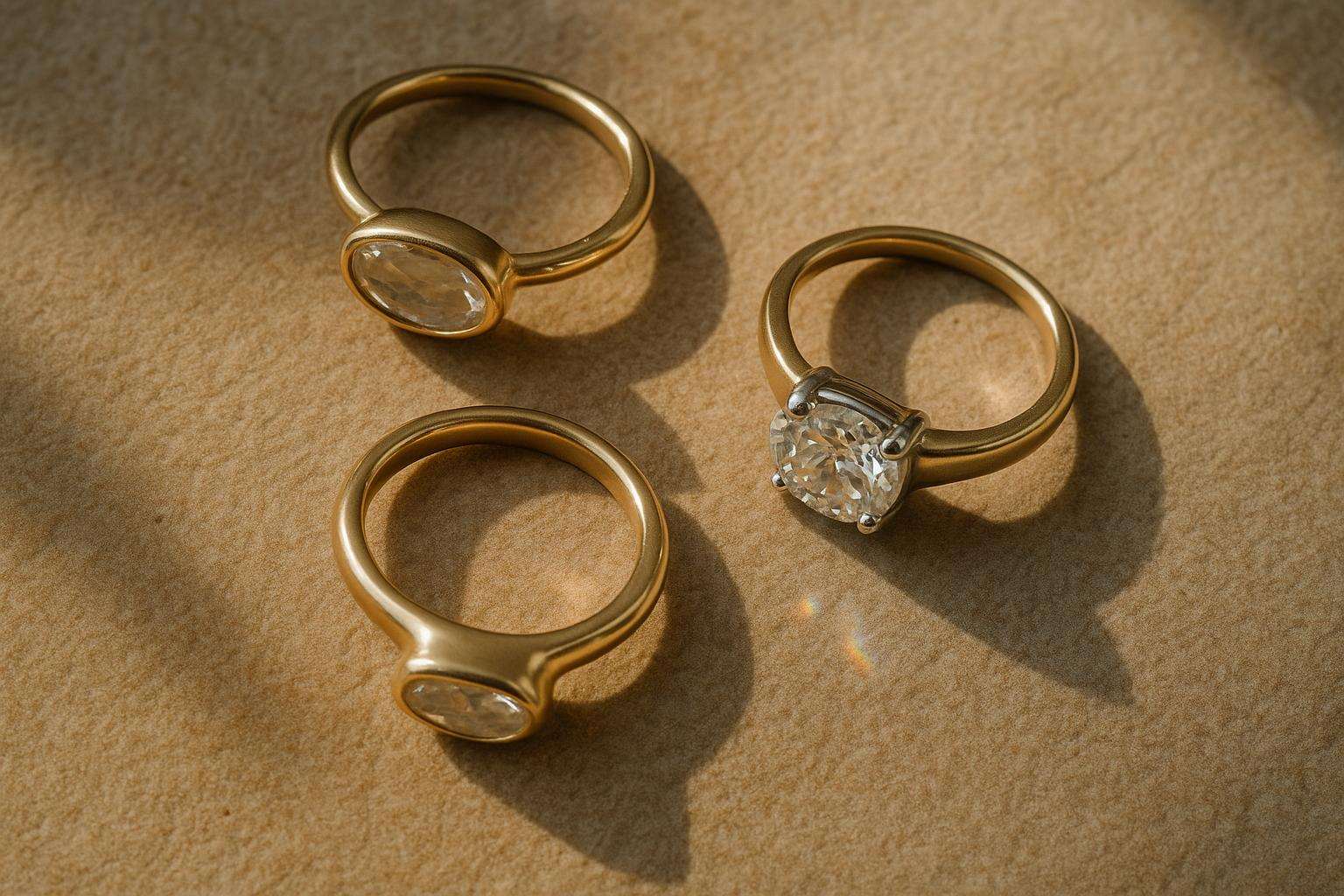
Seven design forces are reshaping engagement ring style in 2026: the east-west stone orientation, a yellow gold resurgence (now ~39% of ring choices per The Knot), mixed-metal two-tone settings, sculptural chunky bands, the continued expansion of bezel designs, a toi et moi category that has matured into genuine variety, and growing demand for vintage-inspired cuts. Each trend has real craft logic behind it — not just a celebrity wearing it. This guide maps every force, explains the trade-offs a bench jeweler would flag, and points you to the deeper dives that matter for your specific decision.
Most trend coverage reads like a Pinterest mood board stitched to a press release. I want to give you something more useful: the actual design reasoning behind each movement, the real wearability trade-offs, and an honest assessment of which trends have functional advantages versus which are purely aesthetic cycles you may or may not care about. I've been working at the bench and in CAD long enough to know that a ring needs to survive thirty years of daily wear — so every trend below gets interrogated from that angle, not just the fashion one.
The framing that makes 2026 coherent: the 2010s were dominated by the stone maximalism model — all-white-gold or platinum, ultra-thin pavé shanks, everything in service of making the center stone look as large as possible. That era is ending. 2026 is the beginning of design parity — the ring's metal, orientation, and sculptural quality are allowed to carry equal visual weight alongside the stone. That single shift explains most of what you are seeing.
What Is the East-West Setting, and Why Has It Taken Over?
The east-west setting rotates the center stone 90 degrees so its longest axis runs horizontally across the finger. It is not a new concept — architects of the Art Deco era in the 1920s used horizontal orientations to create streamlined, geometric silhouettes — but it has become the single most discussed setting orientation in bridal publishing for 2026, driven in large part by a real piece of jewelry: Zendaya's engagement ring from Tom Holland.
Designed by London-based jeweler Jessica McCormack, the ring features an approximately 5.02-carat elongated cushion-cut natural diamond set east-west in a Georgian-inspired button-back setting — a white metal collet (likely platinum) housing the stone, mounted on a yellow gold band, creating a subtle two-tone effect. Independent analyses of the ring estimate its value at approximately $280,000, though the design's impact on broader bridal demand far outpaces its price point. Multiple independent jewelers reported east-west requests rising sharply through 2025 and into 2026.
The functional argument for east-west is stronger than most trend pieces acknowledge. An elongated shape set horizontally creates more finger coverage — more of the stone's surface area is visible from above — without adding carat weight. The horizontal orientation also typically produces a lower total profile than a north-south setting in the same shape, which reduces the stone's elevation above the finger and therefore its tendency to catch on fabric, hair, and gloves. For buyers who work with their hands or dislike snagging, east-west provides a genuine wearability upgrade over an identically sized north-south prong setting.
The shapes that work best east-west are those with meaningful length-to-width ratios: marquise (typically 1.75–2.15:1), oval (1.30–1.60:1), emerald cut (1.30–1.60:1), and elongated cushion (1.15–1.30:1). A round brilliant set east-west is nearly indistinguishable from a standard solitaire — the orientation only creates meaningful visual impact with elongated shapes. Setting prices for east-west designs are broadly comparable to equivalent north-south styles; expect $800–$2,500 for the setting depending on metal and complexity, per current retailer pricing at Blue Nile and independent boutique guides.
The craft caveat: elongated shapes viewed from the side in an east-west orientation appear narrower than in north-south. If you are buying a 7.0mm × 5.0mm oval and plan to set it east-west, its face-up presentation shows 7.0mm of width; but its narrower 5.0mm dimension is what people see when they look at the ring straight-on from the front. Try the ring in both orientations with a physical or virtual sample before committing — the difference is meaningful and personal.
Why Is Yellow Gold Dominating in 2026?
Yellow gold has not merely returned — it has, by most measures, become the dominant metal for engagement rings in 2026. The Knot's most recent bridal data places yellow gold at approximately 39% of engagement ring metal choices, more than double its share five years ago. At the UK retailer Austen & Blake, yellow gold outsold all three silver-toned metals combined in their 2025 and early 2026 data. National Jeweler's 2026 trend report cites the shift as structural rather than cyclical.
The economic catalyst: gold spot prices reached approximately $4,700 per troy ounce by mid-2026 — up roughly 70% from $2,700 in early 2025. This has compressed the historical price gap between yellow gold and platinum settings, which once made platinum feel like a premium splurge and 14K white gold feel like a budget choice. At near price-parity, the decision is now entirely aesthetic and practical — and yellow gold wins on maintenance. White gold requires rhodium plating every one to three years to maintain its bright finish; yellow gold does not. Platinum is the most durable and requires no plating, but it develops a natural matte patina over time that some buyers love and others do not.
Yellow gold's practical advantage for diamond selection is underappreciated. Any warm diamond color tint — grades I, J, or even K — reads warmer against white gold or platinum, which provides a neutral reflective backdrop. Against yellow gold, the same tint is absorbed into the metal's own color and becomes invisible. This means a buyer who chooses yellow gold can typically select one or two grades lower on the GIA color scale and save meaningful money without any visible difference. A 1.50-carat I-color Excellent-cut stone in yellow gold looks as white face-up as the same stone in G color in a platinum setting — and the price delta between I and G at 1.50 carats can be $1,500–$3,000. For the full metal decision framework, see our yellow, rose, and white gold guide.
| Metal | Rhodium Replating? | Approx. Setting Premium vs. 14K Yellow Gold | Diamond Color Recommendation | Best For |
|---|---|---|---|---|
| 14K Yellow Gold | No | Baseline | G–J (warm grades invisible) | Low-maintenance, vintage-inspired, budget-efficient |
| 18K Yellow Gold | No | +$200–$500 | G–J | Richer gold tone, slightly softer metal — heirloom aesthetic |
| 14K White Gold | Yes (every 1–3 yrs) | +$50–$150 | D–H (neutral backdrop) | Classic contemporary look; budget-conscious cool-metal buyer |
| Platinum (PT950) | No (develops patina) | +$400–$800 | D–H | Maximum durability, hypoallergenic, long-term investment |
| Two-Tone (Yellow + White/Plat.) | Setting only if white gold | +$150–$400 | G–I (stone matches setting metal) | Mixed jewelry wardrobe, Zendaya-inspired, design versatility |
What Is Driving the Mixed-Metal and Sculptural Band Movements?
Mixed-metal (two-tone) rings follow logically from both the yellow gold resurgence and the east-west trend. The most common configuration in 2026 is a yellow gold shank paired with a white gold or platinum setting and prongs — the precise combination found in Zendaya's ring, which provided the movement its biggest single cultural moment. 100 Layer Cake's 2026 bridal trend report and Brilliant Earth's own trend data both identify mixed metals as among the highest-growth requests in the category.
The craft logic is sound. Yellow gold prongs next to a diamond's crown introduce a warm color cast onto the stone's upper facets — noticeable with colorless D–F diamonds and occasionally distracting in G–H. White gold or platinum prongs isolate the stone in a neutral reflective environment, maximizing its apparent brightness. By running the shank in yellow gold (no replating required) and the setting in white gold or platinum (small surface area, easy to replate if needed), the two-tone design gets the best properties of both metals. Gabriel & Co.'s dedicated two-tone engagement ring collection and similar lines at Blue Nile demonstrate how mainstream this configuration has become at the retail level.
The sculptural band movement is the 2026 counterpoint to the ultra-thin micro-pavé shank that dominated the previous decade. Where those rings used a nearly invisible band to foreground the stone, sculptural bands are architecturally intentional: wider profiles (3mm and above), bombé or domed cross-sections, split-shank designs that bifurcate and rejoin, and geometric frameworks where negative space becomes a design element. Dua Lipa's engagement ring from Callum Turner — a bold cigar-band yellow gold design with a modern stone presentation — exemplifies this direction. From a bench standpoint, wider shanks are structurally superior: more metal mass means more resistance to deformation over decades of wear, and they resize more cleanly than the narrow pavé designs whose accent stones complicate size changes. The trade-off is weight on the hand, which is subjective — try a physical sample before committing to anything over 4mm wide.
The bezel setting, while not new, has emerged in 2026 as the setting style that connects almost every other trend. Its smooth continuous metal rim aligns with the sculptural band aesthetic, works beautifully in yellow gold (including the cigar-band silhouette), sits naturally in two-tone configurations (yellow gold half-bezel, platinum setting), and lowers the stone's profile in a way that synergizes with east-west orientation. Taylor Swift's ring — an old-mine-cut diamond in a micro yellow gold full bezel by Kindred Lubeck of Artifex Fine Jewelry — and Selena Gomez's marquise (estimated 6–8 carats, bezel-framed in yellow gold) have given the style celebrity validation across two entirely different stone shapes. For a complete bezel guide including durability rankings and light-return trade-offs, see our bezel engagement rings explainer.
How Do the Toi et Moi and Vintage-Cut Movements Fit In?
The toi et moi style — two stones side by side on a single band — has moved from its 2022–2024 breakout phase into a mature, well-stocked category in 2026. James Allen's dedicated Toi et Moi Collection and Brilliant Earth's equivalent offerings (Viridian, and others) now provide genuine depth: matching diamond pairs, asymmetric oval-and-pear combinations, and the increasingly popular diamond-plus-colored-gemstone format. Ariana Grande's oval-and-pearl, Megan Fox's emerald-and-diamond interlocking thorn bands, and Emily Ratajkowski's princess-and-pear pairing represent three distinct aesthetic registers — confirming the style's range. The current edge of the trend is the asymmetric pairing of a brilliant-cut diamond with a single colored stone: sapphire, emerald, or a fancy-color lab-grown diamond in yellow, blue, or pink. For a complete toi et moi buying guide including the critical stone-height-matching principle, see our dedicated toi et moi explainer.
Vintage-inspired cuts — specifically old-mine cut and old-European-cut diamonds — are the stone-side complement to the yellow gold resurgence. These pre-modern cuts, developed before machine precision standardized diamond faceting in the early 20th century, have a softer, warmer sparkle signature than a contemporary GIA Excellent-cut round brilliant. Old-mine cuts (the cushion-like precursor to the modern round, with a high crown, small table, and large culet) appear at their best in yellow gold bezels and East Deco-style settings — which is precisely the aesthetic context driving demand right now. They are not graded on GIA's standard cut scale, so buying requires more individual inspection and ideally advice from a dealer specializing in antique stones. The Natural Diamond Council's 2026 trend analysis cites vintage cuts as one of its five defining engagement ring directions for the year.
A final note on practical prioritization: not every 2026 trend belongs on every hand. The east-west setting requires an elongated stone and suits buyers who want lower profile and more finger coverage. Yellow gold suits warm skin tones and buyers who want to eliminate replating maintenance. Mixed metals suit buyers who already wear both warm and cool jewelry. Sculptural bands suit buyers who find ultra-thin shanks fragile-feeling or visually inadequate. Bezels suit active lifestyles and minimalist aesthetics. Any combination of these can be layered — an east-west oval in a yellow gold bezel with a sculptural wide shank is a coherent, internally consistent choice that captures three concurrent trends for genuine functional reasons, not trend-chasing. Start with the structural setting decision — our setting families comparison is the right first read — and let trend considerations inform the details rather than determine the foundation.
Frequently asked
What is an east-west engagement ring setting?
An east-west setting rotates the center stone 90 degrees so its longest axis runs across the finger rather than toward the fingertip. Any elongated shape — oval, marquise, emerald cut, cushion — gains finger coverage and reads larger face-up without adding carat weight. The horizontal orientation also lowers the stone's profile, reducing snag risk compared with a tall north-south prong setting. Zendaya's approximately 5-carat elongated cushion, set east-west in a Georgian-style yellow gold and platinum bezel by London jeweler Jessica McCormack, is the highest-profile example of this style in 2026. Setting prices for an east-west orientation are comparable to equivalent standard-vertical styles — expect $800–$2,500 for the setting alone depending on metal and complexity. The trade-off: elongated shapes do look narrower from the front in east-west, so choose a length-to-width ratio of at least 1.40 for maximum impact.
Why is yellow gold suddenly so popular for engagement rings?
Yellow gold's dominance in 2026 reflects a convergence of fashion cycles, pricing, and celebrity influence rather than any single cause. According to The Knot's most recent data, yellow gold now accounts for approximately 39% of engagement ring metal choices — more than double its share five years ago. Gold prices reaching approximately $4,700 per troy ounce in mid-2026 have created near price-parity with platinum, removing the historical cost gap that made white metals feel like the practical default. Simultaneously, a broadly documented shift toward "quiet luxury" and "old money" aesthetics has made the warm, un-plated look of yellow gold feel more timeless than trendy. Celebrities including Taylor Swift (old-mine diamond in yellow gold bezel), Dua Lipa (sculptural cigar-band style), and Zendaya (yellow gold shank) have amplified the signal. For the buying decision, yellow gold requires no rhodium replating (unlike white gold), coordinates naturally with warm-toned skin, and allows buyers to choose a warmer diamond color grade — G, H, or even I — without visible tint, effectively freeing budget for cut or carat.
What is a mixed-metal or two-tone engagement ring, and does it look dated?
A mixed-metal ring combines two metal colors in one piece — typically a yellow gold shank with a white gold or platinum setting and prongs. The two metals are joined by soldering, not plating, so the effect is permanent and structurally sound. Far from looking dated, two-tone rings are among the fastest-growing 2026 trends, driven significantly by Zendaya's ring (yellow gold band, white gold collet) and rising Pinterest and search data reported by multiple bridal publications. Practically, the combination makes design sense: yellow gold enriches the band's visual warmth and requires no replating, while white gold or platinum prongs against the diamond avoid any color bleed from yellow metal onto the stone's crown. Buyers who already wear both warm and cool jewelry — and don't want to pick one metal register — often find two-tone the most versatile long-term choice. For setting prices, two-tone designs typically add $150–$400 over a single-metal version of the same style.
What makes a sculptural or chunky band different from a standard solitaire?
A standard solitaire shank is a relatively narrow band — typically 1.8–2.5mm wide — that focuses all visual attention on the center stone. A sculptural or chunky band is intentionally wider (3mm or more), often with architectural detailing: a domed or bombé profile, split-and-rejoin geometry, asymmetric curves, or negative space where the metal forms an open framework around the stone. The movement is specifically a departure from the ultra-thin, pavé-everywhere aesthetic that defined the 2010s. Dua Lipa's cigar-band-style ring from Callum Turner exemplifies the look — substantial yellow gold with a modern, almost sculptural silhouette that makes the band itself a design statement rather than a quiet frame. From a craft perspective, wider shanks are more durable (more metal mass means more structural integrity) and resize more easily than narrow pavé-set designs. The main trade-off: bulkier bands can feel heavier on the hand, so consider your finger anatomy and how you wear rings daily before committing.
How should I decide which 2026 trend, if any, is right for me?
Trends are directional signals, not prescriptions. The right frame is: which trend addresses something real about your life or aesthetic, and which is purely fashion? East-west settings genuinely solve a wearability problem — lower profile, less snag, more finger coverage — so they earn consideration on function, not just style. Yellow gold genuinely eliminates the rhodium-replating maintenance cycle of white gold and can save money on stone color; those are real advantages worth pricing out. Mixed metals genuinely suit buyers who already wear both warm and cool jewelry and don't want to choose. Sculptural bands genuinely offer more durability than micro-pavé hairline shanks. By contrast, any trend adopted purely because a celebrity wore it deserves extra scrutiny: you will wear this ring daily for decades. Start with our setting families comparison to establish your structural preferences (solitaire, halo, bezel, three-stone) before layering any 2026 trend detail on top. Then check our metal color guide to match the finish to your skin tone and maintenance preferences.
Are toi et moi rings still trending in mid-2026, or has the moment passed?
Toi et moi rings — two stones side by side on a single band — remain one of the top-searched engagement ring styles in mid-2026, though the style has moved from breakout novelty (2022–2023) to an established category with genuine depth of inventory at major retailers. James Allen's dedicated Toi et Moi Collection and Brilliant Earth's equivalents (Viridian, and others) now include dozens of configurations. The trend has broadened: early iterations featured matching diamond pairs; current demand is strongest for asymmetric pairings (oval plus pear, diamond plus sapphire, diamond plus fancy-color lab-grown stone) that feel more personal and less trend-driven. The practical buying note: match stone heights as closely as possible to avoid one stone dominating visually and to minimize prong-snag risk at the taller stone. For a complete buying guide, see our toi et moi rings explainer.