Owning & Protecting
Ring Resizing: What's Possible, Cost & Turnaround
A complete guide to what your jeweler can actually do — by metal, setting, and size change — plus current prices and how to avoid costly surprises.
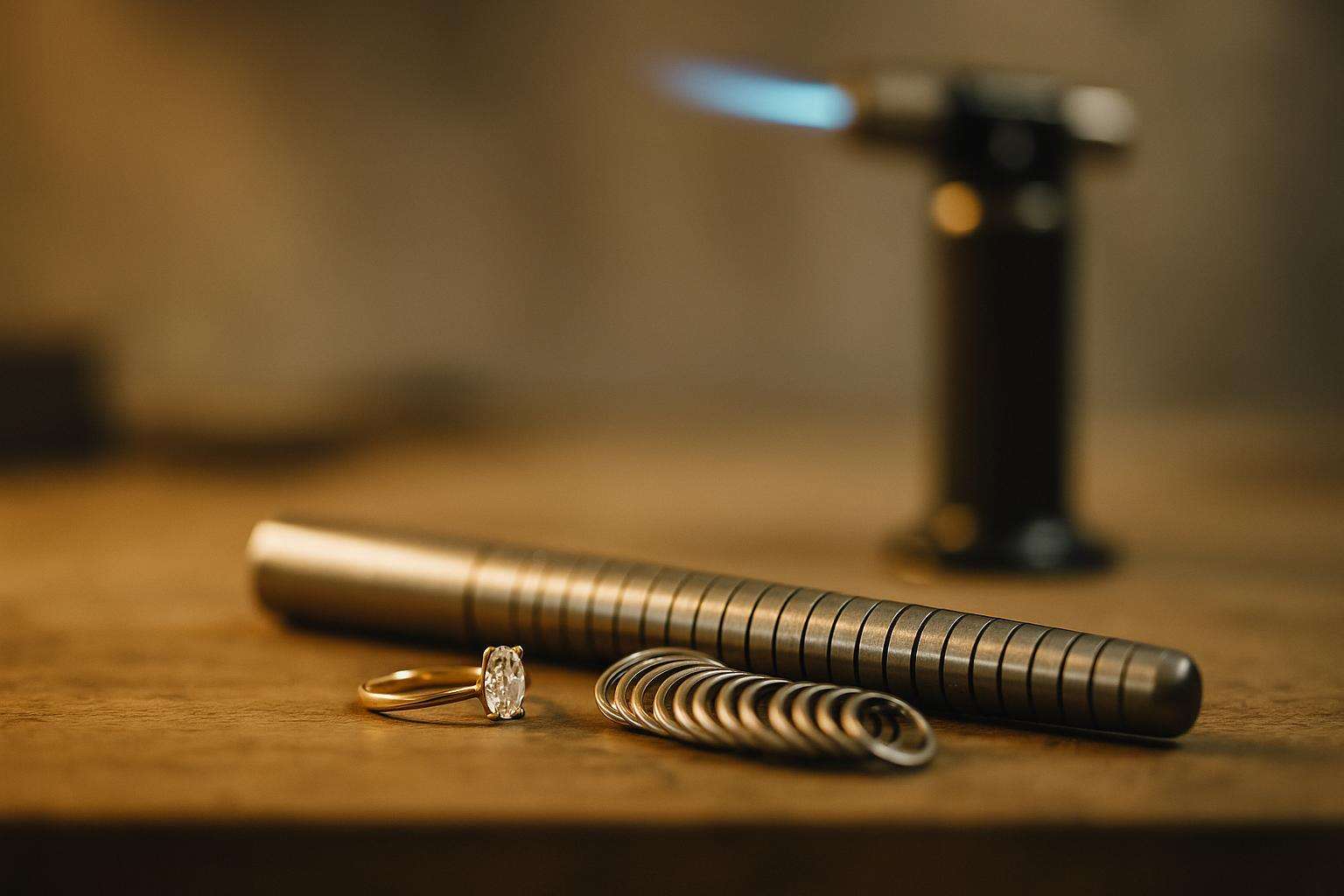
For most gold and platinum engagement rings, resizing up to two sizes costs $50–$250, takes two to seven days, and is structurally sound when done by a qualified bench jeweler. The exceptions — eternity bands, pavé-heavy shanks, and alternative metals like tungsten and titanium — change the math dramatically, and knowing which category your ring falls into before you book an appointment will save you from a surprise bill or a damaged stone.
Ring resizing is one of the most requested services a jeweler performs, and also one of the most misunderstood. Many couples assume any ring can be adjusted to any size; many others assume resizing is always dangerous. Neither is accurate. The truth is governed primarily by metal type, secondarily by design complexity, and — for larger adjustments — by the skill level of the bench jeweler doing the work.
This guide covers everything a consumer needs to know to walk into a jeweler's shop informed: the safe size window for every common precious metal, why certain settings make resizing expensive or impossible, current 2026 price ranges verified against multiple trade sources, and what turnaround to expect by season. For guidance on secretly determining ring size before a proposal — so you arrive at this page needing only a minor tweak rather than a two-size overhaul — see our companion article on how to find her ring size secretly.
Which Metals Can Actually Be Resized — and How Far?
The mechanical reality of resizing is simple: a jeweler cuts a section of the shank, removes metal (to go smaller) or inserts a new piece of matching metal (to go larger), and solders the joint closed. Whether that process is straightforward, difficult, or impossible depends entirely on what the shank is made of.
Yellow, white, and rose gold are the most cooperative metals for resizing. Gold's natural malleability allows a bench jeweler to size most gold rings up to two full sizes in either direction without compromising structural integrity. Sizing down costs slightly less because the jeweler retains the removed gold as scrap metal to offset labor cost; sizing up requires purchasing and adding new metal. White gold requires rhodium re-plating after the soldering process, because the heat burns off the thin rhodium surface layer that gives white gold its bright appearance — budget $40–$80 for re-plating on top of the resize fee. Rose gold deserves a specific caveat: its elevated copper content makes the alloy more brittle under the stress of stretching, and some experienced jewelers decline to size rose gold rings up more than one size. When sizing up in rose gold, go slowly and demand to see the joint under magnification before taking the ring home.
Platinum can also be resized up to approximately two sizes, but requires a meaningfully different skill set. Platinum's density and its extremely high melting point (around 3,215°F, versus roughly 1,900°F for 18k gold) demand laser welding equipment and a dedicated workspace — contamination from gold particles embedded in tools causes permanent discoloration in platinum. Platinum also has what jewelers describe as a metal “memory”: it resists bending and tends to spring back toward its original shape, requiring more careful working than gold. The result is a higher price point and a longer turnaround. A simple platinum solitaire resize typically runs $100–$150; complex settings or larger size changes push toward $200–$250.
Sterling silver is inexpensive to resize — often $25–$50 — but structurally limited. Silver's softness means that stretching or compressing the shank beyond one full size risks cracking the metal at the joint. For silver rings requiring larger adjustments, remaking the shank is usually the better option.
| Metal | Resizable? | Safe Size Range | Typical Cost (Simple Shank) | Key Caveat |
|---|---|---|---|---|
| Yellow gold (14k / 18k) | Yes | ±2 sizes | $50–$100 | Most cooperative metal; minimal caveats |
| White gold (14k / 18k) | Yes | ±2 sizes | $60–$120 (incl. rhodium re-plate) | Rhodium re-plating required after every resize |
| Rose gold (14k / 18k) | Yes, with care | Up to ±2 sizes; sizing up above 1 size carries higher crack risk | $60–$120 | Copper alloy more brittle under stretching stress |
| Platinum | Yes, specialist required | ±2 sizes | $100–$250 | Laser welding required; dedicated contamination-free workspace essential |
| Sterling silver | Yes, limited | ±1 size safely | $25–$50 | Cracking risk beyond one size; remake often preferable |
| Tungsten carbide | No | Cannot be resized | N/A — exchange required | Sintered metal shatters when cut; no solder bond possible |
| Titanium | No (rare exceptions) | Interior boring: up to ¼ size larger only | N/A for standard resize | Cannot be compressed; specialized boring rarely practical |
| Cobalt / ceramic | No | Cannot be resized | N/A — exchange required | Molecular hardness prevents cutting and re-soldering |
The practical upshot for buyers considering alternative metals: confirm your exact size from multiple measurements taken at different times of day before ordering. Many tungsten and titanium brands offer size exchange programs — ask about the policy and get it in writing at purchase. For a full overview of alternative metal properties and long-term wear implications, see our guide to alternative ring metals.
How Does Setting Style Affect Resizing Cost and Risk?
Metal type determines whether a resize is physically possible. Setting style determines how expensive and risky the job is for everything in the feasible category.
Solitaire and simple prong settings are the easiest case. A four- or six-prong solitaire — the classic engagement ring architecture — presents a clean shank with no stones in the way of the resize zone. A skilled jeweler completes the job, re-inspects the prongs, and returns the ring looking factory-finished. This is the scenario the basic price ranges ($50–$150 for gold; $100–$250 for platinum) describe.
Halo settings add modest complexity. The halo of small stones sits on top of the center stone and does not contact the shank, so the resize itself follows the same mechanics as a solitaire. However, the heat of soldering can propagate into the setting zone and subtly loosen halo prongs; a thorough jeweler checks and tightens every micro-prong before returning the ring. Budget an additional $30–$60 for this service.
Pavé and channel shanks change the equation significantly. When small stones are set into the shank itself — running down the side of the band — any resize in that zone risks loosening or displacing stones. The heat of soldering is a particular hazard: it softens the metal holding the stone seats, and if the pavé stones aren't secured immediately after the joint cools, they can migrate or fall out. A competent jeweler working on a pavé ring will: (a) assess whether the stones in the resize zone must be removed before cutting, (b) complete the resize, (c) re-set any removed stones, and (d) tighten every stone in the affected band section. This can add $50–$150 to the base cost, and occasionally more for dense pavé work. Most jewelers will resize a pavé ring by up to one full size before recommending against further adjustment.
Full eternity bands occupy a category apart. Because stones run continuously around the entire circumference — leaving no plain metal shank section to cut — a traditional resize is structurally impossible without removing and re-setting stones. Most reputable jewelers decline to resize full eternity bands at all, recommending instead that the client either live with a ring adjuster insert for minor fit issues or have the ring remade in the correct size with the original stones. The Diamond Producers Association confirms this assessment: for full eternity styles, the only true resize option is a full reconstruction. If you are purchasing an eternity band as a future wedding band or anniversary ring, get sized with professional precision and size at end of day when fingers are at their largest.
What Does Ring Resizing Cost in 2026 — and How Long Does It Take?
Prices cited in guides published before mid-2025 are systematically low. Gold spot prices and jeweler labor rates have both risen sharply — TheCaratCut's 2026 pricing survey notes labor rates for skilled bench jewelers are up roughly 20% compared to 2023–2024 benchmarks, driven by tighter supply of certified bench staff and elevated precious-metal costs. The current ranges verified against multiple live sources are:
| Scenario | Typical Price Range | Standard Turnaround |
|---|---|---|
| Simple gold shank — sizing down (no added metal) | $50–$100 | 1–5 business days |
| Simple gold shank — sizing up (new metal added) | $75–$150 | 2–7 business days |
| White gold — any direction (includes rhodium re-plate) | $75–$160 | 3–7 business days |
| Platinum — simple solitaire shank | $100–$180 | 5–10 business days |
| Platinum — complex or pavé design | $180–$300+ | 7–14 business days |
| Gold with pavé / channel / halo (add-on) | +$50–$150 over base | Add 2–5 days for stone work |
| Rush turnaround surcharge (same-day or next-day) | +25–50% over base | Same day to 24 hours |
| Original retailer (within warranty period) | Often free (1st resize) | Varies; typically 1–2 weeks with shipping |
How to Get a Resize for Free
The most reliable way to pay nothing is to exercise the resizing policy of the jeweler who sold you the ring. Most major retailers — including Brilliant Earth, Zales, Kay Jewelers, and many independent jewelers — include one free resize within the first year of purchase as a standard service. Online retailers like Brilliant Earth extend free resizing within 60 days; Blue Nile and James Allen (now under the same parent company following their 2025 merger) offer free resizing for eligible styles within 30 days. Check your original purchase documentation for the exact terms before booking a third-party appointment — and note that having a ring resized by an unauthorized jeweler may void the original warranty.
If you purchased from a local independent jeweler who does not offer a free resize, ask whether they will discount the labor cost as a courtesy. Many will, particularly for straightforward jobs.
Planning Around the Proposal Season
Demand for ring resizing is highly seasonal. The surge begins immediately after the peak proposal window — late November through Valentine's Day — when jeweler shops are flooded with newly engaged couples whose rings do not fit. If you are proposing in December and the ring needs resizing, plan to drop it at the jeweler no later than the first week of December, before backlogs build. The second-peak season runs May through June (Mother's Day and graduation engagements). Outside these windows, standard turnaround at most competent shops is two to five business days.
Practical Checklist Before Booking a Resize
Before dropping your ring off, confirm the following with any jeweler:
- What metal is the shank? Platinum requires a jeweler with a dedicated platinum workspace and laser welding capability. Not every local shop qualifies.
- Does the ring have stones in the resize zone? If yes, ask specifically what stone-securing work is included in the quoted price and whether any stones will be removed and reset.
- Is white gold involved? Confirm rhodium re-plating is included or quoted separately.
- What is the warranty on the resize work? A reputable bench jeweler stands behind their solder joint; ask for a 30-day warranty on the joint and any reset stones.
- Does the original retailer offer this free? Check your purchase documentation first. Paying $150 for a service that costs $0 through the original retailer is an avoidable loss.
One further consideration: if you are approaching the two-size limit and thinking about going back for a second resize down the road — for example, if you anticipate weight changes or pregnancy — space out the resizes and allow the metal to rest. Repeatedly heating and working the same solder joint over a short period degrades the joint's integrity more than doing it once. A jeweler who monitors the shank thickness at each visit can tell you when a full shank replacement is the smarter long-term investment.
Resizing is straightforward for the vast majority of engagement rings — a gold solitaire adjusted by a size and a half is a routine two-day job at a skilled shop. The cases that warrant real caution are the exceptions: pavé-heavy shanks, eternity bands, platinum in shops without the right equipment, and alternative metals where the resize simply cannot happen. Knowing which category your ring falls into before you make the call is the difference between a smooth repair and an expensive surprise. For ongoing ring care beyond resizing — cleaning schedules, prong re-tipping timelines, and when to schedule a professional inspection — see our ring maintenance schedule guide.
Frequently asked
How much does it cost to resize an engagement ring in 2026?
For a standard gold engagement ring, expect to pay $50–$150 for a straightforward resize of one to two sizes. Sizing down typically costs $50–$100 because no new metal is added; sizing up costs $60–$150 because the jeweler must source and solder in a precisely matched section of metal. Platinum resizing runs higher — $100–$250 — due to the specialized high-heat laser welding and dedicated tooling the metal requires. Rings with pavé, channel, or halo settings add $50–$150 to any base price because of the prong-tightening and stone-inspection work the heat process necessitates. Many original-purchase jewelers — including Brilliant Earth and most national chains — offer the first resize free within one year; always ask your original retailer before paying a third-party bench fee.
How many sizes can an engagement ring be resized?
The practical safe window for gold (yellow, white, and rose) and platinum rings is up to two full sizes in either direction. Beyond two sizes, the proportions of the shank can distort and the structural integrity may be compromised — the band risks becoming too thin at the resize point. Silver is flexible but more prone to cracking beyond one full size of adjustment. Rose gold carries a slightly elevated risk when sized up more than one size because its higher copper content makes the alloy more susceptible to cracking under the stress of stretching. If you need a change larger than two sizes, a reputable jeweler will typically recommend remaking the shank rather than forcing an oversize adjustment.
Can an eternity band or pavé ring be resized?
With difficulty, and often not at all. Full eternity bands — where stones run continuously around the entire circumference — have no plain metal shank section to cut, so a traditional resize is impossible without removing and re-setting stones. Most jewelers decline the job or recommend remaking the ring entirely in the correct size. Partial eternity and pavé engagement ring shanks (where stones occupy only the top third or half of the band) can usually be resized by half a size to one full size, but the heat involved in soldering loosens pavé stones, requiring careful re-securing of every stone in the affected zone. Budget an additional $50–$150 over the standard base price for a pavé or halo ring. If a jeweler quotes a pavé resize without mentioning stone inspection and tightening, treat that as a red flag.
Can tungsten, titanium, or cobalt rings be resized?
No — not by conventional means. Tungsten carbide is approximately ten times harder than 18k gold and is sintered (compressed powder, not cast metal), so it cannot be cut and re-soldered; attempts shatter the band. Titanium cannot be melted and re-fused like gold, and cannot be compressed. Some specialty shops can bore out the interior to increase a titanium ring by a fraction of a size, but the practical adjustment ceiling is about a quarter size. Cobalt and ceramic rings are similarly non-resizable. If you own a ring in any of these materials and need a size change, contact the original retailer about an exchange program — many alternative-metal brands offer size exchanges for a nominal fee. For a full breakdown of alternative metals and their long-term care implications, see our alternative metals guide.
How long does ring resizing take?
A simple gold or silver resize on an unset or minimally set shank can be completed in as little as 24 hours at a well-staffed shop. Most standard requests take two to seven business days. Platinum, complex pavé designs, and proposals made during peak season (late November through February, and May through June) may require one to two weeks due to specialized tooling demand and jeweler workload. Rush turnaround — if offered — typically adds a 25–50% surcharge to the base price. Factor this into your proposal planning: if the ring needs resizing before the moment, drop it at the jeweler at least two weeks ahead of your date during the holiday engagement season.
Does resizing a ring damage or weaken it?
Done correctly by a skilled bench jeweler, resizing within the two-size safe window leaves no visible sign and does not meaningfully weaken the shank. The solder joint used to close the shank after sizing down — or to insert new metal when sizing up — is finished, polished, and rhodium-re-plated (on white gold) to match the original surface. Where resizing can go wrong: excessive force when sizing up rose gold can crack the copper-heavy alloy; platinum soldering with contaminated tools can discolor the joint; and heating a pavé or channel-set ring without carefully re-securing stones afterward leaves loose stones that will eventually fall out. Always choose a jeweler who inspects and tightens all settings as part of the resize service, not as an add-on. Ask to see the ring under magnification before taking it home.