Ring Styles & Settings
Prong vs. Bezel vs. Tension Settings: Which Holds Your Diamond Most Securely?
An honest hold-type ranking for active wearers — and what each setting choice means for resizing, maintenance, and the diamond you plan to put inside it.
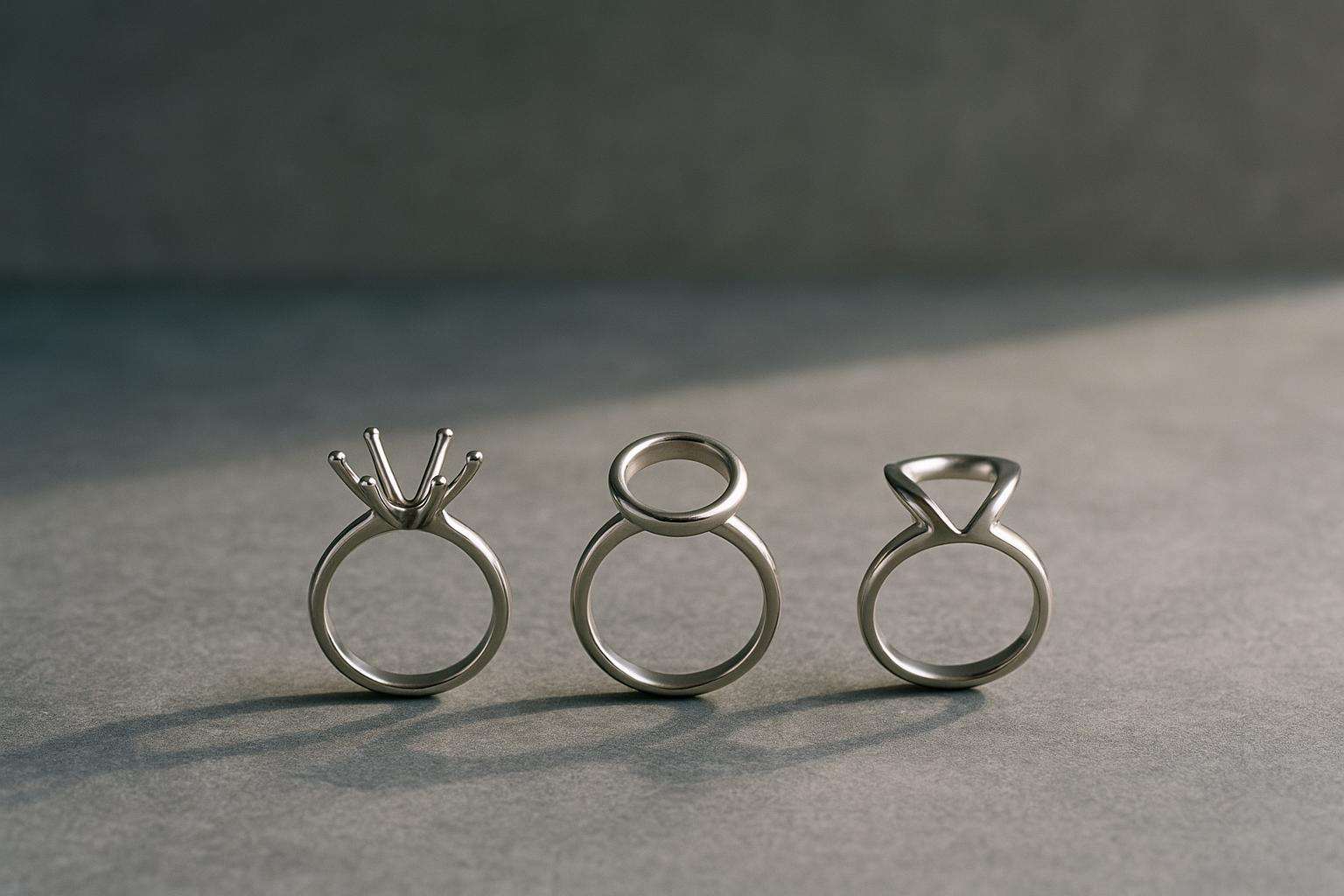
Setting security — the mechanical engineering of how a stone is held — matters more than most engagement ring guides acknowledge. By expert consensus, bezel settings are the most secure hold type; six-prong settings are meaningfully safer than four-prong; and tension settings, despite their dramatic aesthetic, offer the least practical protection for active daily wear and cannot be resized. Your lifestyle, stone hardness, and long-term serviceability needs should drive the decision before you choose a silhouette.
Every engagement ring conversation eventually reaches the stone and the metal. What gets less attention — and deserves more — is the specific mechanical system by which the stone is attached to the metal. That system is the setting, and in technical terms it determines three things: how securely the stone is held under daily stress, how much light reaches the stone's pavilion, and what the ring's long-term serviceability looks like. For buyers who work with their hands, exercise regularly, wear gloves, or simply plan to own this ring for decades, understanding the hold-type hierarchy is as important as choosing a cut or a carat weight.
This guide ranks the three dominant hold architectures — prong, bezel, and tension — by stone security, active-lifestyle performance, maintenance burden, and resize flexibility. It draws on guidance from bench jewelers and gemologists who have documented these trade-offs professionally, not marketing copy designed to sell a particular style. The verdict is not that one setting is universally correct; it is that the right choice depends on variables specific to your life, and that some choices carry consequences most buyers discover too late.
How Does Prong Setting Security Actually Work?
Prong settings are the dominant architecture in contemporary engagement rings for a simple reason: they maximize the amount of light that reaches the stone. Two to six metal claws — typically tapered, rounded, or claw-shaped — grip the stone at its girdle, leaving the crown, table, and most of the pavilion open to light. The result is brilliant optical performance. The security trade-off is real and compound.
Each prong is an independent mechanical lever. Prong tips wear through contact with surfaces — fabric, hair, skin, gloves, countertops — and through the micro-impacts of daily life. A worn prong tip has reduced surface contact with the stone's girdle; a chipped or bent prong may open a gap through which a stone can escape under a single subsequent impact. Mikado Diamonds' gemological guide on setting security notes that all prong settings require annual professional inspection as a baseline maintenance protocol, with twice-yearly checks recommended for active wearers. Prong tips should be re-tipped whenever they appear flat or worn — a procedure that costs $25–$75 per prong at most independent jewelers and is far less expensive than replacing a lost stone.
The distinction between four-prong and six-prong designs matters meaningfully here. A four-prong solitaire distributes the stone's mechanical retention across four independent contact points, each bearing approximately 25% of the load. A single damaged prong removes 25% of that retention in a design where the remaining three prongs must compensate. The security literature is consistent: six-prong settings are more secure because one compromised prong leaves five functioning supports, and the stone remains well-held throughout the interval between inspections. For round brilliant diamonds — the most commonly set stone — six-prong geometry is the standard recommendation for buyers who prioritize security over the marginally cleaner top-view profile of a four-prong design.
Prong settings also present the highest snag risk of the major hold types. The protruding metal tips catch on wool, knitwear, latex gloves, climbing ropes, netting, and hair. The catch-and-pull cycle is precisely what bends prongs over time. For buyers who work in healthcare, education, physical trades, or sports, this daily interaction between prong tips and resistant materials accelerates the wear cycle and increases the frequency at which professional inspection and re-tipping become necessary.
Why Do Jewelers Consistently Recommend Bezel Settings for Active Wearers?
A bezel setting wraps a continuous metal rim — fabricated to the stone's precise girdle circumference — around the stone's perimeter and is pressed or burnished over the girdle edge to lock the stone in place. In a full bezel, the rim runs the complete circumference of the stone. In a half-bezel, metal covers the two most exposed sides — typically the north and south poles of a round stone — while leaving the east and west flanks open for additional light entry.
The security mechanics are fundamentally different from prongs. Rather than concentrating hold at discrete contact points, a bezel distributes the holding force evenly around the stone's entire equator. There are no tips to wear, no levers to bend, and no gaps through which a stone can exit with a single prong failure. Moody's Jewelry, a family-owned jeweler with decades of bench experience, identifies bezel settings as among the strongest designs for everyday active use specifically because of this distributed hold geometry combined with a snag-free surface profile.
That snag-free profile is the second major advantage. A bezel-set ring has no protruding metal above the stone's crown. The ring's top-view silhouette is a smooth metal rim transitioning directly to the stone's table — nothing to catch on fabric, gloves, or climbing surfaces. For nurses and surgeons who don gloves dozens of times per day, teachers who work with children and materials, mechanics and tradespeople, and serious athletes, this characteristic alone makes the bezel the most practical setting architecture. Bezel rings are also the easiest to clean: fewer crevices means less debris accumulation, and a basic soak with warm soapy water and a soft brush is sufficient maintenance.
The honest trade-off is optical. The bezel rim covers more of the stone's visible surface — particularly the girdle and lower crown — than any prong configuration. Light that would enter a prong-set stone from the side is partially blocked by the metal wall, which reduces the stone's brilliance and fire relative to an equivalent four- or six-prong solitaire. A half-bezel recovers some of this lost brilliance by opening the east and west flanks while still protecting the most vulnerable north and south girdle sections. For buyers who want bezel security with better optical performance, a half-bezel in platinum or 14K white gold is the practical compromise.
What Are the Real Risks of a Tension Setting?
Tension settings hold the stone by compressing it between two spring-loaded ends of a split shank. The stone appears to float in open air — no prongs, no bezel, nothing visually connecting it to the band. The aesthetic is architectural and unmistakably modern, and when executed by a skilled jeweler in an appropriately hard alloy, it is structurally sound at the bench. The daily-wear picture is more nuanced.
The fundamental security vulnerability of tension settings is directional. The calibrated compression forces act horizontally, pressing inward against the stone's girdle from two sides. This is effective for holding the stone in the vertical axis but provides essentially no protection against side-on impact — a blow to the east or west face of the stone, in the direction of the open gap. A sufficiently forceful lateral impact can shift the calibrated tension and loosen the stone's hold without any visible damage to the metal. This failure mode is silent: the stone may sit looser than designed for days or weeks before the wearer notices, and a subsequent impact can release it entirely. Diamonds.pro's comprehensive setting guide explicitly notes that tension settings rank among the lowest in the security hierarchy for practical wear conditions.
The compression mechanism also imposes a hard constraint on stone selection. The force required to hold a stone in tension — which can exceed several hundred pounds per square inch at the contact points — is sufficient to fracture softer gems along natural cleavage planes. Gemologists recommend tension settings only for stones rated 8.0 or above on the Mohs hardness scale: diamond (10), sapphire (9), ruby (9), and moissanite (9.25) are appropriate. Emerald (7.5–8.0 with abundant natural inclusions) is marginal and generally inadvisable. The alternative and colored stones gaining popularity in 2026 — opal, moss agate, aquamarine, morganite — must not be set in tension mounts. The International Gem Society's setting guide reinforces this hardness restriction as a categorical safety requirement, not a stylistic preference.
The resize constraint deserves particular attention. Tension settings cannot be resized by any conventional method. The stone's hold depends on the exact shank circumference as manufactured; altering that circumference changes the tension calibration and risks releasing the stone. For buyers whose ring size may change — through weight fluctuation, pregnancy, finger injury, or simple measurement error — a tension setting eliminates the option to correct the fit without commissioning an entirely new setting. Both prong and bezel settings can be resized within practical limits (typically ±2 sizes on plain-shank styles; less on pavé-shank designs), making them categorically more flexible as a long-term ownership proposition.
Setting Security at a Glance: The Hold-Type Comparison Table
| Attribute | Six-Prong | Four-Prong | Full Bezel | Half-Bezel | Tension |
|---|---|---|---|---|---|
| Security ranking | High | Moderate | Highest | Very High | Low (for active wear) |
| Snag risk | Moderate–High | Moderate–High | None | Very Low | None |
| Brilliance | Maximum | Maximum | Reduced | Good | Very High |
| Inspection frequency | Twice yearly (active) / Annual | Twice yearly (active) / Annual | Annual | Annual | Annual (specialist only) |
| Resizable? | Yes (±2 sizes) | Yes (±2 sizes) | Yes (±1–2 sizes) | Yes (±2 sizes) | No |
| Minimum stone hardness | Any (Mohs 4+) | Any (Mohs 4+) | Any (Mohs 4+) | Any (Mohs 4+) | Mohs 8+ only |
| Best for | Maximum brilliance, regular inspections | Clean silhouette, regular inspections | Active lifestyles, nurses, athletes | Active + maximum brilliance balance | Stable size, hard stones, low-impact lifestyle |
How Does Setting Choice Affect Your Options Years from Now?
The decision you make about a hold type at purchase has maintenance, resize, and re-style implications across the full arc of ring ownership. Understanding these downstream consequences before purchase is part of what distinguishes a well-considered ring choice from one that reveals its trade-offs only after the fact.
Prong settings offer the most flexibility for future modifications. They can be resized by any competent bench jeweler, re-tipped when prong tips wear, upgraded to a new center stone, or converted to a different head configuration without replacing the shank. The cost of ongoing maintenance is predictable and modest: inspection plus re-tipping a worn prong runs $25–$150 depending on prong count and metal type. The condition requirement is consistent attention — a missed annual inspection that stretches to three years has a meaningfully different risk profile than one that stretches to fourteen months.
Bezel settings require the least active maintenance of the three major hold types. There are no prong tips to wear or re-tip; the stone's hold is renewed by periodic professional re-burnishing of the bezel rim, which a jeweler performs when the rim shows signs of fatigue or lifting. This is typically a less frequent intervention than prong re-tipping. Bezel settings on plain shanks resize well within the ±1 to ±2 size range; half-bezel shanks with pavé accents have the same resize constraints as pavé-shank prong settings (i.e., the accent stones must not run through the area being resized). Future stone changes in a bezel setting require a bench jeweler to open the rim, remove the stone, and re-bezel the new one — a $150–$400 procedure at most shops, slightly more involved than swapping a prong head but still routine.
Tension settings lock in the purchased size permanently. Beyond resizing, any modification to the ring — adding engraving to the shank, adjusting the split-shank profile, even minor repairs to the inner surface — risks changing the tension calibration. Buyers who prioritize long-term flexibility should view a tension setting as a commitment to the ring exactly as purchased. For buyers who are certain of their size, love a low-maintenance aesthetic, and are selecting a hard stone (diamond, sapphire, ruby, or moissanite), a tension setting from a reputable manufacturer who has engineered the spring constant correctly is a defensible choice. The key phrase is reputable manufacturer: the tolerance precision required for a tension setting to perform safely over years of wear is higher than for prong or bezel designs, and bargain-market tension settings made in soft alloys should be avoided categorically.
Setting security connects directly to long-term ring ownership in one more practical way: insurance claims. Most specialized jewelry insurers — including BriteCo and Jewelers Mutual — process stone-loss claims regularly, and the single most common cause of a lost stone is a prong that has worn beyond safe limits without being caught at inspection. Maintaining an annual inspection schedule is the clearest evidence of due diligence under a jewelry insurance policy. If you are still deciding on insurance, our standalone vs. homeowners insurance guide walks through what each policy type covers for a lost stone specifically.
For the full setting-family picture — including how solitaire, halo, pavé, and three-stone configurations differ in cost, maintenance, and perceived stone size — see our complete setting types comparison. And if the bezel's active-lifestyle credentials have moved it to the top of your list, our dedicated bezel engagement rings guide covers product examples, named retailers, metal pairing, and the half-bezel compromise in full detail.
Frequently asked
What is the most secure engagement ring setting?
Bezel settings are the most secure hold type available for an engagement ring. A full bezel wraps a continuous metal rim around the stone's entire girdle, holding it from every direction simultaneously with no exposed prongs to catch, bend, or chip. Independent gemologists and bench jewelers consistently rank bezel at or above six-prong settings in security hierarchies because the hold distributes force around the full circumference of the stone rather than concentrating it at individual contact points. For active lifestyles — nursing, climbing, manual trades, frequent glove use — a bezel or half-bezel is the practical first choice. The trade-off is optical: the rim partially obscures the stone's sides, which reduces brilliance compared with a prong solitaire. See our bezel engagement rings guide for a full breakdown.
Are four-prong or six-prong settings more secure?
Six-prong settings are meaningfully more secure than four-prong settings, and the difference is not just marginal. In a four-prong design, each prong bears roughly 25% of the holding load. If one prong is damaged, bent, or missing, the stone loses 25% of its mechanical retention — a significant risk that is not immediately visible to the wearer. In a six-prong design, one damaged prong leaves five intact, and the stone remains well-held. The security benefit is most relevant for round brilliant diamonds, which are the most commonly set stone and are optimized for six-prong geometry. Fancy shapes — ovals, marquises, cushions — often use four or six prongs depending on their geometry, with the prong count matched to the stone's corner and girdle profile. All prong settings require annual professional inspection regardless of prong count; active wearers should schedule twice-yearly checks.
Can you resize a tension-set engagement ring?
No. Tension settings cannot be resized under any normal circumstances. The stone in a tension setting is held by the spring compression of the two shank ends pressing inward against its girdle. That compression is precisely calibrated to the exact circumference of the shank as cast. Any modification to the shank's circumference — adding or removing metal to resize — changes the tension calibration and can release the stone entirely or stress it beyond safe limits. Jewelers who encounter a customer requesting a tension-ring resize will universally advise against it; some manufacturers offer a rebuild in a new size, but that is not a resize in any conventional sense and typically costs as much as the original setting. If there is any possibility your ring size will change — through weight change, pregnancy, or a finger injury — a tension setting is the wrong architectural choice. Both prong and bezel settings can be resized by a competent bench jeweler within practical limits (typically ±2 sizes for plain-shank styles).
What engagement ring setting is best for an active lifestyle?
For genuinely active wearers, the security hierarchy runs: bezel first, then six-prong, then four-prong. Tension settings, despite their aesthetic drama, are the worst choice for active wearers because a side-on impact can disrupt the calibrated compression holding the stone. Bezel settings eliminate all protruding metal — the ring's surface is essentially smooth — making them snag-free against fabric, latex gloves, climbing holds, and sports equipment. Half-bezel designs recover some of the brilliance that a full bezel sacrifices while still protecting the most exposed girdle sections. For nurses, teachers, mechanics, athletes, and anyone who frequently wears gloves, a full or half bezel combined with a lower-profile shank is the defensible specification. Flush settings offer similar snag-free performance but are limited to smaller stones and significantly reduce brilliance. See our complete guide to bezel engagement rings for product examples and named retailers.
How often should engagement ring prongs be inspected?
The standard professional guidance is annual inspection for all prong-set rings, with twice-yearly checks recommended for active wearers or anyone who routinely subjects their ring to physical stress — manual work, exercise, sports, or frequent glove use. At a professional inspection, a bench jeweler checks each prong tip under magnification for flattening, wear, cracks, or misalignment; tests whether the stone moves when gently pressed; and re-tips or replaces prongs that have worn below the safe threshold. Re-tipping — rebuilding the rounded metal tip at the prong's end — costs approximately $25–$75 per prong at most independent jewelers and roughly $50–$100 per prong at chain retailers. Full prong replacement runs higher. Catching a worn prong early costs far less than replacing a lost stone; even a well-insured ring involves the inconvenience of a claim, appraisal, and reset. Most lost-stone claims trace to missed or deferred maintenance, not manufacturing defects.
What gemstones should not be placed in a tension setting?
Tension settings should only be used with gemstones rated 8 or above on the Mohs hardness scale. The compressive force that holds a stone in a tension mount — typically measured in hundreds of pounds of force per square inch — can fracture softer gems along natural cleavage planes or internal stress lines. Diamond (Mohs 10), sapphire (9), and ruby (9) are safe for tension mounts. Emerald (7.5–8) is marginal and not recommended because its characteristic inclusions, known as the jardin, create internal planes along which compressive stress concentrates. Moissanite (9.25) is technically within range but should be sourced from manufacturers who have experience with tension-setting tolerances. Softer stones — aquamarine (7.5–8), morganite (7.5–8), opal (5.5–6.5), and pearls — must never be set in tension mounts. For alternative-stone ring shoppers, a bezel or prong setting in a protective metal is the safe default. See our alternative stones guide for Mohs ratings by gemstone species.