Celebrity Rings
Dua Lipa's Engagement Ring: The Cigar Band and Gypsy Setting Explained
A wide 18k yellow gold cigar band, a low-set old European or round brilliant diamond, and zero prongs — how Callum Turner's custom commission became 2026's most-talked-about ring.
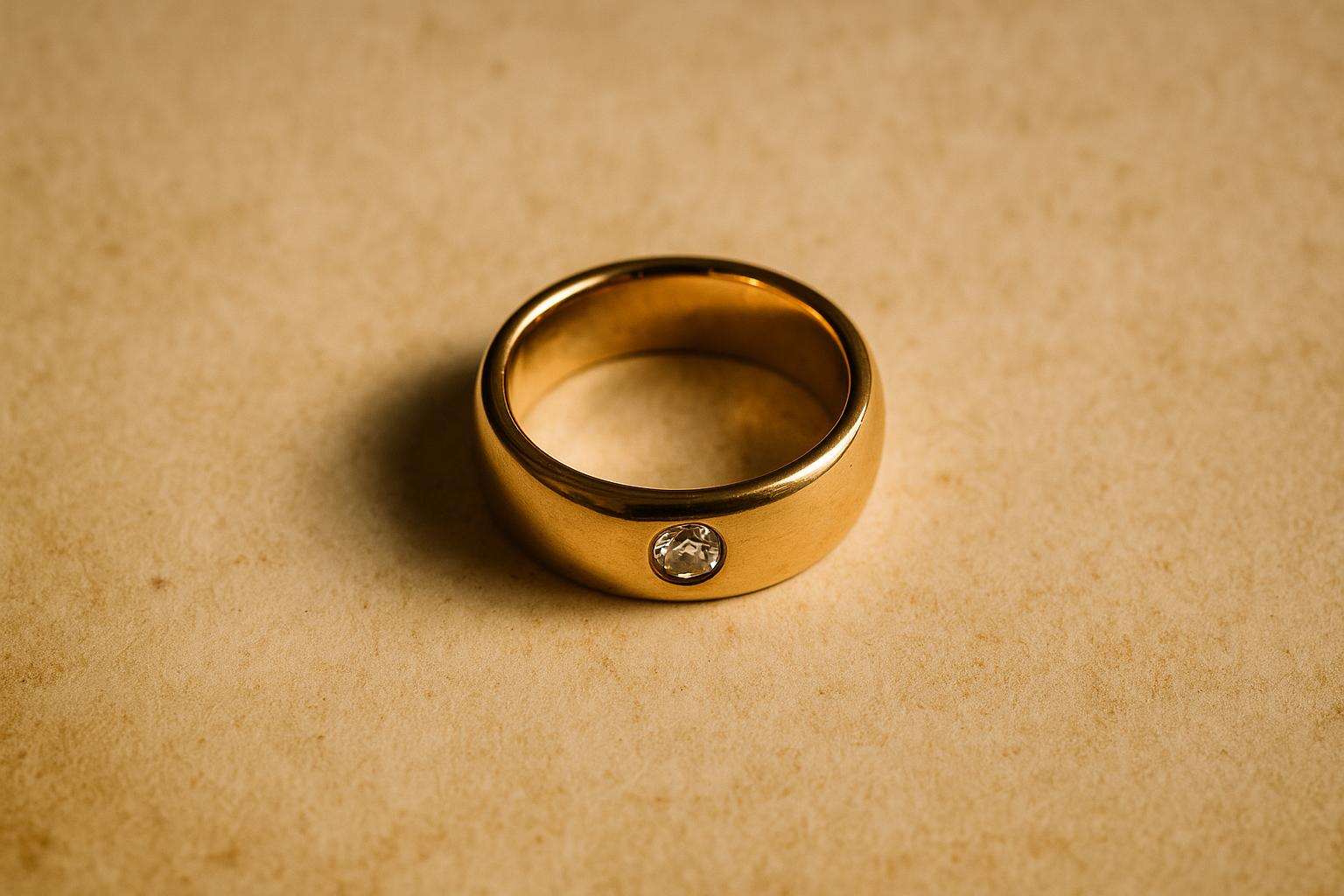
Dua Lipa's engagement ring — custom-made for actor Callum Turner in consultation with her sister and closest friends, and confirmed publicly in a June 2025 British Vogue interview — is a wide 18k yellow gold cigar band set with an approximately 2-carat round brilliant or old European cut diamond in a low-profile gypsy setting. No prongs. No cathedral arch. No halo. The ring is the most visible symbol of a genuine shift in fine bridal jewelry away from the thin-shanked, elevated-stone formula that dominated the 2010s, toward wide, architecturally grounded bands where the setting is as much the statement as the stone.
What is Dua Lipa's engagement ring, exactly?
When Dua Lipa confirmed her engagement to British actor Callum Turner in a British Vogue interview published in June 2025, the ring on her left hand was as noteworthy as the announcement itself. It is a wide cigar band in 18k yellow gold — approximately 5mm across, according to senior gemologist Laura Suttie of Queensmith — with a round diamond set so low into the band that it appears to grow out of the metal rather than sit atop it. There are no prongs visible. There is no elevated head. The stone does not break the ring's horizon line.
This setting technique has a name: a gypsy setting, also called a flush or burnish setting. A precise recess is drilled into the band, the stone is seated into it, and the surrounding metal is then burnished over the stone's girdle to lock it in place. The result is a stone whose table sits flush with or fractionally above the band surface — a technique with roots in Victorian men's dress jewelry that, on Lipa's ring, reads as strikingly contemporary.
The overall effect is a ring that breaks almost every convention of the modern engagement ring. No thin pavé shank. No raised centerpiece. No four-prong cathedral profile. Just a broad sweep of polished yellow gold with a diamond suspended within it. Lipa described the piece to Vogue simply: "I'm obsessed with it. It's so me." She added that Turner had worked with her sister Rina and her closest friends to have it custom-made — a fact that explains the ring's specificity. This was not a ring designed to appeal to general taste; it was designed for one person.
The ring first appeared publicly on New Year's Eve 2024, when observant fans noticed it on Lipa's left hand in an Instagram post. It made a more prominent debut at the May 2025 Met Gala, where Lipa wore it over sheer mesh gloves — an image that circulated immediately in jewelry press. The official engagement announcement came one month later in British Vogue. Lipa and Turner married on May 30, 2026, at Old Marylebone Town Hall in London, followed by a larger celebration in Palermo, Italy, from June 5 through 7.
What stone is in the ring — and what do experts say it's worth?
Because neither Dua Lipa nor Callum Turner has named the jeweler or published a GIA report, all assessments of the stone's cut, carat, and value come from gemologists analyzing photographs — a discipline with inherent limits, since lighting, angle, and compression all affect how a diamond photographs.
The expert consensus on cut is split between a modern round brilliant and an old European cut (OEC). Susie Saltzman, an independent jewelry designer frequently cited by Brides, described the stone as likely an old European cut or a round brilliant — and expressed a preference for the OEC interpretation, noting that it harmonizes naturally with the ring's vintage gypsy setting and the warmer, candlelight-style fire that OEC diamonds produce. Laura Suttie of Queensmith independently reached the same uncertainty: round brilliant or OEC, approximately 2 carats, in an approximately 5mm-wide 18k yellow gold band.
The old European cut distinction matters aesthetically. Unlike the modern round brilliant, which is engineered for peak white-light brilliance under varied ambient lighting, an OEC diamond is cut for fire — the colored spectral flashes, the slow-burning warmth that emerges in lower-light settings. An OEC in yellow gold produces a particularly cohesive aesthetic: the warm metal and the warm stone reinforce each other, creating a unified object rather than a high-contrast sparkle display. If the stone in Lipa's ring is an OEC, it is one of the better-matched pairings in recent celebrity ring history.
The carat estimates diverge more significantly. Suttie placed the stone at 2 carats. Ashley Zhang, founder of Ashley Zhang Jewelry, estimated 2–3 carats, with a ring value of approximately $35,000 to $50,000. Saltzman's range was $65,000 to $125,000. Tracey Ellison of The Diamonds Girl estimated 3–5 carats and a natural-diamond value of $65,000 to $85,000. Nadine Tacorian of Tacorian Jewelry suggested a range of $75,000 to $100,000 or more. Laura Taylor of Lorel Diamonds placed the stone at 3–4 carats with a potential ceiling of $270,000 for an exceptional quality specimen. TODAY, aggregating multiple expert views, reported the ring could be worth over $100,000.
These are estimates, not appraisals. The actual value is known only to Turner and the custom jeweler he engaged. What can be said with confidence is that the ring is not defined by stone size — Lipa's choice to let the band do the work, rather than maximizing carat weight, is itself the design statement.
| Gemologist / Expert | Estimated carat weight | Cut assessment | Estimated value |
|---|---|---|---|
| Laura Suttie, Queensmith | ~2 carats | Round brilliant or OEC, in 18k yellow gold, 5mm band | ~$47,000 |
| Susie Saltzman, independent designer | ~2–2.5 carats (OEC interpretation) | Old European cut or round brilliant; favors OEC | $65,000–$125,000 |
| Ashley Zhang, Ashley Zhang Jewelry | 2–3 carats | Round brilliant cut | $35,000–$50,000 |
| Tracey Ellison, The Diamonds Girl | 3–5 carats | Round brilliant or OEC | $65,000–$85,000 (natural diamond) |
| Laura Taylor, Lorel Diamonds | 3–4 carats | Round brilliant or OEC | Up to $270,000 (exceptional quality) |
Why does this ring signal a real shift in engagement ring design?
Lipa's ring did not arrive in a vacuum. It crystallized a trend that trade press had been tracking for several years: the move from thin, delicate shanks to wide, architecturally confident bands. National Jeweler noted explicitly that Lipa "stays on-trend" — placing the ring within a documented commercial movement rather than treating it as an isolated celebrity quirk.
The forces driving this shift are several, and they are real.
The gold price surge of 2024–2026. Gold spot price reached approximately $4,700 per troy ounce in mid-2026 — up roughly 70% from approximately $2,700 in early 2025. When gold is expensive, buyers reassess what they are buying. A thin 1.5mm shank, which contains very little metal, starts to feel almost arbitrary at those price levels. A wide cigar band, by contrast, makes the metal itself meaningful — the buyer is choosing to invest in the material. Jared Silver, president of Stephen Silver Fine Jewelry, told the Natural Diamond Council: "Instead of choosing rings that are minimal in metal, couples are now selecting rings that have a heavier appearance, with the band as a key part of the design."
The lab-grown diamond effect on center-stone size. As lab-grown diamonds have made larger center stones accessible at lower price points, a segment of buyers who previously chose a thin-shanked ring around a modest stone are now reconsidering proportion. A wide band visually balances a larger center stone in a way that a 1.5mm shank cannot — it prevents the ring from reading as top-heavy. Lily Arkwright, a UK jeweler that tracks trend data closely, named the cigar band as 2026's most exciting engagement ring trend, citing exactly this dynamic.
Fashion's broader move toward Y2K and early-2000s bold gold aesthetics. Wide, highly polished gold chain necklaces and chunky hoop earrings have dominated fine jewelry for several years. The bridal market, which typically runs 12–24 months behind ready-to-wear fine jewelry in absorbing trends, is now registering that same appetite for scale and material confidence.
The practical appeal of flush and bezel settings. A ring with no projecting prongs does not snag. It does not catch on the inside of a glove. It does not scratch an adjacent surface. For a generation of buyers who have watched their mothers re-tip prongs every few years and snag their halo rings on cashmere, the low-profile cigar band represents a genuinely better everyday object. See our complete analysis of bezel and flush engagement rings for the full security and maintenance comparison.
How does the gypsy setting compare with other low-profile options?
The gypsy setting is the most integrated of the low-profile options: the stone is drilled into the band itself, not attached to a separately fabricated head. This creates the most seamless visual transition between stone and metal — the stone appears to emerge from the band rather than sit on top of it. The trade-off is customization flexibility: because the stone is embedded at a fixed depth, precise sizing and stone selection must happen at the custom-order stage.
The bezel setting is the gypsy's closest relative. A fabricated metal collar surrounds the stone's girdle and is soldered to the shank. The stone is more accessible for future service — a bezel can be removed and reset without disturbing the band itself — and the bezel collar can be shaped in various profiles (full bezel, half-bezel, open-sided) to control how much metal is visible and how much light reaches the pavilion. Bezel settings on a wide cigar band produce a look very close to a gypsy setting from above, though the slight elevation of the collar creates a hairline ledge between stone and metal that is not present in a pure gypsy design.
The tension setting, which holds a stone by compressive force between two ends of the shank, produces a floating-stone illusion and no visible metal around the stone at all — but ranks among the least secure settings for active wear and cannot be resized. It is not recommended for diamonds below approximately Mohs 8 due to fracture risk under compressive force. For most buyers drawn to the architectural quality of Lipa's ring, a gypsy or full bezel on a wide band is the more sensible specification.
What does old European cut mean, and why might it suit this ring?
The old European cut was the dominant round diamond form from roughly 1890 to 1930, produced by hand with the tools of the era. It has a smaller table, a higher crown, steep pavilion angles, and a noticeably large open culet — the circular facet visible as a small dark circle at the stone's center when viewed through the table. These proportions create a light-performance character very different from the modern round brilliant: OEC diamonds favor fire — the colored spectral dispersion, the warm rainbow flashes — over the sharp, high-contrast brilliance of a modern cut. Under candlelight or soft indoor lighting, an OEC diamond can appear almost liquid with color.
Why might this matter for Lipa's ring? Because the pairing of an OEC with a warm yellow gold cigar band is one of the most cohesive combinations available in engagement ring design. The gold's warmth and the stone's warm fire reinforce rather than compete with each other. A modern round brilliant in 18k yellow gold can sometimes look slightly incongruous — the stone's cold white brilliance pulling against the warm metal. An OEC in yellow gold produces a unified aesthetic where stone and setting feel designed together, which, given that Turner commissioned a completely custom piece, is exactly the outcome a thoughtful jeweler would pursue.
OEC diamonds are not graded by GIA on the same cut-grade scale as modern round brilliants — there is no Excellent, Very Good, or Good designation for antique cuts. When buying an OEC, look for stones described as "crispy" (high-contrast sparkling edges between light and dark zones) or assessed using the Holloway Cut Advisor or an AGSL Light Performance report. Estate dealers like Estate Diamond Jewelry and Erstwhile Jewelry, and online platforms like Goodstone, maintain curated OEC inventories.
Get the look: cigar band engagement rings at every budget
The cigar band gypsy-set design scales across a wide budget range. Because the wide band is itself a meaningful design element — not just a thin carrier for a stone — buyers can allocate a larger share of their budget to the setting without the choice reading as a compromise. The following tiers reflect mid-2026 market conditions for a complete ring (setting plus stone).
| Budget | Realistic specification | Key guidance |
|---|---|---|
| Under $3,000 | Lab-grown round brilliant, 0.75–1.0 ct, G–H / VS2, in a 4–5mm wide 14K yellow gold gypsy or bezel band | Lab-grown diamonds make this budget viable; choose 14K over 18K to manage metal cost; IGI-certified stone is the standard for lab-grown |
| $3,000–$7,000 | Lab-grown round brilliant or OEC, 1.0–1.5 ct, G–H / VS2, in a 5mm wide 14K or 18K yellow gold band; or natural diamond at lower carat weight | Goodstone and Blue Nile offer customizable wide-band settings; an OEC lab-grown is increasingly available in this range from boutique suppliers |
| $7,000–$18,000 | Natural round brilliant or OEC, 1.0–1.5 ct, GIA-certified, G–H / VS1–VS2, in a 5mm wide 18K yellow gold gypsy or bezel band | At this tier, a GIA report is essential for natural diamonds; commission from a bench jeweler with experience in flush and gypsy setting; ask for references or examples |
| $18,000+ | Natural round brilliant or OEC, 2.0 ct+, GIA-certified, F–G / VS1 or better, in a 5–6mm wide 18K yellow gold band; full custom commission | Commission from a GIA Graduate Gemologist with bespoke bench experience; have the ring appraised independently on delivery; insure immediately — see our guide to ring insurance and ownership protection |
Where to find cigar band and gypsy-set engagement rings
Goodstone (goodstoneinc.com) has published detailed analysis of Lipa's ring and carries a curated collection of wide-band solitaire and bezel designs in yellow gold; their approach is notably aligned with the low-profile, band-forward aesthetic Lipa's ring represents. They also stock antique and OEC diamonds for buyers who want a vintage stone in a contemporary wide-band setting.
Ken & Dana Design (kenanddanadesign.com) published a direct "get the look" guide for Lipa's ring and offers east-west bezel and gypsy-adjacent designs in yellow gold with round stones set close to the band surface. Their half-bezel solitaires are structurally close to the Lipa ring's aesthetic.
Gabriel & Co. (gabrielny.com) maintains a cigar band engagement ring collection with multiple width options and diamond placement variants. Their catalog includes yellow gold options with diamonds set in both full bezel and flush configurations, starting at accessible price points.
Custom commission is the truest path to replicating the precise proportions of Lipa's ring. The band width, the stone depth, and the flush-versus-fractionally-proud specification are all variables a commission can control that a ready-made ring cannot. When commissioning, ask the jeweler for a CAD rendering or wax model before casting so you can review the stone-to-band proportion at scale. A jeweler with GIA Graduate Gemologist credentials and documented bench experience in gypsy and burnish settings is the minimum bar. Our guide to custom ring design: process, timeline and cost covers the full six-phase CAD-to-finish workflow and typical lead times.
One final note on budgeting: because the wide yellow gold band is itself a significant material cost at current gold prices — and will carry ongoing spot-price fluctuations — buyers should factor metal cost explicitly into their estimates. At approximately $4,700 per troy ounce in mid-2026, a 5mm wide 18K yellow gold band in a size 6.5 contains meaningfully more gold by mass than a 1.5mm shank of the same design, which pushes setting costs up before the stone is even selected. Our ring price breakdown guide explains exactly how metal weight, labor, and stone cost combine into the total ring price — and where the real savings opportunities are.
Frequently asked
What does Dua Lipa's engagement ring look like?
Dua Lipa's engagement ring features a wide 18k yellow gold cigar band — approximately 5mm across — with a round diamond set low into the band in a style that gemologists describe as a gypsy or half-bezel setting. The stone does not protrude above the metal surface; instead, it sits nearly flush with the band, giving the ring an architectural, sculptural silhouette. There are no visible prongs. The overall impression is bold and modern while drawing on Victorian-era setting techniques. The ring was custom-made by an unnamed jeweler selected by Turner in consultation with Lipa's sister Rina and close friends. Lipa confirmed in her June 2025 British Vogue interview: "I'm obsessed with it. It's so me."
What cut and carat is the diamond in Dua Lipa's engagement ring?
No official GIA report or designer disclosure has been published, so all estimates come from expert gemologist analysis of photographs. Senior gemologist Laura Suttie of Queensmith identified the diamond as approximately 2 carats, likely a round brilliant cut or an old European cut. Independent jewelry designer Susie Saltzman, quoted in multiple publications, also placed the stone between a round brilliant and an old European cut and estimated its value at $65,000 to $125,000. Laura Taylor of Lorel Diamonds estimated the stone at 3–4 carats, with a possible value up to $270,000 for an exceptional quality specimen. The spread in estimates reflects genuine uncertainty: without seeing the stone under controlled lighting and magnification, even experienced gemologists are working from photographs taken in varied conditions. The old European cut interpretation is supported by the ring's vintage gypsy setting, which pairs naturally with the softer fire-oriented light performance of that cut style.
How much is Dua Lipa's engagement ring worth?
Expert estimates range from approximately $47,000 to over $270,000, a spread that reflects genuine uncertainty about the diamond's cut grade, color, clarity, and whether it is a natural or lab-grown stone. Laura Suttie of Queensmith, who estimated the stone at 2 carats in 18k yellow gold, placed the ring's value at approximately $47,000. Susie Saltzman estimated a range of $65,000 to $125,000. Tracey Ellison of The Diamonds Girl put the natural diamond scenario at $65,000 to $85,000, while Nadine Tacorian estimated $75,000 to $100,000 or more. Laura Taylor's higher estimate of up to $270,000 assumes a larger stone of exceptional quality. TODAY reported it could be worth more than $100,000 and described it as part of a major trend. These are assessments based on photographs, not appraisals — the actual value is known only to Callum Turner, the unknown jeweler, and Dua Lipa herself.
What is a cigar band engagement ring?
A cigar band ring is defined by its wide, flat or very slightly rounded band, typically measuring between 4mm and 8mm across — considerably wider than the slim 1.5–2mm shanks of conventional solitaire engagement rings. The name references the paper band that wraps around a cigar: a broad, flat sleeve that creates an immediate architectural presence on the hand. In the engagement ring context, the center stone is typically set flush with or very slightly proud of the band surface, integrating into the band design rather than perching above it on a raised head. The result is a ring that reads as a single, unified object rather than a stone on a wire. Cigar bands are considered among the most wearable engagement ring styles for active lives — the low-profile stone catches on nothing, and the wide band distributes weight across the finger for comfortable day-long wear. For more on wide band design trends, see our overview of trending settings in 2026.
What is a gypsy setting, and how does it differ from a bezel setting?
A gypsy setting (also called a flush or burnish setting) drills a precise recess directly into the metal of the band, seats the stone into it, and then burnishes the surrounding metal over the stone's girdle to lock it in place. The result is a stone whose table surface sits level with or only fractionally above the band surface — there are no prongs, no collar, and no visible border of metal above the girdle. The design dates to at least the Victorian era and was common in men's signet rings and dress rings before it became an engagement-ring choice. A bezel setting is related but distinct: instead of drilling into the band itself, a thin wall of metal (the bezel) is fabricated separately around the stone's perimeter and attached to the band. This creates a visible metal rim above the girdle. The gypsy setting is slightly more integrated — the stone becomes part of the band rather than sitting on top of it. Both share excellent stone security and a snag-free profile, making them strong choices for physically active wearers. See our deeper analysis of bezel engagement rings for a full comparison of hold types.
Is a gypsy or cigar-band ring practical for everyday wear?
It is among the most practical engagement ring styles for daily wear, precisely because of the stone placement. Because the diamond is set flush within the band rather than raised on prongs, there is nothing to snag on gloves, fabric, hair, or climbing holds. The wide band also distributes the ring's weight more evenly across the finger, reducing the tendency of thin-shanked rings to rotate throughout the day. The trade-off is limited resizing flexibility: a wide band with a stone set into it cannot easily be resized more than one to two sizes in either direction without disrupting the gypsy setting's calibrated fit. For this reason, buyers should be measured professionally before commissioning a cigar-band gypsy-set ring and should account for typical seasonal finger size variation (fingers tend to be slightly larger in warm weather). Annual inspection is still recommended to ensure the burnished metal holding the stone in place has not worn down, which can occasionally loosen the stone over time. See our ring resizing guide for full details on what is and is not possible with different setting styles.
What is the difference between an old European cut and a round brilliant diamond?
Both are round diamonds with 57 or 58 facets, but their optical character differs noticeably. The old European cut (OEC), dominant from roughly 1890 to 1930, has a smaller table, a taller crown, steep pavilion angles, and a distinctively large open culet — the circular facet at the very bottom of the stone that is visible through the table as a small dark circle. OEC diamonds favor fire (the colored flashes of dispersed light) over brilliance (white light return), and their light display tends to be slower, warmer, and more candle-like. The modern round brilliant cut, standardized by Marcel Tolkowsky's 1919 mathematical model and further refined by GIA's Excellent cut grade, has a larger table, shallower crown, precisely angled pavilion facets, and a pointed or very small culet. It is engineered for maximum brilliance under varied lighting — the sharp black-and-white scintillation pattern familiar in modern diamonds. In terms of price, high-quality OEC diamonds can carry a small vintage premium (10–15% over a comparable round brilliant), though they lack an official GIA cut grade. For a full shape-by-shape comparison, see our complete diamond shapes guide.